 EN
EN
 Nederlands
 Français
The best thing to do in Plovdiv is walk the Old Town and the Roman city underneath it, because almost everything worth seeing here sits inside a twenty-minute walk of the Ancient Theatre. Plovdiv claims about 8,000 years of continuous settlement, and the evidence is stacked in layers you can stand on: a Thracian citadel on Nebet Tepe, a Roman theatre still used for opera, a 240 m stadium running under the main pedestrian street, and 2,000 m² of early Christian mosaic in the Bishop’s Basilica.
Two to three days covers the city. Bulgaria adopted the euro on 1 January 2026 and the lev stopped being legal tender on 1 February, so every price below is in euro and there is nothing to change on arrival.
The 18 best things to do in Plovdiv
The 18 attractions worth your time in Plovdiv are listed below, starting with the ones that justify the trip. Most sites run by the Ancient Plovdiv municipal institute charge about €3.60 ($4, £3) for adults and about €1.50 ($1.60, £1.30) for students, and a multi-ticket covering five of them costs about €10.75 ($12, £9), which pays for itself on the third house.
1. Ancient Theatre of Philippopolis
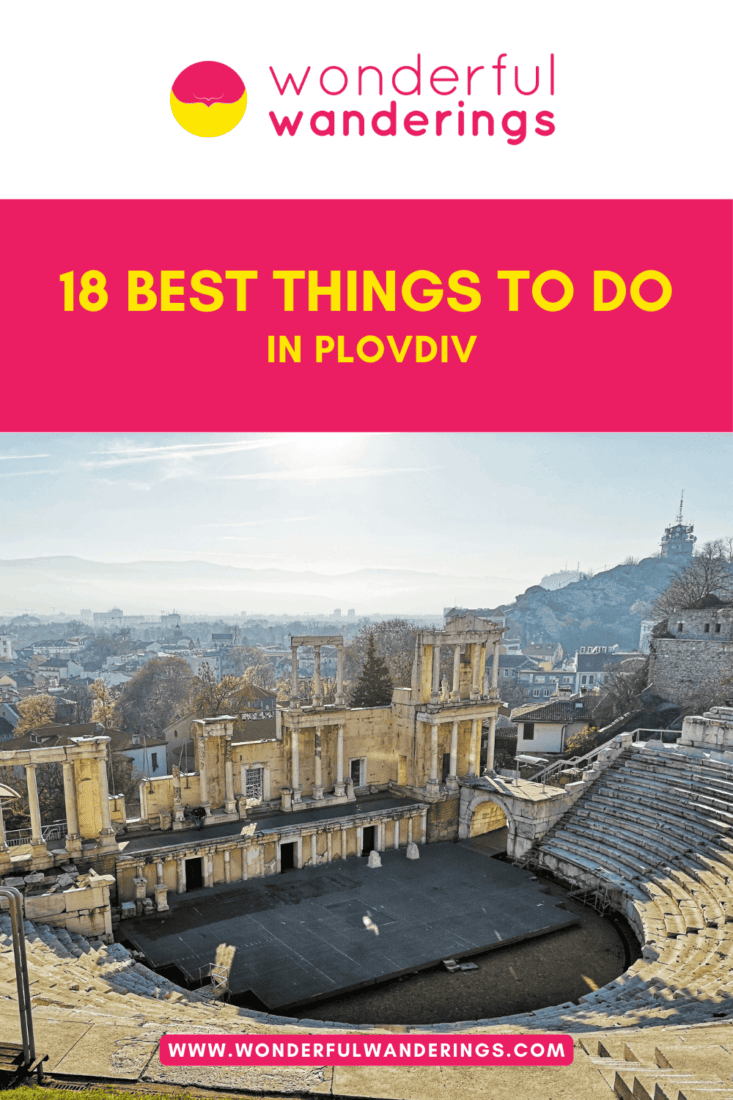
The Ancient Theatre of Philippopolis is one of the most completely preserved Roman theatres anywhere, and it is still a working venue. The theatre was built in the early 2nd century AD, in the reign of Trajan, on the saddle between two of the city’s hills, and it holds between 5,000 and 7,000 people across a two-tier semicircular cavea 80 m (262 ft) across. A landslide buried it in the 5th century and it stayed lost until 1968, when it was found by accident; excavation and restoration ran until 1979. Opera Open and the International Folklore Festival both use it in summer, so check the programme before you book anything else. Admission is about €3.60 ($4, £3).

2. Bishop’s Basilica of Philippopolis
The Bishop’s Basilica holds about 2,000 m² (21,500 sq ft) of late antique floor mosaic, and it is the single most striking thing in Plovdiv. The basilica was built in the late 4th or early 5th century, shortly after Christianity became the official religion of the Roman Empire, and it runs 83 m (272 ft) long by 36 m (118 ft) wide with three naves, an apse, a narthex and an atrium. The mosaics are laid in two layers about fifty years apart, and the birds worked into the second layer are the reason people stand still in here. It was excavated from 1982 and opened to the public in April 2021 after a long restoration. Adults pay about €7.60 ($8, £7).

3. The Roman Stadium
The Roman Stadium ran 240 m (787 ft) under what is now Plovdiv’s main pedestrian street, and about a fifth of it is open. The stadium was built in the 2nd century AD under Hadrian, seated as many as 30,000 people on marble blocks with carved lion paws on the front rows, and its track measured one stadion, roughly 180 m (591 ft). It sits in the natural bowl between Taksim Tepe and Sahat Tepe, unusually close to the city wall for a Roman stadium. The restored northern curve, the sphendone, is visible for free from the square in the middle of the shopping street. Going down onto the ancient track with the 3D reconstruction film costs about €5.10 ($5.50, £4.40).

4. Plovdiv Old Town
Plovdiv Old Town is an architectural reserve covering three of the city’s hills, and walking it is free. The reserve spreads over Nebet Tepe, Dzhambaz Tepe and Taksim Tepe, and its cobbled lanes are lined with Revival-era merchant houses in ochre, blue and dark red, their upper storeys jutting out over the street on carved brackets. Ancient Plovdiv has been on the UNESCO World Heritage tentative list since 2004, which several guides misreport as full inscription. The streets and viewpoints cost nothing; the house museums inside them each charge separately. It is 2 km (1.2 mi) uphill from the railway station, all of it walkable.

5. Nebet Tepe
Nebet Tepe is the hill where Plovdiv began, and the ruins on top are the city’s oldest visible structures. Settlement here goes back to around 4000 BC, when Thracians fortified the summit; Philip II of Macedon took it in 342 BC and the Romans made it the citadel of the acropolis. What survives is a jumble of Thracian, Hellenistic, Roman and medieval walling, a large Roman water cistern and a postern tunnel thought to have run down towards the Maritsa. Go at sunset, because the hill looks north over the whole plain and it is free and never closes.

6. The Kapana Art District
Kapana is the district where Plovdiv eats and drinks, and it is a five-minute walk from the Dzhumaya Mosque. The name means “the trap”, after a grid of narrow lanes that has confused people since the 15th century, when this was the craftsmen’s quarter of furriers, blacksmiths, tailors and goldsmiths. The Plovdiv 2019 Foundation pedestrianised the streets and backed the renovation as part of the European Capital of Culture year, and the workshops are now galleries, bars, third-wave coffee places and small restaurants. Kapana Fest, One Design Week and One Dance Week all run here. Nothing to pay, and it is at its best after dark.

7. Regional Ethnographic Museum Plovdiv
The Regional Ethnographic Museum occupies the finest house in the Old Town, which is half the reason to go in. The Kuyumdzhioglu House was built in 1847 for a wealthy merchant, and its curved black-and-gold facade, wood-carved ceilings and walled courtyard are the standard image of Plovdiv Revival architecture. Inside, six rooms cover farming, animal husbandry, the local crafts of abba weaving and gaytan braiding, pottery, costume and folk instruments, drawn from a collection of more than 60,000 objects gathered since 1917. Admission is about €3.60 ($4, £3), and it takes about an hour.

8. The Dzhumaya Mosque
The Dzhumaya Mosque is one of the oldest Ottoman buildings in the Balkans and it is still a working mosque. It stands at the top of the main pedestrian street beside the Roman stadium, was built shortly after the Ottoman conquest of Plovdiv in 1371 and enlarged in the 15th century, and its prayer hall runs roughly 33 m (108 ft) by 27 m (89 ft) under nine lead domes with a single minaret at one corner. The interior painting of floral motifs and Quranic inscriptions dates from the late 18th and early 19th centuries. Entry is free outside prayer times, shoes come off, and heads and shoulders should be covered.

9. Plovdiv National Archaeological Museum
The Archaeological Museum holds the Thracian silver from the burial mounds at Duvanlii, which is the best reason to go. The museum was founded in 1882 as an archaeological and numismatic office and stands on Saedinenie Square in the centre, with material running from the Neolithic to the Middle Ages. Alongside the Thracian gold and silver sit a collection of Roman surgical instruments recovered from tombs around Philippopolis, medieval glass bracelets and ceramics, and a numismatic collection of roughly 60,000 coins. It is a separate institution from the Regional Historical Museum, which confuses a lot of visitors.

10. The Church of the Holy Mother of God
The Church of the Holy Mother of God is the Old Town’s cathedral church and the place where Plovdiv’s Bulgarians first stopped worshipping in Greek. A church stood on this spot on the slope below Nebet Tepe by the 9th century and was rebuilt as a monastery in 1186, both destroyed when the Ottomans took the city in 1371. The present three-nave building went up in 1844, put up by craftsmen from Bratsigovo and paid for largely by the Chalakov brothers of Koprivshtitsa, with an iconostasis carved by masters of the Debar school. In 1859 it became the first church in Plovdiv to hold the liturgy in Church Slavonic rather than Greek, a direct challenge to the Greek Patriarchate. The bell tower above the steps on Saborna Street was designed in 1880 by Joseph Schnitter. Entry is free.

11. The Church of St Constantine and Helena
St Constantine and Helena is the oldest church site in Plovdiv and the one with the Zahari Zograf frescoes. Local tradition puts a church here in the 4th century, dedicated to the emperor who legalised Christianity and to his mother; the building you walk into was completed in 1832 after repeated destruction and rebuilding. Inside are icons and murals by Zahari Zograf, the most important Bulgarian religious painter of the National Revival, under a colonnaded portico and a small bell tower. It sits on the fortified edge of the Old Town with a long view over the city, and it is free.

12. The Eastern Gate of Philippopolis
The Eastern Gate is where the Roman road into Philippopolis arrived, and the excavated street beside it is 13.2 m (43 ft) wide. The gate began in the 2nd century AD as a marble arch, put up around the visit of Emperor Hadrian to the city in 123 AD, and was rebuilt in the 4th century as a defensive gate with a wide central arch, two side passages and flanking towers. The approach road is paved in syenite slabs with limestone pavements 2.6 m (8.5 ft) wide on each side and lined with Corinthian columns. It was rediscovered during 1970s excavations, and the site is open and free.

13. The Medieval Hisar Kapia Gate
Hisar Kapia is the surviving gate of the Old Town’s acropolis, and it is the most photographed arch in Bulgaria. The name is Ottoman Turkish for “fortress gate”, the present structure dates from the 11th century, and it stands on Roman foundations from the 2nd century AD. It is roughly 11 m high with a semicircular arch of stone and brick set in white mortar, and Revival houses were later built straight into the fortress wall on either side, which is why the gate now looks like a tunnel between two mansions. It is free, always open, and a two-minute walk from the Ethnographic Museum.

14. Balabanov House
Balabanov House is the Old Town house that most often has something on in it, so check its programme. Hadzhi Panayot Lampsha, a merchant in the kaftan-makers’ guild, had it built in the early 19th century; it took the name of its last owner, Luka Balabanov. The original was demolished in the 1930s and rebuilt in the 1970s by Hristo Peev, the architect who did most to document Plovdiv’s Revival houses, working from photographs and survey drawings. The ground floor shows modern Bulgarian art, the upper floor is furnished as a Revival interior, and the basement takes temporary exhibitions, chamber concerts and readings. Admission is about €3.60 ($4, £3).

15. Klianti House
Klianti House has painted landscapes of Vienna and Constantinople on its walls, dated 1817, and that is what you go in for. The house was built in the 18th century and redecorated in 1817 by the same craftsmen who worked on the Church of the Holy Mother of God, which is why the ceilings and doors are of the same quality as a church interior. It has two floors around a covered yard, with storage below and a wide glazed porch called a hayet above leading to three rooms of floral ceiling ornament. It has been a cultural monument of national importance since 1995 and sits on Knyaz Tseretelev Street. Admission is about €3.60 ($4, £3).

16. House of Nikola Nedkovich
The Nedkovich House shows how a rich Plovdiv family actually lived, room by colour-coded room. Nikola Nedkovich, a fabric merchant, had it built in 1863 in a European classical style with Italian Renaissance touches, set back behind a small garden and a patio rather than opening onto the street. The ground floor rooms are each painted a different colour for a different use, with carved geometric ceilings and murals of European cities, and the upper floor holds the office and bedrooms. The family’s own piano, gramophone and sewing machine are still in it. The house is at 3 Tsanko Lavrenov Street; admission is about €3.60 ($4, £3).

17. Plovdiv Regional Historical Museum
The Regional Historical Museum runs four separate expositions in four historic buildings, and the Unification one is the one to pick. That exposition sits in the former Eastern Rumelian Regional Assembly, built between 1883 and 1885 to the design of the Italian architect Pietro Montani, and it covers 6 September 1885, when Eastern Rumelia joined the Principality of Bulgaria and Plovdiv stopped being the capital of anywhere. The other three are the National Revival exposition in the Georgiadi House of 1846, the book-publishing exposition in the house of the publisher Hristo G. Danov, and a modern history venue for temporary shows. Adults pay about €2 ($2.20, £1.75) per site.

18. Museum of Natural Sciences
The Natural Science Museum is where to take children in Plovdiv, and it has a planetarium attached. The museum opened in 1955 and runs twelve permanent halls covering minerals, botany, invertebrates, fish, amphibians and reptiles, birds and mammals, with the mammal hall the largest of its kind in Bulgaria. Its aquarium holds around 7,500 litres across six tanks of marine and freshwater species, and the terrarium keeps live reptiles and amphibians in tropical, desert and temperate sections. The digital planetarium was installed in 2015. Adults pay about €3 ($3.30, £2.60), children about €1.50 ($1.60, £1.30).

Where to stay in Plovdiv
Stay in the city centre or Kapana, not in the Old Town, because the Old Town is on a hill of cobbles with almost nowhere to park and everything in it is a ten-minute walk downhill anyway. The centre puts you on the pedestrian street between the stadium and Tsar Simeon Garden, with the bus and train stations both within 2 km (1.2 mi). Kapana is the same distance from the sights and is where the evening happens, so it is louder. Karshiyaka, across the Maritsa, is quiet and green and about 3 km (1.9 mi) out. Trakia, 4 km (2.5 mi) east, is cheap and has the mall and the zoo but nothing else. Rates rise sharply during the International Fair and around the summer festivals, so compare hotels and apartments in Plovdiv on Booking.com before you settle on a district, because a central room and an Old Town room often cost the same.
Where to eat in Plovdiv
Eat in Kapana, because five minutes of walking there gives you more choice than the whole Old Town. The 5 restaurants below were all open and trading at the time of writing, and they cover the range from a garden by the river to a modern Bulgarian kitchen in an alley.
- Pavaj, Zlatarska 7, Kapana. Small, popular and Bulgarian, with a short handwritten menu and pavement tables. Book or go early.
- Aylyakria, Kozhuharska 3, Kapana. Modern Bulgarian cooking named after aylyak, the local word for unhurried idling that Plovdiv treats as a philosophy.
- Smokini, Otets Paisiy 12. Mediterranean with a Bulgarian accent, a long vegetarian and vegan section, and a courtyard.
- Odeon, Otets Paisiy 40. Sits among the excavated remains near the Roman Odeon, minutes from the Ancient Theatre, and is the obvious sit-down choice in the archaeological quarter.
- Grebetsa, in the park on the Maritsa by the rowing canal. A garden restaurant of grilled meat and salads, worth the walk over the river on a warm evening.
The 5 dishes to order are listed below, and all of them appear on ordinary Plovdiv menus.
- Shopska salata. Tomato, cucumber, pepper and onion under grated sirene; order it first and share it.
- Kebapche. A grilled roll of minced pork and beef seasoned with cumin, ordered by the piece with lyutenitsa.
- Banitsa. Filo pastry with sirene and egg, sold in bakeries in the morning.
- Mekitsa. Fried dough eaten hot for breakfast with jam, honey or white cheese.
- Kapama. A layered meat and rice stew baked for hours in a sealed pot, a winter dish.
More on the wider cuisine sits in our guide to Bulgarian food.
Tours and day trips from Plovdiv
Take a guided trip out of Plovdiv when the transport is the obstacle, which it is for the Rhodope mountains and the Thracian sites. Bachkovo Monastery and Asen’s Fortress are 20 to 30 km (12 to 19 mi) south and reachable by bus, but the wine villages of the Thracian valley, the Devil’s Throat cave, the Wonderful Bridges and the Kazanlak tomb are not, and a hire car or a driver is the only sensible way to reach them. Current guided options and prices are below.
For the Rhodopes under your own steam, a small car is enough and the roads are good as far as Smolyan; rates in Bulgaria are among the lowest in the EU, so it is worth running your dates through DiscoverCars to compare the local and international fleets rather than taking the first desk at the airport.
Getting to and around Plovdiv
Arrive in Plovdiv by train from Sofia, because the line has been modernised and covers the 150 km (93 mi) in a little over 2 hours for a few euro. Plovdiv Airport at Krumovo, south-east of the city, runs only a thin low-cost and charter schedule, so most visitors fly into Sofia and come overland; a taxi or transfer from Krumovo takes 20 to 30 minutes when there is a flight to meet. Buses run to Plovdiv from every sizeable Bulgarian town and from Istanbul and Belgrade, arriving at the South bus station beside the railway station. Book intercity trains and coaches through Omio, which sells Bulgarian rail and bus tickets in English, since the operators’ own booking pages are awkward from abroad.
Inside the city you will not need transport. The centre, Kapana, the stadium, the Ethnographic Museum and the Ancient Theatre are all inside a 20-minute walk of each other, and the only hard part is the cobbles up to the Old Town, which are steep, uneven and no fun in the wrong shoes. For the rest of the country, see our guides to Bulgaria and the most interesting facts about Bulgaria.
Plovdiv practicalities
Plovdiv is straightforward for an English-speaking visitor, and the currency is the thing that changed recently. The details you actually need are listed below.
- Currency. The euro, since 1 January 2026. Bulgaria was the 21st country to join the euro area, the lev circulated alongside it through January at the fixed rate of 1.95583 and stopped being legal tender on 1 February 2026, and mandatory dual pricing ended on 30 June 2026. Cards are taken almost everywhere and ATMs are common.
- Language. Bulgarian, written in Cyrillic. Menus and signs in the centre and the Old Town carry Latin transliterations, and hospitality staff and younger Bulgarians generally speak English.
- Time. Eastern European Time, UTC+2 in winter and UTC+3 from the last Sunday in March to the last Sunday in October. Plovdiv is on the same clock as Athens and Helsinki and 1 hour ahead of Berlin, Paris and Rome.
- Plugs. Type C and Type F, 230V at 50Hz. Continental European devices work as they are; American and British ones need an adapter.
- Borders. Bulgaria has been in the EU since 2007 and a full Schengen member since 1 January 2025, so there are no routine passport checks arriving from another Schengen country.
- Safety. Plovdiv is a low-crime city with an obvious police presence in the tourist streets. The usual care with bags in crowded places applies, and check a bar bill before paying it.
- How long to stay. Two days for the sights, three if you want an evening in Kapana and a day in the Rhodopes.
Plovdiv FAQ
How many days do you need in Plovdiv?
Two to three days is right for Plovdiv. Day one takes the Old Town, the Ancient Theatre, Nebet Tepe and Hisar Kapia; day two takes the Bishop’s Basilica, the Roman Stadium, the Archaeological Museum and an evening in Kapana; day three goes out to Bachkovo Monastery and Asen’s Fortress, or into the Rhodopes. A single day covers the Old Town and the theatre and nothing else.
Is Plovdiv worth visiting?
Yes, Plovdiv is the strongest single city in Bulgaria for a visitor. It has the country’s best Roman remains, the largest early Christian mosaics in the Balkans, an intact quarter of 19th-century merchant houses and a walkable centre, and it costs less than any comparable city in the EU. Plovdiv was the European Capital of Culture in 2019, jointly with Matera in Italy, and the pedestrianisation done for that year is still what makes it pleasant. It is also one of the top places to visit in Bulgaria for anyone with only a week.
Is Plovdiv expensive?
No, Plovdiv is inexpensive by European standards. Most museums and Old Town houses charge about €3.60 ($4, £3), a main course in an ordinary restaurant runs roughly €7 to €12 ($8 to $13, £6 to £10), and a beer costs about €2 ($2.20, £1.75). The one thing that moves is accommodation, which rises around the International Fair and the summer festival season.
How many people live in Plovdiv?
Plovdiv had about 329,000 residents in 2024, which makes it the second largest city in Bulgaria after Sofia. The figure of roughly 634,000 that circulates on many sites is the population of Plovdiv Province, not the city, and it is nearly double the real number.
WonderfulWanderings Pro Tips
The 5 tips below come from rechecking Plovdiv’s sites, prices and opening arrangements after Bulgaria’s changeover to the euro, and each one contradicts something still printed in other guides to the city.
- Buy the multi-ticket before the second house, not after. One site run by the Ancient Plovdiv institute costs about €3.60 ($4, £3), and the ticket covering five of them costs about €10.75 ($12, £9). Anyone doing the Ethnographic Museum, Balabanov, Klianti, Nedkovich and the theatre saves roughly a third by buying it at the first door.
- Bring euros and skip the exchange office. Bulgaria joined the euro area on 1 January 2026 and the lev stopped being legal tender on 1 February 2026. Any lev price you read for Plovdiv is a conversion at 1.95583, not a price anyone will quote you.
- The Old Town is on the tentative list, not the World Heritage list. Ancient Plovdiv has been a UNESCO tentative site since 2004 and has never been inscribed, and neither has the Bishop’s Basilica, which is on the tentative list in its own right. Guides that call either a World Heritage Site are wrong.
- The visible half of the Roman Stadium is free. The restored sphendone in the square on the main shopping street costs nothing to look at from street level, and the paid ticket buys the descent onto the ancient track with the 3D reconstruction film. Decide which you want before queuing.
- Check the Ancient Theatre programme before you buy a sightseeing ticket. It is a working venue for Opera Open and the folklore festival, so in summer it closes to visitors for rehearsals and performances, and a seat at a show is a better way to see it than a daytime walk round the cavea.
About the author. This guide is written and maintained by the Wonderful Wanderings editorial team. Wonderful Wanderings was founded in 2012 by Sofie Couwenbergh, and the team covers Bulgaria for independent travellers, including the Plovdiv museums and Roman sites worth a ticket, the Rhodope day trips worth booking a guide or a car for, and the hotels in the centre and Kapana. Admission prices and opening arrangements are rechecked when they move, and this page was updated after Bulgaria’s changeover to the euro.