 EN
EN
 Nederlands
 Français
Start with Copenhagen, Aarhus and Odense, which sit on one rail line and cover most of what people come to Denmark for. The other 15 places below are day trips or detours off that line, and each entry says where it is, what it is for, and how long it takes to get there.
Denmark uses the krone, written kr or DKK, and has not adopted the euro. Population figures are Statistics Denmark’s municipal counts for the third quarter of 2026, which is why they are larger than the city-centre numbers most guides quote.
This page routes rather than describes. The three main cities have guides of their own: Copenhagen, Aarhus and Odense, each with 2026 prices in kroner.
The three cities on the main line
Denmark’s three largest cities sit on one railway, west from Copenhagen across Zealand and Funen into Jutland. A trip that visits all three needs no car and no internal flight.
| City | Municipality, Q3 2026 | What it is for | From Copenhagen |
|---|---|---|---|
| Copenhagen | 670,389 | The capital: palaces, national museums, Tivoli | – |
| Odense | 213,140 | Hans Christian Andersen’s city | about 75 minutes |
| Aarhus | 378,270 | Second city: ARoS, Den Gamle By, Moesgaard | about 3 hours |
1. Copenhagen
Copenhagen is the capital, on the east coast of Zealand facing Sweden across the Øresund, with 670,389 people in the municipality. It is where the palaces, the national collections and Tivoli are, and it is the only Danish city where you will need three days rather than two.

Copenhagen Airport, code CPH, sits inside the city’s own transport zones, so the metro reaches Kongens Nytorv in 13 minutes on an ordinary ticket. Two things commonly placed in Copenhagen are not in it: Kronborg Castle is in Helsingør and the Louisiana Museum is in Humlebæk, both 40 minutes or so up the coast by train. Our Copenhagen guide lists 18 sights with 2026 prices and marks which ten are free.
2. Aarhus
Aarhus is Denmark’s second city, on the east coast of Jutland, with 378,270 people in the municipality. It is a university town whose three museums, ARoS, Den Gamle By and Moesgaard, are the reason to come.

The train from Copenhagen takes about three hours via Odense, and Aarhus H is in the middle of town. ARoS opened a major underground extension, ARoS – The Next Level, on 19 June 2026, so anything written before that date understates what the 200 kr ticket covers. Two days is enough, and our Aarhus guide prices all 17 sights.
3. Odense
Odense is Denmark’s third city, on Funen halfway along the main line, with 213,140 people in the municipality. It is Hans Christian Andersen’s birthplace, and the museum built over that birthplace is what most visitors come for.

The train is about 75 minutes from Copenhagen and 90 from Aarhus, with direct services from Copenhagen Airport, which makes Odense the easiest first stop of the three. Book H.C. Andersen’s House before you travel: it sells timed slots and does not take walk-ups. Our Odense guide covers 19 sights and the ticket that halves three other museums for 30 days.
4. Aalborg
Aalborg is the largest city in northern Jutland, at the narrowest point of the Limfjord, with 226,404 people in the municipality. It is the university and nightlife city of the north, and it is the base for the Viking burial ground at Lindholm Høje.

Lindholm Høje is the anchor: around 700 Iron Age and Viking cremation graves on a hillside above the fjord, many marked out with stones in the shape of ships. The Utzon Center on the waterfront was Jørn Utzon’s last building, and Kunsten, the modern art museum, is Alvar Aalto’s. Trains run up from Aarhus in roughly 90 minutes on the main Jutland line, and Aalborg Airport is a short bus ride from the centre.
5. Esbjerg
Esbjerg is Denmark’s North Sea port, on the south-west coast of Jutland, with 114,824 people in the municipality. It is a working harbour town rather than a sightseeing one, and it is the gateway to the Wadden Sea and the island of Fanø.

The landmark is Men at Sea, Svend Wiig Hansen’s four vast white seated figures staring out to sea from the shore north of the harbour. It is a sculpture rather than a museum, which several guides get wrong. The Wadden Sea is a UNESCO World Heritage site, the ferry to Fanø is a short crossing from the harbour, and Ribe, Denmark’s oldest town, is half an hour south by train.
6. Roskilde
Roskilde is 30 km (18.6 mi) west of Copenhagen on Zealand, with 93,142 people in the municipality, and it was Denmark’s capital until 1443. Two UNESCO-grade attractions sit within a walk of each other here.

Roskilde Cathedral was inscribed by UNESCO in 1995 as Scandinavia’s first Gothic cathedral built of brick, and it is the burial church of the Danish monarchy. The Viking Ship Museum on the fjord holds five 11th-century ships raised from the fjord in the 1960s and builds working replicas beside them. The train from Copenhagen takes under half an hour, which makes this the easiest day trip in Denmark. The Roskilde Festival takes over the town for a week each summer.
7. Helsingør
Helsingør is on the narrowest point of the Øresund at the north-east corner of Zealand, with 64,460 people in the municipality. Kronborg Castle is here, and Sweden is 4 km (2.5 mi) across the water.

Kronborg was inscribed by UNESCO in 2000 and is the castle Shakespeare called Elsinore in Hamlet. Adult admission is 150 kr, or 135 kr online. Next to it, the M/S Maritime Museum of Denmark is built into a dry dock, so the galleries run below ground level around an empty ship berth. The train from Copenhagen takes about 45 minutes, and the Louisiana Museum in Humlebæk is on the same line.
8. Herning
Herning is in central Jutland, with 90,910 people in the municipality, and it is an events and conference town built on the textile industry. Its draw for a visitor is the Birk Centerpark on the edge of town.

Birk is an unusual thing: an art and architecture park where HEART, Steven Holl’s Herning Museum of Contemporary Art, sits alongside Carl-Henning Pedersen and Else Alfelt’s museum and a set of sculpture gardens laid out among former shirt factories. Herning also hosts large concerts and trade fairs, so check whether the town is full before booking. It is about two hours from Aarhus by road, or by train with a change.
9. Skagen
Skagen sits at the very top of Jutland in Frederikshavn Municipality, which has 57,428 people, and it is where Denmark ends. Grenen, the sandspit north of the town, is the point where the Skagerrak and the Kattegat meet.

You can stand with one foot in each sea and watch the two currents collide, which is the single most photographed thing in northern Denmark. The town is also where the Skagen Painters worked in the 1870s and 1880s, drawn by the light, and Skagens Museum holds their work. It is the furthest point on this list from Copenhagen: train to Frederikshavn and then the local Skagensbanen line, or drive.
10. Vejle
Vejle is at the head of Vejle Fjord in east Jutland, with 123,947 people in the municipality, and its significance is what lies just outside it. The Jelling Mounds are in Vejle Municipality.

Jelling was inscribed by UNESCO in 1994 and is where Denmark’s history starts in writing: two burial mounds, a church, and the runestone Harald Bluetooth raised around 965 that names Denmark and records its conversion to Christianity. That stone is why the country’s name appears when it does, and why the man it was raised by lends his name to Bluetooth. Vejle is about 50 minutes from Aarhus by train, and Jelling is a short local service from there.
11. Viborg
Viborg is in central Jutland, with 98,104 people in the municipality, and it is one of Denmark’s oldest towns. Danish kings were proclaimed here for centuries, on the Viborg landsting.

The cathedral stands over the town, a 19th-century granite rebuild of the medieval church with a cycle of biblical frescoes by Joakim Skovgaard covering its interior. The two lakes, Nørresø and Søndersø, wrap around the centre and give the town a walking route that most visitors find better than the shopping street. It is about an hour from Aarhus by train.
12. Kolding
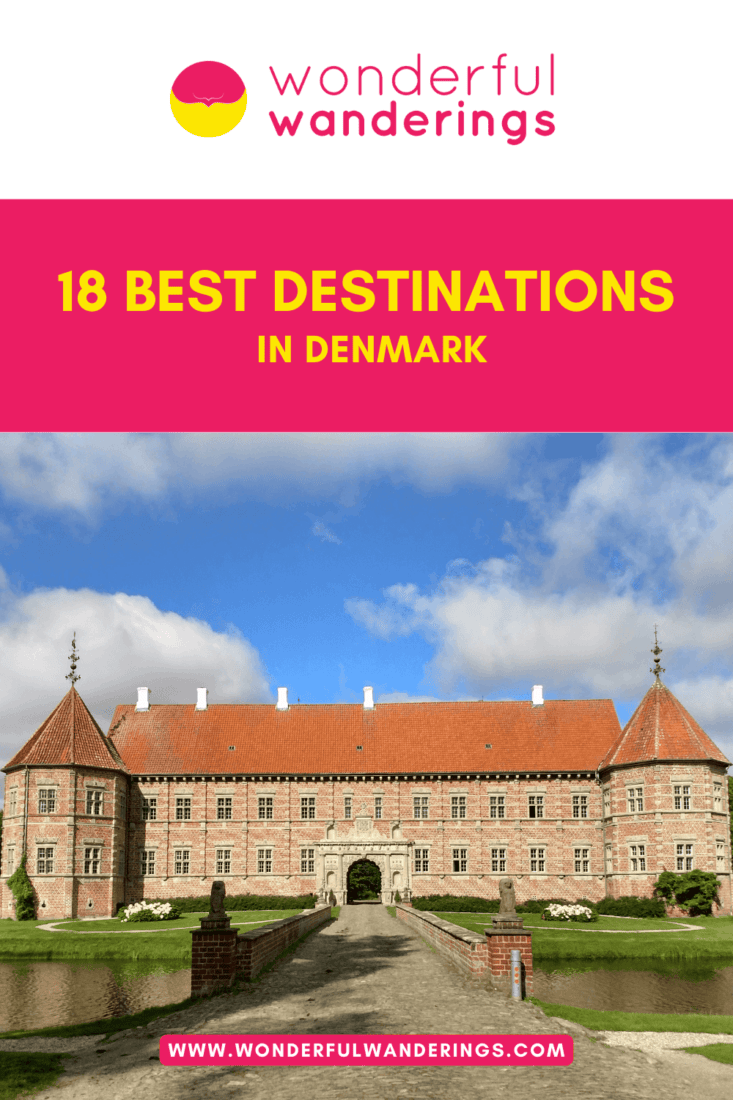
Kolding is at the head of Kolding Fjord in south-east Jutland, with 96,140 people in the municipality, and the reason to stop is Koldinghus. It is one of the six properties of the Royal Danish Collection.

Koldinghus is a royal castle that burned in 1808 and was left as a ruin for most of two centuries before a celebrated restoration left the damage visible rather than hiding it, with new timber and steel inserted against the old brick. Trapholt, the museum of modern art and design on the edge of town, holds the chair collection and one of Arne Jacobsen’s Kubeflex summer houses. Kolding is about 40 minutes from Odense by train.
13. Silkeborg
Silkeborg sits in the Danish Lake District in central Jutland, with 103,293 people in the municipality, and it is the country’s freshwater landscape. Himmelbjerget, one of Denmark’s highest hills, is on the lake shore nearby.

Museum Silkeborg holds Tollund Man, the Iron Age bog body whose face survives so completely that he appears to be asleep. He was found in the Bjældskovdal bog in 1950 and has been at Silkeborg since 1952. Between the lakes, the coal-fired paddle steamer Hjejlen has run since the 19th century and still sails in summer. Silkeborg is about 45 minutes from Aarhus by train, and the lakes are the place in Denmark to hire a canoe.
14. Randers
Randers is on the Gudenå river in east Jutland, with 100,921 people in the municipality. Its one unmissable attraction is Randers Regnskov, a tropical zoo under three glass domes.

The domes hold South American, African and Asian rainforest, and the animals are largely uncaged within them, so you walk through the habitat rather than past it. It is the reason families detour here. Randers is about 40 minutes north of Aarhus by train, and the Gudenå, Denmark’s longest river, runs through the town.
15. Horsens
Horsens is in east Jutland, with 98,999 people in the municipality, and it is a festival town. Its former state prison is now a museum and a concert venue.

FÆNGSLET, the closed prison, ran until 2006 and is open as a museum of Danish prison history in the wings where the cells still are, while the yard hosts large concerts. The town also runs a European Medieval Festival each summer that takes over the centre. Horsens is about 40 minutes from Aarhus by train.
16. Hillerød
Hillerød is in North Zealand, with 55,472 people in the municipality, and Frederiksborg Castle is the reason to come. The castle describes itself as the largest Renaissance complex in the Nordic region, and it stands on three islands in a lake.

Frederiksborg is unusual among Danish museums in opening every day of the year, including Mondays and over Christmas and New Year, which makes it the reliable Monday plan from Copenhagen. It houses the Museum of National History and the National Portrait Gallery, with baroque and landscape gardens across the lake. The S-train line A takes about 35 minutes from Copenhagen, then a 15-minute walk from Hillerød station.
17. Sønderborg
Sønderborg is on Als in southern Jutland, with 73,874 people in the municipality, and it sits on the border country Denmark lost and won back. Dybbøl Banke is on the mainland side of the bridge.

Dybbøl is where the Danish army was defeated on 18 April 1864, a battle that cost Denmark the duchies of Schleswig and Holstein and reshaped the country. The redoubts and the mill are preserved as a national memorial with a history centre, and the region returned to Denmark by plebiscite in 1920. Sønderborg Castle in the town holds the museum of the border region’s history.
18. Kalundborg
Kalundborg is on the west coast of Zealand, with 47,822 people in the municipality, and it is a ferry port for Jutland and Samsø. Its landmark is a church unlike any other in Denmark.

Vor Frue Kirke, the Church of Our Lady, was built in the 12th century with five octagonal towers on a Greek-cross plan, which is a Byzantine arrangement rather than a Scandinavian one and is unique in the country. The town is about an hour from Copenhagen by train, and the ferry to Aarhus crosses the Kattegat from here in a little over two hours.
Getting around Denmark
Take the train between the cities and hire a car only for the coasts. The main line runs Copenhagen to Odense to Aarhus to Aalborg, and almost everything on this list except Skagen, Herning and the Wadden Sea coast sits on or near it.
Trains are the default because the three largest cities are strung along one route and every station on it is walkable to the centre. Booking ahead is what makes them cheap, and comparing rail and coach fares on the same dates is quickest through Omio, which sells Danish tickets alongside the cross-border ones into Germany and Sweden.
A car earns its keep for the west coast, the Wadden Sea, Skagen and the Lake District, where the rail network thins out and the distances between things grow. Denmark is small, so a hire for three days covers a lot of Jutland, and DiscoverCars compares the city and airport depots on the same dates. Fuel and bridge tolls are the two costs to budget for: both the Great Belt and the Øresund crossings charge.
Accommodation is where the difference between Copenhagen and everywhere else shows up hardest, because a room in Aarhus, Odense or Aalborg costs a fraction of the same standard in Indre By. Pricing two or three of these towns on the same nights before you fix the route is worth the ten minutes, and Trip.com lists them on one map.
When to go
Go between May and September if you want the coast, and in late November or December if you want Christmas markets. Denmark’s summer is mild rather than hot, and its winter days are short.
Summer is when the open-air museums, the ferries to the small islands, the lake boats and the beaches all run, and when daylight stretches past ten in the evening. It is also when Tivoli, Tivoli Friheden, Egeskov and the Wadden Sea tours are all open at once, which is not true of any other season. The trade-off is the price of a room in July.
Winter closes a great deal. Tivoli shuts the garden between its four seasons, Egeskov’s 2026 season ends on 18 October, and several island ferries drop to a reduced timetable. What opens instead is the Christmas market season, from the second half of November, and the museums, which are quieter and open all year. Four of Copenhagen’s art museums close on Mondays whatever the season, and Frederiksborg in Hillerød is the one large attraction that does not.
Denmark destinations FAQ
What are the main cities in Denmark?
Copenhagen, Aarhus, Odense and Aalborg, in that order by population, with municipal counts of 670,389, 378,270, 213,140 and 226,404 for the third quarter of 2026. The first three sit on one rail line, which is why most trips cover them in that order.
How many days do you need in Denmark?
Five to seven days covers the three main cities with a day trip from each. Three days is enough for Copenhagen alone with one trip out to Roskilde, Helsingør or Hillerød. Ten days gets you into Jutland properly, including Skagen and the west coast.
What is the most beautiful part of Denmark?
Skagen and the north Jutland coast for the light and the two seas meeting at Grenen, the Lake District around Silkeborg for freshwater and hills, and Møn on the Baltic for its chalk cliffs, which UNESCO inscribed as a World Heritage site in 2025.
Do you need a car in Denmark?
Not for the cities. Copenhagen, Odense, Aarhus and Aalborg are on one rail line with walkable centres, and Roskilde, Helsingør and Hillerød are short trains from Copenhagen. A car pays for itself on the west coast, in the Wadden Sea, at Skagen and around the Lake District.
Is Denmark expensive to visit?
Copenhagen is, and the rest of the country is markedly less so. Three paid sights in Copenhagen come to roughly 500 kr to 600 kr per adult, against around 395 kr for two museums in Aarhus and 300 kr to 400 kr for two attractions in Odense.
What is Denmark’s oldest town?
Ribe, on the south-west coast near Esbjerg, founded in the early 8th century. It is half an hour south of Esbjerg by train and keeps a medieval street plan, a cathedral and a night watchman who still walks the town in summer.
WonderfulWanderings Pro Tips
The five tips below each come from a verified 2026 opening rule or a place this list routes to, rather than from general travel advice.
- Use Hillerød as your Monday. Frederiksborg Castle opens every day of the year, including Mondays and over Christmas and New Year, while four of Copenhagen’s art museums close on Mondays.
- Do not look for Kronborg or Louisiana in Copenhagen. Kronborg is in Helsingør and Louisiana is in Humlebæk, both about 40 minutes up the coast by train. Several guides place both in the capital.
- Jelling, not Vejle, is the reason to stop in Vejle. The UNESCO mounds and Harald Bluetooth’s runestone are a short local train out of the town, and they are where Denmark first appears in writing.
- Book the Andersen museum before you leave home. Odense’s H.C. Andersen’s House sells timed slots and does not take walk-ups, which is the most common way a Denmark itinerary fails at the door.
- Check Egeskov’s season before routing through Funen. It runs 28 March to 18 October in 2026, with limited access and reduced admission from 16 to 21 June during the Heartland Festival.
About the author. This guide is written and maintained by the Wonderful Wanderings editorial team. Wonderful Wanderings was founded in 2012 by Sofie Couwenbergh, and the team covers Denmark for independent travellers, including the three main cities, the day trips worth the train fare, the car hire for the coasts and the travel insurance to book first. Population figures on this page come from Statistics Denmark and the UNESCO inscriptions from UNESCO’s own list, and the page is updated when those figures and the venues’ opening arrangements change. The country’s checked figures are on our facts about Denmark page, what to eat is on our Danish food guide, and the cluster starts at our Denmark hub.