
 EN
EN
 Nederlands
 Français
Latvian traditions run on the forest, the sauna and the song, and 8 of them will shape what you see on a trip: foraging, preserving, winter swimming, the pirts, Jāņi at midsummer, folk singing, wedding customs and the national symbols. More than half of Latvia is forest and the coastline runs to roughly 500 km (310.7 mi), which is why so much of the culture here is seasonal and outdoors. Knowing what people are doing, and why, is the difference between watching a bonfire and being invited to it.
1. Foraging in the forest
Foraging is Latvia’s most widely practised tradition, and it happens because more than half the country is covered in forest. Mushrooms and berries are the headline crop, but people also gather herbs and plants kept for their uses at home, and the knowledge of which is which passes down the family rather than out of a book.

Foraging here predates any wellness trend by centuries. Older relatives teach which mushrooms are safe, where the chanterelles come up after rain, and what to do with St John’s wort, long used as a mood remedy in Latvian households. If you have no Latvian relatives to learn from, farm stays and rural guesthouses often run guided forest walks, which is the safe way to do it: several look-alike mushrooms in these woods are dangerous.
2. Preserving, pickling and smoking
Preserving is the other half of foraging, because a Latvian autumn produces more than anyone can eat fresh. Kitchens across the country turn into small bottling operations at the end of summer, filling jars with cucumbers, tomatoes and onions to see the household through winter.

Smoked fish is the coastal version of the same instinct. Baltic fishers have smoked their catch for centuries, and the wood matters: birch and alder give different results, and the smokehouses along the Kurzeme coast will tell you which they use if you ask. Buy it at Riga Central Market or from a roadside smokehouse on a drive along the Latvian coast, and eat it the same day.
3. Winter swimming
Winter swimming is a genuine popular tradition in Latvia rather than a stunt, and it runs through the coldest months in the sea and in cut ice holes. The people who do it belong to clubs under the name Ronis, Latvian for seal, and the clubs organise swims, events and competitions through the season.

What draws Latvians to it is a mix of the shock, the company and a long-held belief that regular cold exposure keeps you well through the winter. Newcomers go in for seconds rather than minutes and always with someone else on the bank. If you want to try it, do it through a club or a bathhouse rather than on your own, and bring a proper change of clothes; the Riga winter packing list covers what actually keeps you warm afterwards.
4. The pirts, Latvia’s sauna
The pirts is the Latvian sauna, and it is a ritual rather than a room with a heater. Sessions alternate heat with cold, which is why so many bathhouses sit next to a lake, a river or the sea: you steam, you go in the water, you come back.
The part visitors remember is being gently beaten with a bundle of birch twigs, which is done to move heat across the skin and is much more pleasant than it sounds. The black or smoke sauna, heated by a stove with no chimney and aired before use, is the oldest form and the one worth seeking out. Latvia’s Pirts Museum collects historical bathhouses from different regions of the country and runs smoke-sauna rituals for visitors; a museum tour costs €2.00 (about $2.30, £1.70) per person, preschool children go free, and a guided tour has to be booked in advance.
5. Jāņi, the midsummer festival
Jāņi is the midsummer festival and the biggest date in the Latvian year, celebrated on 23 and 24 June, both of which are public holidays. Cities empty, the country fills up, and people stay awake through the short night to meet the sunrise.

Riga sits at roughly 57°N, which gives close to 18 hours of daylight at the solstice and a sky that never goes properly dark; Latvia is well south of the Arctic Circle, so there is no midnight sun, only a long dusk that runs into dawn. The customs are pre-Christian and still recognisable: bonfires that must not go out before morning, folk songs sung in call and response, women in flower crowns and men in oak-leaf wreaths, caraway cheese and beer, and a search for the flowering fern that famously does not exist. Public celebrations run in towns and open-air museums across the country, so you do not need an invitation to a farmhouse to see it.
6. Folk songs and the Song and Dance Celebration
Latvians call themselves a nation of singers, and the Song and Dance Celebration is the proof: it began in 1873 with 1,000 singers and now gathers around 40,000 participants every five years. The 2023 edition, the XXVII Song and XVII Dance Festival, ran in Riga from 30 June to 9 July and marked 150 years of the tradition, with 40,560 participants, the second-highest count on record.

The festival is one of the largest amateur choral events anywhere, and UNESCO added the Baltic song and dance celebrations to its intangible cultural heritage lists in 2003. The week runs on a participants’ parade through the streets of Riga and two historic venues, the Mežaparks Great Bandstand and Daugava Stadium. The cycle is five years, which puts the next celebration in 2028; tickets sell out far ahead, so plan that trip early rather than late.
Outside the festival years the songs themselves are the tradition. Latvian dainas, four-line folk verses collected in their hundreds of thousands in the 19th century, are the source material, and folklore groups perform them year-round.
7. Latvian wedding traditions
Latvian weddings are built around flowers, symbolic obstacles and fire, and most of the customs survive in some form even at modern city weddings. Guests bring flowers for the newlyweds, and the couple gives flowers to their parents, in an exchange that happens after the ceremony.

The route to the venue is blocked by ribbon gates held by guests, who stop the couple and demand a task, a song or a small forfeit before letting them through. At the venue the couple walks an alley of guests throwing oak and maple leaves. Fire ends the night: the vedēji, the couple acting as witnesses, make a small offering to it, traditionally something woollen from the women and something iron from the men, to bring the household luck.
8. Latvian symbols and what they mean
Latvia’s national symbols survived centuries of foreign rule, which is exactly why they matter so much here. The four worth recognising are listed below.

- The flag: the maroon-and-white banner is first recorded in the 13th century, making it one of the oldest national flags in use. The legend says a wounded Latvian chief was laid on a white sheet, his blood stained both edges, and his men carried it into battle and won.
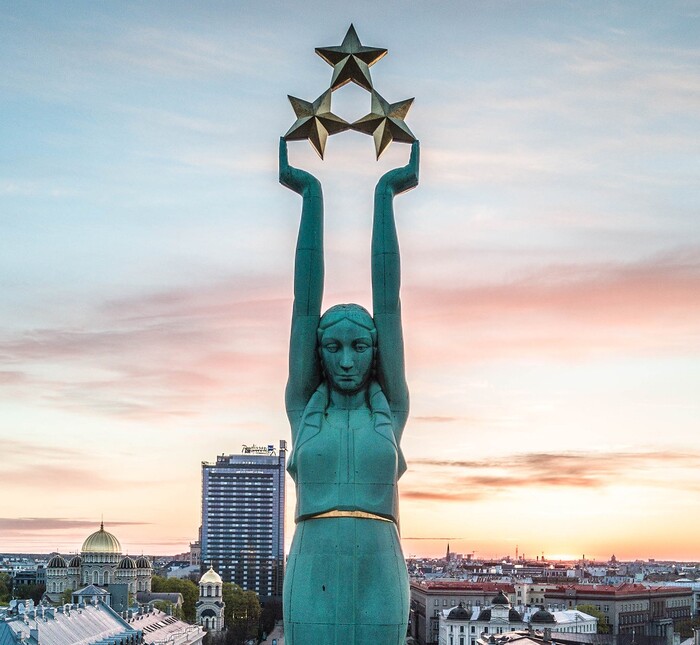
- The Freedom Monument: Brīvības piemineklis in Riga stands for independence and statehood, and the three stars the figure holds represent Latvia’s three historical regions, Vidzeme, Latgale and Kurzeme.
- The oxeye daisy: the national flower, and the one woven into the wreaths women and girls wear at Jāņi. Men wear oak leaves instead.
- The oak and the linden: Latvia’s national trees, both long used in folk medicine and both constant presences in the dainas, where the oak stands for the man and the linden for the woman.
Plan your trip to Latvia
Seeing these traditions takes some planning, because most of them happen outside Riga and several happen on fixed dates. Jāņi falls on 23 and 24 June every year, the Song and Dance Celebration runs on a five-year cycle, and foraging, preserving and winter swimming are all seasonal.

Start with the Latvia travel guide for regions, costs and getting around, and read up on Riga for the city end of the trip. A car makes the rural half far easier, because the bathhouses, open-air museums and farm stays are not on a bus route: hiring a car for two or three days covers most of what you would otherwise miss.
WonderfulWanderings Pro Tips
Four tips make the difference between seeing these traditions and just reading about them, and each one fixes something travellers are told wrongly.

- Book Jāņi accommodation months out, and expect the cities to be shut. 23 and 24 June are both public holidays, Latvians leave town for the countryside, and Riga runs on a skeleton timetable while the rural guesthouses are full.
- The next Song and Dance Celebration is 2028, not sooner. The 2023 edition closed on 9 July 2023 and the cycle is five years. Any guide still telling you to plan around 2023 is out of date.
- Book the Pirts Museum guided tour in advance. The museum’s own terms say a guided tour must be reserved ahead; the plain museum tour costs €2.00 (about $2.30, £1.70) and preschool children go free.
- Do not expect a midnight sun at Jāņi. Latvia is south of the Arctic Circle. What you get at roughly 57°N is close to 18 hours of daylight and a long blue dusk that runs into dawn, which is why the bonfire matters.
About the author. This guide is written and maintained by the Wonderful Wanderings editorial team. Wonderful Wanderings was founded in 2012 by Sofie Couwenbergh, and the first-hand notes in this post come from her winter trip to Riga and the Latvian coast, made in collaboration with Latvia Travel. The team covers Latvia for independent travellers, including the tours, bathhouses, guesthouses and car hire worth booking around the country’s seasonal traditions, and updates this page when dates and prices change.


