 EN
EN
 Nederlands
 Français
Almost every Icelandic town on this list is a base for what is around it rather than a destination in its own right, and knowing which is which saves you days. Reykjavík and Akureyri are cities you can spend time in. Selfoss, Vík, Borgarnes and Stykkishólmur are the places you sleep so that the Golden Circle, the south coast, the west and Snæfellsnes are a short drive away. Húsavík, Siglufjörður and Vestmannaeyjar are worth the detour for one specific thing each.
The 18 below run roughly from the capital region outwards. One of them, Grindavík, is not a normal place to visit any more, and that is covered where it comes.
Two things before the list. Iceland uses the króna (ISK), not the euro, and prices here move fast enough that this page names what things are rather than what they cost. And almost everything below assumes a car: Strætó buses connect the larger towns but they run on a timetable built for residents, not for day trips. Compare car hire rates as soon as your dates are fixed, because Icelandic fleets are small and summer sells out.
1. Reykjavik
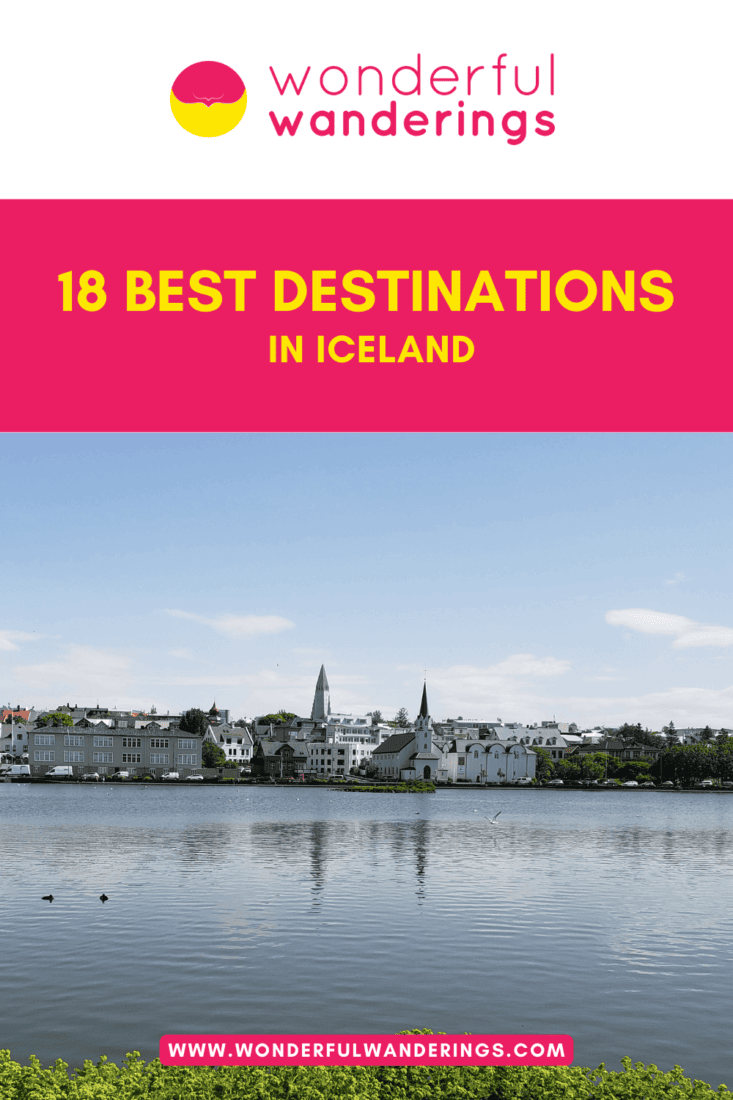
Reykjavík is Iceland’s capital, home to about 140,000 people in the city and 253,000 in the wider capital region, which is nearly two-thirds of the country. Reykjavík stands on the southern shore of Faxaflói Bay, on the spot where Ingólfur Arnarson built a farm around 874 and named it for the steam rising off the hot springs: “smoky bay”.

It became the seat of the restored Alþingi in 1844 and the capital of a sovereign Iceland in 1918. What to do in it: Hallgrímskirkja, Harpa, the Sun Voyager, Perlan, the National Museum, the Old Harbour and Laugardalur. Our guide to things to do in Reykjavík covers 24 of them, including which are free.
Give it two days. Almost every tour in Iceland picks up here, so it is also the default base for the Golden Circle and the south coast.
2. Kópavogur
Kópavogur is Iceland’s second largest municipality and it is contiguous with Reykjavík, so you are likely to sleep or shop there without noticing you have left the capital. Kópavogur sits directly south of Reykjavík across a small fjord, and what it offers a visitor is practical rather than scenic: cheaper hotel rooms, the country’s largest shopping centre at Smáralind, and Salalaug and Kópavogslaug, two of the better geothermal pools in the capital area.

Kópavogskirkja, the modernist church on the ridge, is the landmark, and the Gerðarsafn art museum and the natural history museum are both in the town centre. Treat it as a district of Reykjavík rather than a trip.
3. Hafnarfjörður
Hafnarfjörður is a town of about 26,000 built into a lava field 10 km (6.2 mi) south of Reykjavík, and it is the one capital-region suburb worth going out of your way for. Hafnarfjörður’s harbour is lined with coloured timber warehouses, lava outcrops sit between the houses, and the town has a stronger association with the huldufólk, the hidden people, than anywhere else in Iceland, with guided hidden-world walks running in summer.

Go for the Viking Village restaurant and hotel, Hellisgerði park and its lava garden, the Hafnarborg arts centre, the town museum, and the climb up Helgafell behind the town. The Viking Festival in June is the event worth timing a visit for. It is a 15-minute drive or a 25-minute bus ride from downtown Reykjavík.
4. Akureyri
Akureyri is Iceland’s northern capital and the only town outside the southwest that functions as a city. Akureyri sits at the head of Eyjafjörður, the country’s longest fjord, sheltered enough that it grows trees and runs a botanical garden, Lystigarðurinn, at a latitude where that should not be possible.

Akureyrarkirkja, the church on the steps above the centre, is the landmark, and the town has galleries, museums, a good food scene and the ski area at Hlíðarfjall. It is also the base for north Iceland: Goðafoss, Mývatn, Húsavík and the Diamond Circle are all within a morning’s drive. Flying from Reykjavík takes about 45 minutes; driving the 390 km (242 mi) up Route 1 takes about five hours in summer and longer in winter.
Give Akureyri two days and the north around it another three.
5. Reykjanesbær
Reykjanesbær is the town you land in, because Keflavík International Airport is inside it. Reykjanesbær was formed in 1994 by merging Keflavík, Njarðvík and Hafnir, and it is the largest settlement on the Reykjanes peninsula, which is a UNESCO Global Geopark of lava fields, steam vents and coastal cliffs.

The Viking World museum, built around a full-size replica Viking ship that sailed to New York, is the main attraction, along with the Duus museum and the Rockstock music heritage in Keflavík. Because it is five minutes from the airport, Reykjanesbær is the smart place to sleep on your first or last night rather than driving straight into Reykjavík after a long flight.
6. Keflavík
Keflavík is the part of Reykjanesbær that gives the airport its name, and it is a working port town with an unusual musical history. Keflavík was where American servicemen at the NATO base brought rock and roll into Iceland in the 1950s and 1960s, which is why the town was known as bítlabærinn, the Beatles town, and produced a disproportionate share of Icelandic bands.

For a visitor, Keflavík means the harbour, the coastal walking paths, the Giantess Cave on the shore path, and a place to eat before an early flight. It is administratively part of Reykjanesbær, so treat items 5 and 6 as one stop rather than two.
7. Garðabær
Garðabær is a residential town between Kópavogur and Hafnarfjörður, and the reason to stop is Vífilsstaðavatn and the coastal path. Garðabær grew fast as a commuter suburb of Reykjavík and has little historic centre, but it holds the Hönnunarsafn Íslands, the Museum of Design and Applied Art, and the Álftanes peninsula with Bessastaðir, the president’s official residence, on it.

The walking is the draw: the lakeside loop at Vífilsstaðavatn and the coast path round Álftanes are both flat, easy and busy with locals rather than visitors.
8. Mosfellsbær
Mosfellsbær is the green edge of the capital region, on the road north out of Reykjavík, and it is where the city goes walking. Mosfellsbær sits in a valley of rivers and low mountains, with Esja rising behind it, and the hikes up Helgafell and Úlfarsfell start from the town.

Its cultural draw is Gljúfrasteinn, the house of Halldór Laxness, Iceland’s Nobel laureate in literature, kept exactly as he left it and open as a museum, with his Jaguar still in the drive. It is a 15-minute drive from Reykjavík and a good half-day if you want the book and the walk together.
9. Akranes
Akranes is a port town on the tip of a peninsula 50 km (31 mi) north of Reykjavík, reached through the Hvalfjörður tunnel, and it is a stop rather than a stay. Akranes has two lighthouses at Breiðin, the taller of which you can climb, and the view from the top takes in Snæfellsjökull on a clear day. The lower lighthouse is used for concerts and exhibitions because of its acoustics.

Also here: Langisandur, a long sandy beach with a geothermal pool and hot tubs at one end, and the Akranes folk museum at Garðar. The town has a strong football tradition that Icelanders will mention before anything else.
10. Selfoss
Selfoss is the largest town in south Iceland outside the capital region, with about 6,500 people, and it is the practical base for the Golden Circle and the start of the south coast. Selfoss sits on the Ölfusá river, crossed by a suspension bridge first built in 1891, and it is where south Iceland does its shopping and farming business.

In the town: the rebuilt old-town square with the Skyr museum and food hall, the Bobby Fischer Center, which holds the chess champion’s grave nearby at Laugardælir, and a good swimming pool. Around it: Þingvellir, Geysir, Gullfoss, Kerið and the Secret Lagoon are all within an hour.
It is 50 minutes from Reykjavík on Route 1. Use it as a base for two or three nights rather than a sight in itself.
11. Hveragerði
Hveragerði is a town built on an active geothermal field 45 minutes from Reykjavík, where steam comes out of the ground in people’s gardens. Hveragerði is called the hot spring town for that reason, and it is also called the earthquake town, having been shaken repeatedly, most recently in 2008.

Two things bring visitors. Reykjadalur, the valley behind the town, has a hot river you can bathe in, reached by a walk of about 45 minutes uphill, with a boardwalk and changing screens at the top; it is free and it is one of the most popular short hikes in Iceland. And the geothermal park in the town centre lets you see boiling ground up close and bake bread in it.
Hveragerði also has the LÁ Art Museum and greenhouses that grow bananas at 64 degrees north. It is half a day, or an overnight if you are walking Reykjadalur properly.
12. Vík
Vík í Mýrdal is the service town of the south coast, 180 km (111.8 mi) from Reykjavík, with about 300 residents and the only fuel, food and beds for a long stretch of Route 1. Vík sits under the Mýrdalsjökull ice cap, which covers the Katla volcano, and faces the Atlantic across black sand.

Reynisfjara is the reason people stop, and it is genuinely dangerous. The black beach with its hexagonal basalt columns and the Reynisdrangar sea stacks offshore is also subject to sneaker waves that arrive without warning and have killed visitors. Read the warning signs, watch the flag system at the entrance and do not turn your back on the water.
Also here: glacier hikes and ice caves on Mýrdalsjökull, and the walking in Katla Geopark. Most people stop for two hours; a night here lets you see the beach without the tour buses. A camper van makes this stretch of coast far easier, since accommodation in Vík is limited and books out.
13. Grindavík
Grindavík is not a normal destination any more, and this is the entry to read before you plan anything on the Reykjanes peninsula. Grindavík was a fishing town of about 3,000 people until November 2023, when magma moving under it opened fissures through the town and it was evacuated. Eruptions at Sundhnúkagígar followed repeatedly through 2024 and 2025, lava reached the edge of the town and destroyed houses, and most residents sold their homes to the state.

The town has since partly reopened and some residents have returned, but it remains largely uninhabited. The most recent eruption in the sequence began on 16 July 2025 and no new one had started as of late 2026, though magma continues to accumulate underground and evacuation protocols for Grindavík and the Blue Lagoon stay in force even during quiet spells.
What a visitor can do now is take a guided tour of the town and its defensive lava barriers, which have run since November 2024 and are an extraordinary thing to see. What you should not do is drive in to look at the Saltfish Museum and the harbour as though nothing had happened, which is what older guides describe. Check the Icelandic Met Office and the Department of Civil Protection before you go anywhere on this peninsula.
14. Borgarnes
Borgarnes is a town of about 1,700 on a spit in Borgarfjörður, 75 km (46.6 mi) north of Reykjavík, and everybody driving to Snæfellsnes or the north passes through it. Borgarnes is saga country: Skalla-Grímur Kveldúlfsson settled here and his son Egill Skallagrímsson is the subject of Egil’s Saga, one of the greatest of them.

The Settlement Centre in the old warehouse by the harbour tells that story in two exhibitions, one on the settlement of Iceland and one on Egill, and it is the clearest museum introduction to the sagas in the country. Skallagrímsgarður, the park in the middle of town, holds Skalla-Grímur’s burial mound.
The swimming pool has slides and is a reliable stop with children. Borgarnes is a half-day, but it is the gateway to Snæfellsnes, Reykholt and the Hraunfossar waterfalls.
15. Siglufjörður
Siglufjörður is a fjord town at the northern tip of the Tröllaskagi peninsula, with about 1,200 people, and it was once the herring capital of the Atlantic. Siglufjörður held over 10,000 seasonal workers in the 1950s and one of Europe’s largest fishing fleets, and then the herring vanished in the late 1960s and the town nearly emptied.

The Herring Era Museum is the reason to drive up here: three buildings, a salting station, a boathouse and a factory, and it is widely regarded as the finest industrial museum in Iceland. There is also a folk music centre, a craft brewery, a ski area and hiking on Tröllaskagi.
It is 80 km (49.7 mi) from Akureyri on Route 76, which is a spectacular road along the western side of the peninsula, and about 385 km (239.2 mi) from Reykjavík. Give it two days as part of a north Iceland loop.
16. Vestmannaeyjar
Vestmannaeyjar, the Westman Islands, are an archipelago of 15 islands and about 30 stacks off the south coast, of which only Heimaey is inhabited, by about 4,200 people. Vestmannaeyjar were formed by volcanism over the last 10,000 to 12,000 years, and the islands take their name from Irish slaves, “west men”, who fled here after killing Hjörleifur, the foster-brother of Iceland’s first settler.

The 1973 Eldfell eruption is the story. A fissure opened at the edge of town overnight, the entire population was evacuated by fishing boat, and lava buried a third of Heimaey before islanders stopped it by pumping seawater onto the flow. Eldheimar is the museum built over an excavated house, and it is one of the most affecting museums in Iceland.
Also here: Stórhöfði for puffins, Elephant Rock from a boat, the Sæheimar aquarium, and the Herjólfsdalur valley. The Herjólfur car ferry crosses from Landeyjahöfn in about 35 minutes, several times a day year-round. Give it two days, since the crossing eats half of one.
17. Húsavík
Húsavík is Iceland’s whale-watching town, on Skjálfandi Bay on the north coast, with about 2,200 residents. Húsavík was where the Swedish Viking Garðar Svavarsson overwintered around 870, before Ingólfur Arnarson settled Reykjavík, which makes it arguably the first place in Iceland a Norseman built a house.

Whales are what everyone comes for, and the bay is genuinely reliable: humpback and minke whales through the summer, with blue whales and orcas as occasional sightings rather than expected ones. Boats run from the harbour from around April to October. The Húsavík Whale Museum, in an old slaughterhouse by the quay, is the most thorough whale museum in the country outside Reykjavík.
Two other things: GeoSea, the geothermal sea baths on the cliff above the town, where you soak looking at the bay, and Ásbyrgi canyon an hour away. Give it two days.
18. Stykkishólmur
Stykkishólmur is a town of about 1,100 on the northern shore of the Snæfellsnes peninsula, looking out over the islands of Breiðafjörður, and it is the most attractive small town in west Iceland. Stykkishólmur kept its 19th-century timber houses, including the Norwegian House of 1832, the oldest preserved wooden house in Iceland, now the regional museum.

Climb Súgandisey, the basalt island joined to the harbour by a causeway, for the view over the bay and its islands, said to be uncountable. The modernist Stykkishólmskirkja on the hill and Roni Horn’s Library of Water, a room of glass columns filled with meltwater from Icelandic glaciers, are the other two things to see. Boat tours run out into Breiðafjörður.
It is a 2.5-hour drive from Reykjavík and the natural base for the Snæfellsnes peninsula, which is often called Iceland in miniature and is the finest single day’s driving in the country. The Baldur ferry from here crosses Breiðafjörður to the Westfjords.
Planning around this list
Where to base yourself. Reykjavík for the southwest and the Golden Circle, Selfoss or Vík for the south coast, Borgarnes or Stykkishólmur for the west and Snæfellsnes, Akureyri for the north, Húsavík for whales and the Diamond Circle. Two or three bases beat eight one-night stops. Compare rooms when you look for somewhere to stay in Iceland.
When to go. June to early September gives you long daylight, open mountain roads and every attraction running. Winter gives you the northern lights, ice caves and far fewer people, at the cost of short days and real driving conditions; our guide to driving in Iceland in winter covers what that involves, and our week-long winter itinerary shows what fits.
Data. Iceland is in the EEA, so an EU or EEA SIM roams here at domestic rates within your plan’s fair-use limit. Coming from outside Europe, or expecting to blow through that limit on maps and weather, an eSIM is the cheap fix: check out Airalo and use the code HARRY5578 for €3 off a first eSIM. You will want live road and weather information every day out here.
More on the country in our Iceland guide, on the food in typical Icelandic food, and on the country itself in our facts about Iceland.
Frequently asked questions
Which town in Iceland should you stay in besides Reykjavík?
Akureyri if you want a second city, Selfoss or Vík for the south coast, and Stykkishólmur for Snæfellsnes. Those three cover the parts of Iceland most visitors actually drive to, and each has enough beds and food to work as a base for several nights.
Is it worth going beyond Reykjavík and the Golden Circle?
Yes, and the north is where the difference is biggest. Akureyri, Húsavík and Mývatn take a long drive or a short flight to reach and hold a fraction of the crowds on the south coast, with whales, geothermal baths and canyons that the day-trip circuit never gets to.
Can you visit Grindavík?
Only on a guided tour, and only with current information. The town was evacuated in November 2023 after magma opened fissures through it, eruptions followed through 2024 and 2025, and it remains largely uninhabited. Guided tours of the town and its lava barriers have run since November 2024. Evacuation protocols for Grindavík and the Blue Lagoon stay in force even when nothing is erupting.
When is the best time to visit Iceland’s towns?
June to early September, when daylight runs almost round the clock, mountain roads are open, ferries and museums keep full hours and summer temperatures sit around 12°C to 15°C (54°F to 59°F). Many small-town museums cut their hours sharply from October, so check before a winter detour.
Do you need a car to see these places?
For most of them, yes. Strætó connects the larger towns and there are buses to Selfoss, Borgarnes and Akureyri, but the timetables are built for residents and a bus day trip usually means one direction only. Hire a car, and hire it early, because Icelandic fleets are small.
WonderfulWanderings Pro Tips
Five things will change how you use this list.
- Check the Icelandic Met Office before anything on Reykjanes. Grindavík and the Blue Lagoon are both on a peninsula that has erupted repeatedly since 2021, and evacuation protocols stay in force between eruptions.
- Sleep in Reykjanesbær on your first or last night. It is five minutes from Keflavík Airport rather than 50, which turns an early flight or a late arrival from a problem into a non-event.
- Treat Reynisfjara as dangerous, because it is. Sneaker waves at the black beach outside Vík arrive with no warning and have killed visitors. Watch the flag system at the entrance and stay well back from the water.
- Two or three bases, not eight. Reykjavík, Vík or Selfoss, and Akureyri will reach almost everything on this list, and you will spend your evenings looking at the country instead of checking in.
- Walk up Reykjadalur at Hveragerði for a free hot bath. Forty-five minutes uphill from the car park gets you to a river warm enough to sit in, with a boardwalk and changing screens, and it costs nothing.
About the author. This guide is written and maintained by the Wonderful Wanderings editorial team. Wonderful Wanderings was founded in 2012 by Sofie Couwenbergh, and the Iceland coverage on this site draws on trips made by her father, the photographer Hans Couwenbergh. The team covers Iceland for independent travellers, including the car hire, accommodation and tours worth booking in each of these towns, and updates this page when access, ferry schedules and volcanic conditions change.