
 EN
EN
 Nederlands
 Français
A week in Iceland in winter works as a one-directional drive along the south coast and back rather than as a loop, and this itinerary does exactly that: Reykjanes, the Golden Circle, Þórsmörk, the south coast as far as Jökulsárlón, an ice cave, and the drive home. Winter gives you four to six hours of usable light a day in midwinter, so each day holds two or three stops rather than six, and the plan has to have slack in it for weather.
My father had wanted to go back to Iceland in winter, my mother was not keen on the temperatures, and I volunteered. It was my first time there. What follows is the itinerary I planned and we drove, with what we actually did, where we slept and what it cost, plus the things that have changed since.
Three things have changed since we drove this route and they affect the plan. The Reykjanes peninsula on day 1 has been erupting on and off since 2021, so check the Icelandic Met Office before you go anywhere on it. The Blue Lagoon is now timed-entry, advance-booking only, with no walk-ins. And you can no longer drive across the sand to the Sólheimasandur plane wreck.
If you would rather have somebody else drive, GetYourGuide runs most of the day tours in this itinerary as guided trips out of Reykjavík, with free cancellation up to 24 hours ahead. Take a look at their offer in Iceland.
1 week in Iceland in winter: an Iceland winter itinerary
The seven days are set out below, with where you sleep and how far you drive.

| Day | Sleep in | Main stops |
|---|---|---|
| 1 | Hveragerði | Reykjanes peninsula: Bridge Between Continents, Gunnuhver, Seltún, Kleifarvatn, Blue Lagoon |
| 2 | Near Selfoss | Golden Circle: Þingvellir, Geysir, Gullfoss |
| 3 | Near Selfoss | Þórsmörk by super jeep |
| 4 | Skógar | Seljalandsfoss, Skógafoss, the plane wreck, Vík, Reynisfjara, Dyrhólaey |
| 5 | Near Höfn | Fjaðrárgljúfur, Systrafoss, Skaftafell, Fjallsárlón, Jökulsárlón |
| 6 | Near Höfn | Ice cave tour |
| 7 | Keflavík | Jökulsárlón again, Eldhraun, Vík |
Day 1: Reykjanes Peninsula
Day 1 is the peninsula you land on, so it costs you no driving time at all. Reykjanes runs from Keflavík Airport south and east, and it is a UNESCO Global Geopark of lava fields, steam vents and coastal cliffs.

Check the Icelandic Met Office and the Department of Civil Protection before you set out. The peninsula has erupted repeatedly since 2021 at Sundhnúkagígar near Grindavík, roads have closed at short notice, the town of Grindavík was evacuated in November 2023 and remains largely uninhabited, and evacuation protocols stay in force even during quiet spells. Nothing written in advance overrides what the authorities say on the day.
The Bridge Between Continents
The Bridge Between Continents is a small footbridge over a sand-filled fissure between the North American and Eurasian plates, and the point of it is that you can stand on both. It is free, it is signposted off Route 425, and it takes ten minutes.

It is a symbol rather than a geological boundary line, since the plate margin is a zone rather than an edge, and a bridge over a gap in the sand is a modest thing next to Þingvellir on day 2. Stop because it is on the way, not because it is a destination.
Gunnuhver Geothermal Area
Gunnuhver is the most violent geothermal field on Reykjanes, a set of mud pools and steam vents where the ground hisses and the smell of sulphur reaches the car park. Gunnuhver takes its name from a ghost, Guðrún, said to have been lured into the spring by a priest.

Boardwalks run through it and you stay on them, because the crust around the vents is thin and the water is superheated. The area has been closed at times during the recent eruptive period, so this is one to confirm on the day.
Hot springs of Seltún/Krýsuvik
Seltún, in the Krýsuvík geothermal field, is the more photogenic of the two: orange, yellow and grey mineral ground with boiling pools and steam, crossed by a boardwalk loop that takes twenty minutes. Seltún is free, there is a car park, and there is nothing there but the ground.

Come in the middle of the day in winter. The light is low and short and the colours in this field need it.
Lake Kleifarvatn
Kleifarvatn is the largest lake on the Reykjanes peninsula and one of the emptiest places within half an hour of Reykjavík. Kleifarvatn sits in a fault between black slopes with no outflow, so its level rises and falls with the water table, and it dropped sharply after an earthquake opened fissures in its bed in 2000.

There is a black sand beach on the eastern shore and a road along the west. In winter it is often the stop where you see nobody at all.
The Blue Lagoon
The Blue Lagoon now sells timed-entry tickets in advance only, and walk-ins are not accepted. Popular slots go three to four weeks ahead in summer and over the festive period, and the pricing is dynamic, so booking early is what gets you the lower rate. The lagoon sits near Grindavík, about 20 minutes from Keflavík Airport and 45 to 50 minutes from Reykjavík, and it has closed temporarily when an eruption looked imminent.

Current entry starts at around 11,990 ISK (about €86, $99, £74) for the Comfort package, with Premium and Signature above that and the Retreat Spa in a different bracket entirely. Any guide still quoting a cheapest package of around €50 is years out of date.
We did not go, and I will be honest about why: I am not a spa person, plenty of Icelandic hotels have outdoor hot tubs and heated pools, and the price for an hour felt steep. If you are a spa person, book it properly and give it half a day rather than popping in. It is the single most visited paid attraction in the country and you will not have it to yourself.

Recommended Reykjanes tours
Tours from Reykjavík cover the peninsula’s geothermal sites and combine the Blue Lagoon with an airport transfer, which solves the arrival-day luggage problem neatly. Check what is currently running before you book, because operators reroute around volcanic activity.

A night at the Frost and Fire hotel
We spent our first night at the Frost and Fire hotel in Hveragerði, less than an hour from Kleifarvatn, and it was the right choice for three reasons: it is well placed for the Golden Circle the next day, my parents had stayed there and rated it, and it has its own restaurant, which mattered because we did not want to drive Icelandic roads in the dark looking for dinner.

The hotel is a main building with the restaurant and reception plus smaller buildings of rooms, with a sauna, two outdoor hot tubs and a heated outdoor pool, all looking at the river. The restaurant is in a sunroom over the water and the food was genuinely good: langoustine soup, then fish, then a chocolate cake steamed in the hotel’s own geothermal spring. They boil the breakfast eggs in it too.
Our room was small and complete: twin beds, desk, television, wardrobe, private bathroom, slippers and a bathrobe. Breakfast was a hot and cold buffet with a waffle machine, which is more of a selling point than it sounds at 8am in January.

Pick hotels with restaurants for this whole itinerary. It is the single most useful planning rule for winter in Iceland.
Day 2: The Golden Circle
The Golden Circle is a 300 km (186.4 mi) loop of three sights and it is the one day of this trip you share with everybody. Most people drive it from Reykjavík and back; from Hveragerði you start closer, which gets you to Þingvellir ahead of the coaches.

Thingvellir National Park
Þingvellir is where the Alþingi was founded in 930, which makes it the oldest surviving parliament in the world, and it is also where you walk down a rift between two tectonic plates. Þingvellir is a UNESCO World Heritage Site on both counts, cultural and geological, and the path through the Almannagjá gorge takes you along the edge of the North American plate with the Eurasian one across the plain.

Parking is charged and paid by app or at a machine, which catches people out. Allow two hours: the gorge path, the Öxarárfoss waterfall at the top, the Lögberg law rock, and the church and farm below. In winter the paths ice over and the handrails matter.
Silfra, the flooded fissure where you can snorkel between the plates in glacial meltwater, is here too, and it runs year round in drysuits.

Lunch at The Barnloft
We ate at the Barnloft at Efstidalur II, a working dairy farm on the Golden Circle route that runs a restaurant in its hayloft with a window into the cowshed. You eat beef and dairy from the animals below you, and the ice cream made on site is the reason most Icelanders stop.

It is between Þingvellir and Geysir and it is the most practical lunch on the loop.
Geysir geothermal area
The Geysir field is where the English word “geyser” comes from, and the one that erupts is Strokkur, not Geysir. The Great Geysir, which gave the word to the language, is largely dormant and rarely goes off. Strokkur, 50 m away, erupts every few minutes to about 15 to 20 m (49 to 66 ft), which is why the crowd is always standing round that hole and not the famous one.

Entry to the field is free and there is a large car park, café and shop across the road. Watch the blue dome of water swell before it goes; that is the shot.
Gullfoss
Gullfoss is a two-stage waterfall where the Hvítá drops into a canyon at right angles to itself, and in winter it part-freezes into something better than the summer version. Gullfoss has two viewpoints, an upper one from the car park and a lower path that puts you beside the top drop, and the lower path is closed or lethally icy for much of winter, so check the signs rather than the guidebook.

It is free. It takes an hour with the walking. Spray freezes on everything including you, so this is the stop where waterproof trousers earn their place.
Recommended Golden Circle tours
Day tours from Reykjavík cover Þingvellir, Geysir and Gullfoss in one run, usually with a stop at Kerið crater or a farm, and in winter a guided coach means somebody else is deciding whether the roads are drivable. Several combine the loop with a Game of Thrones filming location tour, which uses Þingvellir among other sites.

Two nights at the Aurora Lodge Hotel
We spent the next two nights at the Aurora Lodge Hotel, which put us within reach of both the Golden Circle and the Þórsmörk departure point, and again had its own restaurant. Two nights in one place in the middle of the week is worth engineering: it means one evening where you are not packing and one morning where you are not checking out.

Day 3: exploring Thórsmörk valley by super jeep
Day 3 is the one day of this itinerary you cannot do in a hire car, and that is the point of it. Þórsmörk is a valley between three glaciers, Eyjafjallajökull, Mýrdalsjökull and Tindfjallajökull, and reaching it means fording unbridged glacial rivers, which no rental agreement in Iceland permits.

The story of Midgard
We went with Midgard Adventure, a company run out of Hvolsvöllur by people who grew up in the valleys they drive you into, and the difference it makes is that the guide knows the rivers rather than the route. Their base is a hostel and bar as well as a tour operator, so you can start and end the day in the same building.

Their Þórsmörk super jeep tour is the trip we took.
The super jeep tour
A super jeep is a modified 4×4 on enormous tyres, deflated for the river crossings, and the drive is half the experience. You ford the Krossá and its braided channels, climb into the valley between the glaciers, and stop to walk in birch woodland that survives here because the glaciers shelter it from the wind.

Two things to know. Whether you go at all is decided on the morning, by the weather and the river level, and a winter tour can be cancelled or shortened without notice. And this is the day to wear everything: you are out of the vehicle, above the snow line, in wind.
Our tour cost 32,000 ISK per person at the time, and tour prices in Iceland have risen substantially since, so treat that as the shape of the cost rather than the current one.

Day 4: along the South Coast
Day 4 is the classic south coast run and the busiest day of the week, so start early and accept that you will share every stop.

Seljalandsfoss and Gljúfrabúi waterfall
Seljalandsfoss is the waterfall you can walk behind, dropping 60 m (197 ft) off the old sea cliff, and in winter the path behind it is usually closed by ice. Seljalandsfoss has a paid car park and it is the first of the big sights coming east from Reykjavík, so it is busy from mid-morning.

Walk five minutes north along the cliff to Gljúfrabúi, which almost nobody does. It falls inside a cleft in the rock, and you reach it by wading a shallow stream into the gorge, coming out in a chamber with the waterfall in front of you and the sky above. Take waterproof boots and expect to get wet.
Skógafoss waterfall
Skógafoss is 60 m (197 ft) high and 25 m (82 ft) wide, and you can walk right up to the base of it, which is why everyone in the photographs looks so small. Skógafoss has a staircase of 527 steps up the side to a viewing platform at the top, and from there the Fimmvörðuháls trail runs on over the pass to Þórsmörk.

The spray is constant, so the path and the steps ice badly in winter. There is a car park, a campsite and the Skógar folk museum next to it.
Optional: Solheimasandur plane wreck
You can no longer drive to the plane wreck, and driving on the sand carries heavy fines. The wreck of a US Navy DC-3, which crash-landed on the black sand in 1973 with no fatalities, sits about 4 km (2.5 mi) from Route 1.

You have two ways to reach it. Walk, following the marked path south across the sand plain, which takes 45 to 60 minutes each way over flat, featureless ground with no shelter. Or take the shuttle bus from the car park, which runs seven days a week from 10.00 to 16.30 and takes 10 to 15 minutes. Parking is charged at around 750 ISK (about €5.40, $6, £4.60), paid through the Parka app, and the shuttle costs extra.
In winter this is a two-hour commitment on foot in weather with nowhere to shelter. Decide before you park, and be honest about the daylight you have left.

Lunch in Vik
Vík í Mýrdal is the only real service town on this stretch, with fuel, food, a supermarket and the beds you may end up needing, and it is where everybody stops for lunch. The cafés and restaurants around the main junction fill between 12 and 2, so either eat early or eat late.

Reynisfjara
Reynisfjara is the most dangerous tourist site in Iceland and people have been killed there. The black sand beach with its hexagonal basalt columns and the Reynisdrangar sea stacks offshore is subject to sneaker waves, which are far larger than the preceding waves, arrive with no warning, and drag people out into water that is both freezing and unswimmable.

There is now a warning light and flag system at the entrance grading the day’s danger. Read it. Stay well back from the waterline, never turn your back on the sea, and do not walk out towards the stacks on a falling tide. Nobody who died there thought they were standing too close.
With that said, it is extraordinary, and the basalt columns at the cave end are worth the drive on their own.

Dyrhólaey peninsula
Dyrhólaey is the headland west of Vík with a natural stone arch through it, big enough for a boat to pass under, and a lighthouse on top. Dyrhólaey gives you the view back along the black coast that Reynisfjara cannot, and in summer it is full of puffins.

Access is restricted during the nesting season, roughly May to late June, and the upper road is closed in bad weather year-round because it is steep and exposed. In winter it is often the one stop of the day where you have the view alone.
A night at Hotel Skogafoss
We slept at Hotel Skógafoss at Skógar, which puts the waterfall out of your window and the south coast either side of you. Check rates and availability for Hotel Skógafoss before you fix the day, because beds on this stretch are limited and the alternative is a long drive back to Vík in the dark.

Day 5: another day along the South Coast
Day 5 runs east from Skógar to the glacier lagoons, and it is the longest driving day. In midwinter you have about four hours of light for it, so cut stops rather than rush them.

Grafarkirkja
Grafarkirkja is a small turf church, and a stop like this is what a winter itinerary is for: five minutes, nobody else there, and a building made of the ground it stands on. Icelandic turf churches are dark, low and lined with timber inside, and several survive along this coast.

Fjadrargljufur Canyon
Fjaðrárgljúfur is a 100 m (328 ft) deep canyon cut into palagonite rock, with a river winding along the bottom and a walking path along the rim. Fjaðrárgljúfur became famous after a Justin Bieber video was filmed in it, the resulting foot traffic damaged the vegetation, and the site has been closed for recovery periods since.

It is open with a managed path and viewing platforms. Stay on them, and check before you drive the gravel track in if the weather has been wet.
Systrafoss
Systrafoss is a twin waterfall at Kirkjubæjarklaustur, falling in two strands beside a small wood, and it is a two-minute walk from the car. Systrafoss is named for two nuns from the convent that stood here, and the lake above it, Systravatn, carries the same story.

Foss a Sidu/Stigafoss
Foss á Síðu drops off the cliff beside Route 1 next to the farm of the same name, and in a strong easterly the wind blows the water back up the rock face before it reaches the ground. Foss á Síðu needs nothing more than a lay-by and two minutes, and the blown-upwards version is the one worth waiting for.

Skaftafell National Park
Skaftafell is the part of Vatnajökull National Park with the visitor centre, the walking trails and the glacier tongues, and it is where glacier hikes and ice cave tours depart from. Skaftafell has the Svartifoss waterfall, a black basalt-column cliff, at the end of a walk of about 45 minutes uphill from the centre, and Skaftafellsjökull at the end of a flat hour.
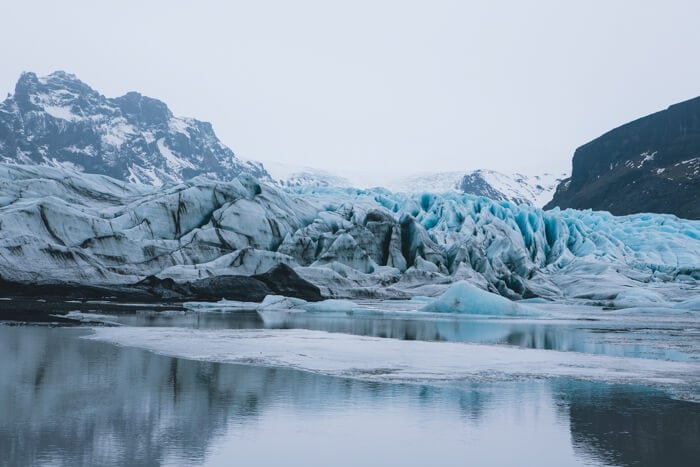
Do not walk onto a glacier without a guide and crampons. Crevasses are covered by snow in winter and the tongue is not a footpath.
Hofskirkja
Hofskirkja at Hof is the last turf church built in the old style in Iceland, completed in 1884, with a grass roof that runs into the graveyard mounds around it. Hofskirkja is free, open and a five-minute stop off Route 1, and in snow it is the most photographed small building on this coast.

Fjallsarlon Glacier Lagoon
Fjallsárlón is the quieter of the two glacier lagoons, a few kilometres before Jökulsárlón, with the Fjallsjökull tongue calving directly into it. Fjallsárlón is smaller and closer to the ice than its famous neighbour, and there is usually a fraction of the traffic.

If you only have time for one lagoon, most people take Jökulsárlón. If you have time for both, do this one first and you will appreciate the scale of the other more.
Jokulsarlon
Jökulsárlón is the glacier lagoon everyone comes for, a deep lake of icebergs calved off Breiðamerkurjökull that drift out to sea through a short river. Jökulsárlón is also where you cross the road to Diamond Beach, where those icebergs wash back up onto black sand and sit there melting, which is the image that sells Iceland in winter.

It is free to look at. Boat trips run in summer only. Watch the seals, keep off the ice, and give yourself an hour.
Two nights at Guesthouse Skálafell
We based ourselves for two nights at Guesthouse Skálafell, which put the ice cave tour and the lagoons within reach without another move. Check rates for Guesthouse Skálafell early, because the choice out here is thin.

Day 6: an Ice Cave tour
Ice caves are a winter-only activity and they must be booked with a guide. Natural ice caves form in the glaciers when summer meltwater carves channels that refreeze, and they are only stable enough to enter from roughly November to March. Every one of them is different every year, and a cave that existed last season may not exist this one.

Tours leave from Jökulsárlón or from Skaftafell, transfer you across the outwash plain by super jeep, and fit you with a helmet and crampons. What you get is blue ice with the light coming through it, which no photograph prepares you for.
Two honest warnings. Tours are cancelled at short notice when conditions change, so book this for a day you can move. And never enter an ice cave without a guide, at any time of year, for any reason.

Day 7: the drive back
Day 7 is 380 km (236.1 mi) back west to the airport, so it is a driving day with stops rather than a sightseeing day.

Jokulsarlon
Stop at Jökulsárlón again on the way out, because it is a different place in different light and the icebergs move. Half an hour in the morning before you start the drive is the strongest use of day 7’s daylight.

Eldhraun/Scenic green lava walk
Eldhraun is the lava field left by the Laki eruption of 1783 to 1784, the largest lava flow in recorded history, and it is now under a deep carpet of grey-green moss. Eldhraun runs for kilometres either side of Route 1 west of Kirkjubæjarklaustur, and there is a marked walking path and car park where you can go into it.

Stay on the path. The moss takes decades to recover from a footprint and the ground under it is jagged lava. The Laki eruption killed a fifth of Iceland’s population through the famine that followed, and cooled the northern hemisphere enough to be felt across Europe, which is worth knowing while you stand in it.
Lunch in Vik
Vík again, for the same reason as day 4: it is the only proper stop on this stretch.

Vik i Myrdal Church
Víkurkirkja is the white church with the red roof on the hill above Vík, and it is the highest point in the village. Víkurkirkja is also the town’s designated evacuation point in the event of an eruption of Katla under Mýrdalsjökull, which is the sort of practical detail that tells you where you are. The view over the village to Reynisdrangar is the reason to walk up.

Souvenir stop at UNA Local Products
UNA in Vík sells Icelandic-made things rather than imported souvenirs, which is the distinction worth caring about: wool, skincare, ceramics and food from Icelandic producers. It is a better use of your money than an airport shop.

Drinks at Kaffi Krús
Kaffi Krús in Selfoss is a house with a garden turned into a café, and it is the natural last stop before the airport run. Cake and coffee in a warm room after a week of standing in wind is not nothing.

A night at the Airport Hotel Aurora Star
We spent the last night at the Airport Hotel Aurora Star at Keflavík, which is five minutes from the terminal, and it is the right call after a week of driving. Check rates for the Airport Hotel Aurora Star, and do not plan to drive from the south coast to a morning flight in one go.

Recommended South Coast tours
Recommended south coast of Iceland day tours
Guided day tours from Reykjavík cover Seljalandsfoss, Skógafoss, Reynisfjara and Vík in a long day, and reach Jökulsárlón only on a two-day trip. In winter the advantage is not the commentary, it is that a professional driver is deciding whether the road is drivable.

Recommended Northern Lights tours
Northern lights tours run from Reykjavík and from the south coast between September and April, and the good operators will rebook you free if the sky is clouded out. What they buy you is somebody who knows which valley will be clear tonight.

Recommended multi-day tours
Multi-day guided trips cover this same south coast route over four to seven days with the driving taken care of, which is the sensible option if you are not confident about winter roads.

Iceland road trip map
Every stop in this itinerary is plotted on our Iceland winter road trip map, which you can open on a phone and follow as you drive.

A word on overtourism
Iceland’s visitor numbers grew fast after 2010 and the pressure landed unevenly: the south coast, the Golden Circle and the Blue Lagoon carry most of it, while the north, west and east would like more visitors than they get. A tourism specialist at Iceland’s Ministry of Industries and Innovation put it to Condé Nast Traveler as pressure “of certain kinds, in certain areas at certain times” rather than a country that is overrun.

Our own experience matched that. We drove stretches of a quarter of an hour without meeting another car, there were coaches at Skógafoss and along the Golden Circle, and there were stops where nobody else was there at all. Dad, who had driven the same coast five years earlier, noticed the difference in infrastructure more than in crowds: more hotels along the main road, toilet blocks at the busiest sites.
If you can travel in the north or west in summer, do. If it is your first visit and it is winter, the south coast is the realistic choice and there is no need to feel bad about it.

How to get to Iceland
Keflavík International Airport is the way in, and it sits 50 km (31.1 mi) from Reykjavík and 20 minutes from the Blue Lagoon. We flew from Brussels with WOW air, which ceased operations shortly after this trip, so that particular recommendation no longer exists; flights into Keflavík from Europe and North America are plentiful and it pays to compare.

Car rental in Iceland
We hired from Lagoon Car Rental, an Icelandic company, and took a 4×4 with a mid-tier insurance package. Get a 4×4 for this itinerary unless you are certain you will not leave Route 1, and read our separate guide to driving in Iceland in winter before you book anything, because the insurance choices matter more here than in most countries.

American drivers: Icelandic hire cars are mostly manual, so specify an automatic if you need one.
What to pack for Iceland in winter
Winter packing for Iceland is its own subject and we have a separate list: what to pack for Iceland in winter. The short version is layers, a genuinely waterproof and windproof shell, waterproof trousers for the waterfalls, boots with grip, and microspikes, which turn an icy path from a hazard into a walk.

How much does a week in Iceland in winter cost?
Iceland is expensive and food is where you feel it most. Rather than publish figures from our trip that have since risen, here is the shape of the budget and where the money actually goes.

The big four costs are flights, the car, accommodation and tours, roughly in that order of how much control you have over them. Flights and hotels swing hardest between high and low season. A 4×4 with a proper insurance package for a week is a substantial line, and the insurance is not the place to economise. Tours are the discretionary part: the super jeep day and the ice cave were the two we budgeted for, and each was a meaningful fraction of a day’s total.
Food. Restaurant main courses rise in a predictable order: a burger, pizza or salad in a casual place is the cheapest bracket, fish is a step up, lamb another, and a good steak the top. Alcohol is where Iceland is genuinely punishing, several times what you would pay elsewhere in Europe for a glass of wine. Tap water is free, excellent and brought to every table. The fix, if you want one, is Bónus, the low-cost supermarket chain, for breakfasts, lunches and road snacks.

Accommodation. Ours was mid-range: twin room, private bathroom, free WiFi, breakfast included, free parking and, most important on this route, an on-site restaurant. You can go cheaper with guesthouses and hostels with shared bathrooms. Compare rooms when you look for somewhere to stay in Iceland.
Souvenirs. We bought wool socks and a hat. A traditional Icelandic wool sweater, a lopapeysa, is the big-ticket item and the genuine hand-knitted ones cost considerably more than the machine-made versions sold beside them.

Data. Iceland is in the EEA, so an EU or EEA SIM roams at domestic rates here within your fair-use allowance. If you are travelling from outside Europe, or you expect to exceed that allowance, an eSIM is the cheap answer: check out Airalo and use the code HARRY5578 for €3 off a first eSIM. You will be checking road and weather information every single day of this itinerary.
Do not forget travel insurance
Winter in Iceland is the trip where insurance earns its money: cancelled tours, weather-grounded flights, an injury on ice. Check out SafetyWing if you have none. Their plans can be started once you are already travelling, and when I caught COVID they reimbursed my costs without an argument.

Frequently asked questions
Is one week enough for Iceland in winter?
Yes, for the south coast. A week covers Reykjanes, the Golden Circle and the coast as far as Jökulsárlón with an ice cave day and slack for weather. It is not enough to circle the island in winter, and attempting the full ring road in December or January is how people end up driving in the dark in conditions they cannot read.
How many hours of daylight does Iceland get in winter?
Around four to five hours in late December, rising to about seven by early February and nine or ten by March. Plan two or three stops a day in midwinter, not six, and do the driving in the dark rather than the sightseeing.
Do you need a 4×4 in Iceland in winter?
For this itinerary, yes. A two-wheel-drive car is legal and adequate on Route 1 in good conditions, but the side roads to Fjaðrárgljúfur, Dyrhólaey and the turf churches are gravel, and winter takes away your margin. Whatever you hire, ask the desk which tyres it is on.
Can you drive to the Sólheimasandur plane wreck?
No. Driving on the sand is prohibited and carries heavy fines. Park at the marked car park, pay through the Parka app, and either walk about 4 km (2.5 mi) each way across the sand, which takes 45 to 60 minutes in each direction, or take the shuttle bus, which runs 10.00 to 16.30 daily.
Is the Blue Lagoon worth it in winter?
That depends on whether you like spas, and it is no longer a decision you can make on the day: tickets are timed-entry and advance-booking only, with no walk-ins, and popular slots sell out weeks ahead. Entry starts at around 11,990 ISK (about €86, $99, £74). It is also on the Reykjanes peninsula and has closed temporarily during volcanic activity, so have an alternative.
WonderfulWanderings Pro Tips
Five things from this week would change how you plan the next one.

- Book hotels with their own restaurant. We chose Frost and Fire partly for this and repeated it all week. In an Icelandic winter you do not want to drive out again after dark to find dinner, and in the small towns on this route there may be nothing open.
- Walk five minutes north from Seljalandsfoss to Gljúfrabúi. Almost nobody does. You wade a shallow stream into a cleft in the rock and come out in a chamber with a waterfall in it, and the coach parties are all still behind you at the famous one.
- Book the ice cave for a day you can move. Tours are cancelled at short notice when conditions change, and we lost one of our two planned tours to a storm. Leaving the slot flexible is the difference between rescheduling and missing it.
- Point the camera at Strokkur, not Geysir. The Great Geysir that named the phenomenon is dormant. Strokkur, 50 m away, goes off every few minutes.
- Stand well back at Reynisfjara and read the warning board. There is a light and flag system at the entrance grading the day, sneaker waves arrive with no warning, and people have died there. It is the one stop on this coast where the rule is not decorative.
About the author. This guide is written and maintained by the Wonderful Wanderings editorial team. Wonderful Wanderings was founded in 2012 by Sofie Couwenbergh, and the first-hand notes in this post come from the week she drove Iceland’s south coast in winter with her father, the photographer Hans Couwenbergh, who had road-tripped the country five years earlier. The team covers Iceland for independent travellers, including the car hire, hotels and tours worth booking, and updates this page when access rules, prices and volcanic conditions change. More on the capital in our guide to Reykjavík, and follow along on Instagram and Facebook.


