 EN
EN
 Nederlands
 Français
Malta has ten places that justify a day or more of a visitor’s time, and roughly fifty localities that do not. The ten below are ranked by how much they reward the trip out, and each one gives the current ticket prices, the day things close and how long to allow, because the difference between a good Malta itinerary and a frustrating one is almost always time budgeting rather than distance. Everything here sits within an hour of everything else, so a visit to Malta of four or five days can cover most of this list from one base.
1. Valletta
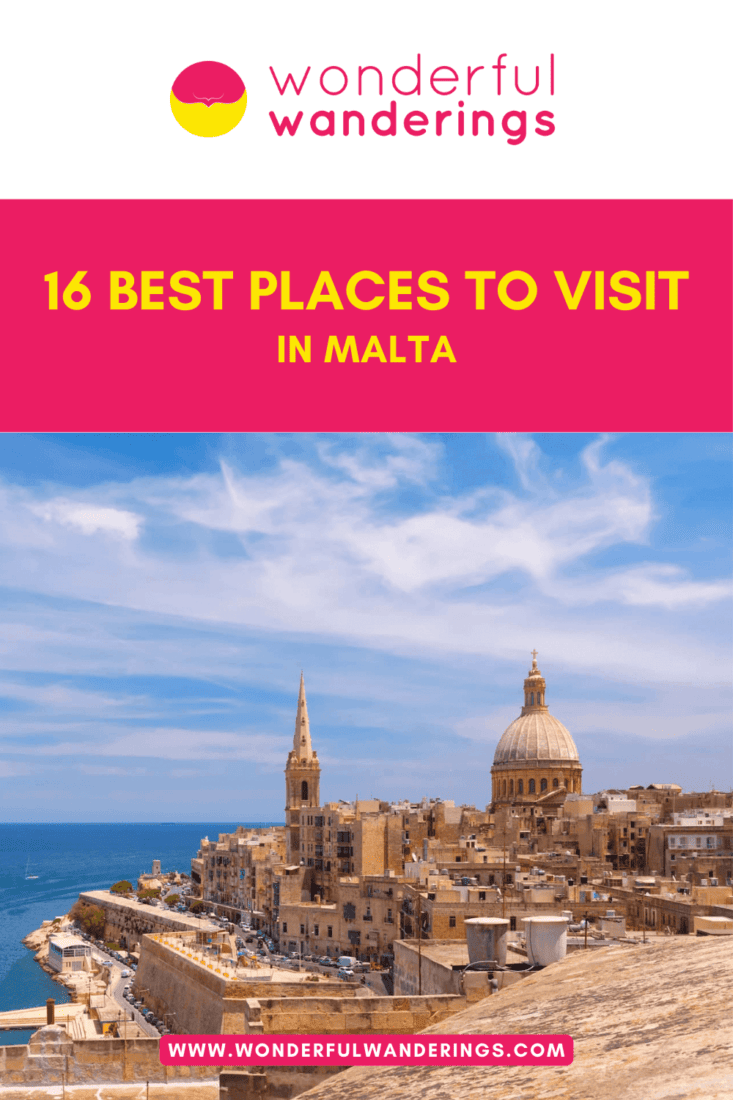
Valletta is the place to start in Malta, because it holds more of what people come for per square metre than anywhere else in the country. Valletta was laid out from nothing on a grid after the siege of 1565, its foundation stone set on 28 March 1566, and the whole fortified city is a UNESCO World Heritage Site you can walk end to end in under half an hour. The paid interiors are what fill the day: St John’s Co-Cathedral with its Caravaggio, the restored Grand Master’s Palace at €12.00 ($13, £10) for adults, and Fort St Elmo with the National War Museum at €10.00 ($11, £9), which is where Malta’s George Cross is displayed.

Allow two full days if you want the interiors, or one long day for the streets, the Upper Barrakka Gardens and the Saluting Battery, which fires at noon and 4pm. Valletta is 5 km (3.1 mi) from Malta International Airport and the TD4 Airport Direct bus runs straight to the city gate. Two things to plan around: the Grand Master’s Palace Throne Room is closed until further notice, and on days when the In Guardia re-enactment runs at Fort St Elmo, ordinary museum admission does not start until 12.00.
2. Mdina and Rabat
Mdina is the one place in Malta that feels medieval rather than baroque, and it is a half-day rather than a full one. Mdina is a walled city of roughly 400 by 300 metres on a ridge in the centre of the island, cars are banned inside the walls, and under 400 people live there, which is where the nickname the Silent City comes from. Entry to the streets costs nothing. Two paid museums are worth the stop: Palazzo Falson, a 13th-century house museum at €12.50 ($14, £11) for adults, and Palazzo Vilhena, now the National Museum of Natural History, at €5.00 ($5, £4).

Check the days before you go. Palazzo Falson opens Tuesday to Sunday, 10:00 to a 16:00 last entry, is closed on Mondays, and does not admit children under 6 at all, which catches families out. Rabat, immediately outside Mdina’s gate, holds St Paul’s Catacombs and is where most of Mdina’s day-trippers eat. Buses connect both to Valletta in 35 to 45 minutes, and the crafts units at the nearby Ta’ Qali Artisan Village are worth checking before you drive out, since many of them stand empty and the shops typically close at 4pm on weekdays and midday at weekends.
3. The Three Cities: Birgu, Senglea and Cospicua
The Three Cities give you Malta’s history without Valletta’s crowds, and they work as one destination rather than three. Birgu, also called Vittoriosa, was the Knights’ base from 1530 and the place that held through the Great Siege, and its Collacchio quarter still has the Knights’ own residences on it. The Inquisitor’s Palace is the standout interior at €6.00 ($7, £5) for adults, covering the tribunal chamber, the torture chamber and the prison complex of an institution that operated in Malta for over 224 years. Fort St Angelo at the tip of the peninsula charges €10.00 ($11, £9) and Heritage Malta suggests two hours for it.

Do not build the day around the Malta Maritime Museum. Heritage Malta has closed it for a full redevelopment with no reopening date announced, so the Birgu alternative is the Malta at War Museum, open Monday to Saturday 09:30 to 17:30 and closed every Sunday. Senglea adds the Vedette lookout over the Grand Harbour and Cospicua the bastions behind both. Reach all three by the harbour ferry from Valletta in about five minutes rather than driving 3 km (1.9 mi) around the water. One full day covers it, or a half day from Valletta.
4. Sliema and St Julian’s
Sliema and St Julian’s are where to stay rather than what to see, and together they hold most of Malta’s hotels, restaurants and nightlife. Sliema sits on a rocky peninsula directly across Marsamxett Harbour from Valletta, about 2 km (1.2 mi) away, and its promenade runs several kilometres along the water with the capital’s bastions in view the whole way. St Julian’s runs into it to the north and takes over after dark, with Paceville at its centre. Neither has a headline monument, which is the honest answer to why they appear on this list at all.

What they do have is position. The Sliema to Valletta ferry crosses in about five minutes for €3.00 ($3.30, £2.60) single, against roughly half an hour by road, and the TD3 Airport Direct bus reaches Sliema and St Julian’s in about 15 minutes. Swimming here is off rock lidos at Qui-si-Sana and the Tigné foreshore rather than sand. Three nights is a reasonable base length, with days spent elsewhere.
5. Marsaxlokk
Marsaxlokk is a working fishing village in Malta’s southeast and the place to go on a Sunday morning, when its market fills the waterfront. Marsaxlokk sits on its own bay about 35 km (21.7 mi) by road from Valletta, and its harbour is lined with the brightly painted traditional boats called luzzus, which are the reason half the photographs of Malta look the way they do. The seafront restaurants serve the morning’s catch the same day, and a long lunch is the correct way to spend the visit.

Half a day is enough, and a Sunday is worth arranging for, since that is when the full market runs rather than the smaller daily stalls. St Peter’s Pool, a natural rock swimming spot, is a short drive or taxi from the village and has no bus of its own. Bus routes 81 and 85 connect Marsaxlokk directly to Valletta in about an hour.
6. Qrendi and the prehistoric south
Qrendi is a small village that happens to sit beside two of the oldest free-standing buildings on earth. The Ħaġar Qim and Mnajdra temples stand together on the southern coast above the sea, date to the late Neolithic and are over 5,000 years old, and Heritage Malta sells them on one combo ticket at €10.00 ($11, £9) for adults with a visitor centre at the site explaining the construction and the solar alignments. Both are part of the Megalithic Temples of Malta World Heritage listing.

The same trip takes in the Blue Grotto at nearby Wied iż-Żurrieq, where small boats run into a sea cave and several smaller grottos, and a free public viewing platform covers the view for anyone skipping the boat. Morning light before about 11am gives the clearest colour in the water. Allow a full day for the temples, the grotto and the Dingli Cliffs above them, and take a car or a tour, because stitching these together by bus eats the day.
7. Mosta
Mosta is a one-sight town, and the sight is a very good one. The Rotunda of Mosta, formally the Sanctuary Basilica of the Assumption of Our Lady, carries one of the largest unsupported church domes in the world, and in April 1942 a German bomb pierced that dome during a service and failed to explode among the congregation. A replica of the bomb is displayed inside, and entry to the church is free.

An hour covers the Rotunda, which makes Mosta a stop rather than a destination on its own. Combine it with Mdina and Rabat, which are 15 minutes away by road, or with the Ta’ Bistra Catacombs on the edge of town. Mosta lies about 11 km (6.8 mi) from Valletta with direct buses taking 25 to 30 minutes.
8. Mellieħa
Mellieħa is where to base yourself for Malta’s beaches and for the Gozo ferry, and it stays more like a village than a resort. Mellieħa sits on a ridge in the north of the island about 16 km (9.9 mi) from Valletta, with the town centre inland and uphill from the water. Mellieħa Bay below it is Malta’s largest sandy beach, with water sports, restaurants and sunbed hire, and Golden Bay and Għajn Tuffieħa are a short drive west.

Popeye Village in Anchor Bay is the family draw, built on the surviving set of the 1980 film and now an open-air attraction with boat rides and shows. Its prices move with the season: adults and teenagers pay €25.00 ($27, £21) in high season to 30 September 2026 and €18.00 ($20, £15) in mid-season, which runs 1 to 31 May and 1 October to 5 November, with the site open daily 09:30 to 17:30. Two or three nights suits Mellieħa, and Ċirkewwa, where the Gozo ferry leaves, is 10 minutes up the road.
9. Victoria and the Cittadella, Gozo
Victoria is Gozo’s capital and the Cittadella above it is the reason to cross the channel. The Cittadella is an open public heritage site, free of charge and accessible around the clock all year, so its walls and the view across most of Gozo cost nothing at any hour, including after dark. Money changes hands only at the Cittadella Visitors’ Centre, whose combo ticket at €5.00 ($5, £4) for adults also covers the Nature Museum, the Old Prisons and the Gran Castello Historic House, and that ticket desk is closed on Mondays all year and on Wednesdays as well in January and February.

Gozo needs its own day at minimum and rewards two or three nights. Ġgantija at Xagħra is the island’s own World Heritage site, the earliest of Malta’s megalithic temples and older than Stonehenge, on a €10.00 ($11, £9) adult combo ticket that includes the Ta’ Kola Windmill next door. The Gozo Channel car ferry crosses from Ċirkewwa to Mġarr in about 25 minutes and charges the whole round trip on the Gozo side, €4.65 ($5, £4) for a foot passenger and €15.70 ($17, £13) for a car and driver. Gozo is also where self-catering makes most sense, since converted farmhouses with their own pools are the local speciality and are easiest to compare on Vrbo rather than through a hotel search.
10. Comino and the Blue Lagoon
Comino is a half-day, not a day, and in 2026 it comes with rules that did not exist a few years ago. The Blue Lagoon is a shallow turquoise bay between Malta and Gozo and the single most photographed spot in the country, and the island is a protected Natura 2000 site. Malta now caps Comino at a maximum of 12,000 visitors a day with no more than 4,000 on the beach and in the lagoon at any one time, entry is checked against a wristband at a tent staffed by Visit Malta and Team Blue Lagoon officials, and the rows of deckchairs that used to fill the ferry landing area have been cleared out of it.

The caps have not made the lagoon quiet. A June 2026 site visit counted 8 to 12 commercial boats docked around the lagoon at a time and a dozen kiosks still trading along it, and found the place noticeably calmer only before about 10am. Santa Marija Bay and San Niklaw Bay on the same island stay far emptier and are mostly reached by boat. There is no car ferry to Comino, so a passenger ferry or boat trip from Ċirkewwa, Mġarr or Sliema is the only way in, and the island has little shade and few facilities.
Which Maltese towns are worth a stop rather than a day?
Six more localities appear on Malta destination lists and none of them needs a day of its own, so they are listed below with the one reason to stop.

- Floriana borders Valletta and is the gateway you walk or drive through to reach it. The Argotti Botanic Gardens and the Msida Bastion Garden of Rest are its two quiet corners, and the Isle of MTV concert is held on its Granaries.
- Birkirkara is Malta’s largest town and a shopping and transport hub 5 km (3.1 mi) from Valletta rather than a sight. The San Anton Palace gardens at nearby Attard are free and worth the detour.
- Marsaskala is a residential seaside town in the southeast with St Thomas Bay nearby, used more by Maltese families than by visitors.
- Żejtun has a parish church whose origins go back to 1308 and a Roman villa site, and it sits between Valletta and Marsaxlokk.
- Żabbar is a large town behind the Three Cities with the Sanctuary of Our Lady of Graces and the Hompesch Gate, once the entrance through its defensive wall.
- Żebbuġ gave its name to a phase of Maltese prehistory after distinctive pottery was found there, and its collegiate parish church anchors the main square.
Which place in Malta is best in summer?
Mellieħa is the place to be in Malta in summer, because the beaches are the point of the season and it has the largest of them. Mellieħa Bay, Golden Bay and Għajn Tuffieħa are all within a short drive, the Gozo and Comino ferries leave from Ċirkewwa nearby, and the town sits high enough to catch a breeze that Valletta’s streets do not. Valletta and Mdina still work in July and August, but they work better early in the morning, since both are stone-walled and hold the heat.

Which place in Malta is best in winter?
Mdina is the place to be in Malta in winter, when the walled city is at its emptiest and walking it is genuinely pleasant rather than hot. Mdina’s paid interiors, Palazzo Falson and the National Museum of Natural History, are indoor options for a wet day, and Rabat next door has the catacombs. Valletta is the other winter answer, for the same reason: its museums, the Co-Cathedral and the Grand Master’s Palace are all inside. Note that some coastal cafes and beach facilities close between November and March, and every Heritage Malta site shuts on 1 January, Good Friday and 24, 25 and 31 December.

How long do you need in Malta?
Four to five days covers Malta’s main places at a workable pace, and seven lets Gozo have its own nights. A four-day plan runs Valletta over two days, Mdina and Rabat with Mosta on the third, and a Gozo day trip on the fourth. Five days adds either the prehistoric south around Qrendi or a beach day in the north. Seven days is the version that stops feeling rushed, with two or three nights on Gozo and a half day on Comino from there rather than as a separate trip from Malta.

Where should you stay in Malta?
Where you stay in Malta decides how much of this list you actually see, and three bases cover almost all of it. Sliema and St Julian’s have the most rooms and the harbour ferry to Valletta, Valletta itself puts six of these ten places within a walk or a short crossing, and Mellieħa suits a beach-led trip with the Gozo ferry up the road. Rooms in the Three Cities usually sit below Valletta prices for the same walking distance to the forts, so it is worth comparing Malta hotels on Booking.com across all three harbours before committing.

Transport is the other half of the decision. Buses reach every place on this list and the public transportation system in Malta guide sets out the 2026 fares, but Qrendi, the Dingli Cliffs and St Peter’s Pool are the ones a bus makes hard work of, and rates for a small car drop sharply outside July and August when you compare Malta car hire on DiscoverCars a few weeks ahead. Read up on driving in Malta before you commit to that, since the island drives on the left, and our guide to renting a car in Malta covers the paperwork and the insurance.
For the rest of the planning, the background numbers are on the facts about Malta page, what a day costs is broken down in our guide to why Malta is cheaper than most of Western Europe, the village feasts and concerts are listed under festivals in Malta, and the pastizzi and ftira to eat between stops are covered in the guide to traditional food to eat in Malta.
WonderfulWanderings Pro Tips
The 4 tips below come from checking each place on this list against Heritage Malta, Gozo’s Cultural Heritage Directorate, the attractions’ own operators and dated 2026 reporting, and each one changes how a day is shaped.

- Reach the Blue Lagoon before 10am or do not bother. Malta’s 2026 rules cap Comino at 12,000 visitors a day and 4,000 in the lagoon at once, and entry is checked against a wristband at the landing area. A June 2026 site visit found the lagoon calmer only until around 10am, after which 8 to 12 commercial boats and a dozen kiosks were trading along it.
- Do not plan a Birgu day around the Maritime Museum. Heritage Malta has closed it for a full redevelopment and has announced no reopening date. The Inquisitor’s Palace at €6.00 and Fort St Angelo at €10.00 are open, and the Malta at War Museum is open Monday to Saturday 09:30 to 17:30 but closed every Sunday.
- Mdina turns families away on two counts. Palazzo Falson is closed on Mondays and does not admit children under 6 at all, even accompanied. Children aged 6 to 12 go in free with an adult, and the National Museum of Natural History across the square charges €2.50 for that age group.
- Check which Popeye Village season you are booking. Adults and teenagers pay €25.00 in high season up to 30 September 2026 and €18.00 in mid-season, 1 to 31 May and 1 October to 5 November, with the site open daily 09:30 to 17:30. The gap is worth a week’s shift in dates for a family of four.
About the author. This guide is written and maintained by the Wonderful Wanderings editorial team. Wonderful Wanderings was founded in 2012 by Sofie Couwenbergh, and the team covers Malta for independent travellers, including the hotels, farmhouses, car hire and tours worth booking across Malta, Gozo and Comino, updating this page when tickets, closures and access rules change.