 EN
EN
 Nederlands
 Français
Malta drives on the left, a rule British colonial rule left behind, and that single fact catches more visitors off guard than anything else on the road. Add narrow, winding village streets, a shortage of parking in Valletta and a ferry crossing if the plan includes Gozo, and a rental car in Malta needs a bit of preparation before it needs a driver.
Does Malta drive on the left or right?
Malta drives on the left, the same side as the United Kingdom, Ireland and Cyprus. The rule dates back to British rule, which ended in 1964, and it means the driver’s seat sits on the right-hand side of the car. Drivers arriving from a right-hand-drive country need a lap or two to stop reaching for the door instead of the gearstick, and roundabouts are where that adjustment gets tested first: traffic flows clockwise, so give way to your right, not your left. Malta, Gozo and Comino all follow the same rule, so nothing changes once a ferry crossing is involved.
What are the roads like in Malta?
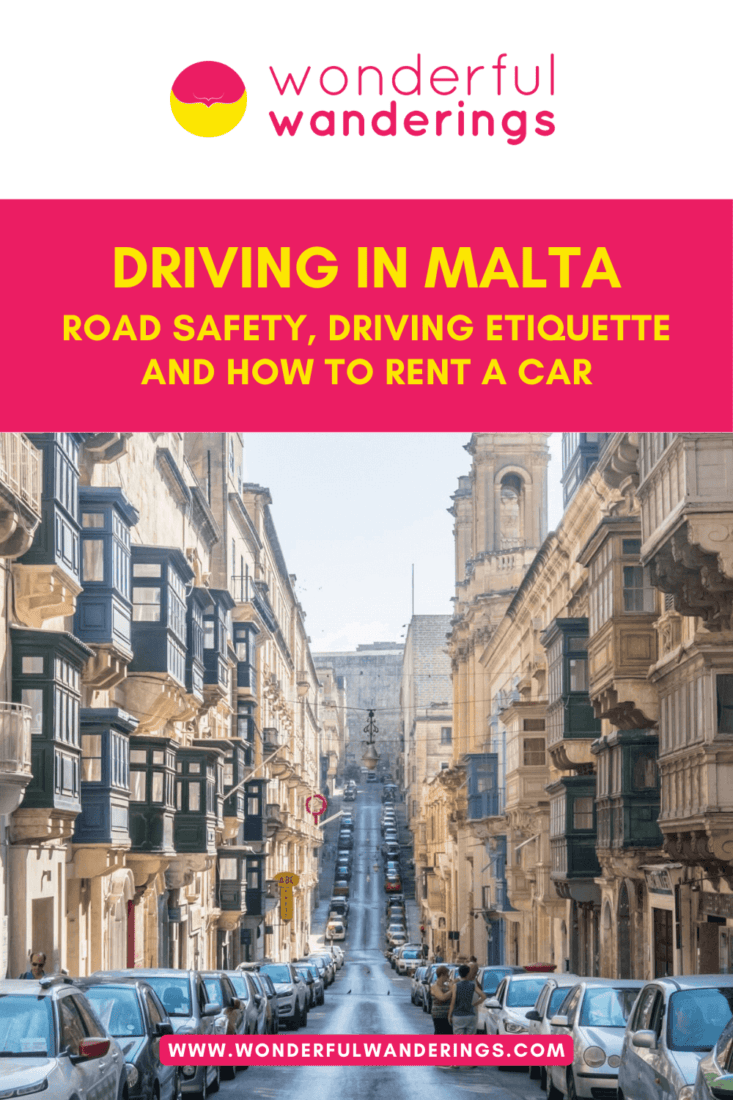
Malta’s roads are mostly narrow, and many village streets were laid out for carts long before cars existed. Main routes between towns are two lanes in each direction and reasonably well kept, but they stop short of being motorways. Malta has no motorways at all, so even the busiest cross-island roads carry roundabouts, traffic lights and the occasional pothole rather than a continuous dual carriageway. Rural roads narrow further still, with dry stone walls close enough on both sides to make a wing mirror the first casualty of an unfamiliar bend. Because the whole island is small, most drives between towns take under an hour, so there is rarely a reason to rush.
Local driving style adds its own pressure. Maltese drivers tend to change lanes decisively and follow closely, so a defensive approach, a wider following distance and patience at roundabouts go a long way. Speed cameras are common on main roads, and fines for speeding start in the hundreds of euros.
What is the speed limit in Malta?
The speed limit in Malta is 50 km/h (31 mph) in built-up areas and 80 km/h (50 mph) on the open road, with some village centres and traffic-calmed zones posted lower, down to 30 km/h (19 mph). Electronic signs mark a handful of stretches where the limit changes with the weather, so it pays to watch the signage rather than assume the standard limit applies.
What do Malta’s road signs and roundabout rules look like?
Malta’s road signs follow the same international system used across the EU: triangular warning signs, round regulatory signs and rectangular information signs. A handful of local signs are worth learning before setting off, including ones marking blind pedestrians, animal crossings and stretches where the normal priority rule is reversed and oncoming traffic has right of way. At roundabouts, traffic already circulating has priority, so give way to your right on approach and signal before exiting, the same clockwise pattern as in the UK. Not every driver signals reliably before changing lanes, so treat every gap in traffic as a car that might move into it without warning.
Overtaking calls for the same caution. Check mirrors and blind spots, never overtake near a junction, bend or dip where visibility is limited, and pass one vehicle at a time rather than stringing several passes together around a blind curve. Leave buses and other wide vehicles alone on the narrowest village roads, where there simply isn’t room to pass safely.
What are Malta’s most scenic drives?
A handful of named routes reward the drive itself, not just the destination at the end of it. Triq l-Imdina in Żebbug runs between green fields with views across to Mdina’s walls. Triq il-Panorama in Qrendi follows the southern coast past benches, sunset spots and views of the uninhabited islet of Filfla. Triq Wied Musa in Mellieħa is one of the straightest roads on the island, linking the beach at Għadira and the ferry terminal at Ċirkewwa. The rebuilt coast road running along the north links several of these in one drive, with the sea on one side and cliffs on the other. If you are choosing the stops rather than the roads between them, our guide to the top places to visit in Malta sets out what is worth the drive.
How do you park in Valletta?
Parking in Valletta is genuinely difficult, and driving into the city adds a congestion charge on top of the search for a space. Valletta has run a Controlled Vehicular Access (CVA) scheme since 2007: cameras read every number plate crossing the city boundary and bill the vehicle for the time it spends inside. On weekday mornings the first 30 minutes are free, and the charge afterwards is small, roughly €0.82 ($0.89, £0.70) an hour, but an unregistered visit that isn’t paid can turn into a fine well into the hundreds of euros. Because of this, many visitors park outside the city walls, at Floriana or one of the park-and-ride areas, and walk or bus in rather than hunting for a space inside Valletta itself. The same narrow-streets problem applies in Mdina and other old town centres, so folding in the wing mirrors before easing down a village lane is standard practice, not overcaution.
Beyond Valletta’s congestion charge, ordinary parking rules apply island-wide. Most street parking is free, including overnight, as long as the car sits between the white lines and clear of double yellow lines and disabled bays without the matching blue badge. A handful of areas run time-restricted parking, where a paper time disc showing your arrival time, kept in every rental car, has to sit visible on the dashboard. A Malta car rental company will usually flag mirror and bumper damage at drop-off, so a quick set of photos at pickup protects against a disputed claim later.
How do you get to Gozo by car?
Getting to Gozo with a car means a short ferry crossing, since no bridge connects the two islands. The Gozo Channel ferry runs between Ċirkewwa on Malta’s northern tip and Mġarr on Gozo, takes about 25 minutes and operates around the clock, roughly every 30 to 45 minutes depending on the time of day. Cars are not charged, or checked in, until the Gozo side: you simply drive on at Ċirkewwa, and the standard return fare for a car and driver is paid when you board at Mġarr for the trip back. Foot passengers pay a small fare each way instead. Queues at Ċirkewwa can run long over a weekend or public holiday, so it’s worth planning ahead and booking Gozo ferry tickets and tours in advance.
Comino, the small island between Malta and Gozo, has no car access at all. Visitors reach the Blue Lagoon by a separate passenger ferry or boat trip from Ċirkewwa, Mġarr or Sliema, leaving the car behind on Malta or Gozo.
Where do you fill up, and what does fuel cost in Malta?
Petrol stations are easy to find across Malta and Gozo, and many operate 24 hours a day. Regular staffed hours generally run Monday to Friday from 6 am to 5 pm and Saturday mornings, with every station switching to unattended self-service outside those hours and on Sundays and public holidays. Malta has some of the cheapest fuel in the EU: in 2026 unleaded 95 has averaged around €1.34 ($1.46, £1.15) a litre and diesel around €1.21 ($1.32, £1.04), according to European fuel-price trackers. Pump prices move month to month, so treat those as a guide rather than a quote. LPG is available at fewer stations, mostly on the main island.
What is the blood alcohol limit for driving in Malta?
The legal blood alcohol limit for most drivers in Malta is 0.5 grams per litre (0.05%). Professional, commercial and novice drivers face a stricter 0.2 g/l limit, and bus and coach drivers are held to zero. Malta lowered the general limit from the older 0.8 g/l standard under its National Alcohol Policy, so an unfamiliar traveller relying on an older account of “0.8” or “0.08%” is working from a rule that no longer applies. Penalties for driving over the limit include fines, licence suspension and, for repeat or serious cases, imprisonment.
Do you need an International Driving Permit to drive in Malta?
A valid driving licence from your home country is enough to drive in Malta if it’s printed in English; if it isn’t, Malta also requires an International Driving Permit (IDP) alongside it, not instead of it. The minimum age to drive in Malta is 18, though rental companies typically require drivers to be at least 21 and to have held a licence for a full year, sometimes charging a young-driver surcharge under 25.

What should you know before renting a car in Malta?
A compact car is the easiest choice for Malta’s narrow streets and tight parking, and it is worth booking before arrival rather than on the spot in high season. The full breakdown of companies, deposits and insurance add-ons lives on the Malta car rental guide, which covers those details in depth so this page won’t repeat them, or compare rental car prices in Malta directly. In short: photograph the car before driving off, check whether the policy is full-to-full on fuel, and expect a hold on a credit card for the security deposit.
Anyone who would rather not drive at all still has options. Malta’s bus network reaches most towns from Valletta, and taxis are a safe, if not especially cheap, way to cover shorter hops. Avoiding city-centre parking altogether is often the easier holiday, so it’s worth looking to compare hotels in Malta close to a bus route or within walking distance of Valletta.
Is it safe to drive in Malta?
Malta’s roads are reasonably safe for an attentive, unhurried driver, even though local driving habits take some getting used to. Main roads and the roundabouts on them are the sections that call for the most attention: give way to traffic already circulating, signal early and expect other drivers to pull out with less warning than you’d get at home. Seat belts are mandatory in every seat, mobile phone use without a hands-free system is illegal, and pedestrian crossings have priority, especially in Valletta, Sliema and the other busy coastal towns.
Malta’s single emergency number is 112, free from any phone including a mobile with no SIM card, and it connects to ambulance, fire and police for any life-threatening situation or collision with injuries. For a minor accident with no injuries, report it to the local police traffic section rather than calling 112, and exchange insurance and licence details with the other driver before leaving the scene. Keep your driving licence, insurance documents and rental agreement in the car at all times, since police can ask to see them during a routine stop.
Malta’s road network covers roughly 3,000 km (1,864 mi), and quality varies more than the island’s small size suggests. Main roads and the routes into Valletta, Sliema and St Julian’s are well kept and well lit; rural lanes and older village streets can be uneven, poorly lit or both, which is worth remembering before planning a night drive to a quieter part of the island. Scooters and mopeds move quickly through gaps in traffic in the busier towns, so checking twice before pulling out of a junction is worth the extra second.
Common questions about driving in Malta
Is it easy to drive in Malta?
No, driving in Malta is not easy for anyone unused to left-hand traffic, and the narrow, congested streets in older towns add a second layer of difficulty on top of that. It is manageable with caution, a compact car and a realistic amount of extra time built into the day, which is why many first-time visitors choose buses or a guided tour instead for at least part of the trip.
Do you need a car to get around Malta?
No, a car is not essential to see Malta, since buses connect Valletta to every major town and ferries cover Gozo and Comino. A car earns its cost on an itinerary that includes several rural sights or an early start to beat the crowds at a spot like the Blue Grotto, where public transport runs less often.
Can you drive from Malta to Gozo without taking the ferry?
No, there is no bridge or tunnel between Malta and Gozo, so a car ferry is the only way to bring a vehicle across. Foot passengers have the same restriction in reverse: a car parked in Gozo can’t be reached on a same-day foot crossing without also paying the car fare back.
WonderfulWanderings Pro Tips
The 4 tips below come from checking Malta’s road rules, charges and ferry fares against Transport Malta, Gozo Channel and current fuel trackers, and each one costs money to get wrong.
- Do not queue to pay on the way out to Gozo. Cars drive onto the boat at Ċirkewwa without paying or checking in at all, and the fare for a car and driver is collected only when you board at Mġarr to come back. The crossing takes about 25 minutes, foot passengers pay their own smaller fare, and the queue at Ċirkewwa is the part that runs long on a weekend or public holiday.
- Work to a 0.5 g/l blood alcohol limit, not the 0.8 that older accounts quote. Malta lowered the general limit under its National Alcohol Policy, and professional, commercial and novice drivers are held to 0.2 g/l, with zero for bus and coach drivers. Penalties run from fines to licence suspension.
- Register a drive into Valletta before the cameras bill you. The Controlled Vehicular Access scheme reads every number plate crossing the city boundary, and while the first 30 minutes on a weekday morning are free and the charge afterwards is roughly €0.82 an hour, an unpaid visit turns into a fine well into the hundreds of euros.
- Fill up between 6am and 5pm on a weekday if you would rather not use an unattended pump. Maltese stations keep staffed hours Monday to Friday and on Saturday mornings, then switch to self-service overnight, on Sundays and on public holidays. Fuel itself is among the cheapest in the EU, averaging around €1.34 a litre for unleaded 95 in 2026.
About the author. This guide is written and maintained by the Wonderful Wanderings editorial team. Wonderful Wanderings was founded in 2012 by Sofie Couwenbergh, and the team covers Malta for independent travellers, including the car rental companies, tours and hotels worth booking, updating pages like this one when road rules, fares and prices change.