 EN
EN
 Nederlands
 Français
Malta has no medieval castle of the drawbridge-and-turret kind, so the sites that fill castle lists are bastioned forts, fortified palaces and coastal watchtowers, most of them raised by the Order of St John between 1530 and 1798. Ten of them are open to visitors, and each entry below gives the current adult ticket, the day it shuts and what you actually walk through inside. Almost all of them ring the Grand Harbour or sit inside Mdina, which is why a single base covers this list and most other attractions to visit in Malta at the same time.
Are there any real castles in Malta?
No true castle survives in Malta, and the buildings sold as castles fall into three groups instead. The first group is bastioned artillery forts such as Fort St Angelo and Fort St Elmo, built low and angular to absorb cannon fire rather than to look imposing. The second is fortified palaces such as the Grand Master’s Palace and Palazzo Falson, which are grand houses rather than defensive buildings. The third is the coastal watchtower, a single stone box with a garrison of two or three men, and a watchtower is not a castle however often a list counts it as one.
1. Fort St Angelo, Birgu
Fort St Angelo is the oldest fortification on the Grand Harbour and the one site on this list with a genuine medieval core. Fort St Angelo appears in medieval records as Castrum Maris, the Castle by the Sea, and served as the seat of the Nava family under Aragonese rule in the 14th century. The Knights Hospitaller arrived in Malta in 1530, settled at Birgu and made the fort their headquarters, rebuilding it hard enough that it held through the Ottoman siege of 1565. The British Army and Navy used it as a base until 1979, and since 1998 the Sovereign Military Order of Malta has held the upper part under a 99-year agreement with the Maltese government.

Heritage Malta runs visits and charges €10.00 ($11, £9) for adults, €6.00 ($7, £5) for youths aged 12 to 17, seniors over 60 and students, and €4.00 ($4, £3) for children aged 6 to 11, with infants free. Heritage Malta recommends allowing two hours. Buses and cabs reach Birgu, and a ferry and water taxis cross from Valletta when the weather allows.
2. The Grand Master’s Palace, Valletta
The Grand Master’s Palace is the most visited site Heritage Malta runs, drawing around 300,000 people a year to St George’s Square. The palace was the first building the Knights put up in their new capital, later served as the British Governor’s residence, housed Malta’s first constitutional parliament in 1921, and is now the seat of the Office of the President. A long restoration reopened more than 85 percent of the building’s footprint, including the Uccelliera, the Piano Nobile corridors and the State Rooms, and put the Armoury back in its original hall, the former Parliament Chamber. Inside the State Rooms hang Matteo Perez d’Aleccio’s painted account of the Great Siege of 1565, and the Armoury holds the armour of Grand Masters Alof de Wignacourt and Jean de Valette alongside captured Ottoman weapons.

Admission covers the State Rooms and the Armoury together at €12.00 ($13, £10) for adults, €10.00 ($11, £9) for youths aged 12 to 17 and seniors over 60, and €8.00 ($9, £7) for children aged 6 to 11. Two closures matter before you go. The Throne Room is shut until further notice, and the State Rooms open only from 1.30pm on 25 September, 28 October, 18 November and 2 December 2026, with the Armoury the only part open before that.
3. Fort St Elmo and the National War Museum, Valletta
Fort St Elmo is the star-shaped fort at the tip of the Valletta peninsula and the single most fought-over building in Malta. Fort St Elmo went up in 1552 to a design by the military engineer Pietro Prato, took the full weight of the Ottoman assault in 1565, and held for a month before surrendering on 23 June. Its later history stayed just as loud: on 11 June 1940 the fort took the first aerial bombardment ever dropped on the islands. The National War Museum inside runs across seven sections and 7,000 years, and its named exhibits include the Gloster Sea Gladiator N5520 “Faith”, Roosevelt’s jeep “Husky” and the George Cross awarded to Malta.

Adults pay €10.00 ($11, £9), youths aged 12 to 17, seniors over 60 and students pay €7.50 ($8, £6), and children aged 6 to 11 pay €5.50 ($6, £5). The First World War display in Section 4 is closed until further notice. On days when the In Guardia re-enactment runs in the fort, ordinary admission does not start until 12.00, so an early morning arrival on a show day gets you nowhere.
4. The Cittadella, Victoria, Gozo
The Cittadella is free to walk into and open around the clock, which makes it the cheapest fortified site in the Maltese islands. The Cittadella crowns the hill above Victoria on Gozo, was rebuilt into its present bastioned form by the Knights across the 16th and 17th centuries, and sheltered the island’s population during raids. Gozo’s Cultural Heritage Directorate is explicit that the fortress is an open public heritage site, free of charge all year, and it suggests a walk around the walls after sunset.

Money only changes hands at the Cittadella Visitors’ Centre, whose combo ticket also covers the Nature Museum, the Old Prisons and the Gran Castello Historic House. That ticket costs €5.00 ($5, £4) for adults, €3.50 ($4, £3) for seniors, youths and students, and €2.50 ($3, £2) for children aged 6 to 11, with under-6s free. Opening runs 09:00 to 17:00 with last admission at 16:30, closed on Mondays from March to December and closed on Mondays and Wednesdays in January and February. The Gozo Museum of Archaeology has shut ahead of a planned new Gozo Museum, though its shop still sells Ħal Saflieni Hypogeum tickets and the combo price is unchanged.
5. Palazzo Falson, Mdina
Palazzo Falson is a private medieval house in Mdina turned into a museum, and its oldest section dates to the 13th century. Palazzo Falson belonged to the noble Falsone family before Captain Olof Frederick Gollcher, an artist, soldier and collector, bought it in 1927 and lived there until his death in 1962. His collections still fill the rooms, arranged around an inner courtyard in the Sicilian-Spanish style, and the ticket price includes an audio guide in Maltese, English, Italian, French, German and Spanish.

Adults pay €12.50 ($14, £11) and students, seniors and ISIC or ICOM cardholders pay €6.00 ($7, £5). Children aged 6 to 12 go free with an adult, and children under 6 are not admitted at all. Opening is Tuesday to Sunday, 10:00 to a 16:00 last entry, closed Mondays and closed on Good Friday, Easter Sunday, Christmas Day and New Year’s Day. The building is grade A listed and has no lift, so wheelchair access covers the courtyard, refectory, armoury, kitchen and studio on the ground floor only. Gustav Café on the roof keeps its own hours, Tuesday to Sunday 10:30 to 16:00.
6. Casa Rocca Piccola, Valletta
Casa Rocca Piccola is the only privately owned palace in Valletta that opens its doors to visitors, and the de Piro family still live in it. Casa Rocca Piccola was built for Don Pietro La Rocca, an Admiral and Knight of Malta, more than 400 years ago, and the family has been in Valletta for almost 350 years. Twelve rooms on the piano nobile are open out of more than 50 in the house, along with the garden and a network of tunnels cut from the rock beneath it, where over 100 people sheltered from the bombing in the Second World War.

Live guided tours in English run 45 minutes and start every hour on the hour, with pre-booking recommended because a full tour cannot take anyone else. An audio self-tour on the house’s own app covers English, French, German, Italian and Spanish, printed guides run to 12 languages, and the ticket also carries 10 percent off at La Giara restaurant in the old kitchens. Book direct through the house rather than turning up, since tour slots and opening times shift with family and private events.
7. Fort Rinella, Kalkara
Fort Rinella exists for one object: the Armstrong 100-ton gun, a rifled muzzle-loader of 17.72 inches that fired a one-ton shell three miles (4.8 km) and could punch through 21 inches of wrought-iron ship armour. Fort Rinella and the Napier of Magdala Battery in Gibraltar hold the only two survivors of the four such guns ever made, which is a stronger reason to go than anything the Victorians built around them. Fondazzjoni Wirt Artna, a voluntary heritage organisation, runs the site and its Soldiers of the Queen gallery on the British Victorian army, and the fort keeps its bent entrance, dry ditch, caponiers, magazines and the only working Guthrie bridge of its type anywhere.

Opening is Monday to Saturday, 09:30 to 17:30 with last admission at 17:00, and the fort is closed every Sunday. It also shuts on 24, 25 and 31 December, 1 January, Good Friday and Easter. Admission includes a guided tour led by staff in Victorian gunner’s dress, an audio guide and the Soldiers of the Queen exhibition, and bus route 3 from Valletta stops outside the main gate every half hour from Monday to Saturday.
8. Palazzo Vilhena, Mdina
Palazzo Vilhena is the French Baroque palace inside Mdina’s gate, and it now houses the National Museum of Natural History. Palazzo Vilhena was built between 1726 and 1728 for Grand Master António Manoel de Vilhena, to a design by the French military engineer Charles François de Mondion, on the site of the Università where Mdina’s nobility had governed the city. Mondion’s work brought French Baroque into a city that had been almost entirely medieval until then, which is why the palace looks so unlike everything around it.

Adults pay €5.00 ($5, £4), youths aged 12 to 17, seniors over 60 and students pay €3.50 ($4, £3), and children aged 6 to 11 pay €2.50 ($3, £2), with infants free. That makes it the cheapest ticketed palace in this list. Heritage Malta runs quiet-space sessions for autistic visitors here on Tuesdays from 13:00 to 16:00, and parts of the building cannot be fully reached by anyone with a mobility impairment.
9. San Anton Palace gardens, Attard
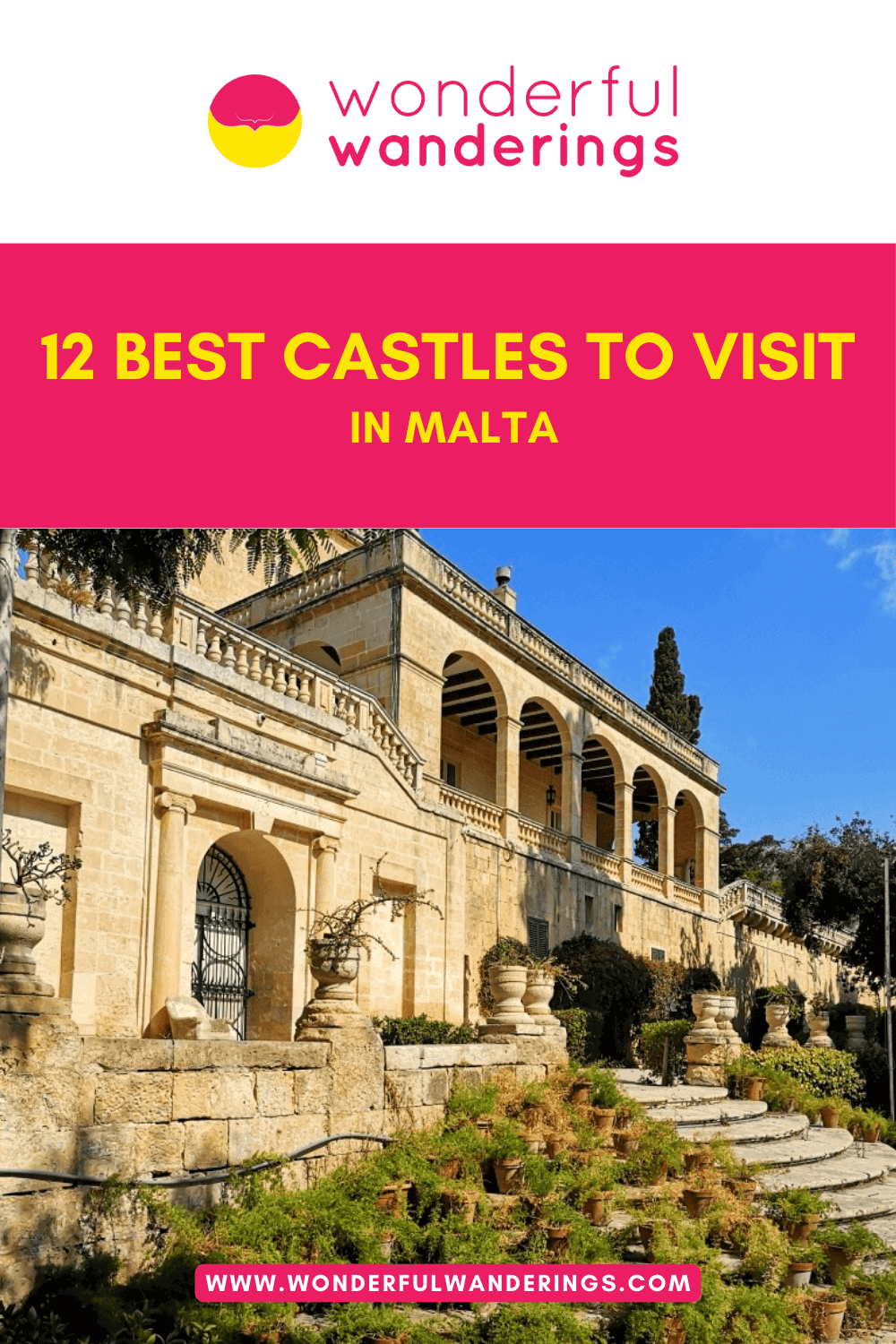
San Anton Palace is the President of Malta’s official residence and stays closed, but its gardens are free and have been public for well over a century. Grand Master Antoine de Paule built San Anton Palace as a country villa in the 1620s and enlarged it into a palace with gardens after his election in 1623, choosing a site near the middle of the island at Attard. The President’s office dates public access to the gardens to 1885, so if you are working from an older write-up that says 1882, that is the figure to drop.

Inside the walls the gardens keep water fountains and exedrae set at the crossings of geometric walkways, mature trees, an aviary and citrus groves whose fruit was traditionally given to visiting dignitaries. Entry costs nothing and no ticket exists, and an hour covers the paths at a slow pace. The Kitchen Garden café and a children’s play area sit across the road.
10. Casa Leoni and the Romeo Romano Gardens, Santa Venera
Casa Leoni is closed to visitors, and the reason to go to Santa Venera is its baroque garden instead. Casa Leoni was built in 1730 as another summer residence for Grand Master António Manoel de Vilhena, served as a command base for Maltese insurgents during the blockade of 1798 to 1800 and later as a British governor’s residence, and today holds government offices. Its garden was opened to the public and renamed the Romeo Romano Gardens.

The gardens cover roughly 4,000 sq m (43,000 sq ft), cost nothing and open daily from 06:30 to 20:00. Inside are a children’s playground, decking areas, a citrus orchard and a restored 19th-century water mill and reservoir, with resurfaced paths that make the whole garden walkable. Half an hour is enough unless you have children with you.
Malta’s forts and palaces you cannot go inside
Four of the buildings that appear on Malta castle lists are shut, and turning up at any of them wastes an afternoon. The four are listed below with their current status.

- Verdala Palace, Buskett. Verdala Palace has been the President of Malta’s summer residence since 1987 and is closed except for the annual August Moon Ball, held in aid of the Malta Community Chest Fund. Girolamo Cassar designed it in 1586 for Grand Master Hugues Loubenx de Verdalle, with pentagonal turrets on each corner, and the exterior can be seen from the surrounding Buskett Gardens.
- Fort Ricasoli, Kalkara. Fort Ricasoli is the largest fort in Malta and is not open to the public. Most of it is leased to the Malta Film Commission and it doubled as Rome in “Gladiator”, Troy in “Troy”, Alexandria in “Agora” and Toulon in “Napoleon”, while the fabric itself remains mostly intact but dilapidated. Restoration plans were approved in 2019.
- Fort Chambray, Għajnsielem, Gozo. Fort Chambray is a mid-18th-century fort now part residential development and part building site, with no public interior access. Europa Nostra placed its British Barracks on the list of Europe’s 7 Most Endangered heritage sites for 2026 after Maltese authorities approved their demolition, and Din l-Art Ħelwa is campaigning to save them.
- Fort Manoel, Manoel Island. Fort Manoel is closed to general visits while it waits on redevelopment, and filming closes it further at short notice. Free open days with guided tours in English and Maltese are announced a few times a year, and the footpath around the headland gives the clearest view of it in between.
Is there a Mdina Castle in Malta?
No building called Mdina Castle exists, and any list that names one has invented it. Mdina is a walled city rather than a castle, roughly 400 by 300 metres of medieval and baroque streets on a ridge in the middle of the island, and its landmarks are Mdina Gate, St Paul’s Cathedral, Palazzo Vilhena and Palazzo Falson. Cars are banned inside the walls, which is where the nickname the Silent City comes from.

The same correction applies to Malta’s coastal watchtowers. Structures such as the Wignacourt Tower in St Paul’s Bay and the Red Tower above Mellieħa are single fortified towers built to spot ships, several of them now cared for by the heritage organisation Din l-Art Ħelwa, and calling one a castle inflates a guardhouse into a fortress.
Which castles in Malta have the best views?
Fort St Angelo gives the widest view in the Maltese islands, because it sits at the point of the Birgu peninsula with Valletta on one side and the Three Cities on the other. Fort St Elmo looks the opposite way across both Marsamxett and the Grand Harbour from the tip of Valletta. The Cittadella beats both for range rather than drama, since its walls stand high enough over Victoria to take in most of Gozo, and it costs nothing to walk them at any hour.
Which Malta forts host festivals?
Fort St Elmo and Fort St Angelo both host annual events, and the events are worth timing a visit around. Fort St Elmo stages the In Guardia re-enactment, a costumed drill display in the fort’s parade ground that pushes ordinary museum admission back to 12.00 on show days. Fort St Angelo anchors BirguFest, when the streets of Birgu below it are lit by candles alone. Mdina’s medieval festival fills the streets of the old city rather than any single building. Dates for all three shift each year, so check them against the wider calendar of festivals in Malta before booking.
Where to base yourself for Malta’s forts and palaces
Valletta and Birgu put six of these ten sites inside a 20-minute walk or a short harbour ferry, which is why they are the two bases that save the most time. Valletta covers the Grand Master’s Palace, Fort St Elmo and Casa Rocca Piccola on foot, and the harbour ferry reaches Fort St Angelo in Birgu in minutes. Mdina adds Palazzo Falson and Palazzo Vilhena in one walled square kilometre, and Gozo needs its own day for the Cittadella. Rooms in the Three Cities tend to sit below Valletta prices for the same walking distance to the forts, so it is worth comparing Malta hotels on Booking.com across both harbours before choosing.
Fort Rinella, Fort Ricasoli, Fort Chambray and the Romeo Romano Gardens all sit away from the walkable core. Buses reach Fort Rinella and Santa Venera, but stitching those into a single day works better on four wheels, and rates for a small car in Malta drop sharply outside July and August when you compare Malta car hire on DiscoverCars a few weeks ahead. Between forts, the harbour ferries and the island’s buses cover most of the rest, and our guide to transportation in Malta sets out how the fares work. Save the pastizzi and the ftira in the streets below the bastions for the separate guide to local food in Malta, and read the country page on Malta for how the three islands fit together.
WonderfulWanderings Pro Tips
The 4 tips below come from checking each site against Heritage Malta, Gozo’s Cultural Heritage Directorate and the forts’ own operators in 2026, and each one decides whether a visit works at all.
- Check the Grand Master’s Palace closure dates before buying a ticket. The State Rooms open only from 1.30pm on 25 September, 28 October, 18 November and 2 December 2026, and the Armoury is all you get before then. The Throne Room is closed until further notice regardless of the date.
- Do not pay to see the Cittadella. The fortress on Gozo is an open public heritage site, free of charge and accessible around the clock all year. The €5.00 combo ticket buys only the Visitors’ Centre, the Nature Museum, the Old Prisons and the Gran Castello Historic House, and it is not sold on Mondays.
- Arrive at Fort St Elmo after noon on In Guardia days. Regular admission to the fort and the National War Museum starts at 12.00 whenever the re-enactment runs, so a 9am arrival on a show day gets you a closed gate. The First World War display in Section 4 is also shut until further notice.
- Plan around the six days every Heritage Malta site is closed. All of them shut on 1 January, Good Friday and 24, 25 and 31 December, and last admission everywhere is 30 minutes before closing time. Fort Rinella, which is not Heritage Malta, adds Easter Sunday and every Sunday of the year.
About the author. This guide is written and maintained by the Wonderful Wanderings editorial team. Wonderful Wanderings was founded in 2012 by Sofie Couwenbergh, and the team covers Malta for independent travellers, including the forts, palaces, tours and hotels worth booking around the Grand Harbour and on Gozo, updating this page when tickets, opening days and closures change.