 EN
EN
 Nederlands
 Français
Go to Prague first, then Český Krumlov and Kutná Hora, and if you have more than a week add Brno and Olomouc for Moravia and Karlovy Vary for the spa towns. That answers the question for most trips. Czechia is small enough that everything on this page is within four hours of Prague by train or bus, and its historic centres survived the 20th century largely intact, which is why the country has 17 UNESCO World Heritage sites for a population of 10.9 million. The 16 places below are ranked by how much a visitor gets out of them, not by population, and the last four are honestly labelled as working cities rather than destinations. Czechia uses the Czech koruna, not the euro, so every price is in koruna first, converted at the rate of 10 September 2026.
One planning rule matters more than the rest. Prague absorbs almost all Czech tourism, so anywhere else you go will be cheaper, quieter and more Czech, and a second base in Moravia is worth more than a fourth day in Prague.
Where to go in Czechia
The 16 destinations in Czechia are ranked below, with the first six covering almost every trip.

- Prague. Prague is the first stop on almost every Czech trip and it earns it: a medieval bridge, the largest ancient castle complex in the world, an astronomical clock from 1410 and a historic centre on the UNESCO list since 1992. Give it three days. It is also the most expensive place in the country by a wide margin, and its centre is the one place in Czechia where you can be overcharged. Our guides to Prague’s bars and to the city’s attractions cover it properly.
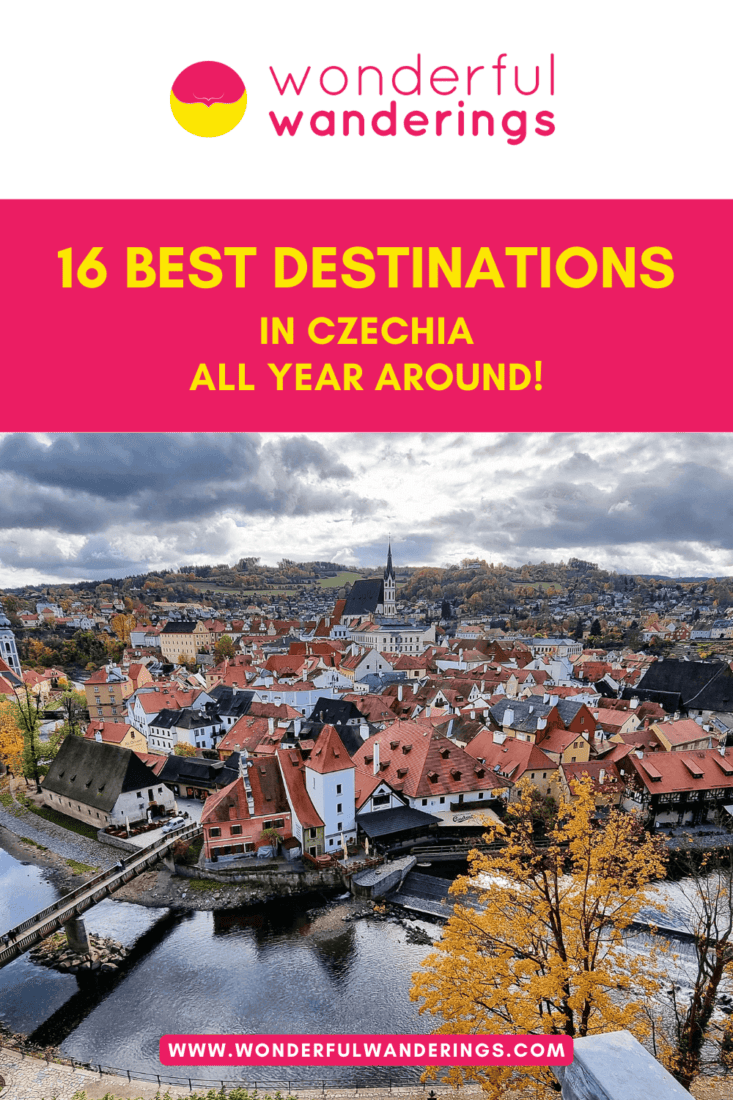
- Český Krumlov. Český Krumlov is a small South Bohemian town inside a hairpin bend of the Vltava, with the country’s second largest castle complex above it, UNESCO-listed since 1992. Its Baroque theatre is one of the most completely preserved 18th-century theatres anywhere, machinery and all. It is 175 km (108.7 mi) south of Prague and it is best seen as an overnight, because the day-trip coaches own it between eleven and four.
- Kutná Hora. Kutná Hora was the silver-mining town that funded medieval Bohemia and is on the UNESCO list, added in 1995, for St Barbara’s Church and the Cathedral of Our Lady at Sedlec. Most visitors come for the Sedlec Ossuary, the chapel decorated with the bones of some 40,000 people. The ossuary now sells timed tickets that must be booked online for a specific date and time, at CZK 220 (about €9.05, $10.55, £7.80) for an adult, with the cathedral a separate CZK 220, St James’s Church CZK 100 and St Anne’s CZK 50. It is an hour from Prague by train and no other day trip in the country matches it.
- Brno. Brno is the capital of Moravia and the second largest city, and it is a university town rather than a tourist town, which means lower prices and shorter queues. It holds Villa Tugendhat, Mies van der Rohe’s UNESCO-listed house of 1930, the second largest ossuary in Europe under the Church of St James, and Špilberk Castle. Its cathedral bells ring noon at 11am, a habit dating from the Swedish siege of 1645.
- Olomouc. Olomouc has the second largest heritage-protected area in the country after Prague and about a tenth of the visitors, plus the Holy Trinity Column, UNESCO-listed since 2000, which is 32 metres high and the largest single grouping of Baroque statues in Central Europe. It also has an astronomical clock rebuilt in Socialist Realist style in 1955, showing workers instead of saints, which exists nowhere else.
- Karlovy Vary. Karlovy Vary is the spa town in a wooded valley in western Bohemia, and it joined the UNESCO list in July 2021 as part of the Great Spa Towns of Europe, a transnational site it shares with Bath, Vichy and Baden-Baden. Thirteen hot springs feed the colonnades, and drinking the water from a porcelain spouted cup is the thing to do. Becherovka, the herbal bitters, is made here.
- Plzeň. Plzeň is where pilsner was invented in 1842, and the Pilsner Urquell brewery still runs tours through the cellars where it happened. Add 20 km (12.4 mi) of medieval tunnels under the old town, the largest synagogue in the country, and the tallest church tower in the country at 102.26 metres. It is 90 minutes from Prague and it is the strongest day trip after Kutná Hora.
- České Budějovice. České Budějovice gave its German name, Budweis, to the Budweiser trademark, and the Budvar brewery still makes the original beer here. Its arcaded main square is one of the largest in the country, and it is the practical base for South Bohemia, cheaper than Český Krumlov and half an hour away by bus. It will be European Capital of Culture in 2028.
- Liberec. Liberec sits under the Jizera Mountains in northern Bohemia and is the base for the Bohemian Paradise sandstone country and for winter sports at Ještěd, whose 1970s hotel and transmitter is one of the strangest and most admired buildings in Central Europe. Its Neo-Renaissance town hall and its zoo, the oldest in the country, fill a day in town.
- Hradec Králové. Hradec Králové in eastern Bohemia is the country’s best-preserved example of early 20th-century urban planning, largely the work of the architects Jan Kotěra and Josef Gočár, and it is known in Czech as the Salon of the Republic for that reason. It is a modern-architecture destination in a country that mostly sells Gothic and Baroque.
- Ostrava. Ostrava is the third largest city and the country’s industrial heart, and it has turned that into its attraction: the Dolní Vítkovice ironworks is now a vast cultural site you can climb, and Stodolní Street is the most concentrated run of bars in Czechia. It is four hours east of Prague and it costs less than anywhere else on this list.
- Pardubice. Pardubice is best known for two things: the Velká pardubická steeplechase, run every October since 1874 and one of the toughest cross-country races in the world, and perník, the spiced gingerbread the town has made for centuries. Its Renaissance chateau and arcaded square make a pleasant half day around them.
The four cities below are working industrial towns rather than tourist destinations, and it is worth being straight about that, because most lists include them without saying so. Each has one specific reason to stop, and none of them justifies a night on a first trip.

- Most. Most is where a 15th-century Gothic church was moved 841.1 metres on rails between 30 September and 27 October 1975, to save it from the open-cast lignite mine that swallowed the rest of the old town. At 12,700 tonnes it entered the Guinness Book of Records as the heaviest building ever moved on wheels, travelling at an average of 2.16 centimetres a minute. The church stands alone in a field where a city used to be, which is the most eloquent monument to 20th-century Czechoslovakia anywhere in the country.
- Ústí nad Labem. Ústí nad Labem sits where the Bílina meets the Elbe in a gorge of the Bohemian Switzerland sandstone country, and it is the transport gateway to that national park and to the Střekov castle rock above the river. The city itself is post-industrial; the landscape around it is why you would stop.
- Frýdek-Místek. Frýdek-Místek is two towns joined by a bridge, one Moravian and one Silesian, with a chateau on the Frýdek side and the Beskydy Mountains behind. It is a base for hiking rather than a sight in itself.
- Kladno. Kladno is a coal and steel town west of Prague with a 19th-century industrial core, and it is best known now as the home town of the ice-hockey player Jaromír Jágr. Its mining museum in the Mayrau pit is genuinely good and almost nobody outside the region has heard of it.
What is the best place to visit in Czechia in summer?
The best places in Czechia in summer are the ones with water and forest rather than the cities, because Prague and Brno get hot and crowded from June to August. The four below are ordered by how far they are from Prague.

- Bohemian Switzerland, near Ústí nad Labem. Sandstone gorges, the Pravčická brána rock arch and boat trips through the Kamenice gorge, two hours from Prague.
- South Bohemia, around Český Krumlov and Třeboň. Canoeing the Vltava, hundreds of medieval fishponds and castle towns within half an hour of each other.
- The Bohemian Paradise, near Liberec. Sandstone towers, rock towns and castle ruins, and the country’s oldest protected landscape area.
- The Beskydy and Jeseníky mountains, in Moravia and Silesia. Long forest ridges, wooden churches and the emptiest hiking in the country.
What is the best place to visit in Czechia in winter?
The best place in Czechia in winter is Prague in December, for the markets, and the mountains after that for snow. Ski resorts in Czechia are small by Alpine standards but cheap, and the season runs roughly December to March.

- Prague and Brno, December. Christmas markets on the old squares, mulled wine and a city at its most photogenic under lights.
- Krkonoše, the Giant Mountains. Špindlerův Mlýn and Pec pod Sněžkou are the main ski areas, below Sněžka, the country’s highest peak at 1,603 metres.
- Jizera Mountains, near Liberec. The country’s largest cross-country skiing network, with Ještěd for downhill.
- Karlovy Vary and the spa towns. Thermal water is at its best when the air is cold, and rates outside the summer season fall sharply.
Czech Christmas markets
The Czech Christmas markets run from late November to early January, with Prague’s Old Town Square and Wenceslas Square the largest and Brno’s Zelný trh and náměstí Svobody the better value. Every market publishes its own dates each autumn and they shift by several days year to year, so check the current season rather than trusting a list. Our guide to the Prague Christmas markets covers what to eat and drink at them.

When is the best time to visit Czechia?
The best time to visit Czechia is May, June and September, when the weather is warm, the days are long and the crowds are smaller than in July and August. December is the other good window if you want the markets and do not mind the cold and the short daylight. January to March is the cheapest time and works for the mountains, but many castles and small-town attractions close entirely for the winter, which is the thing that catches visitors out.

How to get around Czechia
Trains and buses cover Czechia well and cheaply, and for the six destinations at the top of this list you do not need a car at all. Prague, Brno, Plzeň, Olomouc, Ostrava, Kutná Hora and České Budějovice are all on the rail network, and RegioJet and FlixBus run comfortable buses on the routes trains do not. Compare trains and buses across Czechia in one place rather than checking each operator, because the fastest and cheapest options rarely belong to the same company.

A car earns its keep for a castle route, for South Moravia’s wine villages and for the mountains, where buses are thin. Compare car hire rates for a Prague or Brno pick-up. Three rules matter for driving in Czechia: a motorway vignette is required and is bought online or at petrol stations, the drink-drive limit is zero with no allowance at all, and headlights must be on at all times, day and night, in every season. If you are travelling from outside the EU and would otherwise pay roaming for maps and ticket apps, an Airalo eSIM installs on one phone before you fly and the code HARRY5578 takes €3 off.
Where to stay in Czechia
Stay in the historic centre in the small towns and just outside it in the big ones, because Prague and Brno both have cheap, well-connected districts a few tram stops from the middle while Český Krumlov and Telč are small enough that the centre is the whole town. Anywhere outside Prague, a good double room costs roughly half what the same standard costs in the capital, which is the main argument for spending fewer nights in Prague and more elsewhere. Compare accommodation across Czechia once your route is fixed.

Is Czechia expensive?
Czechia is inexpensive by Western European standards everywhere except central Prague. The currency is the Czech koruna, not the euro, and at the rate of 10 September 2026 one euro bought about CZK 24.25. A half-litre of beer in an ordinary pub costs roughly CZK 45 to CZK 70 (about €1.85 to €2.90, $2.15 to $3.35, £1.60 to £2.50), a main course in a neighbourhood restaurant CZK 180 to CZK 300, and a paid attraction CZK 100 to CZK 450. Cards are accepted almost everywhere, but carry notes for small-town cafés and rural attractions.

Two things reliably cost visitors money. Exchange booths on tourist streets quote a spread rather than a fee and can be very bad value, so use a bank ATM or a card. And if a terminal or an ATM offers to charge you in dollars or euros, decline it and take the koruna price, because the rate applied is always worse than your own bank’s.
What to eat in Czechia
The Czech dishes to order are svíčková na smetaně, marinated beef sirloin in cream sauce with bread dumplings and cranberries, guláš with dumplings, and smažený sýr, fried breaded cheese with tartare sauce. In Moravia, order wine instead of beer: South Moravia grows almost all Czech wine and its Veltlínské zelené and Ryzlink are what people drink at home. Our guide to Czech food covers the rest of a Czech menu, and our page of Czech facts covers the country itself.

Czechia destinations FAQ
What is the most beautiful place in Czechia?
Český Krumlov is the place most visitors name, a Renaissance town inside a river bend with a painted castle tower above it, and it is UNESCO-listed. Telč runs it close for its arcaded square, Kutná Hora for St Barbara’s Church, and Karlovy Vary for the spa colonnades in their wooded valley. All four are within three hours of Prague.
How many UNESCO sites does Czechia have?
Czechia has 17 UNESCO World Heritage sites, which is a high number for a country of 10.9 million people. The ones on this page include the historic centres of Prague, Český Krumlov and Kutná Hora, the Holy Trinity Column in Olomouc, Villa Tugendhat in Brno and Karlovy Vary as part of the Great Spa Towns of Europe.
How many days do you need in Czechia?
Five to seven days covers Czechia properly: three days in Prague, one day trip to Kutná Hora or Karlovy Vary, and two or three nights in a second base, either Český Krumlov and České Budějovice for Bohemia or Brno and Olomouc for Moravia. Ten days lets you add the mountains or the wine region. Three days is a Prague trip rather than a Czech one.
Is Czechia worth visiting?
Czechia is worth visiting for its intact historic centres, its beer and wine and its prices, which run well below Western Europe outside central Prague. It is compact enough to see three or four distinct regions in a week by train, and it has one of the highest densities of castles and UNESCO sites in the world. For where the castles are, see our guide to Czech castles.
Is Czechia safe?
Czechia is a safe country for visitors, with low violent crime and the ordinary pickpocketing risk in Prague’s tourist centre, on busy trams and at Christmas markets. The specific risks are commercial rather than physical: inflated bills in tourist-street restaurants, bad exchange rates at street booths and unmetered taxis in central Prague.
WonderfulWanderings Pro Tips
The 5 tips below come from re-checking these destinations’ 2026 rules and prices in September 2026, and each one changes a plan rather than describing a place.

- Book the Sedlec Ossuary online before you leave home. Kutná Hora’s bone chapel now sells timed tickets valid for a specific date and time only, at CZK 220 for an adult, and its capacity is limited. Turning up at the door is no longer how you get in, and the cathedral next door is a separate CZK 220.
- Do not put a small-town castle on a Monday, or in February. Czech state castles and chateaux close on Mondays for most of the year and shut their interiors entirely from November to March. In winter, plan around cities, spa towns and mountains, not around castles.
- Base yourself twice, once in Bohemia and once in Moravia. Everything east of Brno is a different country in terms of food, wine, prices and crowds, and a week split between Prague and Brno shows you far more than a week of day trips from Prague.
- Headlights on, all day, all year. Czech law requires dipped headlights at all times when driving, in July as much as in December, and it is one of the two rules foreign drivers get fined for. The other is the motorway vignette, which you buy online before you set off.
- Most is worth an hour if you are driving north. The Gothic church that was moved 841 metres on rails in 1975 to escape a coal mine, all 12,700 tonnes of it, stands in an empty field where a city of 20,000 used to be. It is one of the strangest sights in Europe and it appears on almost no lists.
About the author. This guide is written and maintained by the Wonderful Wanderings editorial team. Wonderful Wanderings was founded in 2012 by Sofie Couwenbergh, and the team covers Czechia for independent travellers, including the tours, castle tickets, hotels, restaurants and car hire worth booking across Bohemia, Moravia and Silesia. We check the admission prices, opening rules and koruna conversions on this page against the venues’ own listings and update it when they change.