 EN
EN
 Nederlands
 Français
Three days is the right length for Prague, and the city divides neatly into three walking days: the Old Town and the Jewish Quarter on day one, Prague Castle and the Lesser Town on day two, and Vyšehrad, Letná or a day trip on day three. Four or five days lets you add Kutná Hora or Karlovy Vary without rushing; two days covers the headline sights and nothing else.
Prague is a city of 1,405,551 people on the Vltava, about a seventh of the Czech population, and the part visitors use is small. The Old Town, the Jewish Quarter, the Lesser Town and the castle sit within a 40-minute walk of each other, which is why Prague works as a short break and why almost everything below is reachable on foot or on one tram.
Prices are in Czech koruna, checked on 10 September 2026 and converted at the Czech National Bank rate for that day: €1 = 24.25 Kč, $1 = 20.88 Kč, £1 = 28.23 Kč.
Prague in three days: the short answer
Three days in Prague splits into three geographic blocks, and the table below is the plan most first visits should follow. Each day is walkable end to end.

| Day | Area | What you see |
|---|---|---|
| 1 | Old Town and Josefov | Old Town Square, the Astronomical Clock, the Jewish Quarter and its synagogues, Charles Bridge at dusk |
| 2 | Hradčany and Malá Strana | Prague Castle, St Vitus Cathedral, Golden Lane, Lobkowicz Palace, then down through the Lesser Town to St Nicholas and the Vrtba Garden |
| 3 | Vyšehrad, Letná or out of town | Vyšehrad’s ramparts and cemetery, Letná Park for the skyline, or a day trip to Kutná Hora or Karlovy Vary |
Add a fourth day for the museums and the modern city, Holešovice and Karlín, and a fifth if you want a second day trip. Anything under two days and you are queueing rather than seeing.
The best things to do in Prague
Twenty places carry a Prague trip, and most of them cost nothing to look at. They are grouped below by the day that reaches them.

Old Town and Josefov
Old Town Square is the centre of everything, a medieval square ringed by Gothic and Baroque facades with the twin spires of the Týn Church on one side and the Old Town Hall on the other. It is free, always open and always busy; go at 8am if you want it to yourself.

The Old Town Hall and its Astronomical Clock hold the crowd on the hour. The clock has been running since 1410, making it the oldest astronomical clock still working, and the apostles process past the windows on the hour through the day. The tower above it is ticketed and has a lift; the view over the square and the Týn spires is the widest in the Old Town.
The Jewish Museum in Prague is not one building but a set of them across Josefov: the Maisel, Pinkas, Klausen and Spanish synagogues, the Ceremonial Hall and the Old Jewish Cemetery, with the Old-New Synagogue ticketed alongside. The Spanish Synagogue’s Moorish interior is the one people photograph, and the Pinkas Synagogue, whose walls carry the names of nearly 80,000 Czech and Moravian Jews murdered in the Holocaust, is the one that stays with you. Our guide to Josefov, the Jewish Quarter covers the sites in order.

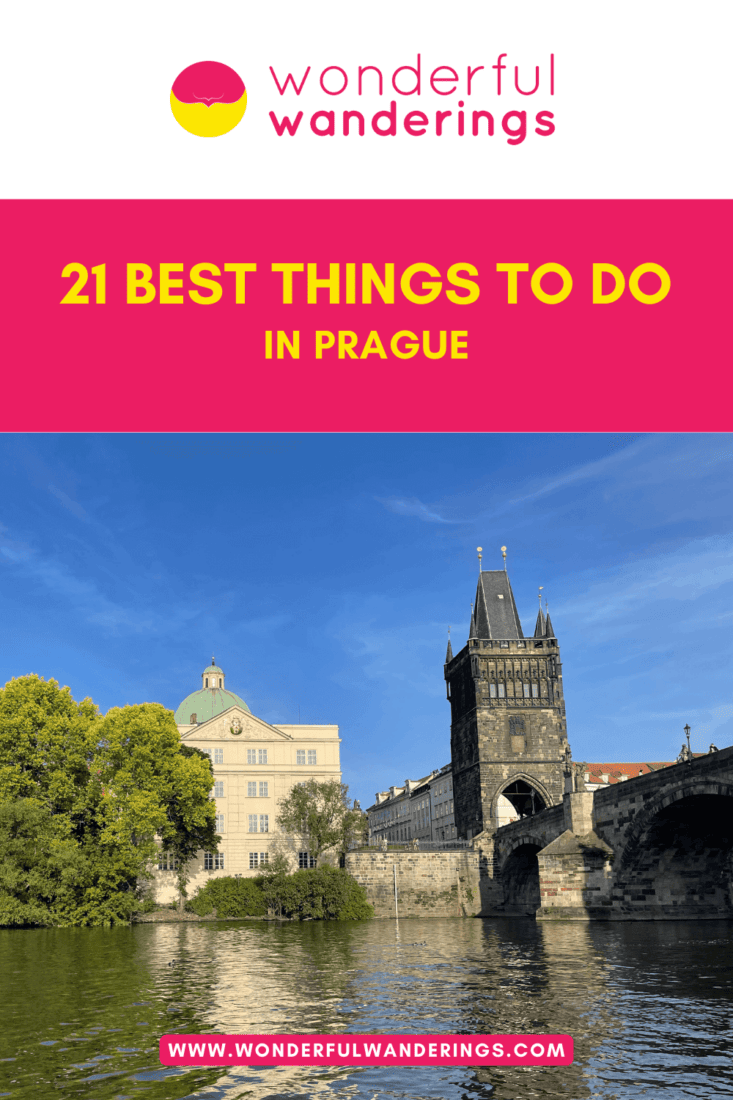
Charles Bridge connects the Old Town to the Lesser Town across the Vltava, 516 m (1,693 ft) of stone laid from 1357 under Charles IV, with 30 Baroque saints along the parapet and towers at both ends. It is free and it is packed from mid-morning to late evening. Cross it at sunrise or after 10pm.
Wenceslas Square is not a square but a boulevard, 750 m long, running from the National Museum down into the New Town. It is where Czechs gather when the country changes: 1918, 1968 and 1989 all happened here. The shops and hotels along it are ordinary; the significance is not.
The Rudolfinum is the neo-Renaissance concert hall on the river, home of the Czech Philharmonic and the main venue of the Prague Spring festival. Its Dvořák Hall is one of the finest rooms in Europe to hear an orchestra in, and its gallery runs contemporary exhibitions.
Thrill Park, Prague’s horror attraction, sits under the Old Town and runs a pitch-dark haunted maze and a horror escape room in 25 to 45-minute slots, year round. It is the counterweight to a day of Gothic architecture, and it is genuinely frightening rather than a fairground ride.
Prague Castle and the Lesser Town
Prague Castle is the largest ancient castle complex in the world and has been the seat of Czech rulers, and now presidents, since the 9th century. The grounds and courtyards are free to walk. The main circuit ticket, which covers St Vitus Cathedral, the Old Royal Palace, St George’s Basilica and Golden Lane, costs 450 Kč (about €19, $22, £16) for an adult and 300 Kč reduced, and it is valid for two consecutive days, so you do not have to do it all in one go.

St Vitus Cathedral fills the castle’s third courtyard and took nearly six centuries to finish, from 1344 to 1929. It holds the Bohemian Crown Jewels, the tomb of St Wenceslas in a chapel encrusted with semi-precious stones, and an Art Nouveau window by Alphonse Mucha. The nave is free to enter as far as the barrier; the rest is on the circuit ticket.
Lobkowicz Palace is the only privately owned building inside the castle, and it is the one museum in the complex with a personality. The Lobkowicz family’s collection includes Canaletto and Brueghel, Beethoven and Mozart manuscripts in the composers’ own hands, and an audio guide narrated by the family. It is ticketed separately from the castle circuit.

The Lesser Town, Malá Strana, is the Baroque district below the castle, and it is where Prague is quietest. Palace gardens, embassies, tiny squares and the Kampa island sit between the castle steps and the river, and the whole quarter is walkable in an afternoon.
St Nicholas Church in Malá Strana Square is the high point of Prague Baroque, built by the Dientzenhofers between 1704 and 1755, with a dome and a bell tower you can climb separately. Mozart played its organ, and the church still runs concerts on it.
The Vrtba Garden is the terraced Baroque garden climbing the hillside behind a palace on Karmelitská, laid out from 1720 and small enough to be missed entirely. It is open seasonally and costs a few hundred koruna, and the view from its top terrace over the Lesser Town roofs to the castle is the one people come back for.
The third day: Vyšehrad, Letná and the modern city
Vyšehrad is the second castle, on a rock south of the centre, and it is where Praguers go when the Old Town is full. The site holds the Basilica of St Peter and Paul with its neo-Gothic twin spires, the Vyšehrad Cemetery where Dvořák, Smetana, Mucha and Čapek are buried, casemates inside the ramparts and a wall walk with the longest view of the Vltava. The grounds are free; the casemates, the gallery and the basilica are ticketed. It is a national cultural monument and it is the least crowded major sight in the city.

Letná Park sits on the plateau across the river from the Old Town, and the view from the beer garden at its eastern end down the Vltava and its bridges is the classic Prague photograph. The giant metronome at the top stands where a Stalin monument once did. It is free, open and full of locals.
Prague Zoo in Troja is consistently rated among the better zoos in Europe, spread over a hillside with a chairlift to the upper section and a strong record on breeding Przewalski’s horses. It is a half-day with children and reachable by bus or by boat up the Vltava in summer.

St Cyril and St Methodius Cathedral in the New Town is where the paratroopers who assassinated Reinhard Heydrich in 1942 made their last stand in the crypt. The bullet holes are still in the outside wall by the crypt window, and the National Memorial to the Heroes of the Heydrich Terror inside tells the story. It is small, sobering and largely missed by visitors.
Palác Lucerna is the Art Nouveau shopping arcade off Wenceslas Square, built by Václav Havel’s grandfather, and it holds a cinema, a music bar and David Černý’s sculpture of St Wenceslas riding an upside-down dead horse hanging in the atrium. Free to walk through, and the fastest introduction to Czech humour in the city.
Kasárna Karlín is the former barracks in Karlín turned into an outdoor cultural space with a summer cinema, a bar and a sand pit. It closed in June 2024 and reopened in May 2025 in a provisional form, using the courtyard only, so check what is running before you cross the city for it.
The Jára Cimrman Theatre in Žižkov is a Prague institution built around a fictional Czech polymath who supposedly invented everything and was credited with nothing. The joke is national, the affection is real, and the performances are in Czech only, which is worth knowing before you book.
Prague’s museums, restaurants, bars and hotels
Four subjects need more room than a hub page can give them, and each has its own guide.

- Museums in Prague: which of the National Gallery buildings, the Museum of Decorative Arts, the Museum of Communism and the National Technical Museum are worth your time, and which run free or reduced entry on set days.
- Restaurants in Prague: where to eat Czech food away from the squares, and which of the city’s fine-dining rooms justify the bill.
- Bars in Prague: the beer halls, the microbrewery taprooms and the cocktail bars, sorted by district.
- Hotels in Prague: what each district costs and which ones put you inside walking distance of the Old Town.
If you are coming in December, the Christmas markets in Prague fill Old Town Square and Wenceslas Square and change the shape of a city break entirely.
Where to stay in Prague
Stay in Prague 1 for a first visit and in Vinohrady or Karlín for a second. Prague 1 covers the Old Town, Josefov, the Lesser Town and the castle approach, which puts almost everything in this guide within 20 minutes on foot, and it is priced accordingly.

Four alternatives are worth the tram ride. Vinohrady, in Prague 2, is the residential quarter of tree-lined streets, parks and good restaurants, ten minutes from the centre by metro. Karlín, in Prague 8, is where the city’s newer kitchens are, rebuilt after the 2002 floods. Holešovice, in Prague 7, is the gallery and warehouse district with the DOX contemporary art centre and easy access to Letná and the zoo. Smíchov, in Prague 5, is cheaper again, well connected and next to the Náplavka riverside.
For a family or a stay of four nights or more, an apartment in Prague with a kitchen usually beats a hotel room on both cost and space, and Prague’s supermarkets are inexpensive. Our guide to where to stay in Prague goes district by district.
What to eat and drink in Prague
Eat Czech at least twice, because Prague does it better and cheaper than anywhere you will read about it. The dishes to order are listed below.

- Svíčková na smetaně: marinated beef sirloin in a root-vegetable cream sauce with bread dumplings, cranberries and a slice of lemon. The national dish, and the one to judge a kitchen by.
- Guláš: beef stew with paprika and onion, served with bread or potato dumplings, or in a hollowed loaf if the restaurant is aiming at tourists.
- Vepřo knedlo zelo: roast pork with dumplings and sauerkraut, the plate every pub does.
- Smažený sýr: a slab of Edam or Hermelín breaded and fried, with tartare sauce and chips. Cheap, and better than it sounds.
- Bramboráky: garlic and marjoram potato pancakes, fried crisp, sold as street food and as a side.
- Trdelník: the sugared chimney cake sold from every stall in the Old Town. It is a fairground pastry rather than a Czech tradition, and it is fine as long as you know that.
Beer is the drink and it is the cheapest thing on the menu. A half-litre of Czech lager runs about 50 Kč (€2, $2.40, £1.80) nationally and up to 70 Kč in the centre, which is still less than a bottle of water in most restaurants. Ask for tap water by name, because it is not brought unprompted. Our guide to Czech food goes further into the dishes and the beer.
What Prague costs
A mid-range day in Prague runs about 2,800 Kč (about €117, $136, £101) per person, covering a shared three-star room, two restaurant meals, drinks, a transport ticket and one paid attraction. A backpacker day is roughly 1,400 Kč and a comfortable one about 5,900 Kč.

Prague is the most expensive city in Czechia, scoring 58.2 on Numbeo’s September 2026 cost-of-living index against 48.5 for Olomouc, but it is still well below western European capitals. The single biggest saving is where you eat: the same Czech plate costs 500 Kč on Old Town Square and 200 Kč in a pub two streets back. Our guide to prices in Czechia breaks down the rest.
Two money traps are specific to Prague. Street exchange offices advertising “0% commission” give rates that are anything but free, and Czech law now gives you three hours to cancel an exchange and get your money back precisely because of them. And when a card terminal or ATM offers to bill you in your own currency, decline it and pay in koruna: the rate on that offer is set by the terminal, not your bank.
Getting around Prague
Walk the centre and take the metro for everything else. Prague’s historic core is compact and largely pedestrian, and three metro lines plus a dense tram network cover the rest, including a 24-hour tram service.

Buy time-based tickets in the PID Lítačka app rather than at machines. Thirty minutes costs 36 Kč in the app or 39 Kč on paper, 90 minutes 46 Kč or 50 Kč, a 24-hour ticket 140 Kč or 150 Kč and a 72-hour ticket 340 Kč or 350 Kč. The 24 and 72-hour tickets cover the metro, trams, buses, ferries and PID trains inside the city including the airport routes, plus the Petřín funicular, which costs 60 Kč on its own, and a piece of luggage that would otherwise cost 25 Kč. Children under 6 travel free, and 6 to 15-year-olds travel free with proof of age.
Validate a paper ticket in the yellow machine before you board or before you go down to the platform, because inspectors do check and the fine is immediate. For taxis, use Bolt, Uber or Liftago rather than hailing, so the fare is agreed before you get in. Our guide to getting around Czechia covers the trains and coaches beyond the city.
Should you buy a Prague city card?
Buy a Prague pass only if you will visit three or more paid attractions a day. Below that, individual tickets are cheaper, and Prague’s quietest hours cost nothing anyway.

There are four passes on sale and they are not interchangeable: the Prague Visitor Pass is the city’s own and the only one that includes public transport, Prague CoolPass and Prague Card are the digital and physical versions of the same commercial pass, and Go City runs a separate attraction-count product. Our comparison of the Prague Card and Prague City Pass sets out the 2026 prices and the break-even points.
Getting to Prague
Fly to Václav Havel Airport, or take the train if you are already in Central Europe. The airport sits 17 km (10.6 mi) west of the centre with no rail link, and the cheap way in is bus 119 to Nádraží Veleslavín and metro line A from there, all covered by a 90-minute or 24-hour PID ticket. The Airport Express coach runs to the main railway station on a separate fare.

Compare flights to Prague as soon as your dates are firm, because the low-cost routes into Prague sell their cheap fares early. Overland, Prague sits 354 km (220 mi) southeast of Berlin and 496 km (308.2 mi) southwest of Warsaw, and direct trains and coaches run from Berlin, Dresden, Vienna, Bratislava, Budapest and Kraków. Compare trains and coaches to Prague across the operators in one search; the Berlin and Dresden runs along the Elbe are among the better rail journeys in Europe.
Day trips from Prague
Four day trips are worth a day of a longer stay, and all four run comfortably from Prague and back. They are listed below by how far they go.

- Kutná Hora, an hour east by train, for the Sedlec Ossuary decorated with human bones and the Gothic cathedral of St Barbara.
- Karlovy Vary, two and a quarter hours west by coach, for the spa colonnades, the drinking cure and the Vřídlo geyser.
- Karlštejn Castle, 40 minutes southwest by train, for Charles IV’s Gothic castle on its wooded rock.
- Český Krumlov, about three hours south, which is really an overnight rather than a day trip but is done as one constantly.
A rental car makes the castles and the smaller towns easier, though not Prague itself, where parking is restricted and expensive. See our guides to driving in Czechia and to Czech destinations for the wider country.
Prague in brief
The city’s basics are set out below.

| Population | 1,405,551, about a seventh of Czechia’s total |
| Country | Czechia, formerly the Czech Republic |
| River | The Vltava |
| Founded | 9th century; capital of the Kingdom of Bohemia from the 13th |
| Language | Czech; English and German widely understood in the centre |
| Currency | Czech koruna (Kč), not the euro |
| Time zone | Central European Time, UTC+1, and UTC+2 in summer |
| Airport | Václav Havel Airport, 17 km (10.6 mi) west of the centre |
| Distance to Berlin | 354 km (220 mi) northwest |
| Distance to Vienna | about 330 km (205.1 mi) southeast |
| UNESCO status | The historic centre has been World Heritage listed since 1992 |
Prague’s golden age was the 14th century under Charles IV, who founded the New Town, Charles University and the bridge that carries his name and made the city an imperial capital. It was sacked in the Thirty Years’ War, rebuilt in Baroque, industrialised under the Habsburgs, occupied in 1939, ruled from Moscow after 1948 and freed by the Velvet Revolution in 1989. Almost none of it was bombed, which is why what you walk through is genuinely old. More background sits in our facts about Czechia.
Prague questions
How many days do you need in Prague?
Three days is right for a first visit: the Old Town and Josefov, then the castle and the Lesser Town, then Vyšehrad or a day trip. Two days covers the headline sights only, and four or five let you add museums and a second excursion.
What is Prague famous for?
Prague is famous for Prague Castle, Charles Bridge, the Astronomical Clock and an Old Town that survived the 20th century almost undamaged, and for Czech beer, which is cheaper than water in most of its pubs. Its historic centre has been UNESCO World Heritage listed since 1992.
Is Prague expensive?
Prague is the most expensive city in Czechia and cheap by western European standards. Budget about 2,800 Kč (€117) a day per person for a mid-range trip. Beer, public transport and Czech food are inexpensive; central hotels and restaurants on the main squares are not.
Is Prague safe?
Prague is a safe city with a low rate of violent crime. The real risks are pickpocketing on crowded trams and around Old Town Square, unlicensed taxis, and currency-exchange and card-terminal tricks aimed at visitors rather than at anyone dangerous.

Do you need cash in Prague?
Cards work almost everywhere, including trams and market stalls. Carry a few hundred koruna for small pubs, market food and public toilets, and always choose to be billed in koruna rather than your own currency.

Is Prague good for children?
Yes. Prague Zoo, the Petřín funicular and mirror maze, Letná Park’s playgrounds, the National Technical Museum and the castle grounds all work with children, and the compact centre means short walks between them.

WonderfulWanderings Pro Tips
Five details change what a Prague trip costs and how much of it you see, listed below with the most useful first.

- Split the Prague Castle circuit across two days. The 450 Kč adult ticket, or 300 Kč reduced, is valid for two consecutive days, and each interior can be entered once. Doing St Vitus and the Old Royal Palace one afternoon and Golden Lane and St George’s the next morning turns a queue-heavy slog into two easy visits.
- Buy the 72-hour ticket in the PID Lítačka app. It costs 340 Kč against 350 Kč on paper, covers the airport buses in both directions, includes the Petřín funicular that otherwise costs 60 Kč, and carries a piece of luggage that otherwise costs 25 Kč. It pays for itself on the airport run alone.
- Cross Charles Bridge before 8am or after 10pm. It is free and never closes, and those are the only hours it is not shoulder to shoulder. The same rule applies to Old Town Square, which is a different place at breakfast.
- Never accept a card terminal’s offer to charge you in your own currency, and stay out of street exchange offices advertising “0% commission”. Czech law gives you three hours to cancel a bad exchange transaction, which tells you how common the problem was.
- Check what is actually running at Kasárna Karlín before you cross the city. It closed in June 2024 and reopened in May 2025 in a provisional form using the courtyard only, so the summer cinema and bar may be operating while the indoor programme is not.
About the author. This guide is written and maintained by the Wonderful Wanderings editorial team. Wonderful Wanderings was founded in 2012 by Sofie Couwenbergh, and the team covers Czechia for independent travellers, including the hotels and apartments, restaurants, bars, museums, city passes and day trips worth booking in Prague, and updates this page when prices, tickets and opening rules change.