 EN
EN
 Nederlands
 Français
Use trains and coaches between Czech cities, trams and the metro inside them, and hire a car only for the villages and castles that neither reaches. Czechia is small enough that nothing is more than about four hours from Prague, the intercity network is cheap and frequent, and a car is a liability in any historic centre.
Czechia is landlocked, borders Germany, Poland, Slovakia and Austria, and covers 78,867 km² (30,450 sq mi). Almost every visitor arrives through Prague, and almost every journey after that is a train or a coach.
Fares are in Czech koruna, checked on 10 September 2026 and converted at the Czech National Bank rate for that day: €1 = 24.25 Kč, $1 = 20.88 Kč, £1 = 28.23 Kč.
Which transport to use in Czechia
The right choice in Czechia depends almost entirely on where you are going rather than on your budget, because everything here is inexpensive. The table below is the short version.
| Where you are going | Use | Why |
|---|---|---|
| Between big cities | Train or intercity coach | Frequent, cheap, seat-reserved, city centre to city centre |
| Inside a city | Metro, tram, bus | Dense, integrated on one ticket, runs all night in Prague |
| To a castle, village or national park | Hire car | Rural bus timetables are thin and often school-term only |
| Airport to city | Bus plus metro | There is no rail link at Prague airport |
| Along the river or through the countryside | Bicycle | Czechia has a marked long-distance cycle network |
| Short hop with luggage | Bolt, Uber or Liftago | The fare is agreed before you get in |
How to get to Czechia
Fly to Prague or take the train from a neighbouring capital. Those two cover almost everyone.
By air
Václav Havel Airport Prague is the country’s main gateway and handled 17,750,528 passengers in 2025, its highest figure on record. It sits 17 km (10.6 mi) west of the centre and is served by full-service and low-cost carriers from across Europe and by long-haul routes from the Gulf, North America and Asia.
Brno-Tuřany is the second airport, with a much smaller network, and Leoš Janáček Airport Ostrava and Pardubice run limited scheduled and charter services. Karlovy Vary Airport has very little traffic and is not a practical way into west Bohemia. Compare flights to Czechia into Prague first, then check whether a regional airport happens to serve your route.
By train
Prague is a few hours by train from Berlin, Dresden, Vienna, Bratislava, Budapest, Warsaw and Kraków, and the Berlin and Dresden run along the Elbe gorge is one of the better rail journeys in Europe. Direct services also link Brno and Ostrava to Vienna, Bratislava and Poland.
By coach
Intercity coaches from most of Central Europe arrive at Prague’s Florenc and Na Knížecí stations and at Brno’s Zvonařka. They are cheaper than trains on almost every route and slower on very few. Compare trains and coaches to Czechia in one search rather than checking each operator separately.
By car
Czechia is crossed by motorways from Germany, Austria, Poland and Slovakia, and the D1 links Prague to Brno and Ostrava. Every four-wheeled vehicle up to 3.5 tonnes needs a motorway vignette, which is digital, tied to your number plate and bought online from 230 Kč for a day. Our guide to driving in Czechia covers the rules that come with it.
Trains in Czechia
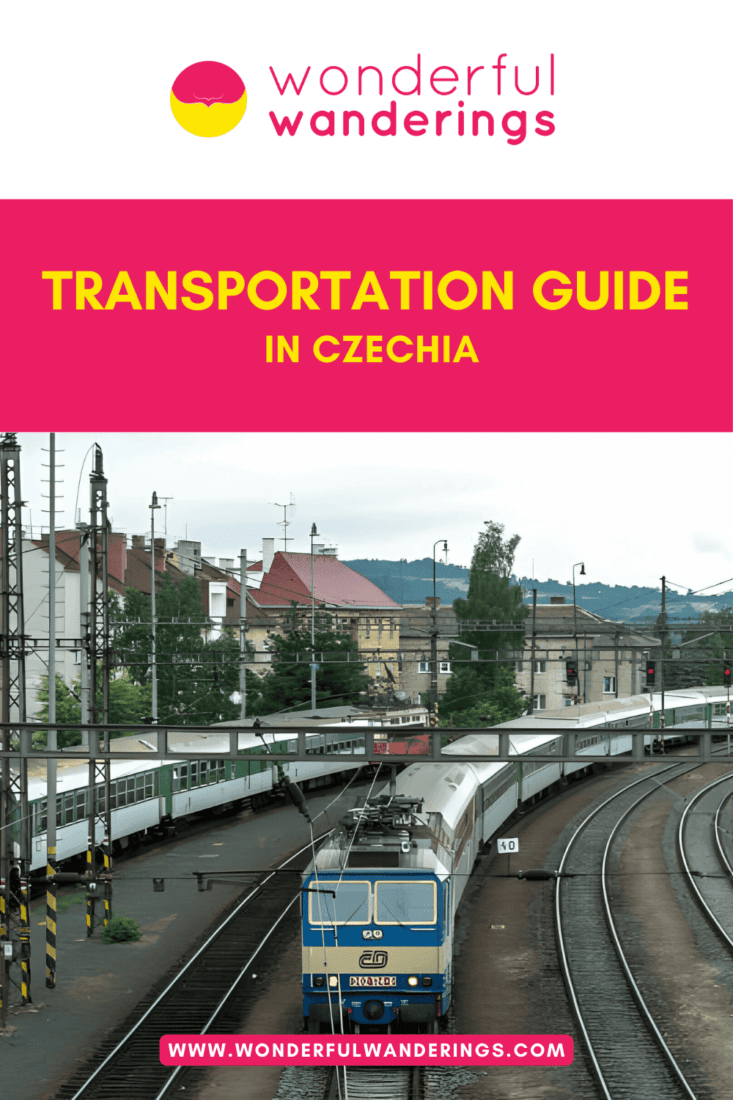
Czech trains are cheap, punctual by European standards and run to almost every town of any size. The network radiates from Prague, which means a cross-country journey usually goes through the capital.
Three operators compete on the main corridors. České dráhy is the state railway and runs everywhere. RegioJet and Leo Express are private and run the busy routes, mostly Prague to Brno, Ostrava and Košice, with seat reservations, drinks brought to your seat and fares that undercut the state operator when booked ahead. Booking a week out rather than at the counter is worth 30% to 50% on most routes.
Two discounts are worth knowing about and are not restricted to Czech citizens. Passengers over 65 and students under 26 get a state-subsidised reduction of roughly half on domestic second-class fares. Over-65s need only show a passport or national ID at the check; students generally need an ISIC card rather than a university card.
Use the national IDOS timetable or the operators’ own apps to plan, because they include the buses and the city networks in the same search. Our guide to prices in Czechia sets fares alongside the rest of a day’s costs.
Buses and coaches in Czechia
Czech intercity coaches are the equal of the trains and beat them on several routes, which is unusual in Europe. RegioJet, FlixBus and Arriva run modern vehicles with reserved seats, wifi and power, and on corridors where the railway takes the long way round, Prague to Karlovy Vary and Prague to Český Krumlov among them, the coach is simply faster.
Regional and local buses fill in everything the railway misses, and that is where the planning starts. Rural timetables in Czechia thin out sharply at weekends and in the school holidays, and some village services run only on school days. Check the return before you commit to the outward journey.
Coaches sell reserved seats and the Friday afternoon and Sunday evening departures out of Prague do sell out. Book those legs ahead.
City transport in Czechia
Czech city transport is integrated: one ticket covers the metro, trams, buses, trolleybuses and, in Prague, the ferries and the funicular. Tickets are time-based rather than distance-based, and they are cheaper bought in the operator’s app than on paper.
Prague
Prague has three metro lines, a dense tram network that runs all night and buses covering the outer districts, all on one fare system. A 30-minute ticket costs 36 Kč in the PID Lítačka app or 39 Kč on paper, 90 minutes costs 46 Kč or 50 Kč, 24 hours costs 140 Kč or 150 Kč and 72 hours costs 340 Kč or 350 Kč.
The 24 and 72-hour tickets also cover the Petřín funicular, which is 60 Kč on its own, and a piece of luggage that would otherwise cost 25 Kč. A monthly pass is 550 Kč. Children under 6 travel free, and 6 to 15-year-olds travel free with proof of age. Validate a paper ticket in the yellow machine before you board or before you go down to the platform.
Brno
Brno runs trams as its backbone, with trolleybuses and buses filling in, across the districts of a city built along the Svratka. The main railway station has domestic services plus international links to Vienna, Bratislava and Budapest, and the intercity coaches use Zvonařka.

Brno-Tuřany airport is about 9 km (5.6 mi) from the centre and is reached by city bus in around 20 minutes.
Ostrava
Ostrava has trams, buses and four railway stations, and its network is built around an industrial city spread wider than its population suggests. Fast trains reach Prague in about three hours, and the city sits close enough to the Polish border for cross-border services.

Leoš Janáček Airport is about 20 km (12.4 mi) out, with a bus link into the centre.
Plzeň
Plzeň runs trams and trolleybuses over a compact centre, and its main station has domestic routes and direct trains into Germany. Trains reach Prague in about an hour and a half.

Plzeň has no scheduled passenger flights; arrive by train or coach from Prague, or by car.
Renting a car in Czechia
Hire a car for the countryside and leave it parked in the cities. A car is the only sensible way to reach Czech castles, the Bohemian and Moravian villages, the Jizera and Krkonoše mountains and the wine country south of Brno, and it is a positive nuisance inside Prague, Brno or Český Krumlov, where centres are restricted, streets are one-way and parking is expensive.
Czech rental is cheap by western European standards and the fleets are modern, with Škoda models forming most of them. Compare car rental in Czechia across suppliers before fixing dates, because the gap between depots at the same airport is usually wider than the gap between car classes. Our guide to car hire in Czechia covers the suppliers and the paperwork.
Four running costs go on top of the daily rate: the motorway vignette from 230 Kč a day, fuel at roughly 38 to 42 Kč a litre, city parking charged by zone and paid by app, and the collision-damage excess, which is where the desk makes its money.
Cycling in Czechia
Czechia has one of the denser marked cycle networks in Central Europe, and the long-distance routes follow rivers, which keeps them flat. The Elbe and Vltava routes, the Moravian wine trails and the Greenways between Prague and Vienna are all signed, mapped and rideable without special equipment.
Bikes travel on most Czech trains for a small supplement, which makes a one-way ride and a train back straightforward. City bike hire and dockless schemes operate in Prague, Brno and Olomouc. What Czechia does not have is much protected urban cycling infrastructure, so riding in Prague’s centre is for the confident.
Getting from Prague airport to the city
There is no railway station at Václav Havel Airport, and any guide that says a train reaches the city centre from the terminal is wrong. The cheap way in is bus 119 from outside the terminals to Nádraží Veleslavín, then metro line A into the centre, all on a single 90-minute PID ticket at 46 Kč in the app or 50 Kč on paper, or free within a 24 or 72-hour ticket.
Two alternatives cost more. The Airport Express coach runs to the main railway station on its own fare and is worth it if you are connecting to a train. Bolt, Uber and Liftago quote a fixed fare and take about 30 minutes off-peak; a metered taxi into the centre usually runs 700 to 900 Kč.
Allow an hour door to door on public transport, and remember that Prague’s public transport tickets cover the airport buses in both directions, which is what makes a 72-hour ticket pay for itself.
Are there ferries in Czechia?
Czechia is landlocked and has no ferry network. What it has are small river crossings: the PID ferries on the Vltava inside Prague, covered by an ordinary city ticket, and seasonal sightseeing cruises on the Vltava and the Elbe run as excursions rather than transport.
No ferry connects Czech cities to each other, and none reaches Kutná Hora, which sits about 70 km east of the Vltava. If a route is described to you as a ferry between Czech destinations, it is a river cruise.
How long journeys take from Prague
Journey times from Prague to the places most visitors go are set out below, taking the fastest usual option. All are approximate and all are comfortable as day trips except the last.
| Destination | Time from Prague | Fastest option |
|---|---|---|
| Plzeň | about 1 hour 30 minutes | Train |
| Liberec | about 1 hour | Coach |
| Kutná Hora | about 1 hour | Train |
| Karlovy Vary | about 2 hours 15 minutes | Coach |
| Brno | about 2 hours 30 minutes | Train or coach |
| České Budějovice | about 2 hours 30 minutes | Train |
| Ostrava | about 3 hours | Train |
| Český Krumlov | about 3 hours | Coach |
Nothing in Czechia is more than about four hours from Prague by public transport, which is why a single base works for a short trip and why the country rewards a slow one. Our round-up of Czech destinations covers where the lines go.
Practical details worth sorting first
Two small things make Czech transport easier and both are done before you arrive.
Download the operator apps: PID Lítačka for Prague, the equivalent for the region you are in, and IDOS for the national timetable, which searches trains, coaches and city services together. App fares undercut paper fares on every Prague ticket.
Those apps want data on arrival rather than after you find wifi at the hotel, so an eSIM for Czechia installed before you fly is the simplest fix for one phone, and the code HARRY5578 takes €3 off.
Getting around Czechia questions
Do you need a car in Czechia?
No, not for the cities. Trains and coaches link every Czech city cheaply and frequently, and city transport is dense. Hire a car only for castles, villages, mountains and the wine country, where rural bus timetables thin out at weekends.
Is there a train from Prague airport to the city?
No. Václav Havel Airport has no railway station. Take bus 119 to Nádraží Veleslavín and metro line A, on one 90-minute ticket, or the Airport Express coach to the main railway station.

Are trains or buses better in Czechia?
Both are good and the answer is route by route. Trains win to Plzeň, Brno, Ostrava and České Budějovice. Coaches win to Karlovy Vary, Liberec and Český Krumlov, where the railway takes the long way round.
How much is public transport in Prague?
A 30-minute ticket is 36 Kč in the PID Lítačka app or 39 Kč on paper, 90 minutes 46 Kč or 50 Kč, 24 hours 140 Kč or 150 Kč and 72 hours 340 Kč or 350 Kč. Children under 6 travel free.
Can tourists get train discounts in Czechia?
Yes. The state-subsidised reduction on domestic trains and coaches, roughly half the fare, is not restricted to Czech citizens. Over-65s show a passport or national ID; students under 26 generally need an ISIC card.
Is public transport in Czechia safe?
Yes. Czech public transport is safe, clean and well used at all hours, and Prague’s trams run through the night. The realistic risks are pickpocketing on crowded trams and unlicensed taxis, not personal safety.
WonderfulWanderings Pro Tips
Five details make Czech transport cheaper and easier, and they are listed below with the most useful first.
- Buy every Prague ticket in the PID Lítačka app. The app fare is lower than the paper fare on every tier: 36 Kč against 39 for 30 minutes, 46 against 50 for 90 minutes, 140 against 150 for 24 hours and 340 against 350 for 72 hours. It also removes the validation step that catches visitors out with an on-the-spot fine.
- Claim the age discount if it applies to you. Passengers over 65 and students under 26 get roughly half off domestic second-class train and coach fares, and the scheme is not limited to Czech citizens. Over-65s need only show a passport or national ID at the check; students should carry an ISIC rather than a home university card.
- Plan the airport run as bus plus metro, not train. Prague airport has no railway station. Bus 119 to Nádraží Veleslavín and metro A into the centre takes about an hour and costs 46 Kč in the app, and it is free inside a 24 or 72-hour ticket, which is where those tickets earn their price.
- Book Friday afternoon and Sunday evening legs out of Prague ahead. Czech intercity coaches sell reserved seats and those two departures fill, especially towards Brno, Ostrava and Liberec. The same booking window is worth 30% to 50% on RegioJet and České dráhy fares.
- Check the return bus before you take the outward one. Rural Czech timetables drop sharply at weekends and during school holidays, and some village services run on school days only. This is the single most common way a castle day trip turns into an expensive taxi.
About the author. This guide is written and maintained by the Wonderful Wanderings editorial team. Wonderful Wanderings was founded in 2012 by Sofie Couwenbergh, and the team covers Czechia for independent travellers, including the trains, coaches, city tickets and car hire that connect Prague, Brno, Ostrava, Plzeň and the small towns between them, and updates this page when fares, routes and operators change.