 EN
EN
 Nederlands
 Français
Ceske Budejovice is a two-day city, and the two things worth building those days around are the Budweiser Budvar brewery and Náměstí Přemysla Otakara II, the arcaded main square that gave the town its shape in 1265. Everything else in the historic centre sits within about ten minutes’ walk of that square: the Black Tower, St Nicholas Cathedral, the Samson Fountain, two surviving fortification towers and the South Bohemian Museum. Two of the region’s headline sights, the UNESCO village of Holašovice and Hluboká nad Vltavou castle, are short trips out. Czechia uses the Czech koruna, not the euro, so every price below is given in koruna first, with an approximate conversion at the rate of 10 September 2026.
The city has about 97,000 residents, which makes it the seventh largest in the country, and it will be European Capital of Culture in 2028, the third Czech city to hold the title after Prague and Plzeň. That matters for timing: prices and opening hours in the centre are being reviewed year on year in the run-up, so check anything time-sensitive before you go.
Things to do in Ceske Budejovice
The 12 things to do in Ceske Budejovice are listed below, most rewarding first.

- Budweiser Budvar brewery tour. The Budvar brewery is the reason the city’s German name, Budweis, ended up on beer labels worldwide, and its guided tour is the one booking to make in advance. Tours run in Czech, English, German, Russian, French, Spanish and Italian, last 70 to 80 minutes and cover the brewhouse, the lager cellar and the production line, finishing with a tasting at the Budvarka restaurant. Standard admission is CZK 290 (about €12, $14, £10.25) and reduced admission CZK 220 (about €9.05, $10.50, £7.80) during opening hours. Booking is required, and the tasting is for visitors over 18 only, although under-18s can join the walk.
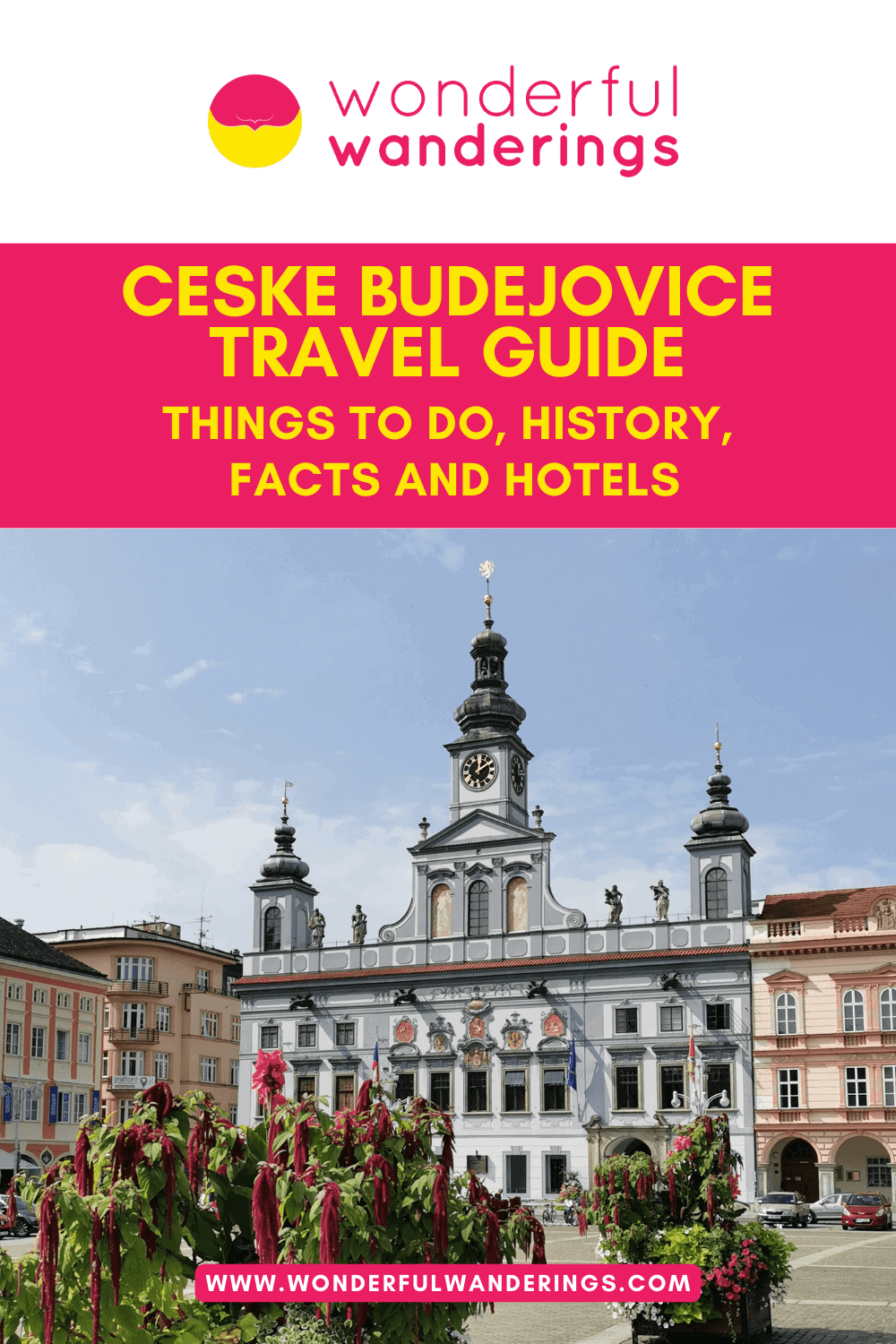
- Náměstí Přemysla Otakara II. The main square is a near-perfect rectangle of 133 by 137 metres covering 1.7 hectares, arcaded on all four sides, and the city’s own tourist portal ranks it the second largest town square in the Czech Republic. Older write-ups often call it the largest in the country, or the second largest in Central Europe after Kraków, and neither claim survives a check. King Ottokar II of Bohemia founded the city here in 1265 and the square has kept his medieval ground plan ever since. It costs nothing to walk on, and it is where the Christmas market, the summer concerts and most of the city’s street life happen.
- Black Tower. The Black Tower stands beside St Nicholas Cathedral on the north-east corner of the square, was built between 1550 and 1577, and rises 72.29 metres with a viewing gallery 46 metres up. You climb 225 steps to reach it and pay at the top, not at street level. Admission is CZK 80 (about €3.30, $3.80, £2.85) for adults, CZK 40 (about €1.65, $1.90, £1.40) reduced, and CZK 200 (about €8.25, $9.60, £7.10) for a family ticket covering two adults and up to four children. The tower opens April to 31 October only, 10am to 6pm, and it closes on Mondays except in July and August, dropping to a 5pm close from 15 October and 4pm on public holidays.
- South Bohemian Museum. The Jihočeské muzeum at Dukelská 1 is the regional collection, housed in a Neo-Renaissance building put up between 1899 and 1901, and it covers South Bohemian archaeology, medieval material, folk art and the city’s own 750-year history. The whole museum costs CZK 120 (about €4.95, $5.75, £4.25), reduced CZK 80 and a family ticket CZK 250 (about €10.30, $12, £8.85) under the price list that took effect on 1 January 2026. A single floor costs CZK 70 and a temporary exhibition alone CZK 40. It opens Tuesday to Sunday and on public holidays, 9am to 5.30pm, and closes on Mondays.
- Boat cruise on the Malše and Vltava. The sightseeing boat Sv. Rozálie carries 12 passengers on a 40-minute circuit through the confluence of the Malše and the Vltava, under five bridges and past the surviving city walls, bastions and fortification towers. It leaves from the Vlnna café landing on Sokolský ostrov, about five minutes on foot from the square, and runs Wednesday to Sunday at 11am, 2pm, 3pm and 5pm. Tickets are CZK 220 (about €9.05, $10.50, £7.80) for adults and CZK 140 (about €5.75, $6.70, £4.95) for children under 10. The boat sails in any weather with a minimum of two passengers, which is worth knowing if you turn up alone on a quiet Wednesday.
- Samson Fountain. The Samson Fountain is the Baroque centrepiece of the square, built between 1721 and 1727 to a design by Zachariáš Horn with sculpture by Josef Dietrich, and its stone basin measures roughly 17 metres across. It supplied the city’s drinking water for well over a century before it became the photograph everyone takes. Standing at it costs nothing and the light on the pastel facades behind it is best in the hour after sunrise, before the square fills.
- St Nicholas Cathedral. St Nicholas Cathedral sits on the square next to the Black Tower and began as a Gothic parish church around 1265, the year the city was founded. A Late Gothic rebuild in 1518 was followed by Baroque reconstruction in the mid-1600s after fire damage, and the triple-nave interior you see now, with its 18th-century stucco and altars, is the result of that long sequence. Pope Pius VI raised it to cathedral status in 1785 when the České Budějovice diocese was created. It is an active church, entry is free outside services, and a donation is the usual courtesy.
- Železná panna. Železná panna, the Iron Maiden tower on Zátkovo nábřeží, is one of two surviving towers of the medieval fortifications and stands where the Malše meets the Vltava. The Gothic tower dates from the 14th century and took its present form in a 1612 rebuild after lightning set it alight. It has been open to the public since 2005, but only between May and September and only on set days, so check before you walk over. Since 2017 it has held the only permanent exhibition on Přemysl Otakar II anywhere in the country.
- Rabenštejnská věž. Rabenštejnská věž on Panská Street is the other surviving fortification tower, built in the 14th century and later used as the town jail. A reconstruction completed in 2000 installed an exhibition of armour and historical weapons inside, and since 2020 the tower and the buildings beside it have housed Rabenštejnská, a cultural centre, gallery and design shop run by the Umění ve městě association. Guides that describe it as a straightforward climbable viewing tower are out of date. The upper floors open at set times during the tourist season only.
- Holašovice. Holašovice is a village of 23 farmsteads and around 140 residents about 16 km (9.9 mi) west of the city, and UNESCO inscribed it on the World Heritage List in 1998 for its South Bohemian folk Baroque architecture and its intact medieval ground plan. The gabled facades around the green are the whole point, and walking among them is free. The information centre opens Saturday and Sunday from 9am to 5pm between April and October, so a weekday visit means the village without the interpretation.
- Hluboká nad Vltavou castle. Hluboká castle is a 19th-century Neo-Gothic rebuild for the Schwarzenberg family, redesigned by Franz Beer between 1840 and 1871 on an English model, and it is roughly 15 minutes north of the city by car or bus. Interiors are guided-tour only and the routes are ticketed separately: Representational Rooms CZK 300 (about €12.35, $14.35, £10.60), Hospitality Rooms CZK 320 (about €13.20, $15.30, £11.35), Private Apartments CZK 220, the Kitchen CZK 180, the self-guided tower CZK 180 and the winter route CZK 200. Children aged 6 to 17 pay CZK 50 to CZK 100 depending on route and under-5s go free. It closes on Mondays, and hours run 9am to 5pm in May and June, 9am to 4.30pm in April, September and October and 10am to 4pm from November to March.
- Šumava National Park. Šumava National Park runs along the German border south-west of the city and protects glacial lakes, peat bogs, old-growth forest remnants and hills topping out around 1,378 metres. It became a UNESCO Biosphere Reserve in 1990 and a national park in 1991. Entry is free and the trail network is enormous, with Železná Ruda, Kvilda, Borová Lada and Strážný the usual gateway towns for accommodation and information. Winter turns much of the trail system over to cross-country skiing.
The best museums in Ceske Budejovice
The strongest museum in Ceske Budejovice is the South Bohemian Museum, and the rest of the city’s collections are small and specialised. The four listed below are the ones worth a detour, with the caveat that opening days at the smaller sites move around and each publishes its own hours.

- South Bohemian Museum, Dukelská 1. The regional collection covers archaeology, medieval artefacts, folk art and the city’s own history over three floors, with a 2026 price list of CZK 120 for the whole museum, CZK 80 reduced and CZK 250 for a family. It closes on Mondays.
- Museum of the Horse-Drawn Railway. The museum records the České Budějovice to Linz line of 1827, one of the first horse-drawn railways in continental Europe, which is the most consequential piece of transport history the city has. It is a branch of the South Bohemian Museum and has its own separate price list and opening days.
- Motorcycle Museum, Kněžská 19. Dozens of historic motorcycles and vehicles are shown inside a 16th-century building, and the pairing of machines with the medieval interior is the reason to go rather than the size of the collection.
- Observatory and Planetarium. The Hvězdárna a planetárium runs shows and telescope sessions on the Malše riverbank and is the one indoor stop here that reliably works for children in bad weather. Programmes are scheduled rather than continuous, so times are worth checking on the day.
Ceske Budejovice with kids
Ceske Budejovice works well with children because the historic centre is flat, compact and largely traffic-free, so a day of sightseeing does not turn into a day of road crossings. The four options below need the least persuasion.

- Zoo Hluboká. The South Bohemian zoo sits beside the Munický pond at Hluboká nad Vltavou, next to the castle, and held 2,316 animals across 269 species at the end of 2024. Pairing it with the castle grounds fills a whole day out of the city. Older guides still call it Zoo Ohrada and place it near Hrdějovice, which is the wrong village.
- The Black Tower climb. The 225 steps are the attraction rather than the obstacle for most children over about six, and the family ticket at CZK 200 covers two adults and up to four children, which is the cheapest big view in the city.
- The 40-minute boat trip. Forty minutes is short enough to hold attention, the boat takes only 12 people so nobody is stuck at the back, and a child under 10 pays CZK 140.
- The planetarium. Scheduled shows and telescope time give you a fixed indoor hour, which is the thing that is hardest to find in a small city on a wet afternoon.
Where to eat in Ceske Budejovice
The three places below were all confirmed trading in September 2026, which is worth saying because the city’s restaurant listings online are unusually stale. Czech restaurant hours change more often than menus do, so ring ahead for a group.

- Masné krámy, Krajinská 13. The city’s landmark beer hall has been a restaurant since 1954, in a building of medieval butchers’ stalls, and it pours kroužkovaný Budvar lager straight from the tank. It is open Monday to Thursday 11am to 11pm, Friday 11am to 11.30pm, Saturday noon to 11.30pm and Sunday noon to 9pm. Some English-language guides list this address under the German name Fleischbänke, which is a translation of Masné krámy and not what the sign says, so search for Masné krámy.
- Klika Kitchen & Coffee, Hroznová 25. Klika serves modern Czech cooking from local suppliers under chef Petr Glaser, with 40 indoor seats built against a 14th-century stretch of the town wall, a heated 20-seat winter garden over the Malše and a south-west terrace. It is open every day, 10.30am to 10pm, and older listings that say it closes on Mondays are wrong.
- BRIO Restaurant, Riegrova 8. BRIO is the city’s fine-dining option, on the edge of the historic centre near the Malše, and it opens Monday to Saturday 11am to 10pm and closes on Sunday. Reserve at weekends.
The regional dishes to look for are South Bohemian fish, especially carp from the Třeboň ponds, roast pork with bread dumplings and sauerkraut, fried cheese with tartare sauce, and dill pickle soup, which is a South Bohemian recipe rather than a national one. For a wider view of Czech eating, our guide to traditional Czech food covers what to order and why.

Where to stay in Ceske Budejovice
Stay inside the old town if you have two days, because the walk between the square and everything on the list above takes under fifteen minutes and you will not need a bus once. The three areas below cover the realistic choices.

- Old Town. The historic core bounded by the Malše and the Mlýnská stoka puts the square, the Black Tower, the cathedral, both fortification towers and the boat landing within a few minutes’ walk. Zátkův dům, the Renaissance house on the square named after the lawyer and politician August Zátka, is now a hotel, which is as central as the city gets.
- Riverside. The banks of the Malše and the Vltava are quieter, still walkable to the square, and closer to the boat landing on Sokolský ostrov. Rooms here tend to cost less than on the square itself.
- Near the brewery. The northern side of the city around the Budvar brewery and Stromovka park is residential and cheaper, and it suits anyone whose main reason for coming is the 14.40 English tour.
Accommodation in Ceske Budejovice runs well under Prague rates, and the city is a cheaper base than Český Krumlov for seeing the same region. Compare hotels in Ceske Budejovice before you fix your dates, because the old town has a small number of rooms and the Capital of Culture programme is already pulling weekends forward.
How to get to Ceske Budejovice
Ceske Budejovice is about 150 km (93.2 mi) south of Prague by road on the D3 motorway, and the direct train from Prague hlavní nádraží takes a little over two hours. Buses run by RegioJet and FlixBus take a similar time and usually cost less, with fares from roughly CZK 150 (about €6.20, $7.20, £5.30) on the cheaper departures and train fares typically two to three times that. Both leave far more often than the timetables of ten years ago, and both drop you within 2 km (1.2 mi) of the square. Compare trains and buses from Prague on one screen rather than checking each operator, since the fastest option changes by time of day.

The city’s own airport handles very little scheduled traffic, so almost every international visitor arrives through Prague. From the main train and bus stations on Nádražní, the square is a 20-minute walk, a short ride on city bus lines heading into the centre, or a taxi of roughly CZK 150 (about €6.20, $7.20, £5.30). If you are coming from outside the EU and would otherwise pay roaming charges for two days of maps and timetables, an Airalo eSIM installs on one phone before you fly and the code HARRY5578 takes €3 off.
Day trips from Ceske Budejovice
Ceske Budejovice is the practical base for South Bohemia, and four trips are close enough to do without moving hotel. They are listed below by travel time.

- Hluboká nad Vltavou, 15 minutes. The Neo-Gothic castle, the zoo beside the pond and the Vltava-side park make the fullest day out, and buses run frequently from the city stations.
- Holašovice, 25 minutes. The UNESCO village is a short bus ride or drive west, and an hour is enough unless the information centre is open.
- Český Krumlov, 30 minutes. The bus covers the 25 km (15.5 mi) in around half an hour and the train takes about 45 minutes to a station a 12-minute walk from the centre. Buses run roughly hourly and are the faster option in both directions.
- Šumava National Park, 90 minutes. The park is far enough that it wants a full day, and a car makes far more sense than buses once you are past the gateway towns.
A car earns its keep only for Šumava, Holašovice and the smaller villages, since Hluboká and Český Krumlov are both well served by bus. If you want one, compare car hire rates for a Prague or Ceske Budejovice pick-up, and read our guide to driving in Czechia first, because the motorway vignette and the winter tyre rules both catch visitors out. For more of the country, our Czechia destinations guide sets out where each region is worth your days.
How many days do you need in Ceske Budejovice?
Two days is the right length for Ceske Budejovice. Day one covers the square, the Black Tower, the cathedral, the Samson Fountain, both fortification towers and the boat trip, all of it within a fifteen-minute radius. Day two takes the Budvar tour in the early afternoon and either the South Bohemian Museum or the trip to Hluboká. A third day only makes sense if you are adding Šumava or using the city as a base for Český Krumlov, which many people do because rooms here cost less.

Is Ceske Budejovice expensive?
Ceske Budejovice is inexpensive by Western European standards and noticeably cheaper than Prague. The Czech koruna is the currency, not the euro, and at the rate of 10 September 2026 one euro bought about CZK 24.25. The paid attractions in the city centre all sit between CZK 80 and CZK 290, so a full day of sightseeing for two adults comes in under CZK 1,000 (about €41, $48, £35) before food. Card payment is accepted almost everywhere, but the Black Tower desk at the top of the stairs is one place to have coins. Our Czechia prices guide has the wider picture on meals, transport and accommodation.

Avoid changing money at the exchange booths clustered around tourist streets, which quote a spread rather than a fee, and use a bank ATM or a card instead. If an ATM offers to charge you in euros or dollars, decline and take the koruna price.
Ceske Budejovice FAQ
What is Ceske Budejovice famous for?
Ceske Budejovice is famous for beer. The city’s German name, Budweis, is where the Budweiser trademark comes from, and the Budweiser Budvar brewery still produces the original Czech beer of that name in the city. Beyond beer, it is known for the size and regularity of its main square, for the horse-drawn railway to Linz that opened in 1827, and as the garrison town of the 91st Infantry Regiment in Jaroslav Hašek’s novel The Good Soldier Švejk, whose Budějovice anabasis is one of the book’s best-known episodes.
What language do they speak in Ceske Budejovice?
Czech is the language of Ceske Budejovice. The city had a German-speaking majority until 1880 and German is still understood by some older residents and in the tourist trade, but Czech has been the everyday language for over 140 years. English is widely spoken at hotels, at the brewery and on guided tours, less so in neighbourhood restaurants.
What time zone is Ceske Budejovice in?
Ceske Budejovice is on Central European Time, UTC+1, and switches to Central European Summer Time, UTC+2, from late March to late October like the rest of the European Union.
How many people live in Ceske Budejovice?
About 97,000 people live in Ceske Budejovice, which the Czech Statistical Office put at 97,128 on 1 January 2026. That makes it the seventh largest city in the country and the largest in South Bohemia.
Is Ceske Budejovice safe?
Ceske Budejovice is a safe city for visitors, with low rates of violent crime and the ordinary risk of pickpocketing in crowds, at the Christmas market and on busy summer weekends on the square. The historic centre is well lit and walkable at night. The usual precautions are enough.
Is Ceske Budejovice worth visiting?
Ceske Budejovice is worth visiting for the brewery, the square and its position at the centre of South Bohemia. It gets a fraction of Český Krumlov’s crowds, costs less to sleep in and puts Hluboká, Holašovice and Šumava within reach of one hotel. If you have four days in the region and want to see more than one town, this is the place to put them.
WonderfulWanderings Pro Tips
The 5 tips below come from re-checking every opening day and 2026 price for this guide in September 2026, and each one changes how you should plan the day.

- Do not make Monday your sightseeing day. The Black Tower, the South Bohemian Museum and Hluboká castle all close on Mondays, and the Black Tower only opens on Mondays in July and August. A Monday in Ceske Budejovice leaves you the square, the cathedral and the brewery, which is not two days’ worth.
- Book the Budvar tour in English before you leave home. English departures run at 2.40pm year-round and add a 10.40am slot in July and August, tours must be reserved, and admission is CZK 290 for adults and CZK 220 reduced. Turning up at the visitor centre without a booking usually means a Czech-language tour or none.
- Carry the Black Tower entry money up the stairs with you. You climb all 225 steps first and pay at the desk on the gallery, not at street level. Adults pay CZK 80, reduced CZK 40, and a family ticket at CZK 200 covers two adults and up to four children, which beats four singles.
- The river boat runs Wednesday to Sunday only. Sv. Rozálie sails at 11am, 2pm, 3pm and 5pm, takes 12 people and needs a minimum of two passengers to leave, so a solo traveller on a quiet weekday can be turned away. It sails in rain.
- Buy Hluboká castle tickets by route, and pick one. The six routes are separately priced and ticketed, from CZK 180 for the self-guided tower to CZK 320 for the Hospitality Rooms, and the Representational Rooms at CZK 300 are the route most people mean when they say they toured the castle. Nothing there is a single all-in ticket.
About the author. This guide is written and maintained by the Wonderful Wanderings editorial team. Wonderful Wanderings was founded in 2012 by Sofie Couwenbergh, and the team covers Czechia for independent travellers, including the brewery tours, castle tickets, hotels, restaurants and car hire in Ceske Budejovice and South Bohemia worth booking. We check the opening days, admission prices and koruna conversions on this page against the venues’ own sites and update it when they change.