 EN
EN
 Nederlands
 Français
Norway’s 16 main destinations divide cleanly by what you want from the trip: fjords on the west coast, the Arctic in the north, Viking and maritime history around the Oslofjord, and skiing inland. Oslo, Bergen and Tromsø handle most first visits between them, and the other thirteen are worth the detour once you know which coast you are on. This page is the starting point for everything we have written about Norway.
Krone prices carry conversions at the rate of 11 September 2026, when €1 bought about 10.8 NOK and $1 about 9.3 NOK.
Start here
Two of the sixteen have a full guide of their own, and they are the two most people build a trip around. Our 20 things to do in Oslo covers the capital museum by museum, and our 16 things to do in Tromsø covers the Arctic city, the northern lights season and the summer midnight sun. Everything else we have published about the country is collected in all our Norway posts.
Getting between any two of these places is a train, a coastal ferry or a short domestic flight, and Omio compares the European rail, coach and flight options in one search, which is how to work out whether the Oslo to Bergen train is worth the seven hours.
16 destinations to visit in Norway
The 16 destinations below run from the largest city to the smallest town, with what each one is for and how you reach it. Four are north, five are on the west coast and seven are within a few hours of Oslo.
1. Oslo
Oslo is the capital, the largest city and the arrival point for most trips, at the head of the Oslofjord. It was founded in 1048 and rebuilt after a fire in 1624, and it became the capital of an independent Norway in 1905 when the union with Sweden ended.

What to see: the Opera House you can walk up the roof of, Akershus Fortress, Vigeland sculpture park, the Holmenkollen ski jump, the Munch museum, the Fram polar ship and the Kon-Tiki. Two closures to plan around: the old National Gallery shut in 2019, with its collection now in the National Museum that opened in 2022, and the Viking Ship Museum on Bygdøy has been closed since October 2021, rebuilding as the Museum of the Viking Age with a reopening currently planned for late 2027. Viking material is on show at the Historical Museum in the centre in the meantime.
Getting there: Oslo Airport is 47 km (29.2 mi) out, and the Flytoget express train reaches the centre in 19 minutes. Allow 2 to 3 days.
2. Trondheim
Trondheim is the medieval religious capital, on the Trondheimsfjord at the mouth of the Nidelva. Olav Tryggvason founded it as a trading post in 997, and Nidaros Cathedral was built over the grave of Saint Olav, which made the city the end point of a pilgrimage route that still runs.

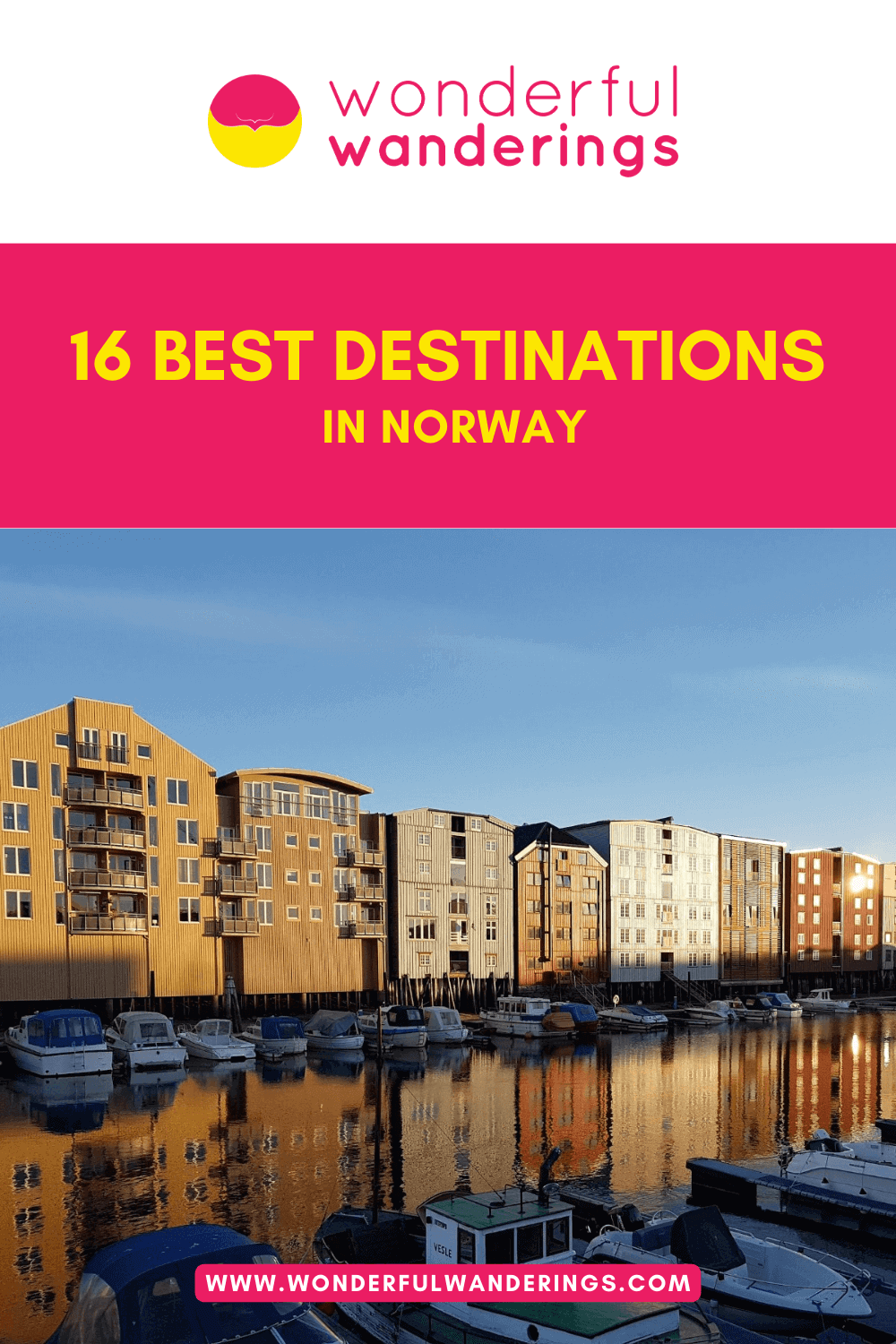
What to see: Nidaros Cathedral, the Archbishop’s Palace museum beside it, the Gamle Bybro old town bridge with the warehouse row behind it, Kristiansten Fortress above the city, and the Ringve music museum in its botanical garden.
Getting there: Trondheim Airport Værnes is 35 km (21.7 mi) out, with the Flybussen into town. The Dovre line train from Oslo takes around 7 hours. Allow 2 days.
3. Bergen
Bergen is the fjord gateway and Norway’s second city, set among seven mountains on the west coast. Founded in 1070, it was the Hanseatic League’s Norwegian trading post, and the wooden warehouse fronts of Bryggen that survive from that trade have been a UNESCO World Heritage Site since 1979.

What to see: Bryggen and the Hanseatic museum, the fish market, the Fløibanen funicular up Mount Fløyen, and Edvard Grieg’s house at Troldhaugen. Bergen was a European City of Culture in 2000 and kept the festival calendar.
Getting there: Bergen Airport Flesland, or the Bergen line train from Oslo, which takes about 7 hours and is the journey people take for its own sake. Allow 2 to 3 days plus a fjord day trip.
4. Stavanger
Stavanger is the oil capital and the base for the two famous hikes, on a peninsula between the Boknafjord and the Hafrsfjord. The city grew around a cathedral finished in about 1125, lived on herring canning, and was remade by the North Sea oil discoveries of the late 1960s.

What to see: Gamle Stavanger, a quarter of 173 white wooden houses from the eighteenth and nineteenth centuries; Stavanger Cathedral, the country’s oldest still largely in its medieval form; and the Norwegian Petroleum Museum, built to look like a platform. The reason most people come is Preikestolen, the Pulpit Rock above the Lysefjord.
Getting there: Stavanger Airport with daily Oslo flights, or the coastal train from Oslo. Allow 2 days plus a day for the hike.
5. Tromsø
Tromsø is the Arctic capital, about 350 km (217.5 mi) north of the Arctic Circle on an island connected by bridge to the mainland. It was chartered in 1794 and grew as a base for Arctic hunting and polar expeditions, and it now runs on its university and on tourism.

What to see: the Arctic Cathedral, the Polar Museum, the world’s northernmost botanical garden, and the cable car up Mount Storsteinen. The city is the standard base for northern lights trips between roughly September and March, and for midnight sun, whale watching and fjord cruises in summer.
Getting there: fly, or arrive on the Hurtigruten coastal ship. Allow 3 days.
6. Kristiansand
Kristiansand is the summer town on the south coast, founded in 1641 by Christian IV on a grid plan that still survives. It is the family destination Norwegians themselves use, at the mouth of the Otra on the Skagerrak.

What to see: Bystranda, a genuine sand beach in the middle of town; Markens, the pedestrian street; Kilden, the concert hall and theatre on the water; Christiansholm Fortress; and Kristiansand Dyrepark, the country’s largest zoo and the reason families come.
Getting there: 320 km (198.8 mi) from Oslo by road, or fly to Kristiansand Airport. Ferries cross to Denmark. Allow 2 days, and come between May and September because a good deal of it closes in winter.
7. Ålesund
Ålesund is the art nouveau town on the northwest coast, rebuilt in one style after a fire destroyed it in 1904. Almost nothing older survives, which is why the whole centre reads as a single design.

What to see: the Jugendstilsenteret art nouveau centre, the view from the 418 steps up Aksla, the Sunnmøre open-air museum, and the Atlantic Sea Park. The town is the practical base for reaching Geirangerfjord, which is a couple of hours away rather than on the doorstep.
Getting there: Ålesund Airport Vigra, or a long drive from Bergen or Trondheim. Allow 2 days.
8. Fredrikstad/Sarpsborg
Fredrikstad and Sarpsborg are twin towns on the Glomma in the southeast, close enough to count as one urban area. Fredrikstad was founded in 1567 after the Swedes burned Sarpsborg, and its Gamlebyen is the most completely preserved fortified town in northern Europe, a star-shaped fortress laid out from 1663 with people still living inside it.

What to see: Gamlebyen and its ramparts, the Østfold art museum, the ferry out to the Hvaler islands, and Sarpsfossen, the waterfall that carries more water than any other in Europe even though the drop is only about 20 m (65.6 ft).
Getting there: 100 km (62.1 mi) south of Oslo, 1.5 to 2 hours by train. Allow 1 to 2 days.
9. Bodø
Bodø is the Arctic Circle town that got a second life, and it was the European Capital of Culture in 2024, the first city north of the Arctic Circle to hold the title. It sits at the top of the Salten region, with the Lofoten ferry leaving from its harbour.

What to see: Saltstraumen, one of the strongest tidal currents in the world, 30 km (18.6 mi) away; the Norwegian Aviation Museum; the Nordland Museum; and the sea-eagle and puffin colonies on the islands offshore. The Hurtigruten calls here on the Bergen to Kirkenes run.
Getting there: fly, or take the Nordland line train from Trondheim, which takes about 10 hours. Allow 2 days, or use it as the gateway to Lofoten.
10. Tønsberg
Tønsberg is the oldest town in Norway, on the west side of the Oslofjord and founded before 871. The Viking connection is the point: the Oseberg ship was excavated nearby, and a full-size sailing replica, the Saga Oseberg, is moored in the harbour.

What to see: the Slottsfjellet tower and museum on the hill above the town, the converted warehouse row along the harbour, and the Jarlsberg estate south of town.
Getting there: 100 km (62.1 mi) from Oslo, about 1 hour 15 by train. Allow 1 day.
11. Haugesund
Haugesund is the herring town on the west coast, between Bergen and Stavanger on the Karmsund strait. Its claim is the Haraldshaugen monument, the national memorial marking where Harald Fairhair, who first unified Norway, is traditionally said to be buried.

What to see: Haraldshaugen, the harbourfront, the Norwegian International Film Festival in August, and the island of Karmøy with its Viking farm reconstruction at Avaldsnes.
Getting there: Haugesund Airport, 8 km (5 mi) from the centre, or the coastal express boat from Bergen or Stavanger. Allow 1 to 2 days.
12. Larvik
Larvik is the coastal town at the mouth of the Lågen in Vestfold, with market rights from 1671 and a long shipbuilding past. Thor Heyerdahl of the Kon-Tiki was born here, and the Kon-Tiki connection is the main reason non-Norwegians stop.

What to see: Herregården, the 1677 count’s residence and the largest wooden building of its kind in Norway; the Bøkeskogen, the northernmost beech forest in the world; and the ferry across to Denmark. Stavern, the old naval town a few kilometres south, is the prettier half of a day here.
Getting there: 120 km (74.6 mi) from Oslo, about 1 hour 30 by train. Allow 1 day.
13. Lillehammer
Lillehammer is the winter sports town, in the Gudbrandsdalen valley at the top of Lake Mjøsa, and it hosted the 1994 Winter Olympics. The venues were kept in use rather than abandoned, which is unusual and is what makes the town worth a visit outside ski season.

What to see: Maihaugen, an open-air museum of around 200 relocated buildings; the Olympic ski jump and the bobsleigh and luge track, both open to the public; the Norwegian Olympic Museum; and the Lillehammer Art Museum.
Getting there: 180 km (111.8 mi) north of Oslo, about 2 hours by train. Allow 2 to 3 days.
14. Molde
Molde is the town of roses and panoramas, on the north shore of the Romsdalsfjord. The view across the water takes in a long line of peaks, and the Molde International Jazz Festival, running every year since 1961, is one of the oldest jazz festivals anywhere.

What to see: the Varden viewpoint above the town, reached on foot or by road; the Romsdal Museum; the waterfront promenade; and the fishing village of Bjørnsund. The Atlantic Road and the Trollstigen mountain pass are both within driving distance.
Getting there: Molde Airport, 5 km (3.1 mi) out, or the coastal road from Ålesund. Allow 2 days.
15. Arendal
Arendal is the shipping town on the Agder coast, granted town privileges in 1723 and rich on timber and sailing ships until the trade collapsed in the 1880s. The archipelago in front of it is the reason to come in summer.

What to see: Tyholmen, the old town of white wooden houses; Pollen, the harbour basin ringed with cafés; the Bomuldsfabriken contemporary art gallery in a former textile mill; the KUBEN museum; and the boat out to Merdø island. The Arendal chamber music festival runs in summer.
Getting there: 250 km (155.3 mi) from Oslo on the E18, about 3 hours. Allow 2 days.
16. Horten
Horten is the naval town on the west shore of the Oslofjord, built around the Karljohansvern base established in 1819. It is an easy day trip from Oslo and a good one if maritime history or Viking burial mounds interest you.

What to see: Karljohansvern, now a cultural quarter; the Norwegian Naval Museum; the Preus photography museum; and Borre, whose burial mounds form the largest concentration of monumental Viking-age graves in Scandinavia. Åsgårdstrand, just south, has Edvard Munch’s summer house.
Getting there: about 95 km (59 mi) from Oslo, and a car ferry crosses the fjord to Moss. Allow 1 day.
When to visit Norway
Mid-June to mid-August is the main season, with daytime temperatures of roughly 12–18°C (54–64°F) in most of the country and occasional days above 25°C (77°F). It is also when the mountain roads, the coastal ferries and the smaller museums are all actually open, which matters more in Norway than the temperature does.
For the northern lights, come between late September and late March and go north: Tromsø, Bodø or further. For the midnight sun above the Arctic Circle, come between late May and late July. For skiing, January to March, with Lillehammer and the Gudbrandsdalen valley the easiest reach from Oslo. Late autumn, from October to early December, is the one stretch worth avoiding in the south: dark, wet and with the summer operations shut.
How to get around Norway
Trains, coastal ferries and domestic flights are the three ways to cover Norway, and the country’s shape makes flying more normal than it sounds. The rail network runs south of Bodø, and two of its lines, Oslo to Bergen and Trondheim to Bodø, are scenic journeys in their own right rather than just transport. The Hurtigruten coastal ship runs Bergen to Kirkenes and back and can be used port to port as a ferry.
Driving is the right choice for the fjord country and the Atlantic Road, and the wrong choice for a city-to-city itinerary, because the distances are long and the ferries are frequent. If you do drive, DiscoverCars compares the Norwegian rental companies including the one-way drop-offs that fjord routes usually need. Note that many mountain passes, including Trollstigen, close from roughly October to May.
Is it expensive to visit Norway?
Yes, Norway is expensive, and the two costs that hurt are alcohol and eating out. Restaurant meals and bar drinks are where a budget disappears fastest, because both carry high duty and high labour costs, and a supermarket does the same job for a fraction of it. Alcohol above 4.75% is sold only through Vinmonopolet, the state monopoly, which keeps limited hours and closes on Sundays.
Four things reliably cut the bill: buy food from a supermarket such as Rema 1000, Kiwi or Coop rather than eating three meals out; use public transport instead of taxis, which are among the most expensive in Europe; book a city pass in advance if you are doing more than two museums; and use the right to roam, which lets you camp for free on uncultivated land for up to two nights as long as you stay 150 m (492.1 ft) from the nearest house. Self-catering accommodation pays for itself quickly here, and Vrbo lists whole cabins and apartments across the fjord country and the ski valleys.
What to eat in Norway
Norwegian cooking is built on what keeps through a long winter: fish, lamb, potatoes, dairy and berries. The dishes below are the ones you will meet on menus rather than the ones tourists are shown.
- Fårikål, mutton and cabbage stewed with peppercorns, is the national dish and has its own day in late September.
- Kjøttkaker, larger and coarser than Swedish meatballs, served with potatoes, brown sauce and lingonberries.
- Laks, salmon, either cured as gravlaks or smoked, and the thing Norway exports most of.
- Brunost, the caramelised brown whey cheese, sliced thin onto bread or waffles.
- Skillingsboller, the Bergen cinnamon bun, which is the standard accompaniment to rain.
- Reinsdyr, reindeer, on menus in the north, usually as a stew or a fillet.
Norway quick facts
The figures below are the ones worth knowing before you book.
Capital: Oslo Currency: Norwegian krone (NOK), and Norway is not in the euro In the EU? No. Norway is in the EEA and the Schengen area but not the European Union Language: Norwegian, in two written standards, Bokmål and Nynorsk, with Sami official in parts of the north. English is spoken almost universally National day: 17 May, Constitution Day, celebrated with children’s parades rather than a military one Payment: card and phone almost everywhere, and cash is genuinely rare Right to roam: allemannsretten lets you walk and camp on uncultivated land Coastline: heavily indented by fjords, which is why the driving distances are so much longer than the map suggests
WonderfulWanderings Pro Tips
The 4 tips below each save a wasted journey or a wasted afternoon in Norway, and two of them are about something being shut.
- Do not put the Viking Ship Museum on an Oslo itinerary. It closed on Bygdøy in October 2021 and reopens as the Museum of the Viking Age, currently planned for late 2027. Viking material is at the Historical Museum in the city centre until then.
- The old National Gallery is also gone. It closed in 2019 and the collection moved to the National Museum, which opened in 2022, so one ticket now covers what used to be three buildings.
- Buy alcohol before Sunday. Anything above 4.75% comes from Vinmonopolet, which closes on Sundays and shuts early on Saturdays, and supermarkets stop selling beer in the early evening.
- Check mountain pass dates before planning a fjord drive. Trollstigen and several other passes are closed from roughly October to May, which turns a scenic route into a long detour.
About the author. This guide is written and maintained by the Wonderful Wanderings editorial team. Wonderful Wanderings was founded in 2012 by Sofie Couwenbergh, and the team covers Norway for independent travellers, including the tours, cabins, trains and car hire worth booking between Oslo, Bergen and the Arctic, and updates this page when museums, passes and prices change.