 EN
EN
 Nederlands
 Français
The northern lights, the Fjellheisen cable car, the Arctic Cathedral and a whale safari are the four things to do in Tromsø that shape most trips, and three of the four depend entirely on when you come. Tromsø sits about 350 km (217 mi) north of the Arctic Circle, which is why the calendar matters more here than in any other Norwegian city.
Work out your season before you book anything else. The aurora is visible from roughly September to early April with the strongest odds from November to February, the polar night runs from 27 November to 15 January when the sun never clears the horizon, the whales come into the fjords from early November to late January, and the midnight sun runs from about 20 May to 22 July. A summer trip and a winter trip to Tromsø are two different holidays.
Things to do in Tromsø: the short answer
The 6 things below carry a first trip, with the season each one needs. The full list of 18 follows underneath.
| What | Season | Cost | Getting there |
|---|---|---|---|
| Chasing the northern lights | September to early April, peak November to February | Guided minibus tours, or free from a dark spot | Tours pick up from central hotels |
| Fjellheisen cable car | Year-round, open until midnight | 495 NOK return (about €46, $53, £39) | Bus 26 to the lower station in Tromsdalen |
| Arctic Cathedral | Year-round | Free to enter, concerts ticketed | Buses over the bridge from the centre |
| Whale watching | Early November to late January only | Guided boat trips, half or full day | Boats leave Tromsø, some drive north to Skjervøy |
| Dog sledding or a Sámi reindeer camp | Roughly December to April | Guided, half or full day | Camps are outside the city, transfers included |
| The Arctic University Museum and the Polar Museum | Year-round | 130 NOK each (about €12, $14, £10), under 18 free | Both reachable by local bus |
1. Arctic Cathedral
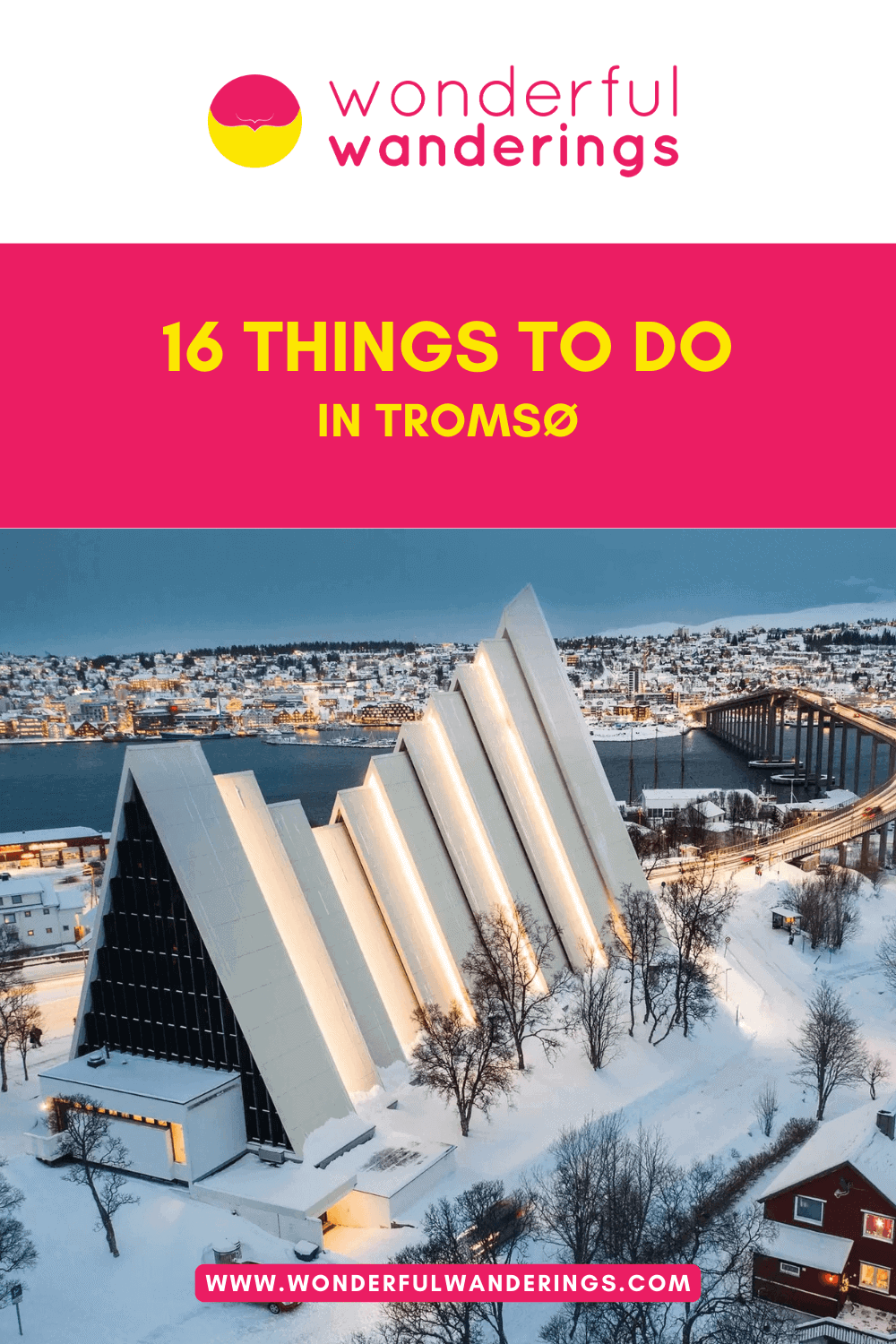
The Arctic Cathedral is the building on every photograph of Tromsø, and it is free to walk into. Jan Inge Hovig designed it and it was finished in 1965, a row of eleven concrete triangles that reads as an iceberg from the fjord and as a row of drying racks from close up. Its real name is Tromsdalen Church, and it is a parish church rather than a cathedral.

Go inside for the glass. The east wall is filled by an enormous stained-glass mosaic, and the organ built by Jürgen Ahrend carries more than 2,900 pipes and is arranged so that it does not block it. The church seats around 600 and the interior is deliberately plain apart from that one wall.
Time a visit around a concert if you can. Midnight sun concerts run through the summer nights and northern lights concerts through the winter, both short and both worth the ticket. The church is across the bridge in Tromsdalen, on local bus routes from the centre, and about 2 km (1.2 mi) from the middle of town.
2. Fjellheisen Cable Car
Fjellheisen is the fastest way to understand where Tromsø actually is, because from the top you see the island, the bridge, the fjord and the mountains behind them at once. The cable car has run since 1961 and takes about five minutes to reach Storsteinen, 421 m (1,381 ft) above the fjord, from a lower station in Tromsdalen.

Go up in the evening rather than the middle of the day. The cars run until midnight, the viewing platform faces west over the city, and in winter this is one of the easiest aurora vantage points in Norway because you are above the streetlights without needing a car. Fjellstua at the top has a cafe and a restaurant.
A return ticket is 495 NOK (about €46, $53, £39) for an adult and 280 NOK (about €26, $30, £22) for a child aged 3 to 15, and a one-way ticket lets you walk down. Bus 26 from the centre stops at the lower station, and it is a 30-minute walk from town across the bridge.
3. Polaria
Polaria is the Arctic aquarium in the middle of Tromsø, and it is the reliable answer to a wet afternoon with children. It opened in 1998 in a building shaped like ice floes pushed up onto the shore, and it sits on the waterfront a short walk from the centre.

The bearded seals are the reason most people come. They live in a large basin with underwater viewing windows, and the daily training and feeding sessions are when to be there. Around them are tanks of local cold-water species, a panoramic cinema running Arctic films, and displays on polar expeditions, sea ice and climate.
Allow an hour and a half. Polaria is on Hjalmar Johansens gate, a 10 to 15-minute walk from the middle of town, and the airport bus stops outside it.
4. Tromsø Museum
Tromsø Museum, properly the Arctic University Museum of Norway, is the oldest scientific institution in northern Norway and the museum to pick if you visit only one. It was founded in 1872 and its permanent displays cover the northern lights, Arctic geology and wildlife, and Sámi history and culture, which is the part most visitors remember.

Start with the aurora exhibition. It explains what is actually happening 100 km above your head before you go out looking for it, which makes the first clear night far more interesting, and the Sámi galleries cover reindeer herding, language and the Norwegianisation policies of the 19th and 20th centuries with real depth.
An adult ticket is 130 NOK (about €12, $14, £10), seniors pay 100 NOK and under-18s go free. The museum is on Lars Thøringsveg at the southern end of Tromsøya, about 2.5 km from the centre, on local buses and on the airport bus route.
5. Perspektivet Museum
Perspektivet is the small museum that deals with Tromsø as a place people live rather than a place people visit. It occupies a 19th-century wooden building on Storgata that was the town’s first workers’ hall, and its exhibitions use photography, objects and text to look at migration, identity and daily life in the north.

The photographic archive is the collection that matters. It holds several hundred thousand images of Tromsø going back to the earliest years of the camera, and the displays draw on it constantly, which is why the museum reads more like a documentary than a display case. A permanent exhibition covers the novelist Cora Sandel, who grew up here as Sara Fabricius.
Give it an hour. It is on the main street in the middle of town, so it slots into any walk, and the admission charge is small.
6. Mack Brewery
Mack is the world’s northernmost brewery and it has been in Tromsø since Ludwig Markus Mack founded it in 1877. It is still family owned, which is unusual at this age, and the beer is part of the city’s identity in a way that is hard to overstate this far north.

Know what is where before you go. Main production moved to Nordkjosbotn, about 70 km away, in the autumn of 2012, but the historic Mack quarter in the centre still holds the microbrewery, the Kjeller 5 beer shop on Storgata and Ølhallen, the brewery’s beer hall and the oldest pub in Tromsø. Guided tours start at Kjeller 5, run around 45 minutes to an hour and end with a tasting.
Book the tour ahead in winter. Ølhallen keeps its own hours and pours a long list of Mack beers plus guest taps, and it opens earlier in the day than any other bar in town.
7. Tromsø War Museum
The Tromsø War Museum is built around a restored German coastal battery above Tromsdalen, and it is the one attraction on this list with a season short enough to catch people out. The site holds the gun positions, a searchlight, a mine thrower and the tunnels behind them, put there to defend the approaches during the German occupation.

The Tirpitz exhibition is the reason to make the trip. The German battleship was sunk by RAF bombers just outside Tromsø on 12 November 1944, with heavy loss of life, and the wreck lay in the shallows off Håkøya for years afterwards; the museum holds recovered material and photographs. A third section covers the retreat of German forces through Finland into Troms in 1944 and 1945, and the forced evacuation and burning of Finnmark that went with it.
Check the calendar before you set out. The museum opens only on Sundays in May and September and at weekends from June to August, and it is at Solstrandvegen in Tromsdalen, reached by local bus.
8. Arctic-Alpine Botanic Garden
The Arctic-Alpine Botanic Garden is the northernmost botanic garden in the world, and entry is free. It is run by the university museum and planted almost entirely with cold-climate species, roughly 1,200 of them, arranged in collections from the Arctic, the Himalaya, South America and the mountains of Europe.

Come between late June and August, and understand why that window is so short. There is snow on the beds for much of the year and everything flowers at once when it goes, so the garden goes from bare to full in a couple of weeks and then runs at full colour through the midnight sun. Blue Himalayan poppies are the flower people photograph.
There is no gate and no ticket, and the garden is open at any hour. The summer cafe in the reconstructed farmhouse runs through the season, and local buses to the university stop a short walk away.
9. Tromsø Cathedral
Tromsø Cathedral is one of the largest wooden churches in Norway and it stands in the middle of town, which makes it the easiest historic building in the city to visit. Christian Heinrich Grosch designed it in Gothic Revival style and it was consecrated in 1861, on a site where there has been a church since the Middle Ages.

The interior is the surprise. Everything is timber, painted pale, with an open beamed roof and long galleries, and it seats around 600, which was a very large church for a town of a few thousand people at the time. The altarpiece is a copy of Adolph Tidemand’s Resurrection.
Entry is free during opening hours and guided tours run in summer. The cathedral is a couple of minutes from Storgata and the main square, and concerts are held here through the year.
10. The Polar Museum
The Polar Museum is where Tromsø’s history as a hunting and expedition port is kept, in a wooden wharf warehouse on the harbour. It belongs to the same university museum group as Tromsø Museum, and it is the more atmospheric of the two: low ceilings, tar and rope, and the smell of an old quayside building.

The subject is not comfortable, and the museum does not pretend otherwise. The displays cover Arctic trapping on Svalbard, sealing in the ice, and the overwintering hunters who did it, alongside the polar expeditions that used Tromsø as their last port, including Roald Amundsen’s, whose final flight left from here in 1928. Wanny Woldstad, who trapped on Svalbard in the 1930s, gets a section of her own.
An adult ticket is 130 NOK (about €12, $14, £10) and under-18s go free. The museum is on Søndre Tollbodgate on the waterfront, five minutes from the main street, and the sealing vessel MS Polstjerna is preserved nearby under the same management.
11. Verdensteatret
Verdensteatret is a cinema from 1916 that is still showing films, which makes it one of the oldest working cinemas in Norway. The Art Nouveau building on Storgata has been a listed structure since 1999, and the auditorium keeps its original murals, painted to fill the silence in the days before sound.

Go for whatever is on rather than for a specific film. The programme runs to independent and international releases, documentaries and retrospectives, and tickets cost a fraction of what an evening out costs elsewhere in Norway.
Time a January visit around the Tromsø International Film Festival, which uses Verdensteatret as one of its main venues and fills the city in the middle of the polar night. The cinema is on the main street in the centre.
12. Tromsø Kunstforening
Tromsø Kunstforening is the oldest art society in northern Norway and its gallery is free to enter. It shows contemporary art, weighted towards the experimental end, mixing international names with artists working in the north, and the programme changes several times a year.

Treat it as a 30-minute stop rather than an afternoon. There is no permanent collection, so what you see depends entirely on the date, and the guided tours and talks that go with each exhibition are also free.
The gallery is a short walk from the centre. Combine it with the Nordnorsk Kunstmuseum, which is nearer the harbour and covers the region’s art with a collection behind it.
13. Prestvannet Lake
Prestvannet is the lake on the roof of Tromsøya, and it is the aurora spot you can reach on foot. It sits at the high point of the island, around 100 m above the sea, and it was the city’s water reservoir before becoming a nature reserve, which is why it is ringed by trees rather than houses.

Walk up on a clear winter night and it does the job. The lake is far enough from the streetlights to give a usable dark sky without a car or a tour, and the low horizon in every direction is what you want for a display that arrives from the north. Bring a torch, spikes for your boots and more layers than feel necessary.
In summer it is a different place entirely: nesting birds, marked paths and a circuit that takes about half an hour. It is a steep 20 to 25-minute walk up from the centre, or a short bus ride.
14. North Norwegian Science Center Tromsø
The North Norwegian Science Center is the hands-on science museum on the university campus, and its planetarium is the reason adults go too. It opened in 2002 with more than 100 interactive installations covering weather, energy, astronomy, physics and the human body.

Book the northern lights show in the dome. It is a full-dome film on the aurora, which explains the physics and shows a good display on a night when the sky outside may not deliver one, and it is the sensible insurance policy for a short winter trip. Other shows cover the Arctic sky and the solar system.
The centre is on the university campus a few kilometres north of the centre, on frequent local buses, and it sits next to the university museum’s Botanic Garden, so the two combine.
15. Chasing the northern lights
Chasing the northern lights is the reason most people come to Tromsø, and the season runs from roughly September to early April, with the strongest odds between November and February. The lights need darkness and a clear sky, not cold, which is why September and March work as well as midwinter and are considerably more comfortable.

Take a guided chase rather than standing still if you have only a night or two. Tromsø sits under the auroral oval, so the display is usually there; the problem is coastal cloud. Minibus tours exist to drive away from it, sometimes several hours inland towards Finland or Sweden, and a guide who checks the forecast and moves is worth more than any particular viewpoint.
Do it yourself if you have a week and a car. Kvaløya and the road towards Ersfjordbotn get you out of the light in half an hour, Prestvannet works on foot, and the cable car runs to midnight. Whatever you choose, allow at least three nights, because one clouded-out evening is common and two in a row is not unusual.
16. Nordnorsk Kunstmuseum
The Nordnorsk Kunstmuseum is the art museum of northern Norway, and it is the place to see Sámi art properly. It sits on the harbour front in the centre of Tromsø and combines a collection of northern Norwegian art from the 19th century onwards with a changing exhibition programme.

Look for the duodji and the contemporary Sámi work. The museum has done more than any other Norwegian institution to put Sámi artists into the national art conversation, and its exhibitions regularly travel, so what is on the walls in Tromsø often ends up in Oslo later.
An adult ticket is 130 NOK (about €12, $14, £10) and under-18s go free. The museum opens Tuesday to Sunday, it is five minutes from the main square, and the free guided tours are a good use of half an hour.
17. Whale watching in the fjords
Whale watching from Tromsø works from early November to late January and not at any other time, which is the single most useful thing to know about it. Norwegian spring-spawning herring overwinter in the fjords north of the city, and orcas and humpback whales follow them in, in numbers that have made this one of the more reliable whale encounters in Europe.
Expect a long day rather than a boat trip. The herring move between fjords from year to year, and in recent seasons the animals have concentrated around Kvænangen and Skjervøy, several hours north of Tromsø, so many operators drive or sail a long way to reach them. Trips run in almost no daylight in December, which is part of the experience and hard on photographers.
Choose the operator on how it behaves around the animals, not on price. Silent hybrid-electric boats and small-group RIB trips both exist, guidelines limit how close vessels may approach, and a good crew will keep its distance and tell you why.
18. Dog sledding and a Sámi reindeer camp
Dog sledding and reindeer sledding are the two Arctic activities Tromsø does at scale, and both run roughly from December to April, once there is enough snow. They are half-day or full-day trips out of the city with transfers included, and both are worth doing once even if you think you are not the type.
Understand the difference before you book. On a husky trip you usually drive a team yourself, standing on the runners with a guide’s sled ahead of you, and it is faster and more physical than it looks. A reindeer camp is slower and quieter: a short sled ride behind a single animal, feeding the herd, and a meal in a lavvu, the Sámi tent, usually with a joik and an account of reindeer herding from the family who does it.
Book the reindeer camps with Sámi-owned operators where you can. Several families around Tromsø run their own camps, the money stays with the herding community, and the account you get of Sámi life is first-hand rather than second.
What are the best museums to visit in Tromsø?
The best museums in Tromsø are the Arctic University Museum, the Polar Museum and the Nordnorsk Kunstmuseum, and the first two are run by the same institution. The 5 below are the ones worth the entrance money.
- The Arctic University Museum of Norway (Tromsø Museum). Northern lights, Arctic natural history and the strongest Sámi collection in the city. 130 NOK, under 18 free, at the southern end of Tromsøya.
- The Polar Museum. Trapping, sealing and the expeditions that left from this harbour, in a wooden warehouse on the quay. 130 NOK, under 18 free.
- Nordnorsk Kunstmuseum. Northern Norwegian and Sámi art, on the harbour front. 130 NOK, under 18 free, closed Mondays.
- Perspektivet Museum. Photography and social history of Tromsø itself, in an old workers’ hall on Storgata. Small admission charge.
- Polaria. Not strictly a museum, but the aquarium, the seals and the Arctic cinema are what most families pick first.
What are the best things to do in Tromsø with kids?
The best things to do in Tromsø with children are Polaria, the science centre and a husky trip, in that order of effort. The 5 below all work for a family and 2 of them cost nothing.
- Polaria. Bearded seals, feeding sessions, touch pools and a film. Indoors and central.
- The North Norwegian Science Center. More than 100 things to press, plus a planetarium show on the northern lights.
- A husky camp. Most operators run shorter family trips with a guide driving, and the puppies do the rest of the work.
- Fjellheisen. The ride is short, the view is enormous and the cafe at the top sells hot chocolate.
- Prestvannet in winter. Free, walkable and frozen hard enough to slide on for months.
How many days are needed to see Tromsø?
Three days is the minimum for a winter trip to Tromsø and four or five is better, because the aurora needs more than one attempt. The city itself takes a day and a half; the rest of the time is weather insurance and excursions.
Plan it as one indoor day, one big excursion and one flexible evening. A summer trip works differently: two days covers the museums, the cable car and a fjord trip, and the light lasts all night, so an evening walk up Storsteinen at 11pm is a normal thing to do.
Is Tromsø worth visiting?
Yes, Tromsø is worth visiting, and it is the easiest place in the world to combine a real Arctic experience with a city that has restaurants, buses and a cinema. You can be on a dog sled or under the aurora within an hour of a hotel bed, which is not true of most places this far north.
Set the expectation on weather rather than sights. Tromsø is coastal and cloudy, the aurora is never guaranteed on any given night, and the trips that get cancelled are cancelled for good reasons. Come for four nights rather than two and the odds change completely.
Is Tromsø expensive to visit?
Yes, Tromsø is expensive, and it is more expensive than Oslo for the things visitors actually buy. Guided excursions are the main cost: a northern lights chase, a whale trip or a day of dog sledding each run into several hundred kroner or more per person, and they are the reason a Tromsø week costs what it does.
Three habits keep it down. Buy your alcohol at Vinmonopolet rather than in bars, eat the fixed lunch menus rather than dinner, and lean on the free attractions, which here means the Arctic Cathedral, the Botanic Garden, Tromsø Kunstforening, Tromsø Cathedral and Prestvannet.
Is Tromsø safe to visit?
Yes, Tromsø is a safe city, and the realistic hazards are environmental rather than criminal. Ice on the pavements from November to April is the one that catches visitors out, and studded overshoes cost very little and are sold in every supermarket.
Two more worth taking seriously. Dress for the temperature you will be standing still in rather than walking in, because an aurora chase involves hours of not moving, and check avalanche warnings before any winter hike outside the city, since the mountains around Tromsø kill people most winters.
What is Tromsø famous for?
Tromsø is famous for the northern lights, the Arctic Cathedral and its history as the departure point for polar expeditions. It was called the Paris of the North in the 19th century, when the town’s imported fashions surprised visitors who had expected a fishing station, and the name has stuck in the tourist literature.
Two other things belong on the list. Tromsø is the largest city in northern Norway and the base for its university, its Arctic research institutes and the Norwegian Polar Institute, and it is one of the main urban centres of Sámi life, with Sámi language teaching, institutions and a large community in and around the city.
What to eat in Tromsø
The 5 things below are what to eat in Tromsø, and 3 of them come out of the water in front of you.
- Skrei. Migratory Arctic cod, caught between January and April, poached and served with liver, roe and potatoes. The great seasonal dish of northern Norway.
- Reindeer. Served as a steak, a stew or thin-sliced finnbiff with mushrooms and lingonberries, and central to Sámi food.
- King crab. Caught in the Barents Sea and served by the leg, usually cold with mayonnaise. Expensive and worth it once.
- Bacalao. Salt cod stewed with tomato, pepper and potato, a leftover from the Norwegian salt fish trade with Portugal and Spain.
- Cloudberries. Multer, picked on the bogs in late summer, served with cream or in a dessert. The one Arctic ingredient nobody can farm.
Where is Tromsø and how do you get there?
Tromsø is on an island in the fjords of northern Norway, about 350 km (217 mi) north of the Arctic Circle and roughly 1,150 km (715 mi) north of Oslo. Almost everyone arrives by air, at Tromsø Airport on the western side of the same island.
Getting in from the airport is easy and short. The Flybussen airport coach reaches the centre in about 15 minutes and calls at the main hotels, the local bus is cheaper and takes a little longer, and a taxi is a short ride, because the airport is only 4 to 5 km (2.5 to 3.1 mi) from town.
Compare the routes before fixing your dates, since fares into Tromsø move a great deal between the aurora season and the rest of the year. Compare flight options to Tromsø on Trip.com and set a price alert if your dates can move. Our guide to where to go in Norway covers what else to add to the trip.
How do you get from Tromsø to Oslo?
You get from Tromsø to Oslo by air in about two hours, and there is no realistic alternative. There is no railway to Tromsø; the line north ends at Bodø, still around 600 km short of the city, so a train and bus combination takes the better part of two days.
The scenic alternative is the coastal ship rather than the road. Hurtigruten and Havila call at Tromsø daily on the run between Bergen and Kirkenes, which is a genuine way to arrive or leave rather than a cruise, and Oslo is better treated as a separate stop with its own flight than as a drive.
Do you need a car in Tromsø?
No, you do not need a car in Tromsø itself, and most winter visitors do not hire one. The centre is walkable, local buses reach the cable car, the museums and the university, and every excursion picks up from central hotels.
A car changes what you can do outside the city, which is why some people take one anyway. Kvaløya, Ersfjordbotn, Sommarøy and the Lyngen Alps are all within a day’s drive and none is well served by public transport, and having your own vehicle means you can move away from the cloud on an aurora night. DiscoverCars compares the local and international suppliers side by side, and winter tyres, which are a legal requirement here, should be confirmed before you book.
Where to stay in Tromsø
Stay in the centre of Tromsø rather than outside it, because that is where the excursion buses pick up and where you will want to be at four in the afternoon in December. The 3 areas below cover the realistic choices.
- Sentrum. The grid of streets around Storgata and the harbour, with the museums, the restaurants and the tour pick-up points all within a few minutes’ walk. The most convenient and the most expensive.
- Tromsdalen. Across the bridge, beneath the Arctic Cathedral and the cable car, quieter and often cheaper, with the mountain on the doorstep and a 20-minute walk or a short bus ride into town.
- Outside the city. Lodges and cabins on Kvaløya and in the fjords, darker skies and better aurora odds, but you will need a car and you give up the restaurants.
Book far earlier than you would for anywhere else in Norway, because Tromsø’s aurora season sells out months ahead and prices in December and January are the highest of the year. Apartment rentals usually work out better than hotels for a family or a stay of several nights, and a kitchen saves a lot on a trip where dinner out is a real expense.
PIN FOR LATER
WonderfulWanderings Pro Tips
The 3 tips below come from checking this page’s attractions, seasons and prices against the operators’ and museums’ own sources, and each one corrects something the Tromsø round-ups repeat.
- Sommarøy needs no ferry. The island is connected to Kvaløya by road bridge and you drive the whole way from Tromsø, so ignore any itinerary that budgets a crossing and a sailing time into the day.
- There is no indoor ski slope in Tromsø. Guides that promise children year-round skiing under a roof are describing something the city does not have, so plan a wet winter afternoon around the museums, the pool or the cable car instead.
- The wooden town centre is standing because the war largely missed it. Tromsø was one of the few towns in northern Norway to come through the occupation intact, and it took in people from Finnmark after their villages were burned. That is why the 1861 cathedral, the quayside warehouses and the timber buildings on Storgata are still here to look at.
About the author. This guide is written and maintained by the Wonderful Wanderings editorial team. Wonderful Wanderings was founded in 2012 by Sofie Couwenbergh, and the team covers Norway for independent travellers, from Oslo and the Oslofjord to Tromsø and the Arctic north. We cover the flights, the hire cars, the places to stay and the northern lights, whale and dog sledding trips worth booking, and update this page when seasons, opening hours and prices change.