 EN
EN
 Nederlands
 Français
Vigeland Sculpture Park, the MUNCH museum, the polar ships on Bygdøy and the Holmenkollen ski jump are the four things to do in Oslo that almost every visitor keeps on the list, and three of them are reachable from the centre in under half an hour on a tram, a bus or the metro. Oslo is compact in the middle and enormous at the edges, with the Oslofjord on one side and the Nordmarka forest on the other, both inside the city boundary.
Two practical points shape a first visit. Several of the biggest museums sit together on the Bygdøy peninsula, so it makes sense to give them one day rather than three separate trips, and a good number of the city’s landmarks cost nothing at all, including the sculpture park, the Opera House roof, the harbour promenade and the Armed Forces Museum inside Akershus Fortress.
Things to do in Oslo: the short answer
The 6 attractions below are the ones to book a trip around, with what each costs and how you reach it. The full list of 23 follows underneath.
| Attraction | What it is | Cost | Getting there |
|---|---|---|---|
| Vigeland Sculpture Park | More than 200 Gustav Vigeland sculptures in a public park | Free, open day and night | Tram 12 to Vigelandsparken, or metro to Majorstuen |
| MUNCH | The world’s largest collection of Edvard Munch’s work | Ticketed | Walk from Oslo S, in Bjørvika behind the Opera House |
| Holmenkollen ski jump and Ski Museum | Norway’s most visited attraction, with a viewing platform at the top | Ticketed | Metro line 1 to Holmenkollen, then a short climb |
| Fram and Kon-Tiki museums | The original polar ship Fram and Thor Heyerdahl’s raft | Ticketed, combo ticket available | Bus 30 to Bygdøynes, or the summer ferry |
| Oslo Opera House | A marble roof you walk up for the view over the fjord | Free to walk on | Across the road from Oslo Central Station |
| Norwegian Museum of Cultural History | An open-air museum of more than 160 relocated buildings | Ticketed | Bus 30 to Folkemuseet on Bygdøy |
1. Vigeland Sculpture Park
Vigeland Sculpture Park is the one attraction in Oslo nobody should skip, and it costs nothing. The park sits inside Frogner Park about 3 km (1.9 mi) northwest of the centre and holds more than 200 sculptures in bronze, granite and wrought iron, all by Gustav Vigeland, which makes it the largest sculpture park anywhere created by a single artist.

Walk the 850 m main axis and the sequence does the explaining. It runs from the entrance gates over the bridge, past the Angry Boy, up to the Fountain with its bronze figure groups, and finishes at the Monolith, a 14 m column carved from one block of granite with 121 human figures climbing over each other towards the top. The subject throughout is the human life cycle rather than any myth or history.
There is no ticket, no gate and no closing time, so an early morning or a late summer evening gives you the place almost to yourself. The Vigeland Museum across the road, in the studio the city built for him, does charge admission and explains how the whole thing was made.
2. Munch Museum
MUNCH holds the largest collection of Edvard Munch’s work anywhere, because the artist left almost everything in his studio to the city of Oslo when he died in 1944. The museum opened at Tøyen in 1963 and moved in 2021 to a 13-storey tower on the Bjørvika waterfront designed by the Spanish practice Estudio Herreros, which is where you will find it now.

Go for the paintings you know and stay for the ones you do not. The Scream, Madonna, The Dance of Life and The Sick Child are the draws, and the building holds several thousand more works, so the displays rotate. There are versions of The Scream in both this museum and the National Museum, which catches people out.
Book a timed ticket online, because capacity is limited and the museum sells out at peak times. It is a short walk from Oslo Central Station along the waterfront, past the Opera House, and the top-floor bar is worth the lift ride for the view even if you skip the drink.
3. Fram Museum
The Fram Museum is built around a ship you can walk onto, which is what separates it from every other museum in Oslo. Fram is the 39 m polar schooner that carried Nansen, Sverdrup and Amundsen on expeditions between 1893 and 1912, built with a rounded hull so that pack ice would lift her rather than crush her.

Go below decks and the point lands. You see the cabins, the galley, the engine room and the equipment the crews actually used, and the exhibits around the hull cover the attempts on the North Pole, Amundsen’s South Pole expedition and the science that came out of them. The neighbouring hall holds Gjøa, the first vessel to sail the Northwest Passage.
The museum is on Bygdøynes on the Bygdøy peninsula, about 15 minutes from the centre on bus 30, or on the ferry from the City Hall pier between spring and autumn. A combined ticket with the Kon-Tiki Museum next door costs less than two separate ones.
4. Akershus Fortress
Akershus Fortress is the medieval castle on Oslo’s harbour and the cheapest history lesson in the city, because the grounds are free to walk. Building started around 1300, Christian IV rebuilt it as a Renaissance residence in the 17th century, and it has never been taken by a besieging army.

Walk up from the waterfront and you get ramparts, a parade ground, the castle church and views over the fjord and the Opera House. Two museums stand inside the walls: the Armed Forces Museum, which covers eight centuries of Norwegian military history and has free admission, and Norway’s Resistance Museum, which deals with the German occupation from 1940 to 1945 and is the more affecting of the two.
The castle interior itself is ticketed and worth it for the halls and the royal mausoleum. The fortress is a 15-minute walk from Oslo Central Station and about 200 m from the Kontraskjæret tram stop.
5. Oslo Opera House
The Oslo Opera House is a building you climb rather than only enter, and walking on it is free. The Snøhetta design puts a sloping roof of white Italian marble straight down into the water of Bjørvika, and the public is meant to walk up it, which is why there is no railing and no ticket barrier.

Go up for the view over the fjord, the Barcode towers and the islands, and go inside for the oak-lined main auditorium, the home of the Norwegian National Opera and Ballet. Guided tours take you backstage into the costume workshops and the scene-painting room, and performances run through the year.
The Opera House stands across the road from Oslo Central Station, with the metro, trams and buses at Jernbanetorget a couple of minutes away. Wear shoes with grip: the marble is slick when it is wet or icy, which in Oslo is often.
6. Aker Brygge
Aker Brygge is the waterfront strip where Oslo goes to eat outside, built on the site of the Akers Mekaniske Verksted shipyard that closed in 1982. The redevelopment in the 1980s turned the quays into shops, restaurants, bars and offices, and it now draws millions of visitors a year without charging anyone to walk through it.

Keep going west past the marina and you reach Tjuvholmen, which is the better half. The Astrup Fearnley Museum of Modern Art sits at the end of it in a Renzo Piano building with a sail-shaped glass roof, there is a small city beach beside it, and the sculpture park along the water is free.
Boat tours on the fjord leave from the quays here and from the City Hall pier next door. Aker Brygge is a four-minute walk from the Nationaltheatret metro station and about six from Jernbanetorget.
7. Karl Johans Gate
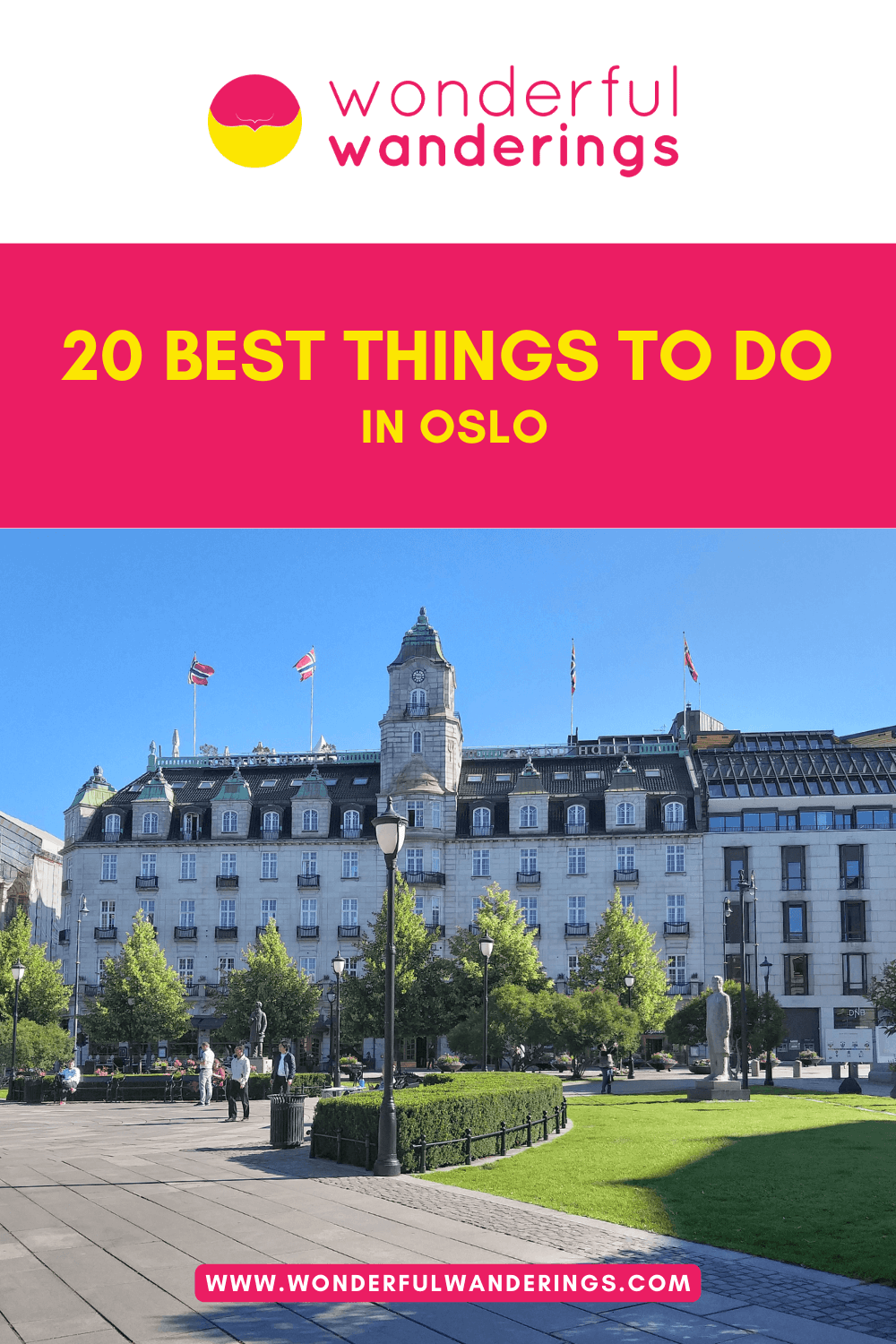
Karl Johans gate is Oslo’s main street and the simplest orientation walk in the city, running about 1 km from Oslo Central Station up to the Royal Palace. Everything official is on it or beside it: the Parliament, the National Theatre, the old University buildings, the Grand Hotel and the cathedral.

Start at the station end, which is pedestrianised and busy with buskers and stalls, and walk west. Halfway along, Eidsvolls plass opens out in front of the Parliament with lawns and fountains in summer and a public ice rink in winter, and at the top the palace sits in its own park, where the changing of the guard happens daily at 1.30pm.
The street costs nothing to walk and takes about 20 minutes end to end without stopping, which is never what happens. Trams 11, 12, 13, 17 and 18 all stop at Nationaltheatret partway along.
8. Nobel Peace Center
The Nobel Peace Center is the museum of the Nobel Peace Prize, and it stands beside Oslo City Hall where the prize is handed over every 10 December. It opened in 2005 in the former West Railway Station building of 1872, overlooking the harbour, and takes around 200,000 visitors a year.

Expect installations rather than cabinets. The permanent displays cover Alfred Nobel and more than 100 laureates, from Martin Luther King Jr to Malala Yousafzai, and the Nobel Field changes each year to present the current winner. Temporary exhibitions usually take one conflict or one laureate and go deep.
Tickets are timed and guided tours are included with entry. The centre is two minutes from the Aker Brygge tram stop on line 12 and three minutes from the ferry terminal.
9. Norwegian Museum of Cultural History
The Norwegian Museum of Cultural History, Norsk Folkemuseum, is an open-air museum where more than 160 buildings from around Norway have been taken apart, moved to Bygdøy and rebuilt. It was founded in 1894, which makes it one of the oldest museums of its kind anywhere, and it covers roughly 40 hectares.

Head for the stave church first. Gol stave church, built around 1200 and moved here from Hallingdal, is the single most photographed thing on the site, and the reconstructed 19th-century farmsteads and the early 20th-century apartment block around it show how Norwegian domestic life changed. Indoor galleries cover folk art, Sami culture and national costume.
Costumed staff run demonstrations in summer, and there is usually baking, folk dancing or a horse and cart involved. Bus 30 stops at the entrance, about 15 minutes from the centre, and the summer ferry from the City Hall pier lands a short walk away.
10. Oslo Cathedral
Oslo Cathedral is the working parish church in the middle of the shopping district, and there is no charge to go in and look. The current building went up between 1694 and 1697 on Stortorvet square, in a plain Dutch Baroque style, and it is where the Norwegian royal family holds its weddings and funerals.

Look up rather than around. The ceiling paintings by Hugo Lous Mohr were added in the 1930s and 1940s, the pulpit and the altarpiece survive from the original 17th-century church, and the stained glass is by Emanuel Vigeland, brother of the sculptor whose park opens this list.
The cathedral has served as the city’s gathering place at difficult moments, and the flower memorials after the attacks of 22 July 2011 filled the square outside. Trams 11, 12 and 13 stop at Stortorvet directly in front of it.
11. Oslo City Hall
Oslo City Hall is where the Nobel Peace Prize is presented every December, and on any other day you can walk into the main hall for nothing. The dark red brick building with its two towers went up between 1931 and 1950, in a Norwegian version of Functionalism, and it faces the harbour rather than the city.

The interior is the reason to go in. The main hall is covered in murals by Norwegian artists including Henrik Sørensen and Alf Rolfsen, running from Norse myth through the labour movement to the occupation years, and the effect is closer to a public art gallery than a council office. The eastern tower carries a 49-bell carillon.
Free guided tours run in summer in several languages and get you into rooms that are otherwise closed. Trams 12 and 13 stop outside, and the harbour promenade runs past the front steps.
12. Kon-Tiki Museum
The Kon-Tiki Museum holds the balsa raft that Thor Heyerdahl sailed 8,000 km across the Pacific in 1947, and it is the strangest object on Bygdøy. Heyerdahl built the raft to a pre-Columbian South American design and drifted from Peru to Polynesia in 101 days to argue that ancient South Americans could have reached the islands.

The raft is the centre of it, and the rest fills in the man. The museum also holds Ra II, the papyrus boat he sailed from Morocco to Barbados in 1970, along with expedition logs, film and finds from his work on Easter Island and in the Galápagos. The documentary made from the crew’s own footage won an Academy Award in 1952 and is shown daily.
The museum is next door to the Fram Museum on Bygdøynes, so the two are one trip and one combined ticket. Bus 30 from the centre stops outside.
13. Natural History Museum
The Natural History Museum in Tøyen is Norway’s oldest and largest natural history collection, and its outdoor Botanical Garden is free. The University of Oslo founded it in 1814 and it now holds several million zoological, botanical, geological and palaeontological specimens.

Two things pull visitors in. The Geological Museum has the fossil primate known as Ida, a 47-million-year-old skeleton preserved almost complete, and the Zoological Museum sets Norwegian wildlife in habitat dioramas from the Arctic to the coast. The glasshouses in the garden are a genuine relief on a February afternoon.
Entry to the indoor exhibitions is ticketed, the garden is not. Tøyen metro station is about six minutes’ walk from the southern gate, and tram 17 stops closer still.
14. Norwegian Maritime Museum
The Norwegian Maritime Museum covers the part of Norwegian history that happened at sea, which is most of it. Founded in 1914 and sitting on Bygdøynes beside the Fram and Kon-Tiki museums, it runs from prehistoric boats through the Viking and medieval periods to the modern merchant fleet and offshore industry.

Look for the oldest boat first. The museum holds a dugout canoe more than 2,000 years old, alongside finds from medieval wrecks, a boat-building laboratory, a large collection of maritime painting and a panoramic film about the Norwegian coast. The schooner Svanen is usually moored outside.
The building is about 5 km from the centre. Bus 30 from Nationaltheatret takes around 17 minutes to Bygdøynes, and the museum ferry from the City Hall pier runs from spring to autumn.
15. Oslo Reptile Park
Oslo Reptile Park is the wet-weather option with children, an indoor zoo in a basement on St. Olavs gate a few minutes from Karl Johans gate. It opened in 2002 and keeps more than 100 species of reptiles, amphibians, fish, insects and small mammals.

Snakes and lizards take up most of the space. Boa constrictors, pythons, chameleons, geckos, poison dart frogs, tarantulas, turtles, a dwarf crocodile and a few monkeys are all here, and staff run handling sessions and feeding demonstrations at set times. It is small, so an hour covers it.
The park is a four-minute walk from Stortinget metro station and two minutes from the Stortorvet tram stop. Check the opening hours before setting out, because they change between the summer and winter seasons.
16. Oslo Harbour Promenade
The Oslo Harbour Promenade is a 9 km (5.6 mi) walking route along the whole waterfront, from Frognerkilen in the west to Kongshavn in the east. It opened in stages from 2008 as the city reclaimed its industrial docks, and it is the clearest way to understand how Oslo is put together.

Walk it in sections rather than in one go. The central stretch takes you past Tjuvholmen, Aker Brygge, City Hall, Akershus Fortress, the Opera House and the Deichman library in about an hour, with orange information towers marking the route, sculptures along the way and swimming decks and floating saunas at Sørenga and Operaen.
Everything about the walk is free. Trams and buses cross it at several points, and the summer fjord ferries stop along it if you want to cut a section short.
17. Mathallen Food Hall
Mathallen is Oslo’s indoor food market and the easiest place in the city to eat well without booking. It opened in 2012 in a restored 1902 iron foundry in the Vulkan quarter beside the Akerselva river, and holds around 30 shops, bars and counters under one roof.

Come hungry and graze. There are cheesemongers, bakers, a fishmonger and butchers selling to take away, plus counters doing everything from Norwegian seafood to tacos, and communal tables in the middle so a group can eat from four different places at once. Cooking demonstrations and tastings run through the week.
Entry costs nothing and you pay only for what you buy. Mathallen is about 1.5 km from the centre, a 15-minute walk up the river path through Grünerløkka, or a short ride on bus 34 or 54 to Møllerveien.
18. The National Museum, formerly the National Gallery
The National Museum is the largest art museum in the Nordic countries and it replaced the old National Gallery, which is the single thing most Oslo guides still get wrong. The National Gallery on Universitetsgata closed to the public in 2019, and its collection moved into the new building at Brynjulf Bulls plass 3 by the harbour, which opened on 11 June 2022.

Everything is now under one roof. Norwegian and international art, architecture and design run from antiquity to the present across some 90 rooms, and the collection includes the 1893 version of Edvard Munch’s The Scream along with Madonna and the Munch room around them. The Light Hall on the top floor is a 2,400 sq m glass-ceilinged gallery used for temporary exhibitions.
Give it half a day rather than an hour, and buy the ticket online. The museum is about 1 km west of Oslo Central Station and a short walk from the Nationaltheatret metro and tram stops.
19. Oslo Fjord Boat Tour
A fjord boat tour is the quickest way to see Oslo from the water, and the inner Oslofjord is dotted with small islands that most visitors never set foot on. Sightseeing cruises leave from the City Hall piers, run for roughly two hours and pass the Opera House, Akershus Fortress, the Bygdøy museums and the summer cabins along the shore.

There is a cheaper way to do almost the same thing. The public ferries to Hovedøya, Lindøya, Gressholmen and Langøyene run on ordinary Ruter tickets from Vippetangen, and Hovedøya has the ruins of a Cistercian monastery, swimming beaches and marked paths, all about ten minutes from the quay.
Book the sightseeing cruise ahead in summer and check what is included, because some tours are guided, some are silent electric boats and some come with a meal. Prices differ accordingly.
20. Oslo Winter Park
Oslo Winter Park is the ski area inside the city limits, about 20 minutes from the centre at Tryvann, and it is the reason Oslo people do not need a weekend to ski. It has 18 slopes and 11 lifts across the Tryvann, Hyttli and Wyller sectors, with runs for beginners, a terrain park and floodlighting for evening skiing.

Go up on the metro. Line 1 climbs out of the city into the Nordmarka forest and the ski area is a short walk from the station, which means you can ski in the afternoon and be back at your hotel for dinner. Equipment hire and a ski school are on site.
Check conditions before committing in a warm winter. Snow cover at this altitude is variable and the longest run does not always open, though the resort makes snow to cover the gap.
21. Holmenkollen Ski Jump and Ski Museum
Holmenkollen is the most visited attraction in Norway, drawing roughly a million people a year, and the view from the top of the jump reaches further than any other in the city. Ski jumping has been held on this hillside almost every year since 1892, and the current steel tower, finished in 2010, stands over the city like a diving board.
Buy the combined ticket and do both halves. The Ski Museum in the base of the jump is the oldest museum of skiing in the world and covers 4,000 years of the sport, including the Norwegian polar expeditions, and a lift plus 114 steps takes you to the observation deck at the top for a 360-degree view over the city, the fjord and the forest. A zip line runs 360 m down the length of the landing slope for anyone who wants it.
Metro line 1 to Holmenkollen station puts you a steep ten-minute walk below the arena. Go on a clear day, because the view is the point.
22. Deichman Bjørvika
Deichman Bjørvika is Oslo’s main public library and one of the few genuinely great buildings you can walk into for nothing. It opened in 2020 next to the Opera House, with an upper floor cantilevered out over the entrance, and it won the International Federation of Library Associations’ Public Library of the Year award in 2021.
It does more than lend books. There are six floors of reading rooms, a cinema, a games area, workshops with 3D printers and sewing machines, a restaurant and a lot of seating with a view over the fjord, and nobody minds how long you stay. On a rainy Oslo afternoon it is the most comfortable free space in the city.
The library is a two-minute walk from Oslo Central Station and next door to both the Opera House and MUNCH, which makes the three of them a natural half-day.
23. Ekebergparken
Ekebergparken is a sculpture park on the wooded hillside east of the centre, free to enter, and it holds the viewpoint where Edvard Munch set The Scream. The park opened in its current form in 2013 and mixes contemporary and modern sculpture into an old public wood, with works by Salvador Dalí, Louise Bourgeois, James Turrell and Damien Hirst among the trees.
Follow the marked route and the city keeps appearing between the trunks. The Munch spot is signposted, with the view down over the fjord that the painting distorts, and there are Bronze Age rock carvings on the hillside as well.
Tram 13 or 19 to Ekebergparken drops you at the entrance, about ten minutes from the centre. Combine it with the walk down through the old wooden houses of Kampen if the weather holds.
What are the best museums to visit in Oslo?
The best museums in Oslo are MUNCH, the National Museum, the Fram Museum and the Norwegian Museum of Cultural History, and between them they cover art, polar exploration and how Norwegians actually lived. The 5 listed below are the ones to choose from if your time is limited.
- MUNCH. The largest Munch collection in the world, in a 13-storey tower on the Bjørvika waterfront. Go for The Scream and stay for the rotating displays from several thousand other works.
- The National Museum. Norway’s national collection of art, architecture and design under one roof at Brynjulf Bulls plass, including the 1893 version of The Scream. It absorbed the old National Gallery.
- The Fram Museum. The polar ship Fram, which you board and walk through, plus Gjøa and the story of Nansen and Amundsen. On Bygdøy, next to the Kon-Tiki Museum.
- The Norwegian Museum of Cultural History. More than 160 relocated buildings including the Gol stave church, on 40 hectares of Bygdøy. The strongest value for money on a dry day.
- The Museum of the Viking Age. The Oseberg, Gokstad and Tune ships are the finest preserved Viking vessels anywhere. It is closed. The old Viking Ship Museum shut in September 2021 for a full rebuild, and the new museum is currently planned to open at the end of 2027, so check before building a trip around it.
What are the best things to do in Oslo with kids?
The best things to do in Oslo with kids are the ones where they can run, climb or touch something. The 5 below all work for a family and 2 of them are free.
- Vigeland Sculpture Park. Open space, no ticket, no rules about noise, and the Angry Boy is a reliable hit.
- The Fram Museum. Children can walk the decks of a real polar ship and crawl into the cabins, which is more interesting than any display case.
- Oslo Reptile Park. Small, indoor, warm, and full of snakes and lizards. The right answer to a wet afternoon.
- The Norwegian Museum of Science and Technology. Hands-on physics, a science playground and a workshop, at Kjelsås on the northern edge of the city.
- Tusenfryd. Norway’s largest amusement park, about 20 minutes south of the city, with roller coasters, a log flume and small rides. It opens seasonally, so check the calendar before promising anything.
What free things can you do in Oslo?
Oslo has more free attractions than its reputation suggests, and 7 of them are listed below. This matters here more than in most capitals, because paid admission and restaurant bills are where a Norwegian trip gets expensive.
- Vigeland Sculpture Park. More than 200 sculptures in a public park with no ticket and no closing time.
- Ekebergparken. A sculpture park in the woods above the city, including the viewpoint from The Scream.
- The Armed Forces Museum. Eight centuries of Norwegian military history inside Akershus Fortress, free to enter.
- Akershus Fortress grounds. Ramparts, parade ground and harbour views, free to walk at any time.
- The Opera House roof. A marble slope you climb for the view over the fjord, at no charge.
- Deichman Bjørvika. Six floors of library, cinema, workshops and fjord views, open to anyone.
- The Botanical Garden at Tøyen. Free outdoor gardens attached to the ticketed Natural History Museum.
MUNCH has also run free entry on Wednesday evenings outside high summer, which is worth checking against your dates rather than assuming.
How many days are needed to see Oslo?
Three days is enough for Oslo, and two will do if you are willing to skip Bygdøy. A workable split gives the first day to the centre, the second to the Bygdøy museums and the third to Holmenkollen and the forest or the fjord islands.
Add a fourth day if you are travelling with children or visiting in winter, because indoor attractions absorb more time and the daylight is short. Oslo in December gets roughly six hours of usable light, which changes what fits into a day.
Is Oslo worth visiting?
Yes, Oslo is worth visiting, particularly for a traveller who wants a capital city with a forest and a fjord inside its own boundary. The museums are strong and unusually specific, the waterfront has been rebuilt into something genuinely walkable, and you can be swimming off an island or skiing above the city within 30 minutes of the centre.
Set your expectations on scale rather than grandeur. Oslo is small for a capital, most of the historic centre burned or was rebuilt, and the pleasure of the place is in the setting and the details rather than in a grand old town.
Is Oslo expensive to visit?
Yes, Oslo is expensive, and eating and drinking out is where the difference shows. Restaurant meals, beer and taxis all cost noticeably more than in the rest of Western Europe, and museum admission adds up quickly if you are paying separately at four or five places.
Three habits bring the cost down. Eat your main meal at lunch, when many restaurants run cheaper fixed menus; buy food at Mathallen, a supermarket or a bakery rather than sitting down for every meal; and work the free list above, which covers a full day on its own.
An Oslo Pass is worth doing the arithmetic on if you plan to visit several ticketed museums. It gives unlimited travel on Ruter public transport in the central zones plus free entry to more than 30 attractions, in 24, 48 and 72-hour versions, with the 24-hour adult pass priced at 580 NOK (about €54, $63, £46) in 2026. It pays for itself at roughly three paid museums in a day.
Is Oslo safe to visit?
Yes, Oslo is a safe city for visitors, including at night and on public transport. The realistic risks are pickpocketing in crowded places like Karl Johans gate, the central station and the summer festivals, and ice on the pavements between December and March.
Two local details are worth knowing. Cycling is common and cycle lanes are used at speed, so look before stepping into one, and swimming off the harbour decks is normal but the water is cold enough year-round to matter.
What is Oslo famous for?
Oslo is famous for the Nobel Peace Prize, Edvard Munch and The Scream, Viking ships and polar exploration. The peace prize is announced and awarded in Oslo every December while the other Nobel prizes are given in Stockholm, which is a quirk of Alfred Nobel’s will.
The city is also known for skiing and for its architecture. Holmenkollen has hosted competitions since 1892 and the metro carries skiers to the forest, and the run of new waterfront buildings since 2008, the Opera House, MUNCH, Deichman and the National Museum, has changed how the city looks from the fjord.
What to eat in Oslo
The 5 dishes below are the ones worth ordering in Oslo, and none of them requires a tasting menu.
- Reker. Fjord prawns bought by the kilo from the boats at Rådhusbrygge in summer, eaten on the quay with bread, mayonnaise and lemon. This is the local ritual, not a restaurant dish.
- Smørbrød. Open sandwiches on dense dark bread, topped with shrimp, roast beef, egg or herring. The standard cheap lunch.
- Fårikål. Mutton and cabbage stewed together with peppercorns, treated as Norway’s national dish and eaten mainly in autumn.
- Brunost. Brown whey cheese with a sweet, caramelised taste, sliced thin onto bread or waffles. It divides opinion on first contact.
- Waffles. Made in heart-shaped irons and served soft with sour cream and jam, or with brunost. Sold at cafes, bakeries and street stands.
Where is Oslo and how do you get there?
Oslo is at the head of the Oslofjord in southeastern Norway, and almost everyone arrives through Oslo Airport Gardermoen, about 47 km north of the city. Two trains run into Oslo Central Station from the airport terminal.
Take the cheaper one unless you are in a hurry. The Flytoget airport express reaches Oslo S in about 19 minutes and runs every 10 minutes, while the ordinary Vy regional trains take roughly 25 to 30 minutes for about half the fare, and both leave from the same platforms under the terminal.
Check the routes before you fix your dates, since direct flights into Oslo thin out sharply outside the summer. Compare flight options to Oslo on Trip.com and set a price alert if your dates can move. Oslo also works well as one stop on a wider trip, and our guide to where to go in Norway sets out the alternatives.
How do you get around Oslo?
You get around Oslo on Ruter, the single ticketing system covering the metro, trams, buses and the local ferries. One ticket works across all of them, the metro runs from the fjord into the forest, and almost everything in this guide is inside the central zone.
Leave the car alone for the city itself. Oslo has a congestion charge, high parking prices and a compact centre, and the metro to Holmenkollen or the bus to Bygdøy is faster than driving to either. A car earns its keep only when you leave, for the fjords, the mountains or the coast, and DiscoverCars compares the local and international suppliers side by side so the deposit and excess terms are visible before you book.
How do you get from Oslo to Gothenburg, Sweden?
You get from Oslo to Gothenburg by train or coach, and the journey takes roughly 4 hours either way. Trains run from Oslo Central Station across the border to Gothenburg Central, and long-distance coaches cover the same route several times a day, usually for less.
Book ahead for the cheaper fares, because walk-up prices on this route are high. Compare trains and buses across the region before you travel, and note that Gothenburg is an easy add-on to an Oslo trip rather than a separate holiday.
Where to stay in Oslo
Stay in Sentrum or on the western side of the centre if this is your first visit, because everything in the first half of this list is then within walking distance. The 5 areas below cover the realistic choices.
- Sentrum. The blocks around Karl Johans gate and the central station. Closest to the Opera House, MUNCH, Deichman and the airport trains, and the most expensive.
- Aker Brygge and Tjuvholmen. The waterfront west of City Hall, with the restaurants, the Astrup Fearnley Museum and the fjord ferries on the doorstep.
- Grünerløkka. East of the river, with the independent cafes, bars, vintage shops and Mathallen. Better value than the centre and a 20-minute walk or short tram ride in.
- Majorstuen and Frogner. West of the palace, quieter and residential, next to Vigeland Sculpture Park and on the metro line to Holmenkollen.
- Grønland and Tøyen. East of the station, the cheapest central option, next to the Botanical Garden and the Natural History Museum.
Book earlier than feels necessary for June to August and for the week of 17 May, Norway’s constitution day, when the city fills up. Amerikalinjen is the pick in Sentrum, in the old Norwegian America Line headquarters directly across from the central station, and apartment rentals work out better for a family or a longer stay.
If Oslo is the start of a longer Norwegian trip, our guide to Tromsø covers the Arctic end of the country, where the northern lights and the midnight sun are.
PIN FOR LATER
WonderfulWanderings Pro Tips
The 5 tips below come from checking every address and opening date on this page against the museums’ own sites, because 3 of Oslo’s headline collections have moved or closed since 2021 and the listings elsewhere have not caught up.
- Do not build a trip around the Viking ships. The Viking Ship Museum closed in September 2021 and reopens as the Museum of the Viking Age, currently planned for the end of 2027 and explicitly subject to change. Anything promising 2025 or 2026 will send you to a building site on Bygdøy.
- Ignore the Tøyen address for MUNCH. The museum moved to Bjørvika in 2021 and is now a 13-storey tower on the waterfront within walking distance of Oslo Central Station, yet listings still print Tøyengata 53 and tell you to take the metro to Tøyen.
- Take the Vy regional train in from the airport rather than Flytoget. Both leave from the same platforms under the terminal, and Vy takes 25 to 30 minutes against Flytoget’s 19 for roughly half the fare.
- Expect to find The Scream in two different museums. MUNCH holds versions of it and the National Museum holds the 1893 one, which is the mix-up Oslo visitors make most often. The old National Gallery building on Universitetsgata has been shut to the public since 2019.
- Put the free places where the budget hurts. The Armed Forces Museum inside Akershus Fortress charges nothing, and neither do Vigeland Sculpture Park, which has no gate and no closing time, the fortress grounds, the Opera House roof or Deichman Bjørvika.
About the author. This guide is written and maintained by the Wonderful Wanderings editorial team. Wonderful Wanderings was founded in 2012 by Sofie Couwenbergh, and the team covers Norway for independent travellers, from Oslo and the Oslofjord to Tromsø and the Arctic north. We cover the museums, the flights, the hire cars, the hotels and the guided tours worth booking, and update this page when opening dates, closures and prices change.