 EN
EN
 Nederlands
 Français
The 16 destinations worth planning a Romanian trip around are Bucharest, Brasov, Cluj-Napoca, Sibiu, Timisoara, Constanta, Alba Iulia, Iasi, Oradea, Targu Mures, Suceava, Arad, Baia Mare, Braila, Bacau and Pitesti. Use this page to pick which of them your trip actually needs, then follow the links into the full city guides.
Romania is bigger than most people expect at 238,397 km² (92,046 sq mi), and the Carpathians cut across the middle of it, so the difference between a good itinerary and a bad one is which cities you skip. The rule of thumb is simple: pick one region and stay in it. Transylvania alone will fill ten days. Trying to pair Maramures in the north with the Black Sea in the southeast means two long driving days you could have spent somewhere.
All population figures below are from the 2021 census, the last full count, and distances are by road from Bucharest. For the country’s practical rules, money, holidays and packing, start from our Romania travel guide.
1. Bucharest
Bucharest is the capital and the place most trips start, because it has the flights, the trains and the largest concentration of museums in the country. Bucharest sits on the Dambovita river in the southern plain, about 60 km (37 miles) north of the Danube, and had 1,716,961 residents at the 2021 census.

Give it two days. The Palace of the Parliament is the heaviest building in the world by Guinness count and takes a booked tour with a passport in hand; the Romanian Athenaeum is the concert hall to hear rather than photograph; the open-air Village Museum in Herastrau Park is the fastest way to understand rural Romania; and the Old Town around Curtea Veche holds the churches, Manuc’s Inn and the bars. Read the full list in our guide to things to do in Bucharest.
Go if you want museums, architecture from four eras stacked on one street and the cheapest good food and drink of any EU capital. Skip it if you have five days and want mountains, in which case fly into Cluj or Brasov instead.
2. Brasov
Brasov is the base for Transylvania and the one city almost every Romanian itinerary should include. Brasov lies 166 km (103 miles) north of Bucharest at the foot of the Carpathians, had 237,589 residents in 2021, and its Saxon center is the most complete in the country.

Two to three days covers Council Square, the Black Church, the cable car up Mount Tampa, Catherine’s Gate and the surviving walls, plus the day trips that make Brasov worth basing in: Bran Castle 30 km away, the Libearty bear sanctuary at Zarnesti and the Seven Ladders Canyon. The full list is in our guide to things to do in Brasov.
Sighisoara, an hour and a half north, has the only inhabited medieval citadel in Europe, UNESCO-listed since 1999, and it makes the finest day out of Brasov after Bran. Vlad III’s father lived in the citadel in the 1430s and Vlad was probably born in the house on Piata Cetatii, now the Casa Vlad Dracul restaurant, although the building has been rebuilt since.
Go if you want one place to sleep for a week of Transylvania. Skip it only if you are going straight to Sibiu, which is the other candidate for the same job.
3. Cluj-Napoca
Cluj-Napoca is Romania’s second city and its student and technology capital, which makes it the liveliest place in the country outside Bucharest. Cluj lies in the Somesul Mic valley in northwestern Transylvania, 445 km (276.5 miles) from Bucharest by road, and had 286,598 residents in 2021, making it the largest Romanian city after the capital.

The Roman city of Napoca stood here, Cluj was the capital of the Principality of Transylvania for two spells between 1790 and 1867, and the Hungarian community is still a significant share of the population. Unirii Square with St Michael’s Church, Museum Square, the birthplace of Matthias Corvinus, Central Park and the view from Cetatuia Hill fill two days, and the Turda salt mine an hour away fills a third. Untold in early August is Romania’s largest music festival. The full list is in our guide to things to do in Cluj-Napoca.
Go if you want a city with a pulse, the north of Transylvania and an airport with cheap flights. Skip it if your trip is three days long.
4. Sibiu
Sibiu is the most attractive town center in Romania and the one to pick in winter. Sibiu sits in southern Transylvania below the Fagaras Mountains, about 275 km (170.9 miles) from Bucharest, and had 134,309 residents in 2021.

Founded by German settlers in the 12th century, it was European Capital of Culture in 2007 alongside Luxembourg, and the restoration that came with that is why the Large Square, the Small Square and the Huet Square look the way they do. The roof dormers that make the houses look like they are watching you are the town’s signature. Brukenthal Palace holds Romania’s oldest museum, and the ASTRA open-air museum outside town is the largest of its kind in the country. Sibiu’s Christmas market, running from late November, is the oldest and largest in Romania.
Go if you want the prettiest streets and the biggest Christmas market. Skip it if you are already spending a week in Brasov and short on time; the two towns cover similar ground.
5. Timisoara
Timisoara is the most central-European city in Romania and the one where the 1989 revolution started. Timisoara lies on the Bega in the western Banat, 550 km (341.8 miles) from Bucharest, and had 250,849 residents in 2021.

It was European Capital of Culture in 2023, which paid for the restoration of the three linked squares that make up its center: Victory Square with the Orthodox Cathedral and the National Theater, Union Square with its Baroque and Secession facades, and Liberty Square. The Maria Theresia Bastion survives from the Habsburg fortress. The protests that brought down Ceausescu began outside the Reformed church here in December 1989, and the memorial museum covers it. The full list is in our guide to things to do in Timisoara.
Go if you are crossing from Hungary or Serbia, or you want Habsburg architecture without the Transylvanian crowds. Skip it if you are flying into Bucharest and staying in the east.
6. Constanta
Constanta is the Black Sea port and the only Romanian city with both Roman ruins and a beach. Constanta lies in Dobrogea, about 225 km (139.8 miles) east of Bucharest on the A2 motorway, and had 263,688 residents in 2021.

Greek colonists founded it as Tomis around 600 BC, which makes it the oldest continuously inhabited city in the country, and Ovid was exiled here in AD 8 and died here. The Roman Mosaic Edifice preserves about 850 m² of 4th-century floor in the place it was laid and reopened in November 2025. The Art Nouveau Casino reopened in May 2025 after four years of restoration. The Carol I Mosque’s minaret is 140 steps up. Mamaia’s beaches run north from the city. The full list is in our guide to Constanta’s top attractions.
Go if you want the coast, the Danube Delta or Roman archaeology. Skip it between October and April, when the resort strip shuts.
7. Alba Iulia
Alba Iulia has the largest and most complete Vauban citadel in Romania and it is where modern Romania was declared. Alba Iulia sits on the Mures in west-central Transylvania, about 340 km (211.3 miles) from Bucharest, and had 64,227 residents in 2021.

The Romans built Apulum here, the Hungarians made it Gyulafehervar, and it was the capital of the Principality of Transylvania from 1542 to 1690. The star-shaped Alba Carolina citadel was built in the early 18th century under Habsburg rule and its seven bastions have been restored, with the Union Hall, the Batthyaneum Library, the Roman Catholic and Orthodox cathedrals and the National Museum of the Union inside the walls. The union of Transylvania with Romania was proclaimed here on 1 December 1918, which is why that date is the national day, and Ferdinand and Marie were crowned here in 1922.
Go if you want to understand why 1 December matters to Romanians, or you are driving between Sibiu and Cluj. Skip it if citadels are not your thing, because that is most of what is here.
8. Iasi
Iasi is the cultural capital of Moldavia and the city with the most churches in Romania. Iasi sits on the Bahlui river in the northeast, close to the Moldovan border, 380 km (236.1 miles) from Bucharest, and had 271,692 residents in 2021, which makes it the third largest Romanian city.

It was the capital of the Principality of Moldavia from 1564 to 1859, co-capital of the united principalities until 1862, and the capital of Romania again from 1916 to 1918 when the government retreated here in the First World War. The Palace of Culture, a neo-Gothic pile of 365 rooms, holds four museums. The Three Holy Hierarchs Monastery of 1639 has its entire exterior carved in stone lace. The Copou public garden dates from 1833 and holds Eminescu’s lime tree.
Go if you are interested in Orthodox architecture, or heading on to Moldova or Bucovina. Skip it if you are short on time; it is six hours by train from Bucharest and a long way from everything else on this list.
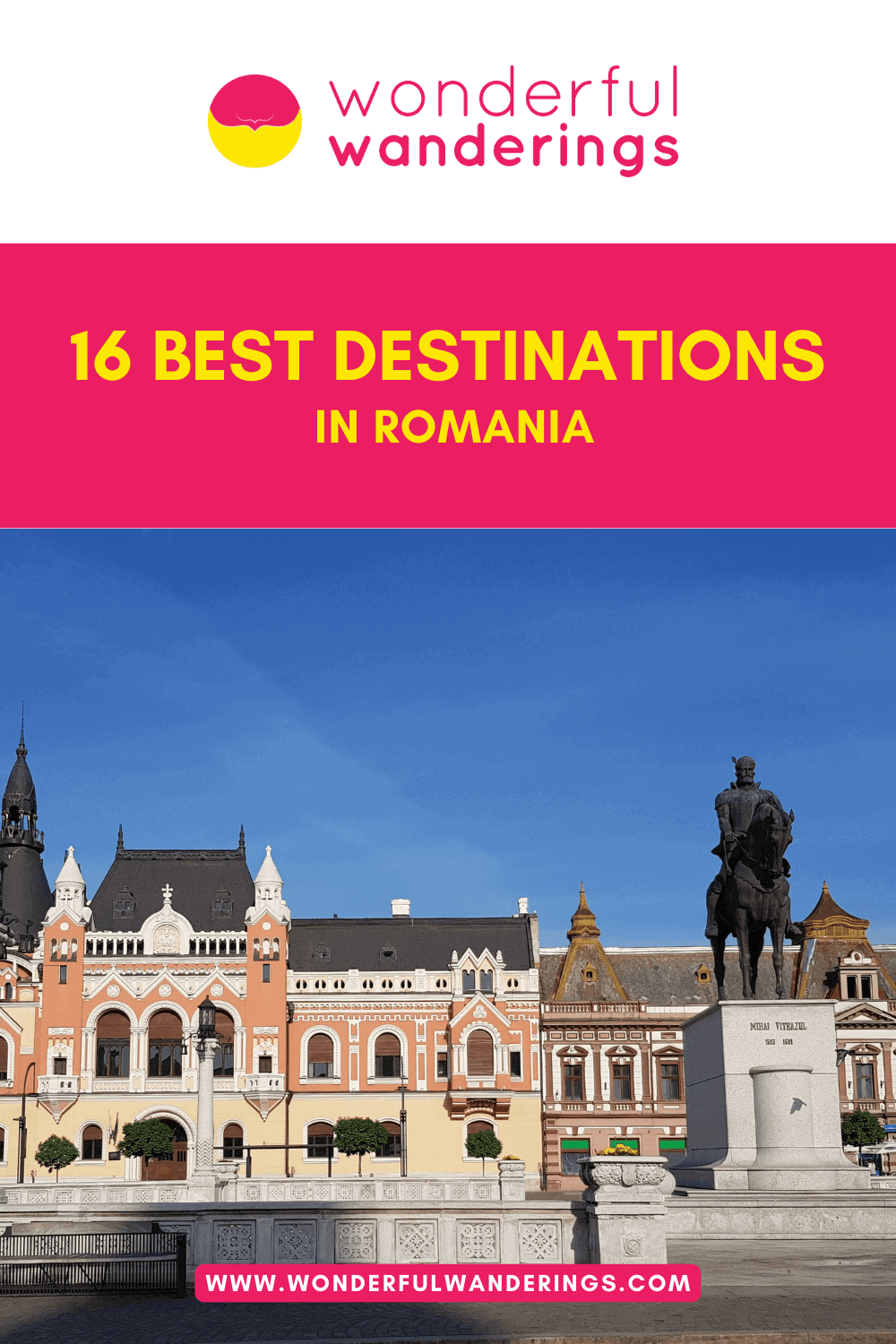
9. Oradea
Oradea has the densest Art Nouveau center in Romania and has been comprehensively restored in the last decade. Oradea sits on the Crisul Repede in Crisana, 10 km (6.2 miles) from the Hungarian border and 580 km (360.4 miles) from Bucharest, and had 183,105 residents in 2021.

The city’s wealth came at the turn of the 20th century and it was spent on Secession architecture: the Black Eagle Palace of 1907 to 1909 with its stained-glass arcade, the Moskovits and Ullmann palaces, the Poynar house and the buildings along Republicii street, all of them recently restored in the original colours. The Baroque Roman Catholic basilica is the largest in Romania, the Zion Neolog Synagogue is one of the largest in central Europe, and Oradea Fortress, a five-pointed Renaissance citadel, has been rebuilt as a cultural quarter.
Go if you are crossing from Debrecen or Budapest, or you like early-20th-century architecture. Skip it if you are not in the west of the country, because it is a long way from the rest.
10. Targu Mures
Targu Mures is a Hungarian-Romanian city in central Transylvania with one exceptional building. Targu Mures sits on the Mures in the Transylvanian basin, about 345 km (214.4 miles) from Bucharest, and had 116,033 residents in 2021.

The Culture Palace, built between 1911 and 1913 in Hungarian Secession style, is the reason to stop: a stained-glass Hall of Mirrors, a mosaic facade and a concert hall, all of it from the same short burst of Art Nouveau wealth that produced Oradea. The 14th-century Fortress Church and the citadel around it, the Teleki Library of around 200,000 volumes and the neo-Byzantine Orthodox cathedral fill the rest of a day. Around half the city speaks Hungarian.
Go if you are driving between Cluj and Sighisoara, because it is on the way. Skip it as a destination in itself unless Secession architecture is what you came for.
11. Suceava
Suceava is the gateway to the painted monasteries of Bucovina, which are the reason to come to this corner of Romania. Suceava sits in the northeast near the Ukrainian border, about 450 km (279.6 miles) from Bucharest, and had 84,322 residents in 2021.

It was the capital of Moldavia from 1388 to 1565, fortified by Petru I Musat and extended by Stephen the Great, and the Seat Fortress above the town survives as a substantial ruin with a modern visitor route through it. The town itself has the Bukovina history and ethnographic museums, the open-air village museum, St George’s Monastery and Zamca. But the monasteries are the trip: Voronet, Sucevita, Moldovita, Humor and Arbore, all within an hour or so, all UNESCO-listed, all frescoed on the outside walls as well as the inside.
Go if the painted monasteries are on your list, which they should be. Skip it as a city break; treat it as a base and hire a car.
12. Arad
Arad is a western border city with a large Vauban fortress and a substantial 19th-century center. Arad sits on the Mures 50 km (31.1 miles) from the Hungarian border and about 550 km (341.8 miles) from Bucharest, and had 145,078 residents in 2021.

The Arad fortress is an 18th-century star fort that was used as a prison for the leaders of the 1848 Hungarian revolution, and the Thirteen Martyrs of Arad were executed here in 1849, which makes the city a place of pilgrimage for Hungarians. The center carries the Baroque Serbian Orthodox cathedral, the neo-Gothic Red Church, the Palace of Culture and a line of eclectic palaces along Bulevardul Revolutiei. The Lunca Muresului nature park runs along the river outside the city.
Go if you are crossing at Nadlac or heading to Timisoara, 50 km south. Skip it otherwise; Timisoara does the same things better.
13. Baia Mare
Baia Mare is the base for Maramures, the most traditional region in Romania. Baia Mare sits on the Sasar river in the far north, about 590 km (366.6 miles) from Bucharest, and had 108,759 residents in 2021.

The city’s history is mining, from the medieval gold and silver workings that made it Rivulus Dominarum in a 1328 document to the heavy industry of the communist period, and the Mineralogy Museum’s collection of local specimens is a genuine speciality. St Stephen’s Tower, built in the 15th century under John Hunyadi, stands in the main square. What you actually come for is outside the city: the eight UNESCO-listed wooden churches of Maramures, the carved village gates, the Merry Cemetery at Sapanta with its painted grave markers, and the Mocanita steam railway up the Vaser valley.
Go if you want rural Romania rather than urban Romania. Skip it if you will not have a car, because the villages are the point and the buses are not frequent.
14. Braila
Braila is a Danube port with a semicircular street plan and a literary reputation out of proportion to its size. Braila sits on the left bank of the lower Danube in southeastern Romania, 217 km (134.8 miles) from Bucharest by road, and had 154,686 residents in 2021.

Ottoman rule left the town its shape: when it returned to Wallachia in 1829 the streets were laid out in concentric semicircles radiating from the old fortress, which is why the center reads like nowhere else in Romania. Grain wealth in the 19th century brought Greek, Jewish, Armenian, Italian and Lipovan merchants and the buildings they put up, including the Greek church, the Maria Filotti theater and the old water tower. Panait Istrati and Mihail Sebastian both came from here and both have memorial houses. The Small Wetland of Braila nature park, a miniature Danube delta, is just outside town.
Go if you are traveling between Bucharest and the Danube Delta. Skip it if you have fewer than ten days in the country.
15. Bacau
Bacau is a working city in western Moldavia and the least touristic entry on this list, which is worth saying plainly. Bacau sits on the Bistrita at the Carpathian foothills, about 300 km (186.4 miles) north of Bucharest, and had 136,087 residents in 2021.

The Princely Court founded by Alexandru, son of Stephen the Great, and the Precista church of 1491 beside it are the oldest things here. The Bacau County Museum Complex covers the region’s history, art and natural sciences, Cancicov Park is the city’s green space, and the poet George Bacovia was born here in 1881 and took his pen name from the town, with a memorial house to show for it. The Bistrita meets the Siret 8 km (5 miles) south and the accumulation lake on the edge of town is where the city goes at weekends.
Go if you are flying into its airport, heading for the eastern Carpathians, or already traveling between Brasov and Suceava. Skip it on a first trip to Romania; nothing here competes with what is two hours away in any direction.
16. Pitesti
Pitesti is the gateway to the Transfagarasan and the Arges valley, which is the real reason to be here. Pitesti sits on the Arges in Muntenia, 110 km (68.4 miles) from Bucharest on the A1 motorway, and had 141,275 residents in 2021.

The town itself is modest: the Princely Church of St George, the Arges County Museum in an 1886 building, Trivale forest on the edge of town and the Dacia car plant at Mioveni that employs much of the region. North of it the Arges valley climbs past Curtea de Arges with its 16th-century episcopal church, Poenari Citadel on its crag, which Vlad III really did hold and which reopened in 2025 after restoration, and on to the Transfagarasan itself, the mountain road built in the 1970s that is usually open only from late June to October.
Go if you are driving the Transfagarasan or the Arges valley. Skip it as a standalone stop.
How to choose between them
Four itineraries cover almost every reason people come to Romania, and they barely overlap. The 4 routes are listed below.
- Transylvania in a week. Fly into Brasov-Ghimbav or Cluj. Brasov, Bran, Rasnov, Sighisoara, Sibiu, back through Alba Iulia. This is the trip most first-time visitors should take and it needs a car for at least three of the days.
- Bucharest and the mountains in four days. Bucharest for two days, then the train north to Sinaia for Peles Castle and on to Brasov. No car needed at all.
- The northeast in a week. Fly into Iasi or Suceava. Iasi for the churches, then Suceava as a base for Voronet, Sucevita, Moldovita, Humor and Arbore, then west into Maramures for the wooden churches. Needs a car from Suceava onwards.
- The coast and the Delta in five days. Bucharest, train to Constanta, two days on the coast and the Roman sites, then north to Tulcea and into the Danube Delta by boat. June or September rather than August.
Whichever one you pick, compare car hire prices with DiscoverCars before you fly, because airport desk rates are higher on the day and automatics have to be booked well in advance.
What is the best place to visit in Romania in summer?
Constanta is the place to go in summer, because it is the only destination on this list with a beach. Constanta pairs the Black Sea and the Mamaia resort strip with Roman mosaics, the restored Casino and the Grand Mosque, so a beach week there does not have to be only a beach week.
The Danube Delta, two hours north at Tulcea, is the other summer answer, and it is the better one for anyone who would rather be on a boat than a sunbed. Inland, July and August are hot and the cities empty out, which is why the mountains fill up instead: Brasov, Sinaia and the Fagaras trails all come into their own in the same months.
What is the best place to visit in Romania in winter?
Sibiu is the place to go in winter, because its Christmas market is the oldest and largest in the country and the town looks better under snow than at any other time. Sibiu’s market runs in the Large Square from late November into early January, with the Brukenthal Palace courtyard beside it, and the Fagaras Mountains behind the town give you snowshoeing and winter walking without a resort.
Brasov is the alternative, with its own market in Council Square under the Black Church and the ski slopes at Poiana Brasov 12 km away. Bucharest runs the biggest market of all in Constitution Square, in front of the Palace of the Parliament, if scale is what you want.
What to do in Romania by season
Romania’s seasons change what is open, not just what the weather is like, and two of them close things. The 4 seasons are listed below.
- Spring, April to June. The strongest all-round window. Everything is open, the monasteries and Transylvanian towns are green and empty, and prices are low. The Transfagarasan is still shut until late June.
- Summer, July and August. The coast, the Delta, the mountain trails and the festivals: Untold in Cluj, Electric Castle near Cluj and the Sighisoara medieval festival. Hot, busy and dearer, and the cities are uncomfortable in a heatwave.
- Autumn, September and October. The second window. Warm sea into September, the vineyards in harvest, the Carpathian forests turning, and Halloween at Bran Castle at the end of October.
- Winter, November to March. Christmas markets from late November, skiing at Poiana Brasov, Sinaia and Predeal from December, and a lot of rural museums, mountain roads and coastal businesses shut. Check before you drive anywhere remote.
How long do you need in Romania?
Ten days is the right length for a first trip to Romania, and it buys one region properly rather than four badly. Ten days covers Bucharest and Transylvania, or Bucharest and the northeast, or the coast and the Delta with a few days in the capital at either end.
Five to seven days works if you fly into a regional airport and stay put: Cluj or Brasov for Transylvania, Iasi or Suceava for the monasteries, Timisoara for the Banat. Three days is Bucharest plus one day trip, and nothing more. Distances here are longer in time than in kilometers, because the motorway network is incomplete and the mountain roads are slow. Compare trains and coaches on Omio before assuming a route is quick.
Where to stay across Romania
Accommodation in Romania is cheap by western European standards, and the useful distinction is between city hotels and rural pensiuni. Cities have the full range from hostels to international five-star hotels, all of it inexpensive outside festival weeks.
The pensiuni are the better experience in Maramures, Bucovina and the Carpathians: family-run guesthouses, usually with a home-cooked dinner included if you ask, and often the only option in a village. Book mountain and monastery guesthouses well ahead for weekends, because Romanians travel domestically and take the good ones first. Check availability and prices across Romania on Booking.com once your route is fixed.
WonderfulWanderings Pro Tips
The 4 tips below come from checking each city’s transport and access in September 2026, and each of them changes an itinerary rather than decorating it.
- Brasov has its own airport now. Brasov-Ghimbav International opened in June 2024 and puts you twenty minutes from the old town and thirty from Bran Castle. Almost every Romania itinerary online still routes Transylvania through Bucharest and a three-hour train, which costs a day in each direction.
- Poenari reopened, Rasnov has not. Poenari Citadel, the fortress Vlad III actually held above the Arges valley, reopened in 2025 after restoration and is 1,480 steps up from the road. Rasnov Citadel near Brasov has been closed to visitors since 2022 and a phased reopening is not expected before 2028, although plenty of itineraries still pair it with Bran as though you can walk in.
- Do not pair the far north with the far southeast. Baia Mare to Constanta is about 800 km on roads with very little motorway, and the same is true of Suceava to Timisoara. Romania looks compact on a map and drives like a much larger country. Pick one corner.
About the author. This guide is written and maintained by the Wonderful Wanderings editorial team. Wonderful Wanderings was founded in 2012 by Sofie Couwenbergh and covers Romania for independent travelers, from the Saxon towns of Transylvania and the painted monasteries of Bucovina to the Black Sea coast and the Danube Delta, with the guesthouses, hotels, car hire and rail routes worth booking for each. The team checks the cities, distances, airports and access on this page against their own sources and updates it when they change.