 EN
EN
 Nederlands
 Français
The main things to do in Timișoara are the three linked squares of the old fortress town, Union Square, Liberty Square and Victory Square, plus the Orthodox Metropolitan Cathedral, the Roman Catholic Dome, the Communist Consumer Museum and a walk along the Bega Canal. Timișoara (written Timisoara in most English guides) sits in western Romania, about 450 km (280 miles) northwest of Bucharest, in the historical region of Banat near the Hungarian and Serbian borders. Habsburg, Hungarian, Serbian, German and Jewish communities all left their mark on it, which is why a city of roughly a quarter of a million people has Baroque, Secession and Art Nouveau architecture on this scale and why locals still call it Little Vienna.
Two dates explain the city better than any list. In 1884 Timișoara became the first city in Europe lit by electric street lamps. In December 1989 it became the place where the Romanian Revolution started, and on 20 December of that year the first Romanian city declared free of communism. In 2023 it held the title of European Capital of Culture alongside Veszprém in Hungary and Elefsina in Greece, and the restoration work that came with the title is why the old town looks as good as it does now.
The seven sights that give you the shape of the city in a single day are listed below.
- Union Square (Piața Unirii). Union Square is the oldest square in Timișoara and the one people photograph, with the Serbian Orthodox Cathedral and the Roman Catholic Dome facing each other across a run of Baroque facades. The 1740 Monument of the Holy Trinity stands in the middle, and cafe terraces fill the edges.
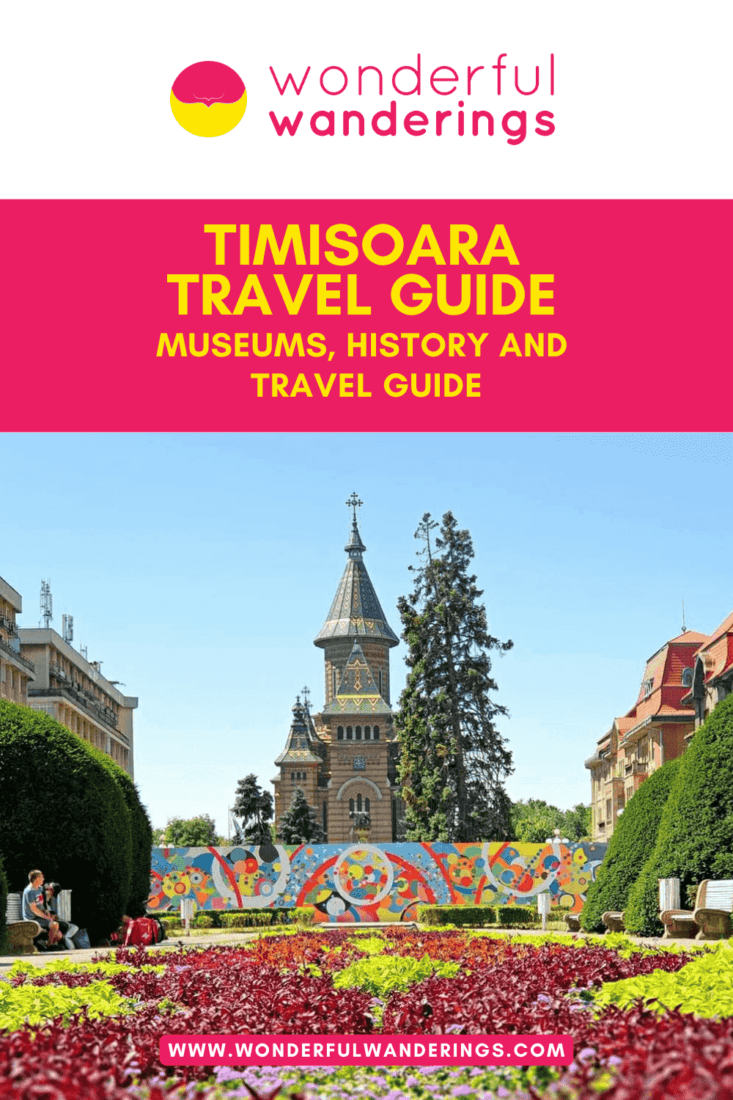
- The Orthodox Metropolitan Cathedral “Three Hierarchs”. The Metropolitan Cathedral stands at the end of Victory Square, built between 1936 and 1940 and consecrated in 1946. Its central tower reaches 90.5 m, which makes it the second tallest church in Romania, and it holds the relics of Saint Joseph the New of Partoș.
- Victory Square (Piața Victoriei). Victory Square is the long pedestrian axis between the Opera House and the Metropolitan Cathedral, lined with early 20th-century palaces. It is where crowds gathered in December 1989 and where the revolution is commemorated.
- Liberty Square (Piața Libertății). Liberty Square is the second oldest square in the old fortress, home to the Old City Hall, the Garrison Command and the Military Casino. The umbrella-covered stretch of Strada Alba Iulia starts a few steps away.
- Art Museum of Timișoara (Muzeul de Artă Timișoara). The Art Museum occupies the Baroque Palace on Union Square and holds Romanian and European art from the 15th century onward, including a room of works and personal effects left by the painter Corneliu Baba.
- Roses Park (Parcul Rozelor). Roses Park opened in 1891 on the north bank of the Bega and gave Timișoara its second nickname, the city of roses. It has an open-air stage that hosts concerts through the summer.
- The Roman Catholic Dome, St. George’s Cathedral (Catedrala Sfântul Gheorghe). The Dome was built between 1736 and 1774 in Baroque style on Union Square and is the seat of the Roman Catholic Diocese of Timișoara. Its two towers reach 35.5 m and the acoustics inside carry the organ recitals that are held there.
1. Union Square (Piața Unirii)
Union Square is the oldest square in Timișoara and the place to start, because the two cathedrals, the Baroque Palace and the city’s whole 18th-century story stand around one open rectangle. Union Square is also called Dome Square, after the Roman Catholic Dome on its eastern side, and it was given its current name in 1919 to mark the union of Banat with Romania.

The square was laid out after the Habsburgs took the city from the Ottomans in 1716, and it holds the densest run of Baroque buildings in Timișoara. The Monument of the Holy Trinity, the plague column at its center, dates from 1740. The Serbian Orthodox Cathedral and its bishop’s palace face the Roman Catholic Dome across the paving, which is a fair summary of how the city was governed and populated.
Romania’s largest pedestrian area begins here and runs through Liberty Square to Victory Square, so most of the sights in this guide are reachable on foot from this one spot. Entry to the square costs nothing, the cafes around the edge open early, and late-afternoon light suits the Dome.
2. The Orthodox Metropolitan Cathedral “Three Hierarchs”
The Metropolitan Cathedral is the tall brick church at the southern end of Victory Square, and it is the single building most people picture when they think of Timișoara. The cathedral is dedicated to the Three Holy Hierarchs, Basil the Great, Gregory the Theologian and John Chrysostom, and it serves as the seat of the Archbishopric of Timișoara and the Metropolis of Banat.

Construction began in March 1936 to a design by the architect Ion Trajanescu, the building was finished in 1940 and it was consecrated on 6 October 1946 in the presence of King Michael I. The style is Neo-Moldavian, drawing on the painted monasteries of northern Romania rather than on anything Habsburg. The central dome rises 90.5 m, making this the second tallest church in the country after the People’s Salvation Cathedral in Bucharest, and the marshy ground under it is held by more than a thousand concrete pillars driven 20 m down.
Inside, the cathedral seats 5,000, the iconostasis is gilded in 22-carat gold and the exterior brickwork is patterned in red and yellow-orange. It holds the relics of Saint Joseph the New of Partoș, a 17th-century bishop of Timișoara who is considered the protector of Orthodox believers in Banat. The basement houses the religious art collection of the Metropolis of Banat, with rare church books and icons gathered from across the region. There is no admission fee, services run daily, and shoulders and knees should be covered.
3. Victory Square (Piața Victoriei)
Victory Square is the wide pedestrian boulevard that runs between the Opera House at one end and the Metropolitan Cathedral at the other, and it is where modern Timișoara happened. The square was called Opera Square until 1990, and before that Parade Square, and it carries palaces built in the first two decades of the 20th century when the fortress walls came down and the city expanded.

This is the ground of the 1989 revolution. Protests that began on 16 December around the church of the Hungarian pastor László Tőkés reached the square within days, and on 20 December Timișoara was proclaimed the first Romanian city free of communism from a balcony here. Plaques, a memorial and the Memorial of the 1989 Revolution a short walk away tell that story properly.
Trams and buses stop at both ends, the fountains run through the summer, and the benches under the trees are where the city sits in the evening. There is no admission fee. Give yourself half an hour here at dusk, when the Opera House and the cathedral are both lit.
4. Liberty Square (Piața Libertății)
Liberty Square is the middle square of the pedestrian chain and the second oldest in the former fortress, quieter than the other two and lined with the buildings that ran the Habsburg garrison. Liberty Square was named Sfântul Gheorghe Square and then Elisabeth Square before it took its present name, and the Old City Hall on its southern side is the oldest civic building in the center.

The Garrison Command and the Military Casino stand on the square, both with their Baroque detailing intact after the recent restoration work. Terraces spill across the paving in summer, and the solar Charging Trees, benches with photovoltaic canopies and USB sockets, sit between them.
The umbrella alley, the stretch of Strada Alba Iulia hung with hundreds of colored umbrellas, starts at the corner of the square and is the most photographed spot in the city. Entry is free and the square is a two-minute walk from Union Square in one direction and Victory Square in the other.
5. Art Museum of Timișoara (Muzeul de Artă Timișoara)
The Art Museum of Timișoara holds the city’s collection of Romanian and European painting inside the Baroque Palace at Piața Unirii 1, which is worth the ticket on its own. The museum grew out of the Museum of Banat, founded in 1872, moved into the Baroque Palace in 1984 and has run as an independent institution since 2006.

The permanent collection covers European art from the 15th century onward, Romanian painting of the 19th and 20th centuries, decorative arts and a contemporary section. The Corneliu Baba room is the draw for Romanian visitors: the painter left the museum a large group of works together with personal belongings and studio material. Temporary exhibitions run on the ground floor and the museum programmes concerts, lectures and workshops.
The Baroque Palace itself was the governor’s residence, and Franz Joseph and Franz Liszt both passed through it. Check the opening days on the museum’s own site before you walk over, because it does not open every day of the week and the hours are shorter than you would expect.
6. Roses Park (Parcul Rozelor)
Roses Park is the rose garden on the north bank of the Bega between Strada George Enescu, Strada Alexandru Borza and Strada Michelangelo, and it is the reason Timișoara is called the city of roses. The park opened in 1891, and by 1934 it covered 25,000 m² and grew more than 1,200 varieties, which made it the largest rosarium in southeastern Europe at the time.

The gardens were destroyed in the Second World War and replanted afterwards, so the present layout of beds, pergolas and lawns dates from the post-war rebuild rather than from the 1890s. Roses Park now runs to several hectares, with white pergolas, an open-air stage and statues of the founders among the beds.
June is the month to come, when the beds are at their fullest. The open-air theater hosts concerts through the summer, including large classical performances, and those are ticketed even though the park itself is free. Ion Creangă Children’s Park sits directly opposite across the road, which makes the pair an easy hour with children.
7. St. George’s Cathedral (Catedrala Sfântul Gheorghe)
St. George’s Cathedral, known locally as the Roman Catholic Dome, is the twin-towered Baroque church on the eastern side of Union Square and the seat of the Roman Catholic Diocese of Timișoara. The cathedral was built between 1736 and 1774, which is why the plans changed several times along the way and why the interior is plainer than the facade promises.

The building is 55 m long and 22 m wide, and its two towers each rise 35.5 m. Inside there are nine Baroque altars, a large pipe organ and the tombs of bishops, including Augustin Pacha, the first bishop of the diocese. The church sheltered civilians during 18th and 19th-century sieges and was damaged by bombing in the Second World War.
Entry is free outside services. The organ recitals and concerts held here are the reason to come back in the evening, because the acoustics under the barrel vault are the finest in the city. The square outside hosts markets and open-air events through the year, so the cathedral is rarely a quiet stop.
8. Brück House (Casa Brück)
Brück House is the corner building at 2 Strada Emanuil Ungureanu, on the edge of Union Square, and it is the most complete Secession facade in Timișoara. The house was designed by László Székely, the city’s chief architect, and finished in 1910 for the merchant Hugo Brück, whose pharmacy occupied the ground floor.

The facade carries floral and plant reliefs, wrought-iron balconies, bay windows and stained glass, worked in the Viennese Secession manner rather than the heavier Hungarian version. Both faces of the building are meant to be read from the street, because the house sits on a corner, and the roofline with its mansard attic finishes the composition.
The pharmacy is still there behind the original fittings, which is unusual and worth a look inside. The building has been listed as a historical monument since 2004. Nothing else is open to visitors, so this is a five-minute stop on the way between Union Square and the Bega, and morning light suits the facade.
9. Bega River Walk
The Bega River Walk is the paved promenade and cycle path that follows the canalised Bega through the middle of Timișoara, and it is the easiest way to see the city without a map. The Bega is a canal rather than a natural channel, cut in the 18th century to drain the marshes, and it is the oldest navigable canal in Romania.

The path runs past a chain of parks, including Parcul Justiției, Parcul Alpinet and the Roses Park, with willows on the banks and small wooded islands in the water. It is flat, paved and continuous, which makes it usable with a pushchair, a wheelchair, a bike or a running plan, and benches and riverside cafes are spaced along it.
Since October 2018 the canal has also carried public waterbuses, the vaporetto line V1, which runs nine stops along roughly 7 km of water between the Modoș Bridge and the Mihai Viteazul Bridge. It operates as ordinary public transport on weekdays and as a leisure service at weekends, and the full run upstream takes a little over an hour. Boarding at the Metropolitan Cathedral stop is the simplest option for visitors.
10. Pedestrian Street Alba Iulia (Strada Pietonală Alba Iulia)
Strada Alba Iulia is the pedestrian street that links Liberty Square with Piața Victoriei, and it is the one visitors photograph because of the umbrellas. Hundreds of colored umbrellas hang above the paving for the whole length of the street, giving shade in summer and a strong picture in any weather.

The street is closed to traffic. Boutiques, souvenir shops, cafes and restaurants line it, buskers play along it in the afternoon, and terraces take over the middle in the evening. It is short, five minutes end to end at a walking pace, so treat it as the connection between two squares rather than a destination.
Landmarks stack up at either end: the Roman Catholic Dome and the Serbian Orthodox Cathedral behind you, the National Bank Palace and the Opera House ahead. Come back after dark, when the historic facades are floodlit and the umbrellas are lit from below.
11. Communist Consumer Museum (Muzeul Consumatorului Comunist)
The Communist Consumer Museum is a recreated 1970s apartment in a cellar at Strada Arhitect László Székely 1, and it is the most interesting museum in Timișoara precisely because it is not a museum in the usual sense. You reach it through the bar of Scârț Loc Lejer and go down the stairs.

Rooms are laid out as a kitchen, a living room and a bedroom, filled with thousands of ordinary objects from communist Romania: furniture, kitchenware, toys, radios, food packaging, records, magazines and propaganda. Nothing is behind glass. Visitors are expected to pick things up, flick through the books and put the records on, and the effect of handling the objects is what makes the point about scarcity land.
Entry is free and the museum takes donations. Allow 45 minutes, longer if you were alive in the 1980s anywhere east of Vienna. Come in the afternoon and stay upstairs for a drink in the garden afterwards.
12. Timisoara Free Walking Tour
Free walking tours in Timișoara run on a pay-what-you-want basis and are the fastest way to fit the squares, the revolution and the Habsburg fortress into one morning. Timișoara’s free tours are organized by local associations and independent guides, they last around two hours, and they cover the center on foot with no ticket sold in advance.

Tips are how the guides are paid, so bring cash and plan on the amount you would have paid for a ticketed tour. Paid small-group and private tours go deeper and last two to three hours, and specialist walks cover the 1989 revolution, the Secession architecture and the Jewish heritage of the city separately. Self-guided audio and app tours are the third option if you would rather set your own pace.
Book a guided walk a day or two ahead in summer, because Timișoara has fewer guides than Bucharest or Brașov and the English-language departures fill. Ask whether the route goes inside the Metropolitan Cathedral, since not all of them do.
13. Visit the Old Town of Timișoara (Centru Timisoara)
The Old Town of Timișoara is the former fortress area between the Bega and Victory Square, and walking it end to end takes about an hour without stopping. The center holds the three main squares, both cathedrals, the Baroque Palace, the Opera House and the largest pedestrian zone in Romania, so almost everything on this page except the Village Museum sits inside it.

The architecture runs from 18th-century Baroque through 19th-century eclecticism to the Secession and Art Nouveau palaces built between 1900 and 1914, when Timișoara was one of the richest cities in Hungary. Much of it was restored for the 2023 European Capital of Culture year, and the difference from photographs taken ten years earlier is obvious.
The Theresia Bastion is the piece most visitors miss. It is the largest surviving section of the Habsburg fortress, a short walk east of Union Square, and it now holds exhibition spaces of the Museum of Banat along with restaurants, bars and shops built into the casemates. Huniade Castle, the oldest building in the city and home to the National Museum of Banat, has been closed for restoration since 2010 and is still a building site, so check before you plan a visit around it.
14. Dine at Scârț Loc Lejer
Scârț Loc Lejer is a bar, garden, museum and independent theater in one old house at Strada Arhitect László Székely 1, and it is the place to understand what Timișoara does with its own recent past. The venue is run by the Auăleu theater company, the furniture is salvaged communist-era stock, and the whole thing works as a bar rather than as a themed attraction.

Drinks are the main business: craft beer, homemade cordials and wine, served in the rooms upstairs or in the garden, where there is a ping-pong table. Snacks rather than full meals come out of the kitchen, so eat elsewhere and come here after. The Communist Consumer Museum is in the cellar, the Auăleu troupe stages absurdist comedy in Romanian, and live music turns up without much warning.
There is no entrance fee and the museum downstairs runs on donations. Opening hours shift with the season and with what is on, so check the venue’s own Facebook page the day you go. Cash is useful here.
15. See the Opera House (Opera Națională Română Timișoara)
The Romanian National Opera in Timișoara stands at the western end of Victory Square, and seeing a performance there costs less than a cinema ticket in most of western Europe. The building opened in 1875 to a design by the Viennese partnership of Fellner and Helmer, burned twice, and was rebuilt in the 1920s with a Neo-Byzantine and Neo-Romanian facade by Duiliu Marcu, which is why the outside and the inside do not match in period.

The house shares the building with the Hungarian State Theatre “Csiky Gergely” and the German State Theatre, an arrangement that exists almost nowhere else in Europe and that says a great deal about Timișoara. The auditorium holds around 600 in red velvet and gilt, and the season runs from September to July with opera, operetta and ballet.
Tickets go on sale at the box office and online, and even good seats are inexpensive by western standards. It was also from the Opera House balcony that Timișoara was declared free of communism on 20 December 1989, which is worth knowing before you look up at it.
16. Explore the Fabric District of Timisoara
Fabric is the old industrial and craft quarter east of the center across the Bega, and it is where you go to see Timișoara without the restoration budget. The district takes its name from the factories and workshops that filled it from the 18th century, and it grew as a separate town with its own squares, synagogue and market before the city absorbed it.

Piața Traian is the heart of it, a square of faded Secession and eclectic facades with a market, small shops and a growing number of cafes and galleries in the ground floors. The Fabric Synagogue, the Millennium Church with its two brick towers and the old brewery buildings are all within a few streets. Street art covers passageways and gable ends throughout the quarter.
Fabric is a 20-minute walk or a short tram ride from Union Square. The contrast with the polished center is the point: half the district is restored and half is not, and the unrestored half is where the photographs are. Go in daylight and allow two hours.
17. Drink Timisoreana Beer
Timișoreana is the beer brewed in Timișoara since 1718, and drinking one in the city that gave it its name is the cheapest piece of local history available. The brewery was founded under Habsburg administration during the reign of Prince Eugene of Savoy, partly because the town’s water was not safe to drink, and it is the oldest brewery in Romania.

Timișoreana today is a pale lager at 5% ABV, brewed by Ursus Breweries, and it is the top-selling beer brand in the country. It is sold everywhere in the city, and the terraces around Victory Square, Union Square and the Bega all pour it on draught. Berăria 700 on Piața 700 is the obvious place to drink it in volume, in a beer hall with long tables and a large terrace.
Order it with mici, the grilled minced-meat rolls that come with mustard and bread, or with a plate of cured meats and pickles. A half-litre on a central terrace runs to roughly 12 to 18 RON (about €2.30 to €3.40, $2.70 to $4, £2 to £2.90), which is a fair guide to how far money goes in Timișoara generally.
What are the best museums to visit in Timișoara?
The museums worth your time in Timișoara are listed below, in the order most visitors should take them.
- Memorial of the 1989 Revolution. The Memorial documents the December 1989 uprising that began in Timișoara through photographs, film, documents and objects, housed in a former military building near Liberty Square. A short documentary with English subtitles runs on request and is the part people remember. The memorial’s own site gives visiting hours of 08:00 to 17:00 Monday to Friday and 10:00 to 18:00 at weekends, with last entry half an hour before closing.
- Communist Consumer Museum. The Communist Consumer Museum recreates a communist-era apartment in the cellar of Scârț Loc Lejer, filled with objects visitors are allowed to handle. Entry is free and donations are welcome.
- Art Museum of Timișoara. The Art Museum occupies the Baroque Palace on Union Square and covers European art from the 15th century, Romanian painting, decorative art and a Corneliu Baba collection. The building alone justifies the visit.
- Banat Village Museum. The Banat Village Museum is an open-air ethnographic museum spread over 17 hectares at the edge of the Green Forest in the northeast of the city, laid out as a traditional Banat village. It opened on 20 August 1971 and its Alley of Ethnicities has Romanian, Hungarian, German, Slovak and Ukrainian houses moved here from villages across the region. Take a tram or a taxi, because it is not walkable from the center.
- Theresia Bastion exhibitions. The Theresia Bastion holds permanent and temporary exhibitions of the Museum of Banat inside the casemates of the old fortress wall, which is currently the only way to see parts of that collection while Huniade Castle stays closed for restoration.
What are the best things to do in Timișoara with kids?
The 5 things to do in Timișoara with children are listed below, from the ones that fill a morning to the ones that fill an hour.
- Ion Creangă Children’s Park. Ion Creangă Children’s Park sits opposite the Roses Park across the road and combines playgrounds with small fairground rides, a miniature train and food kiosks. Entry to the park is free and the rides are paid for individually.
- Timișoara Zoo. Timișoara Zoo is in the Green Forest in the northeast of the city, next to the Banat Village Museum, which makes the two an easy half-day together. Enclosures are wooded rather than concrete, and the site is small enough to finish without complaints.
- Boating on the Bega Canal. Rowing boats, pedal boats and hydrobikes are hired from operators along the Bega in the center, and the public waterbus is a cheaper way to get children on the water. Life jackets are provided by the rental operators.
- Banat Village Museum. The Banat Village Museum works well with children because it is outdoors, the houses can be walked into, and craft demonstrations run on event days. Seventeen hectares is a lot of ground, so bring water.
- The umbrella street and the squares. Strada Alba Iulia, Liberty Square and Union Square are car-free, flat and short, which makes the whole central walk manageable with a pushchair and gives you cafe terraces at every stop.
What are the best activities for a business traveler in Timișoara?
Timișoara is Romania’s main technology and manufacturing center outside Bucharest, so business visitors usually have half a day rather than a week. The 5 things worth doing with that half-day are listed below.
- Dinner on Victory Square. Victory Square is the obvious place to take a client to dinner, with Romanian and international restaurants on and immediately off the square and outdoor tables from spring to autumn.
- Iulius Town. Iulius Town, opened in 2019, combines the Iulius Mall shopping center of around 450 shops with the city’s largest cluster of office space, a hypermarket, a twelve-screen cinema and a food court. If your meetings are here, everything else you need is in the same complex.
- A walk in Central Park. Central Park, properly Parcul Anton von Scudier, faces the Metropolitan Cathedral across the road and holds the Monument to the Unknown Soldier under mature trees. It is the quietest green space within walking distance of the business hotels.
- The Communist Consumer Museum. The Communist Consumer Museum gives more useful context on how Romania got here than any briefing document, takes 45 minutes and costs nothing. Explanatory material is available in English.
- The Bega promenade. The Bega promenade is flat, continuous and lit, which makes it the reliable option for a run or an evening walk between meetings.
Where is Timișoara?
Timișoara is in western Romania, roughly 450 km (280 miles) northwest of Bucharest, in the historical region of Banat and close to the borders with Hungary and Serbia. The city stands on the Bega Canal, is the capital of Timiș County, and functions as the economic and cultural center of western Romania.
Its position explains its history and its economy. Banat was governed from Vienna and then from Budapest, which is why the architecture, the food and the surnames here look west rather than east, and why German, Hungarian and Serbian are still spoken in the city. Proximity to central Europe also gives Timișoara strong industrial links with Germany, Italy and France, and Traian Vuia International Airport connects it directly to a long list of western European cities. If you are building a wider trip, the other major cities are covered in our guide to Romanian destinations.
What is the history of Timișoara?
Timișoara’s recorded history starts in the 13th century, when it appears as a castle on the Timiș in the Kingdom of Hungary, first named in 1315. Charles I of Hungary made it his royal seat for several years in the 1310s and 1320s, and John Hunyadi rebuilt the castle in the 15th century, which is the building that still stands as Huniade Castle.
The Ottomans took the town in 1552 and held it for 164 years as the seat of an Ottoman province. Prince Eugene of Savoy captured it for the Habsburgs in 1716, and the Austrians then drained the marshes, cut the Bega Canal, laid out a star fortress and repopulated the area with German, Serbian, Hungarian and Romanian settlers. That century of engineering produced the city plan visitors walk through today.
Industrial growth in the 19th century made Timișoara a place of firsts. It was the first city in the Habsburg monarchy with public street lighting, in 1760, and the first city in Europe lit by electric street lamps, in 1884. It published the first German-language newspaper in southeastern Europe in 1771. Banat was united with Romania in 1919, and the Romanian army entered Timișoara on 3 August of that year, a date the city still marks. In December 1989 protests around the church of the Hungarian Reformed pastor László Tőkés grew into the Romanian Revolution, and on 20 December Timișoara declared itself free of communism, three days before the Ceaușescu regime fell.
What language is spoken in Timișoara?
Romanian is the language spoken in Timișoara and the official language of Romania. Romanian is the first language of most residents, but the city has never been monolingual, and the 2021 census still recorded Hungarian and Serbian minorities alongside a much reduced German community.
Hungarian is the most widely spoken minority language, followed by Serbian and German. Timișoara has state theaters performing in Hungarian and in German, publicly funded schools in both languages, and church services in several more. English is widely spoken by younger people and in the technology sector, and German is common in business because of the industrial links with Germany and Austria. Learning “bună ziua” for hello and “mulțumesc” for thank you will still be appreciated.
What time zone is Timișoara in?
Timișoara is in the Eastern European time zone, two hours ahead of Coordinated Universal Time in winter. The city uses Eastern European Time, UTC+2, from late October to late March and Eastern European Summer Time, UTC+3, for the rest of the year. That puts Timișoara seven hours ahead of United States Eastern Time for most of the year and two hours ahead of the United Kingdom.
How many people live in Timișoara?
The 2021 census counted 250,849 inhabitants in Timișoara, while the city hall’s own population records put the figure above 309,000 as of 2023. The gap is real and disputed: local authorities and sociologists argue the census undercounted, and the city also carries a large floating population of students and workers who are not registered as residents.
By the census figure Timișoara is the fifth most populous city in Romania, after Bucharest, Cluj-Napoca, Iași and Constanța, and by the city hall figure it sits in third place. Its functional urban area holds around 400,000 people. Around 40,000 students are enrolled in the city’s universities, which changes the feel of the center noticeably between term and the summer.
What are the most interesting facts about Timișoara?
The practical facts you need before travelling to Timișoara are listed below.
- Currency. The currency is the Romanian leu, plural lei, abbreviated RON. Romania is not in the eurozone and euros are not generally accepted, so draw lei from a bank ATM rather than a currency exchange kiosk. Cards work almost everywhere in the center, but keep some cash for markets, tips and the donation boxes in the small museums.
- Time zone. Timișoara is on Eastern European Time, UTC+2, moving to UTC+3 for daylight saving between late March and late October.
- Language. Romanian is the official language. It is a Romance language, so anyone with French, Italian or Spanish will read signs more easily than they expect. English is common among younger people, and German and Hungarian are widely spoken in the city.
- Power plugs. Sockets are Type C and Type F, the two round pins used across most of continental Europe, at 230 V and 50 Hz. Travelers from North America need a plug adapter and should check that their devices accept 230 V.
- European Capital of Culture. Timișoara held the title in 2023, together with Veszprém in Hungary and Elefsina in Greece, and the restoration work funded around it is why the squares look the way they do now.
How many days are needed to see Timișoara?
Three days is the right length for Timișoara. Two days cover the center properly: the three squares, both cathedrals, the umbrella street, the Art Museum, the Communist Consumer Museum, the Bega promenade and the Revolution Memorial, with evenings on the terraces. The third day gives you either the Banat Village Museum and the zoo in the Green Forest, or the Fabric district and the Theresia Bastion at a slower pace.
A fourth day makes sense only if you want a day trip. Corvin Castle at Hunedoara, the Danube Gorges at the Serbian border and the Semenic mountains are all reachable by car in a couple of hours, and none of them works well by public transport. Compare flights to Romania before you fix the dates, because Timișoara is served by budget airlines from a lot of western European cities and the fare difference between weeks is often larger than the hotel bill.
Is Timișoara worth visiting?
Yes, Timișoara is worth visiting, and it is the easiest introduction to Romania for anyone who has already done central Europe. The center is compact, flat and almost entirely pedestrian, the Habsburg and Secession architecture is on a par with much better-known cities, and prices are roughly half what the same day costs in Vienna or Budapest.
The city also gives you something no other Romanian city can: the place where the 1989 revolution started, told on the ground where it happened. Add the multilingual theater scene, the summer festivals, a genuinely good cafe and terrace culture and the Bega running through the middle of it, and two or three days fill themselves. It is quieter than Brașov and Cluj, which is either the point or the problem depending on what you want.
Is Timișoara expensive to visit?
No, Timișoara is inexpensive by western European standards, and slightly cheaper than Bucharest, Brașov or Cluj-Napoca. Numbeo’s Romania averages put a meal at an inexpensive restaurant at around 50 RON (about €10, $11, £8) and a three-course dinner for two at a mid-range restaurant at around 200 RON (about €38, $44, £33), and Timișoara sits close to those national figures rather than above them.
A rough daily budget of 200 to 250 RON per person (about €38 to €48, $44 to $55, £33 to £41) covers a mid-range hotel bed, three meals out, local transport and a museum ticket or two. Public transport is the cheapest part: a single ride on the tram, trolleybus, bus or waterbus costs a few lei, and most of the sights in this guide charge nothing to enter. The expensive items are a hotel room on Victory Square in festival season and dinner with wine in the fine-dining restaurants, and both are avoidable.
Prices move, so treat those figures as a shape rather than a quote, and check current rates before you budget.
Is Timișoara safe to visit?
Yes, Timișoara is a safe city for visitors, with low violent crime and a well-policed center. The usual city rules apply: watch your bag in crowded markets and on busy trams, do not leave phones on outdoor tables, and use licensed taxis or a ride-hailing app rather than unmarked cars at the airport and the station.
Pickpocketing is the realistic risk and it is concentrated where tourists gather. Stray dogs are less of a problem than Romania’s reputation suggests but still exist on the outskirts. Pavements in the unrestored parts of Fabric and Iosefin are uneven, so bring shoes that cope. Tap water is drinkable across the city.
Is Timișoara easy to visit with kids?
Yes, Timișoara is straightforward with children. The center is flat and pedestrianized, which makes a pushchair easy, and the three main squares are close enough together that nobody has to walk far between sitting down.
Parks do the heavy lifting: Roses Park, Ion Creangă Children’s Park directly opposite it, Central Park by the cathedral and the Botanical Park all sit inside the walkable center. The Bega gives you boats and the waterbus, the Green Forest gives you the zoo and the Village Museum in one trip, and Iulius Town has indoor play areas and a cinema for a wet afternoon. Restaurants are relaxed about children, portions are generous, and grilled meat, polenta and pancakes cover most fussy eaters.
What is Timișoara famous for?
Timișoara is most famous as the city where the Romanian Revolution began in December 1989 and as the first Romanian city declared free of communism, on 20 December 1989. That is the fact every Romanian associates with the name.
It is known second for its architecture and the nickname Little Vienna, earned by the Baroque squares of the Habsburg fortress and the Secession palaces built in the boom before 1914. Third, it is the city of firsts: the first in Europe with electric street lighting in 1884, the first in the Habsburg monarchy with public street lighting in 1760, and the site of Romania’s oldest brewery, working since 1718. Fourth, it is a technology and manufacturing center with around 40,000 university students, and it held the European Capital of Culture title in 2023.
Who are the most important people born in Timișoara?
The people born in Timișoara whose names travel furthest are listed below.
- Johnny Weissmuller (1904-1984). Weissmuller was born in Freidorf, now a district of Timișoara, and emigrated to the United States as an infant. He won five Olympic swimming golds and a water polo bronze across the 1924 and 1928 Games, then played Tarzan in twelve films between 1932 and 1948.
- Ana Blandiana (born 1942). Blandiana is a poet, essayist and civil rights campaigner born in Timișoara on 25 March 1942, banned three times under the communist regime. After 1989 she co-founded the Memorial to the Victims of Communism and to the Resistance at Sighet.
- Iolanda Balaș (1936-2016). Balaș was born in Timișoara to a Hungarian family and became the first Romanian woman to win an Olympic gold medal, taking the high jump title at Rome in 1960 and again at Tokyo in 1964. She held the world record and went 140 competitions unbeaten.
- Ioan Holender (born 1935). Holender was born in Timișoara in 1935, sang as an operatic baritone, and ran the Vienna State Opera from 1992 to 2010, the longest tenure any general director has had there.
- Francesco Illy (1892-1956). Illy was born in Timișoara on 7 October 1892 when the city was Temesvár in Austria-Hungary. He founded illycaffè in Trieste in 1933 and patented the Illetta in 1935, the first automatic espresso machine to use pressurized water instead of steam.
- Ștefan Kovács (1920-1995). Kovács was born in Timișoara and coached Ajax to consecutive European Cups in 1972 and 1973, taking over the side Rinus Michels had built and winning with it twice.
What to eat in Timișoara?
Banat cooking sits between Romanian, Hungarian, Serbian and Swabian traditions, so a menu in Timișoara reads differently from one in Bucharest. The 6 dishes to order here are listed below.
- Mici. Mici, also called mititei, are skinless grilled sausages of minced beef, pork and lamb with garlic and bicarbonate, ordered by the piece and served with mustard, bread and a beer. They are the default street and terrace food in Timișoara.
- Sarmale. Sarmale are minced pork and rice rolled in pickled cabbage leaves and simmered slowly, served with sour cream and mămăligă, the Romanian polenta. Banat versions are often larger and fattier than those in Transylvania.
- Ciorbă. Ciorbă is the family of sour soups, soured with borș made from fermented wheat bran or with lemon. Ciorbă de burtă, the tripe version with garlic and cream, and ciorbă de fasole cu afumătură, beans with smoked meat, are the two to try.
- Papanași. Papanași are fried doughnuts of fresh cow’s cheese, served hot with sour cream and sour cherry jam, one large ring with a small ball on top. One portion is generous for two people.
- Plăcintă. Plăcintă is a flaky pastry filled with salty cheese, cabbage, minced meat, apple or sweetened curd, baked or fried and sold from bakeries and market stalls all day.
- Gulaș and paprikaș. Gulaș and paprikaș appear on most Banat menus as a direct inheritance from the Hungarian half of the city’s history, usually with dumplings or polenta rather than potatoes.
What are the best places to eat in Timișoara?
The restaurants worth booking in Timișoara are listed below.
- Casa Bunicii. Casa Bunicii, whose name means grandmother’s house, cooks Banat and Romanian home food: sarmale, ciorbă, mici, papanași and daily specials. It has grown to several branches around the city, including one on Union Square and a large garden restaurant, and it remains the reliable first meal in Timișoara.
- Berăria 700. Berăria 700 is the beer hall on Piața 700, with long tables inside, a big terrace outside, and a menu of ham hock, goulash, grilled meat and Romanian classics built to go with beer. It is the loudest and the easiest place to eat well on a Friday night.
- The Bega terraces. The riverside bars and restaurants along the Bega serve simpler food than the town-center restaurants and are where locals go in warm weather, several of them turning into music venues later in the evening.
- Piața Traian in Fabric. The square at the center of the Fabric district has the highest concentration of small independent kitchens and cafes in the city, and prices there run below the ones on Victory Square.
Check current opening hours before you go. Timișoara’s restaurant scene changes quickly, and several places that appeared in guides written before the 2023 Capital of Culture year have since closed or changed hands.
What are the best areas to stay in Timișoara?
The 4 neighborhoods to stay in Timișoara are listed below, in the order most visitors should consider them.
- Cetate. Cetate is the old fortress quarter and the historic center, which puts Union Square, Victory Square, both cathedrals and the pedestrian streets outside the door. It is the most expensive area and the only one where you can do everything on foot.
- Iosefin. Iosefin lies southwest of the center across the Bega, around the market hall and the railway station, with 19th-century apartment buildings, cheaper rooms and a 15-minute walk into Cetate. It is the practical choice for arriving or leaving by train.
- Fabric. Fabric sits east of the center and offers period apartments and small guesthouses at lower prices, in the quarter with the most character and the least polish. Trams run into the center in about ten minutes.
- Circumvalațiunii. Circumvalațiunii runs north of the center towards Iulius Town, which makes it the area for business travelers who want the office cluster, the mall and the newer hotels within walking distance of each other.
What are the best accommodations to stay in Timișoara?
Timișoara has fewer international chain hotels than Bucharest or Cluj, so the choice is between a handful of four-star hotels in the center, a growing number of design guesthouses in period buildings, and apartments. Hotel Timisoara, the large four-star property beside Victory Square, is the standard central option, and Hotel Central on Strada Nicolaus Lenau is the cheap and genuinely central one, a plain two-star block next to Huniade Castle with prices to match. ATLAS Hotel on Piața Sfântul Gheorghe is the newer four-star in the old town.
Book early for late May and the first week of July, when the theater festival and the summer festivals fill the center, and for the first days of August around the city celebration. Rooms in restored period buildings in Cetate and Iosefin are the most interesting value in the city and they are small operations that sell out first. Compare places to stay across Romania if you are combining Timișoara with Brașov or Bucharest, since a single booking across several cities is usually simpler than separate ones.
How to get from Timișoara to Bucharest Henri Coandă International Airport?
Flying is the only sensible way to get from Timișoara to Bucharest Henri Coandă International Airport. Direct flights from Timișoara Traian Vuia International Airport to Bucharest Otopeni take a little over an hour and are operated by Tarom, HiSky and Wizz Air, with several departures a day including an early-morning service that connects to long-haul departures.
The train is the scenic alternative and the slow one. Direct services from Timișoara Nord to Bucharest Gara de Nord take roughly nine hours, so this is an overnight or a full-day journey, and you then need the airport train or the 783 express bus from the center out to Otopeni. Long-distance coaches take a similar time to the train and drop at the bus terminals in Bucharest, which is worth two days at the other end rather than a single airport transfer.
Driving takes six to seven hours on the A1 motorway and the national roads that fill its gaps, and it only makes sense if you want to stop at Corvin Castle in Hunedoara or in Sibiu on the way. Compare car hire in Romania with DiscoverCars if you plan to drive, and take the full insurance, because Romanian road surfaces outside the motorway network are variable. Bucharest is worth two days at the other end rather than a single airport transfer.
Where to go shopping in Timișoara?
The shopping in Timișoara splits between one large mall, a couple of smaller centers and the independent shops in the old town. The 4 places to shop are listed below.
- Iulius Town. Iulius Town in the north of the city holds the Iulius Mall, around 450 shops, an Auchan hypermarket, a twelve-screen cinema and a food court across roughly 105,000 m² of retail space, which makes it the largest shopping area in Romania outside Bucharest. International brands, Romanian chains and the whole electronics and sports offer are here.
- Shopping City Timișoara. Shopping City Timișoara opened in 2015 on the eastern edge of the city and carries the same international fashion brands with less crowding and easier parking.
- The old town streets. Strada Alba Iulia, Strada Mercy and the streets around Union Square hold independent boutiques, Romanian designers, bookshops and craft shops, which is where to look for anything that is not available at home.
- Piața Badea Cârțan and the Iosefin market hall. The city’s produce markets sell Banat cheese, smoked meats, honey, pickles and țuică, the plum spirit, and they are the right place to buy edible souvenirs rather than the mall.
What festivals or events are taking place in Timișoara?
Timișoara’s festival calendar runs from late spring to early autumn, with a second cluster around the Christmas market in December. The 4 main events are listed below.
- TESZT, the Euroregional Theatre Festival. TESZT has been organized annually since 2008 by the Csiky Gergely Hungarian State Theatre and brings performances, concerts and exhibitions from Romania, Hungary, Serbia and further afield to venues across the city. It runs in late May.
- Timișoara City Celebration. The city marks its day on 3 August, the anniversary of the Romanian army entering Timișoara in 1919, and the celebration now spreads across several days at the start of the month with concerts, street performance and events in the squares.
- Summer music festivals. Timișoara programmes open-air music through July and August, with classical concerts on the Roses Park stage and larger events in Victory Square and along the Bega. Check the city’s cultural calendar for the current year before you fix dates.
- The Christmas market. The Christmas market fills Victory Square through December with wooden chalets, mulled wine, grilled sausage and a stage, and the illuminated cathedral behind it makes it one of the better-looking markets in the region.
WonderfulWanderings Pro Tips
The 4 tips below come from checking this guide’s museums, parks and landmarks against their own sources in 2026, and each one saves you a walk to the wrong place.
- Do not build a day around Huniade Castle. The oldest building in the city has been closed for restoration since 2010, and a report in August 2025 put full completion three years further out again, which means the National Museum of Banat collection stays in the Theresia Bastion casemates for now.
- Sort out which cathedral you are heading for before you set off. The Orthodox Metropolitan Cathedral is the tall brick one at the end of Victory Square, finished in 1940. St. George’s Cathedral, the Roman Catholic Dome, is the Baroque twin-towered one on Union Square, finished in 1774. English guides regularly attach one’s dates to the other.
- The roses are in Parcul Rozelor, not in Central Park. Central Park, properly Parcul Anton von Scudier, faces the Metropolitan Cathedral and holds the Monument to the Unknown Soldier under mature trees. The rose beds and the pergolas are on the north bank of the Bega, opposite Ion Creangă Children’s Park.
- Order Timișoreana knowing it is a pale lager. It pours at 5% ABV and is brewed by Ursus Breweries, whatever older write-ups say about an unfiltered wheat beer at 4.7% or yeast caught from the city’s air. It is the country’s top-selling brand and every terrace in the center has it on draught.
About the author. This guide is written and maintained by the Wonderful Wanderings editorial team. Wonderful Wanderings was founded in 2012 by Sofie Couwenbergh and covers Romania for independent travelers, from the Habsburg squares and revolution sites of Timișoara to the Carpathian towns further east. The team checks the museums, restaurants, hotels and tours named on this page against their own sources and updates it when opening hours, prices and venues change.