 EN
EN
 Nederlands
 Français
Stockholm, Gothenburg, Malmö, the walled town of Visby on Gotland and Swedish Lapland cover most of what people travel to Sweden for. Which of them suits you depends less on taste than on the month you arrive, because the south and the west coast work from May to September while the Arctic north works from November to March.
Sweden is a long country. Malmö in the far south sits at roughly the latitude of Edinburgh and grows beech forest, while Kiruna in the far north stands 145 km (90 mi) above the Arctic Circle. That length is why a single Swedish itinerary rarely holds together, and why this guide is split into 16 cities and 6 stretches of island, coast and mountain rather than one ranked list.
Where to go in Sweden: the short answer
The 8 destinations that carry a first trip to Sweden are listed below, each with the season it is built around. Pick one anchor city, add one island or mountain area, and leave the rest for a second visit.
| Destination | Go for | When it works | How you get there |
|---|---|---|---|
| Stockholm | Old town, the Vasa ship, 14 islands, metro art | May to September, plus December for the markets | Fly to Arlanda, then the Arlanda Express in about 20 minutes |
| Gothenburg | Seafood, canals, Liseberg, the west coast archipelago | May to September | Just over 3 hours by direct SJ train from Stockholm |
| Malmö and Lund | Öresund architecture, a 12th-century cathedral, Copenhagen next door | May to September | Train across the Öresund link from Copenhagen Airport |
| Visby, Gotland | A walled medieval town and Baltic beaches | June to August, Medieval Week in August | Ferry from Nynäshamn or Oskarshamn, about 3 hours |
| Kiruna and Abisko | Northern lights, the iron mine, the Icehotel | November to March for aurora, June to July for midnight sun | Fly to Kiruna, or take the night train to Abisko |
| Uppsala | Sweden’s oldest university, royal burial mounds | April to September | Under an hour by train from Stockholm |
| The Bohuslän coast | Granite islands, fishing villages, a marine national park | June to August | Drive or take the train north from Gothenburg |
| The High Coast | The world’s highest post-glacial land uplift, hiking | June to September | Drive or take the train north from Stockholm towards Örnsköldsvik |
Sweden also holds 15 UNESCO World Heritage Sites, and 12 of them appear in this guide, from Drottningholm and Birka near Stockholm to Visby, Gammelstad at Luleå, the Falun copper mine, the High Coast and southern Öland. They make a useful route-planning spine, because they are spread across the whole country rather than clustered in the capital.
1. Stockholm
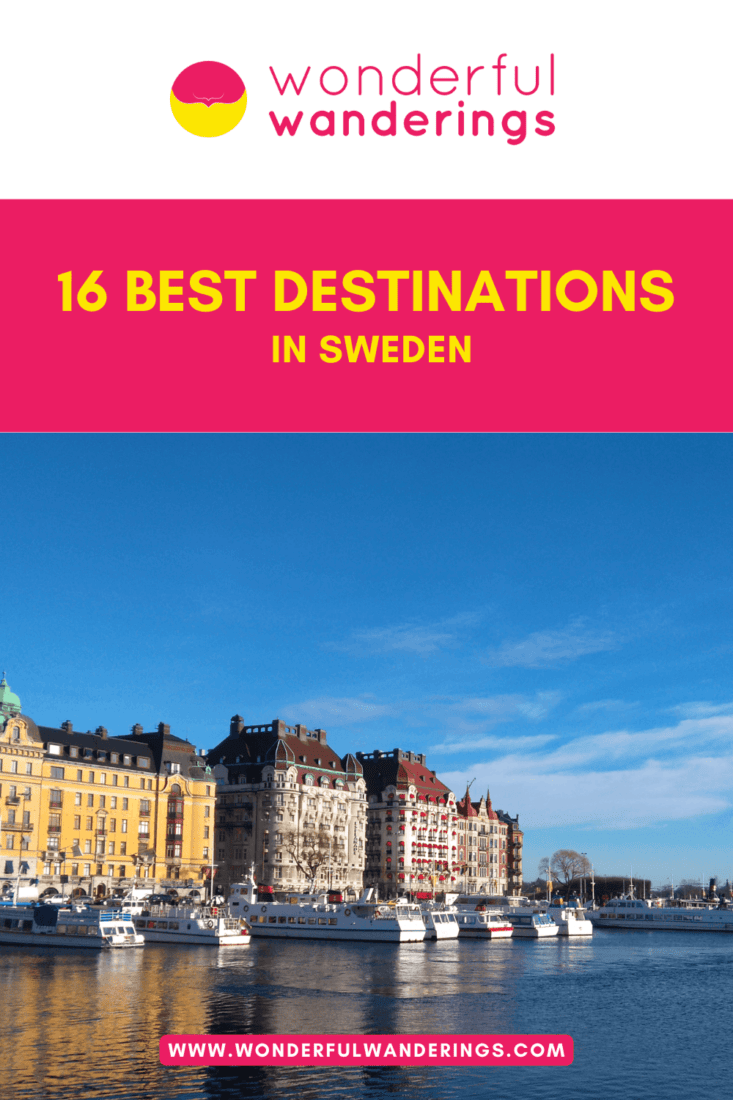
Stockholm is the destination to start with, because the capital holds the country’s two most-visited attractions and sits at the head of an archipelago you can reach by public ferry. The city centre is built across 14 islands, and the medieval core, Gamla Stan, is small enough to walk in a morning.
The single sight most people come for is the Vasa Museum, which houses a 17th-century warship that sank on her maiden voyage in Stockholm harbour and was raised almost intact. The museum calls itself one of Scandinavia’s most visited, and it is worth an early slot before the tour groups arrive. Skansen, the open-air museum on Djurgården, covers Swedish rural buildings and Nordic animals in one visit, and Moderna Museet holds the modern art collection.
Ride the metro even if you do not need to. More than 90 of the network’s 100 stations are decorated, by close to 150 artists working since 1957, across a system of over 110 km, which is why it is described as the world’s longest art exhibition. Two UNESCO sites also sit inside Stockholm County: the royal palace at Drottningholm and the woodland cemetery Skogskyrkogården.
Give the city 3 to 4 days. Our 4 days in Stockholm itinerary sets out how that time divides, and our Stockholm guide covers neighbourhoods and getting around.
2. Gothenburg
Gothenburg is the west coast alternative to Stockholm, and it suits travellers who want seafood, canals and boat trips more than palaces. Sweden’s second city was founded in 1621 by King Gustavus Adolphus and laid out by Dutch engineers, which is why the old centre still runs on canals cut through what was marshland.

The Haga district keeps its wooden houses and is the easiest half-day in the city. Liseberg, the amusement park in the centre, runs a large Christmas market from late November. Ferries from Saltholmen reach the car-free southern archipelago islands in under an hour, and the port itself is the largest in the Nordic countries.
Time your visit around one of the two events the city is known for internationally. The Göteborg Film Festival runs in late January and early February and is the largest film festival in the Nordics, and the Gothia Cup fills the city with youth football teams in July.
Two to three days is enough. Our Gothenburg guide covers what to do with them.
3. Malmö
Malmö is the easiest Swedish city to reach from outside Sweden, because Copenhagen Airport is 20 minutes away by train across the Öresund link. Sweden’s third city faces Denmark across the strait, and it was Danish itself until Sweden took Skåne in the 17th century.

The crossing is worth understanding before you book. The Öresund link is about 16 km (9.9 mi) long in total and opened on 1 July 2000, and it is not one bridge: the cable-stayed bridge runs 7.8 km (4.8 mi) from the Swedish side to the artificial island of Peberholm, where the road and railway drop into an immersed tunnel for the last stretch into Denmark.
In the city, Gamla Staden holds the two squares, Stortorget and the smaller Lilla Torg, which is where the restaurant terraces are. Malmöhus Castle dates from the 16th century and now houses the city museums and an aquarium. On the water at Västra Hamnen, the Turning Torso stands 190 m tall over 54 storeys, finished in 2005 to a Santiago Calatrava design, with the old dockyards around it rebuilt as a residential quarter with swimming spots.
Allow two full days, and use the trains for day trips to Lund and to Copenhagen. Our Malmö guide has the detail.
4. Uppsala
Uppsala is the day trip every Stockholm visitor should consider, since the train takes under an hour and the city holds Scandinavia’s oldest university. Uppsala University was founded in 1477, and its buildings, gardens and library still define the centre.

Carolina Rediviva, the university library, displays the Codex Argenteus, the sixth-century Silver Bible written in silver and gold ink on purple vellum. The Gothic cathedral holds royal tombs, and Linnaeus Garden preserves the botanical garden the 18th-century botanist Carl Linnaeus worked in.
Take the bus 5 km north to Gamla Uppsala for the part most visitors miss. The royal burial mounds there date from the sixth century and mark the pre-Christian religious centre of the region, which is why Uppsala became the seat of the archbishop when Sweden converted.
One day covers the centre, two if you add Gamla Uppsala and the museums. Our Uppsala guide sets out the order.
5. Lund
Lund is the medieval companion to Malmö, 16 km (10 mi) to the northeast and a short train ride away. The town was founded around 990, when this was Denmark, and it spent centuries as the seat of the Archbishop of Scandinavia.

Lund Cathedral is the reason to come. It was consecrated in 1145, keeps much of its Romanesque 12th-century fabric, and its astronomical clock plays twice a day to a small crowd. Kulturen, the open-air museum in the centre, fills two blocks with relocated Swedish buildings, and Lundagård is the park between the cathedral and the university.
Lund is not reached by the Arlanda Express, which only runs between Stockholm and its airport. Come instead on the Öresundståg regional trains, which call at Lund several times an hour from Malmö and Copenhagen. Half a day is enough unless you are visiting the university.
6. Visby
Visby is the most completely preserved medieval town in Scandinavia, and it is on the Baltic island of Gotland rather than the mainland. UNESCO inscribed the Hanseatic Town of Visby in 1995, and the reason is visible from the harbour: the ringmur, a town wall of about 3.4 km (2.1 mi) still standing almost complete, with towers along its length.

Inside the wall the streets are cobbled and narrow, several medieval churches survive as roofless ruins after the Reformation, and merchant houses from the Hanseatic period are still in use. Walking the outside of the wall takes about an hour and is the clearest introduction to the town’s shape.
Come in August if you want the town at its liveliest. Medieval Week fills Visby with markets, jousting and costumed performers in week 32 every year, and accommodation books out months ahead. Ferries run year-round from Nynäshamn and Oskarshamn and take roughly 3 hours, and Visby Airport takes flights from Stockholm and Gothenburg.
7. Kiruna
Kiruna is Sweden’s northernmost city and the base for the Arctic, and it is also a town in the middle of physically moving itself. Kiruna was founded in 1900 around the LKAB iron ore deposit, and because the ore body runs under the old centre, the buildings above it are being relocated.

That move is now the thing to know before you go. The new town centre was inaugurated in September 2022, and Kiruna Church, one of Sweden’s largest wooden buildings, was carried 5 km on trailers over two days on 19 and 20 August 2025. The church is closed while the work at its new site is finished, so check its status before making a special trip.
The mine itself is open to visitors. LKAB runs a guided tour by bus down to a visitor centre 540 m below ground in what is the world’s largest underground iron ore mine, and it books out, so reserve ahead rather than turning up. Above ground, Luossavaara has a marked path and a ski lift to a viewpoint over the town and the mine.
Kiruna has direct flights from Stockholm, which makes it the practical gateway to Abisko, Jukkasjärvi and Swedish Lapland. Visit between November and March for the northern lights and the winter activities, or in June and July for the midnight sun.
8. Luleå
Luleå is the Gulf of Bothnia city that holds one of Sweden’s stranger World Heritage Sites. Gammelstad Church Town, 10 km outside the modern centre, was inscribed by UNESCO in 1996: 424 wooden cottages packed around an early 15th-century stone church, built so that parishioners who lived too far away to travel home the same day had somewhere to sleep after the Sunday service.

The custom that produced it lasted 400 years and has almost vanished elsewhere in northern Scandinavia, which is what makes Gammelstad worth the detour. In the town itself, Norrbottens Museum covers the region and the Sámi, and the archipelago off the coast is open for boat trips in summer and, in a hard winter, walkable on the sea ice.
North of Luleå at Harads, Treehotel puts individually designed rooms up in the pine forest, including the mirrored Mirrorcube. The Icehotel is not here: it is at Jukkasjärvi outside Kiruna, several hours away by road, so do not plan both on the same day.
Luleå Airport is close to the city and takes direct flights from Stockholm. Two to three days covers Gammelstad, the museum and one excursion.
9. Helsingborg
Helsingborg is the crossing point to Denmark that most travellers skip in favour of the Öresund Bridge, and it is quicker than the bridge if you are already in Skåne. The ferry to Helsingør takes about 20 minutes and runs around the clock, several times an hour, which makes Kronborg Castle a genuine half-day trip from the Swedish side.

Kärnan, the square medieval keep on the ridge above the harbour, is what remains of the castle that once controlled the strait, and the climb is the town’s viewpoint. Fredriksdal is an open-air museum of 19th-century Skåne buildings and gardens, and Dunkers Kulturhus on the waterfront holds the art and local history collections.
North of town, Sofiero Palace opens its gardens from spring and is known in Sweden for its rhododendron valley. Helsingborg is under an hour from Malmö by train, not a short hop from Stockholm: the capital is at the other end of the country.
10. Örebro
Örebro is the castle town of central Sweden, roughly 200 km (124 mi) west of Stockholm on the Svartån river near Lake Hjälmaren. Örebro Castle stands on an island in the middle of the river in the centre of town, which is unusual enough to make the walk from the station worth it on its own.

Wadköping, the open-air museum a short walk upstream, is a street of relocated wooden houses from the 17th to 19th centuries with working craft shops rather than roped-off rooms. Svampen, the mushroom-shaped water tower on the edge of town, has a viewing platform, and Stadsparken runs along the river between the two.
Time a visit for Open Art if you can. The biennial exhibition installs contemporary sculpture through the city streets over a summer, which turns an ordinary walk into the main attraction. Direct SJ trains from Stockholm take about 1 hour 30 minutes, so Örebro also works as a long day trip.
11. Västerås
Västerås is the Lake Mälaren city, about 100 km (62 mi) west of Stockholm and an hour away by direct train. The cathedral is the oldest thing in the centre, Gothic and much rebuilt, and the city has been a trading point for the iron produced in the Bergslagen district behind it since the Middle Ages.

Anundshög, 6 km northeast, is the reason archaeologists come. It is one of the largest burial mounds in Sweden, set among standing stones laid out in ship formations and a runestone, on what was a major route north. Djäkneberget in town is a wooded hill of walking paths, carved inscriptions and swimming spots.
Use Västerås as the base for Engelsberg Ironworks, inscribed by UNESCO in 1993 and about an hour north. The site preserves a complete 17th to 19th-century Swedish ironworks, manor house, workers’ housing and blast furnace, which is the clearest surviving picture of the industry that paid for much of early modern Sweden.
12. Linköping
Linköping is the aviation city of Östergötland, 190 km (118 mi) southwest of Stockholm and under two hours by direct train. Saab has built aircraft here since the 1930s, and that history is the thread through the city’s main museum.

The Swedish Air Force Museum at Malmslätt outside the centre holds the national aircraft collection, including a Soviet-era DC-3 shot down over the Baltic in 1952 and raised from the seabed. The car museum many guides place in Linköping is not here: the Saab Car Museum is in Trollhättan, on the other side of the country.
In the centre, Gamla Linköping is an open-air museum laid out as a working town of relocated 19th-century buildings, with a bakery, a chocolate maker and shops that trade. The 13th-century cathedral and the Östergötland County Museum sit beside each other in the middle of town. Two days is enough.
13. Halmstad
Halmstad is a beach town on the Halland coast, 190 km (118 mi) south of Gothenburg at the mouth of the Nissan river. Tylösand, 9 km west of the centre, has the long sand beach the town is known for in Sweden, and it is busy from late June to mid-August and empty either side.

The old centre keeps St Nikolai Church from the 15th century, the Norre Port town gate and a pedestrian street along the river. Halmstad Castle, red and Dutch-Renaissance, faces the water and is a county administrative building rather than a museum, so it is a photograph rather than a visit.
Drive 65 km up the coast to Varberg for Grimeton Radio Station, inscribed by UNESCO in 2004. Built in 1922 to 1924, it is the only surviving early longwave transmitter of its kind anywhere, and its six 127 m masts are visible from the road. May to September is the season here; a good number of coastal businesses close outside it.
14. Falun
Falun is a mining town in Dalarna, and its mine is the reason Sweden could afford its 17th-century wars. The Mining Area of the Great Copper Mountain was inscribed by UNESCO in 2001, and at its peak the mine produced a large share of the copper used in Europe.

Guided tours go underground into the old workings, and the Great Pit at the surface, left by a collapse in 1687, can be looked into from the edge without a ticket. The mine also produced the pigment for Falu red, the dark red paint on wooden houses across Sweden, which is made from the waste ore and is still manufactured here.
Carl Larsson’s house at Sundborn, a short drive northeast, is the other reason to come. The painter’s home is preserved as he and Karin Larsson decorated it, and the interiors did much to shape what people now think of as Swedish domestic design. Two days covers both, more if you carry on into the Dalarna countryside.
15. Karlstad
Karlstad sits at the north end of Lake Vänern, the largest lake in Sweden, where the Klarälven river runs into it. The city is the capital of Värmland, 200 km (124 mi) west of Stockholm and about 2 hours 45 minutes away by direct SJ train.

Sola i Karlstad, the smiling serving girl the city took as its emblem, is behind its nickname as Sweden’s sunshine town, and there is a statue of her by the river. Värmlands Museum covers the province’s art and industrial history, and Mariebergsskogen is a large park on the lakeshore with a small zoo of Nordic animals and a nature centre.
Use Karlstad as a base for the Vänern archipelago and the Klarälven valley rather than as a destination on its own. The Klarälvsbanan, often mistaken for a water park, is a 90 km rail trail on a former railway line north of the city and one of the better cycle routes in the country. Two days is enough in town.
16. Norrköping
Norrköping is Sweden’s industrial-heritage city, 160 km (100 mi) southwest of Stockholm on Bråviken bay. The Industrial Landscape along the Motala ström is a run of restored 19th-century textile mills in the middle of town, now holding a university campus, museums and cafes, with the water still running through the middle of it.

Arbetets Museum, the Museum of Work, occupies Strykjärnet, a wedge-shaped mill building on an island in the river, and it is free to enter. Norrköpings Konstmuseum holds one of the stronger Swedish 20th-century art collections outside Stockholm, and Visualiseringscenter C runs a dome theatre using scientific visualisation data.
Kolmården, 30 km northeast, is the largest wildlife park in Scandinavia and the reason many Swedish families come to Norrköping at all. It is a full day on its own. The city centre needs only a day, so pair the two.
17. Swedish Lapland and Abisko National Park
Abisko is the most reliable place in Sweden to see the northern lights, and the reason is weather rather than latitude. The mountains on the Norwegian border strip the moisture out of Atlantic weather systems before they reach the Torneträsk basin, which leaves a persistent gap in the cloud over the park that guides call the blue hole.
The Swedish Tourist Association runs the Aurora Sky Station on Mount Nuolja above the park, reached by chairlift from Abisko Turiststation, and it opens through the winter season. Aurora nights run from roughly September to March, with the darkest and most reliable stretch from late autumn to early spring. Book a night visit rather than hoping, because the chairlift has limited capacity.
Come in summer for a completely different park. The Kungsleden, the long-distance trail most walked in Sweden, starts at Abisko and runs south through the mountains, and Lapporten, the U-shaped glacial valley across the lake, is the landmark on every photograph of the area. Further south, the Laponian Area was inscribed by UNESCO in 1996 as a mixed site covering Sarek and Stora Sjöfallet and the Sámi reindeer-herding culture that still uses them.
Get here on the night train from Stockholm, which runs to Abisko and on to Narvik, or fly to Kiruna and drive the last 95 km.
18. The Stockholm archipelago
The Stockholm archipelago is roughly 30,000 islands, skerries and rocks spread east of the city, and the point of it is that you reach it on scheduled public ferries rather than a tour. Waxholmsbolaget boats leave from Strömkajen in central Stockholm, and a day return to a single island is the standard first trip.

Pick the island by how far you want to go. Fjäderholmarna is 25 minutes out and works as an evening trip, Vaxholm is the archipelago’s main town with a fortress guarding the channel, Grinda is a small island with a hostel and swimming rocks, and Sandhamn on the outer edge has the sailing scene and open Baltic beaches.
West of the city rather than east, Birka on the island of Björkö in Lake Mälaren was inscribed by UNESCO in 1993. It was Sweden’s main Viking-age trading town, and boats run there from Stockholm in summer with the museum and the excavated site included.
19. Gotland beyond Visby
Gotland is worth more than the walled town, and the island’s landscape is unlike anywhere else in Sweden. Limestone rather than granite lies under it, which gives Gotland long pale beaches, dry flower meadows and the raukar, sea stacks left standing where the softer rock around them has eroded away.
Fårö, reached by a free car ferry from the northern tip, holds the largest raukar fields at Langhammars and Digerhuvud. Ingmar Bergman lived and filmed there, and the Bergman Center covers that connection. Tofta on the west coast and Sudersand on Fårö are the beaches Swedes drive for.
Hire a car or a bicycle at Visby, because the island is 176 km long and the bus network is built for residents. July and early August are the season, and they are also when the ferries and the accommodation are fullest.
20. The Bohuslän coast
Bohuslän is the granite coast north of Gothenburg, and it is the classic Swedish summer: bare pink rock, red fishing sheds, cold clean water and shellfish. The coastline runs from Gothenburg to the Norwegian border, and the villages along it are close enough together to string into a road trip of a few days.
Work north through the ones worth stopping in. Marstrand has the 17th-century Carlsten Fortress on its island and a busy sailing scene in July, Smögen has a boardwalk of fish shops and Fjällbacka sits under a granite cliff split by a ravine you can climb. Tanum, inland from Fjällbacka, was inscribed by UNESCO in 1994 for Bronze Age rock carvings cut into the glacier-smoothed rock.
At the far end, Kosterhavet became Sweden’s first marine national park in 2009. It covers about 390 sq km of sea and skerries around the Koster islands off Strömstad, holds more than 6,000 recorded marine species and takes in Sweden’s only coral reef. Ferries from Strömstad reach the islands, which are largely car-free.
21. The High Coast
The High Coast, Höga Kusten, is where the land is still rising out of the sea, and that is precisely why UNESCO inscribed it in 2000. The ice sheet that covered this coast pressed the crust down, and since it melted the land has risen about 800 m, the largest post-glacial uplift measured anywhere in the world.
The evidence is walkable. The highest coastline, the old shore line left stranded by the uplift, sits about 286 m above the present sea, and the rock is still rising by roughly 8 mm a year, which means fishing harbours here have gone dry within living memory. Skuleskogen National Park has the marked trails, including the Slåttdalsskrevan ravine, and Skuleberget above the E4 gives the view over the fjords in one short climb.
Walk the Höga Kusten Trail if you have a week, or drive the coast road and stop at the fishing villages of Bönhamn, Barsta and Norrfällsviken. The High Coast Bridge over the Ångermanälven marks the southern end. June to September is the practical season.
22. Öland and Kalmar
Öland is the long thin island off Sweden’s southeast coast, reached from Kalmar over a 6 km road bridge that opened in 1972 and is still the longest bridge in the country. The island is flat, sunny by Swedish standards and full of windmills, and it is where the Swedish royal family spends its summers at Solliden.
The Agricultural Landscape of Southern Öland was inscribed by UNESCO in 2000, and it protects a living farmed landscape rather than a monument. Stora Alvaret, the limestone plain that covers much of southern Öland, is too thin-soiled to plough and has been grazed continuously for thousands of years, which is why it carries orchids and other plants that have vanished from farmland elsewhere in Europe.
Start on the mainland at Kalmar. Kalmar Castle is one of the better-preserved Renaissance castles in Sweden and gave its name to the Kalmar Union of 1397, which joined Sweden, Denmark and Norway under one crown. The town centre around it is compact enough for an afternoon.
What is the best time to visit Sweden?
The best time to visit Sweden is June to August, when temperatures in the southern region of Götaland sit between 15 and 23 °C (59 to 73 °F) and the daylight runs late into the evening. Almost everything seasonal is open in those months: the archipelago ferries, the island beaches, the outdoor museums and the coastal restaurants.
The two useful exceptions are worth planning around. December suits Stockholm and Gothenburg for the Christmas markets and the early dark, and January to March suits Kiruna and Abisko, because the aurora needs long nights and the winter activities need frozen ground.
May and September are the quiet compromise. Prices drop, the light is still generous, and the queues at the Vasa Museum and Liseberg are shorter, though some coastal businesses in Halland and Bohuslän have already closed for the year.
What is the best place to visit in Sweden during the summer?
Gothenburg is the best place to visit in Sweden during the summer, because everything the season is good for is within an hour of the city. Ferries from Saltholmen reach the car-free southern archipelago islands, the Bohuslän coast with its fishing villages starts immediately north, and Liseberg runs at full capacity from late April.
The city itself is at its most usable in July and August. Seafood is the local speciality, terraces fill the squares in Haga and along the canals, and the summer festival calendar runs through both months.
What is the best place to visit in Sweden during the winter?
Kiruna is the best place to visit in Sweden during the winter, because it is 145 km (90 mi) north of the Arctic Circle and the aurora season runs from roughly September to March. The town is the gateway to Abisko for the northern lights, to Jukkasjärvi for the Icehotel and to the dog sledding and snowmobiling that fill the short days.
Jukkasjärvi is worth understanding before you book. Icehotel 365, opened in 2016, is kept at around minus 5 °C by solar power and is open all year, while the seasonal ice hotel next to it is rebuilt each December from Torne river ice and melts in spring, so a winter visit is the only way to see both.
What is the best place to visit in Sweden during Christmas time?
Stockholm is the best place to visit in Sweden at Christmas, because the markets, the decorations and the museums are all within a short walk or metro ride of each other. The Christmas market in Stortorget, the main square of Gamla Stan, is the one most visitors picture, and Skansen runs a larger market on Djurgården with food stalls, bonfires and demonstrations of old Christmas customs.
Gothenburg is the alternative if you would rather have one big event than several small ones. Liseberg turns the amusement park into a Christmas market with millions of lights from late November, and it stays open into early January.
How do travellers get around in Sweden?
Travellers get around Sweden by train for the long distances, by bus where the trains do not go, and by hire car for the coast and the countryside. SJ runs the intercity and high-speed network from Stockholm, and the fast services reach Gothenburg in just over 3 hours and Malmö in about 4 hours 30 minutes.
Long-distance coaches such as Flixbus cover the same routes more slowly and more cheaply, and regional operators such as Öresundståg in Skåne and Mälartåg around Stockholm handle the short hops. Domestic flights are the sensible choice for the far north, because Stockholm to Kiruna is a journey of well over 1,000 km that takes a night by train and under two hours in the air.
Compare the routes before you fix the dates, since direct flights into Gothenburg, Kiruna and Visby thin out sharply outside summer. Check Trip.com for flight options to Sweden and set a price alert if your dates can move.
Is a road trip a good idea to explore Sweden?
Yes, a road trip is a good idea in Sweden for the coasts and the countryside, and a poor idea for the cities. Roads are well maintained, traffic outside the three big cities is light, and the places public transport handles badly are exactly the ones worth driving to: the Bohuslän villages, the High Coast, inland Dalarna and the Skåne coast.
Drive on the right, keep dipped headlights on at all times, and treat the drink-driving limit as effectively zero, because it is 0.02%. Watch for wildlife at dawn and dusk, particularly reindeer and elk in the north, and slow down when you see the warning signs rather than after.
Park the car in the cities. Stockholm, Gothenburg and Malmö all charge congestion or high parking fees and are quicker to cross by metro, tram or bicycle.
Can travellers rent a car in Sweden?
Yes, travellers can hire a car in Sweden, and the major suppliers have desks at every airport and most city stations. A small car with unlimited mileage starts at roughly SEK 750 (about €67, $78, £58) per day or SEK 1,300 (about €116, $135, £100) per week, with the summer weeks in July and the winter weeks in Lapland at the top of that range.
Read the terms before you commit rather than at the counter. Drivers under 25 and over 70 attract surcharges with most suppliers, one-way drops between cities are charged, and winter tyres are a legal requirement from 1 December to 31 March when winter conditions apply, which is normally included but worth confirming for a northern pickup. DiscoverCars puts the local and international suppliers side by side so the deposit and excess terms are visible before you book.
Where to stay in Sweden
Stay in the centre of whichever city you are using as a base, because Swedish city centres are compact and the evening life is in them. Stockholm splits into Gamla Stan for the old town, Södermalm for the bars and independent shops and Norrmalm for the station and the shopping streets, and any of the three keeps you within walking distance of the ferries.
Book earlier than feels necessary for three specific things. Visby in Medieval Week, Kiruna and Abisko in the aurora season, and anywhere on the west coast in July all sell out months ahead, and prices rise steeply once they thin out. Compare places to stay across Sweden once your route is fixed, and filter by neighbourhood rather than by the map pin alone.
Is it expensive to visit Sweden?
Yes, Sweden is expensive by European standards, and accommodation, restaurants and alcohol are where the difference shows most. Spirits, wine and stronger beer are sold only through Systembolaget, the state monopoly, which closes on Sundays and early on Saturdays, so a drink in a bar costs noticeably more than it would elsewhere in Europe.
Three habits cut the cost more than anything else. Eat your main meal at lunch, when almost every restaurant runs a fixed-price dagens lunch that includes salad, bread and coffee; travel outside July, when Swedes take their own holidays and prices peak; and use the free attractions, since several state museums in Stockholm charge nothing for entry.
Nature costs nothing at all. Allemansrätten, the right of public access, lets you walk, cycle, swim, forage berries and mushrooms and camp for a night on uncultivated land, as long as you keep away from houses, leave no trace and light no fires in dry conditions.
What should you know before travelling to Sweden?
The 6 things worth knowing before a first trip to Sweden are listed below.
- Money. The currency is the Swedish krona (SEK), and Sweden is close to cashless. Cards and phone payments are accepted almost everywhere, and a number of buses, museums and cafes take no cash at all, so a card is more useful than a currency exchange.
- Language. The official language is Swedish, and English is spoken widely and confidently by most people under 60. Signage in the cities and on the trains is bilingual.
- Tipping. Tipping is optional and service is included in the price. Rounding up a restaurant bill is normal, and nothing is expected in cafes, bakeries or taxis.
- Alcohol. Systembolaget is the only shop that sells drinks above 3.5% alcohol, its opening hours are short, and it closes on Sundays. Supermarkets sell only weaker beer.
- Entry. Sweden is in the Schengen Area, so US, UK, Canadian and Australian visitors can stay 90 days in any 180 without a visa. The EU’s Entry and Exit System now records non-EU arrivals at Schengen borders, so allow extra time on arrival.
- Weather. Pack layers and a waterproof in every season. Summer in Götaland is mild rather than hot, the north can be cold at night in June, and winter in Lapland regularly runs well below freezing.
Sweden also sits within easy reach of its neighbours if you want to combine countries. Oslo is about 5 hours from Stockholm by train, and Copenhagen is 20 minutes from Malmö.
PIN FOR LATER
WonderfulWanderings Pro Tips
The 4 tips below come from rechecking the northern attractions on this page against what their operators publish, and each one is a booking decision rather than a sightseeing suggestion.
- Work out which Icehotel you are booking, and where it is. Icehotel 365 opened in 2016, is held at around minus 5 °C by solar power and is open all year, while the seasonal ice hotel beside it is rebuilt each December from Torne river ice and melts in spring, so only a winter trip shows you both. Both are at Jukkasjärvi outside Kiruna, several hours by road from Luleå, which is where guides that pair the two in one day go wrong.
- Check the status of Kiruna Church before you build a day around it. The church was carried 5 km on trailers over two days on 19 and 20 August 2025, and it is closed while the work at its new site is finished. LKAB has published no reopening date, so treat it as shut until the mining company says otherwise.
- Reserve the LKAB mine tour before you fly to Kiruna, not after you land. The guided bus tour runs down to a visitor centre 540 m below ground in the world’s largest underground iron ore mine, and it books out, so turning up on the day is how people miss it.
- Take the Öresundståg to Lund. Several guides send readers there on the Arlanda Express, which runs only between Stockholm and its airport, roughly 600 km away. The Öresundståg regional trains call at Lund several times an hour from Malmö and Copenhagen, and half a day in the town is enough unless you are there for the university.
About the author. This guide is written and maintained by the Wonderful Wanderings editorial team. Wonderful Wanderings was founded in 2012 by Sofie Couwenbergh, and the team covers Sweden for independent travellers, from Stockholm and Gothenburg to Gotland, Skåne and Swedish Lapland. We cover the flights, hire cars, hotels and guided tours worth booking in each of them, and update this page when prices, dates and rules change.