 EN
EN
 Nederlands
 Français
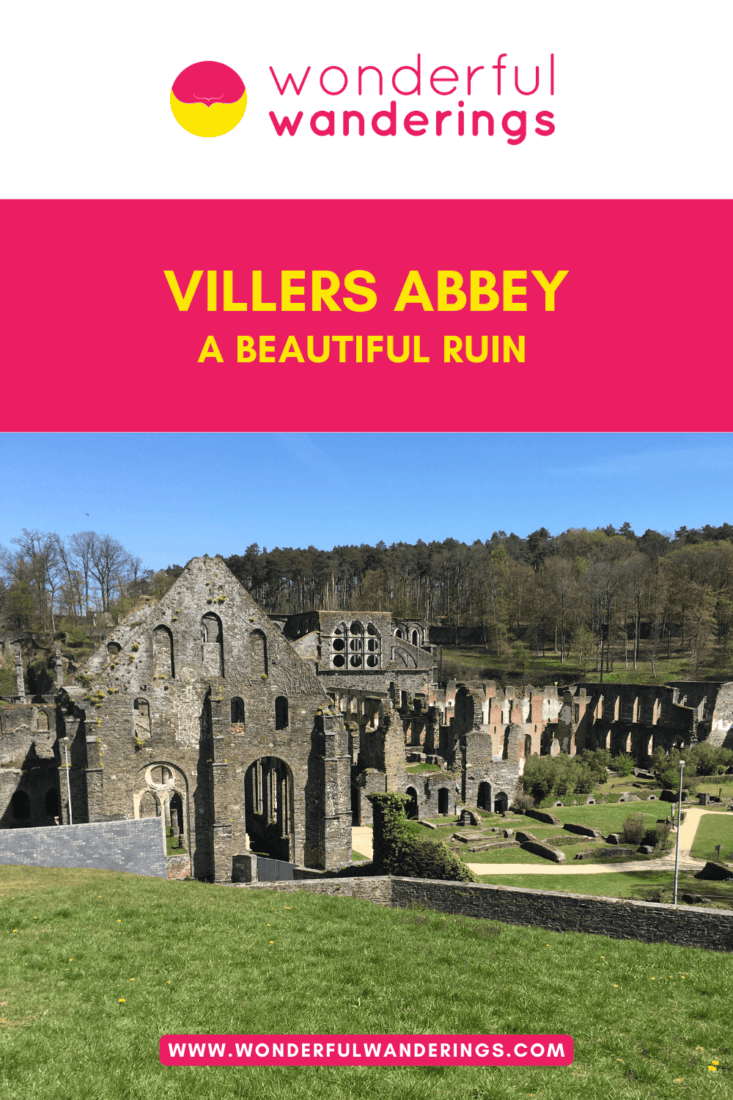
Villers Abbey is a ruined Cistercian abbey at Villers-la-Ville, 30 km (18.6 miles) south of Brussels, and it is one of Wallonia’s outstanding heritage sites and among the most complete abbey ruins in Belgium. Twelve monks and three lay brothers came from Clairvaux in 1146 to found it, the site was abandoned in 1796 after the French Revolution, and the Belgian state bought and began conserving it in 1893.
What makes it worth the trip is how much is still legible. You walk from the church into the cloister, the refectory, the kitchens, the cellars, the dormitory, the infirmary and the brewhouse, and each one is standing high enough to read as a room. Allow about an hour and a half for the route, more if you take the gardens and the vineyard. Admission in 2026 is €10 (about $12, £9) for an adult, and the site opens every day of the year except four.
Villers Abbey opening hours
Villers Abbey opens daily all year, on two seasonal timetables, and it closes on only four dates. From 1 April to 31 October it runs 10am to 6pm, and from 1 November to 31 March it runs 10am to 5pm. Both seasons are open every day of the week.

Last admission is one hour before closing, which is the detail that catches people who arrive late in the afternoon for the light.
The abbey closes on 24, 25 and 31 December and on 1 January. It can also close at short notice in high winds, because the ruins are high masonry and loose stone is a real risk. If it is blowing hard, check before you drive out.
Older guides say Villers shuts on Tuesdays in winter. It does not: the low season is open daily.
Villers Abbey ticket prices
Adult admission to Villers Abbey is €10 (about $12, £9) in 2026, up from the €9 that most guides still quote. The full price list is below, and groups need a minimum of 15 people to qualify for the group rate.
| Ticket | Price |
|---|---|
| Adult | €10 (about $12, £9) |
| Senior 65+ or student | €8 (about $9, £7) |
| Child aged 6 to 12 | €4 (about $5, £3) |
| Child under 6 | Free |
| Jobseeker with an unemployment card | €5 (about $6, £4) |
| Adult group, minimum 15 | €9 (about $10, £8) |
| Senior or student group, minimum 15 | €7 (about $8, £6) |
| Children’s group, minimum 15 | €3.50 (about $4, £3) |
| Visitor with a disability, or a teacher with a valid card | Free |
The abbey accepts the European Disability Card. Card payment is strongly preferred at the ticket desk, with Bancontact, Visa and Mastercard taken, so do not rely on cash.
What to see at Villers Abbey
The ruins are laid out as a working monastery rather than as a single church, and that is the point of the visit. The 7 things below are what to look for as you go round.
- The abbey church. The church took roughly 70 years to build and was finished by the end of the 13th century. Its vaulting, arches and rose windows are a textbook example of Cistercian Gothic, and it is roofless, which is why the scale of it lands the way it does.
- The cloister. The cloister is where the ruins stop being an attraction and start being a building you can imagine living in, with the chapter house, the warming room and the passages off it still readable.
- The refectory and the kitchens. The refectory was finished in 1267 and the kitchens beside it show how a house feeding several hundred people worked.
- The cellars and the dormitory. The vaulted cellars survive well, and the dormitory above gives you the scale of the community that lived here.
- The brewhouse. Villers brewed its own beer, and the brewhouse is still standing. The abbey brews under its own name again today.
- The gardens. The site holds a medicinal herb garden planted with the species medieval monks actually used, plus formal gardens laid out around the ruins.
- The vineyard. The abbey’s hillside vineyard was replanted in the modern era and sits across from the ruins. It is worth the short climb for the view back over the whole site.
There is also a meditation path through the grounds, a shop at the entrance, and a visit app and a virtual reconstruction of the abbey as it stood in 1298, which is the easiest way to see what you are standing in.
The history of Villers Abbey
Villers Abbey was founded in 1146 by twelve Cistercian monks and three lay brothers sent from Clairvaux, on land granted by Gauthier de Marbais. The community tried two earlier sites, known now as Villers I and Villers II, before settling on the one you visit. Construction of the abbey as it stands is 13th-century work: the choir was up by 1217, the crypt by 1240 and the refectory by 1267.

The 13th century was also its height. Contemporary accounts put roughly 100 monks and 300 lay brothers inside the walls, a figure historians treat as possibly inflated, and the abbey’s lands ran to some 100 km² (39 sq mi) of woods, fields and pasture. Members of the ducal house of Brabant were buried here, including Henry II, Duke of Brabant, and John III.
Decline set in during the 16th century with the wars of the Low Countries. Spanish troops did serious damage to the church and cloister during the campaign of 1544, and both were partly repaired in 1587. Fortunes kept slipping through the 17th and 18th centuries as the community and its wealth shrank, and the abbey was abandoned in 1796 in the wake of the French Revolution.
Then it was quarried. The site was sold and stripped for building stone, and in 1855 the railway line between Ottignies and Charleroi was driven straight through the old abbey grounds, which did as much damage as any war. The Belgian state bought the site in 1893 and began the conservation work that made public visits possible. The abbey was classified as a historic site in 1973 and is now part of Wallonia’s Major Heritage.
When to visit Villers Abbey
Come between April and October if you want the long timetable and the gardens in leaf. The high season runs to 6pm rather than 5pm, which is an extra hour of light in a site you walk rather than sit in, and the herb garden and the vineyard only make sense in leaf.

July and August are the busiest months. Late spring and early autumn give you the same opening hours with fewer people, and autumn does something to bare stone and wet leaves that summer does not. Winter is quieter still and perfectly walkable, though the shorter hours and the bare gardens make it a shorter visit.
Whatever the season, arriving in the first hour or the last two is the reliable way to have the church largely to yourself.

How to get to Villers Abbey
Drive if you can, because Villers Abbey has free parking at the gate and the public transport is thin. The abbey is at Rue de l’Abbaye 55, 1495 Villers-la-Ville, roughly 30 km (18.6 miles) south of Brussels and about 20 km (12.4 miles) north-east of Charleroi, in Walloon Brabant. The drive from Brussels takes around 45 minutes.

The alternatives:
- By train: line 140 between Ottignies and Charleroi stops at Villers-la-Ville station, which is 2 km (1.2 miles) from the abbey, about a 25-minute walk.
- By bus: TEC line 51 runs from Louvain-la-Neuve to Villers-la-Ville, Monday to Saturday only, so it is no use on a Sunday.
- By bike: the abbey sits on cycle node 30 and has a covered bike park.

If you are coming into Belgium from elsewhere in Europe, Omio compares the trains and coaches into Brussels and Charleroi on one screen, which is quicker than checking each operator separately.
Rules for visiting Villers Abbey
Villers is a stabilised ruin rather than a restored building, so its rules are mostly about the masonry. The 6 below are the ones that affect an ordinary visit.

- Stay on the marked paths. Sections that are not structurally sound are fenced off, and the fences are there for a reason.
- No climbing on the ruins. This applies to walls, stairs and window openings.
- Supervise children closely. The site is genuinely good with children, and it also has drops and loose stone.
- Dogs are welcome on a lead. This is the rule most guides get wrong: Villers allows dogs on a leash, it does not restrict them to assistance animals.
- No drones. They are banned outright for the peace of other visitors, which is worth knowing if you were planning aerial shots.
- No professional photography without permission, and no flash inside the church.
There are baby-changing facilities in the toilets, and the site is partly accessible to visitors with reduced mobility.

Where to eat at Villers Abbey
Eat at the Bistro de l’Abbaye, which is on the site, opens every day and is better than a heritage-site cafe has any right to be. Snacks run from 11am until half an hour before closing: soup, a cheese and dried sausage board, rillettes with bread, a raclette and smoked ham tartine, breaded chicken.

Full plates come out between noon and 3pm, and the one to order is the beef cheek braised in Ténébreuse, the abbey’s own dark beer. Salads, burgers, lamb shank and a vegetable mafé fill out the menu, and there are three bistro specials at €14 (about $16, £12) if you want lunch without the full carte.
The abbey brews and sells its own beers, and the shop at the entrance carries them alongside books about the site. Picnicking on the grounds is normal and pleasant if you would rather bring your own.

Is Villers Abbey worth visiting?
Villers Abbey is worth the trip for the completeness of the ruin rather than for any single building in it. Most abbey ruins leave you a church and a footprint; here you get the church, the cloister, the refectory, the kitchens, the cellars, the dormitory, the infirmary and the brewhouse, all standing high enough to read, on a green site with a herb garden and a vineyard.

It works as a half-day from Brussels and as a full day if you walk the surrounding countryside afterwards. It also works with children better than a museum does, because the whole thing is outdoors and there is space to move.
What I thought of Villers Abbey
The photographs I had seen of Villers Abbey turned out to be accurate, which is not usually how this goes. When I made the left turn to where the GPS said the abbey would be, I drove straight through an old gate and there it was on my left, an enormous structure, with the road running through the middle of the domain and a secondary building, now a bistro, on the right.

I left the car in the car park, took out my camera and paid at the desk. The same ticket got me a map with detailed notes on everything on the site and a separate brochure about the medicinal herb garden. I spent the next two hours wandering, trying every small path I could find and trying to picture the place at full strength.
What makes the Abbaye de Villers unusual is exactly that: it lets you imagine abbey life across the centuries, because the transept, the cloisters, the infirmary and the dormitory are all still there in some form. There were a handful of other visitors and nothing like the number this place deserves.

Where to stay near Villers Abbey
Base yourself in Brussels rather than in Villers-la-Ville, because the abbey is 45 minutes away by car and the village has almost nothing else in it. Brussels also gives you the train and the airport, and a much wider choice of rooms at every price.

Louvain-la-Neuve and Nivelles are the closer alternatives if you want to be nearer for an early start, and both have hotels. Rooms across Belgium are listed on Booking.com’s Belgium pages. There is more on the country in the guide to Belgium.
Villers Abbey FAQ
How much does Villers Abbey cost?
Adult admission to Villers Abbey is €10 in 2026, with €8 for over-65s and students, €4 for children aged 6 to 12 and free entry for under-6s, teachers with a valid card and visitors with a disability. Groups of 15 or more pay €9, €7 and €3.50 in the same categories.
Is Villers Abbey open on Tuesdays?
Yes. Villers Abbey opens every day of the week in both seasons, and the claim that it closes on Tuesdays in winter is out of date. It shuts only on 24, 25 and 31 December and 1 January, and occasionally at short notice in high winds.
How long does it take to visit Villers Abbey?
The abbey gives its tour duration as about an hour and a half, and most visitors spend between 90 minutes and three hours on the site. Add another half hour for the herb garden and the vineyard, and longer again if you eat at the bistro.
Can you get to Villers Abbey by train?
Yes. Line 140 between Ottignies and Charleroi stops at Villers-la-Ville station, which is 2 km (1.2 miles) from the abbey and about a 25-minute walk. TEC bus 51 runs from Louvain-la-Neuve Monday to Saturday, so the bus is not an option on Sundays.
Can you bring a dog to Villers Abbey?
Yes, dogs are allowed on a leash at Villers Abbey. Several guides state that only assistance animals are permitted, which is not the abbey’s own rule. Drones, by contrast, are banned outright.
WonderfulWanderings Pro Tips
The 5 tips below come from my own visit and from re-checking every price, opening hour and rule against the abbey’s own site in September 2026.
- Buy the ticket at the desk and take the map that comes with it. The same price gets you a detailed site map and a separate brochure on the medicinal herb garden. I used both for the whole two hours I was there, and the site is large enough that wandering without the map means missing rooms.
- Do not budget €9 or plan around a Tuesday closure. Adult admission is now €10, seniors and students €8, and the abbey opens every day in both seasons. Both of the old figures are still all over the internet.
- Arrive at least two hours before closing. Last admission is a full hour before the gates shut, so a 5pm arrival in winter is a locked door and a 4pm arrival is an hour inside a site that wants ninety minutes.
- Check the wind before you drive out. The abbey closes to the public at short notice on high-wind days because of the loose masonry, and it is a 45-minute drive from Brussels to find that out at the gate.
- Order the beef cheek braised in Ténébreuse at the bistro. The abbey brews its own beer and the bistro cooks with it, which is the one thing on the menu you cannot get anywhere else. Full plates are served between noon and 3pm only; outside those hours it is boards and tartines.
About the author. This guide is written and maintained by the Wonderful Wanderings editorial team. Wonderful Wanderings was founded in 2012 by Sofie Couwenbergh, a Belgian travel writer, and the first-hand account of visiting the abbey in this post is hers. The team covers Belgium for independent travellers, including the abbeys, castles, guided tours and hotels worth booking, and updates this page when ticket prices, opening hours and site rules change.