
 EN
 Nederlands
 Français

Brussels has three ways into its chocolate, and a hands-on workshop teaches you more in 90 minutes than any shop window will. You can book a workshop where you temper, fill and mould your own pralines, join a guided tasting walk between the historic houses on and around the Grand Place, or work through the city’s chocolatiers on your own with a list. This guide covers all three, and every venue named here was checked against its own site before it went in.
I did the workshop-and-tour version myself. Intercontinental Hotels Group invited me to try their Rewards programme and gave me 37,000 points to spend, and I put them straight into a chocolate workshop and walking tour in Brussels. What that was actually like is further down, along with the parts of it that surprised me.
Chocolate workshops in Brussels
Three chocolate workshops in Brussels are worth booking, and they differ in who teaches them and how much chocolate you go home with. All three are in the centre and all three need booking ahead, because the class sizes are small.
The Belgian Chocolate Makers, Rue Lebeau
The Belgian Chocolate Makers run daily public workshops from a training centre between the Sablon and the Grand Place, and theirs is the bean-to-bar option. The company started in 2020 and its two shops sit side by side at Rue Lebeau 3-11, 1000 Brussels, opposite the Royal Library, with a 170 m² workshop space attached. Sessions run every day including weekends and public holidays, and a standard workshop takes about 90 minutes, with a certified chocolate maker guiding you through tempering and moulding your own truffles.
Book direct if you can. The company sells the same workshop through the large booking platforms and says openly that those platforms can take up to 30% of the ticket, so booking on its own site puts more of the money into the workshop and gives you more dates to choose from. Buses 48, 33 and 95 stop nearby and Gare Centrale is a short walk.
Laurent Gerbaud’s Saturday workshop
Laurent Gerbaud teaches his beginners’ workshop himself, every Saturday, in the kitchen behind his Ravenstein shop. Gerbaud’s chocolate is unusual in Brussels for leaning on dried fruit and nuts rather than sugar, and the session starts with a tasting of several different cocoas before you make chocolates to take home. It is the one to pick if you want to understand what you are tasting rather than just enjoy it.
Gerbaud has two Brussels addresses. The shop, tearoom and kitchen is at Rue Ravenstein 2D, open Tuesday to Sunday from noon to 6pm, and there is a second boutique at Rue de l’Étuve 19, open Tuesday to Sunday from 11.30am to 7.30pm. The hot chocolate at Ravenstein is made at 72% cocoa and is worth the detour on its own. Book the workshop through the shop’s own site, and note that places go quickly because there is one session a week.
Choco-Story Brussels
Choco-Story Brussels is the museum answer, and its workshop is sold separately from the entry ticket. The museum sits at Rue de l’Étuve 41, a two-minute walk from the Manneken Pis, opens every day from 10am to 6pm, and covers three floors from Maya and Aztec cocoa through to the Belgian praline. Entry includes an audio guide in 11 languages, a live chocolate demonstration and several tastings, one of them an artisanal praline.
Allow an hour to 90 minutes for the museum and another hour if you add the workshop. Booking online gets you priority entry through a separate queue, which matters in the school holidays, and the museum is included in the Brussels Card. Combined tickets pair it with the Frietmuseum, Belgian Beer World or the Atomium.
Guided chocolate walking tours
A guided chocolate walk pairs tastings at several chocolatiers with a workshop at the end, and it is the option that covers the most ground. The usual shape is a 2-hour to 4-hour walk starting on the Grand Place in front of the City Hall, stopping at four to six houses for a tasting at each, with a guide filling in the history of Belgian chocolate between stops. The longer versions finish with a hands-on hour where you make your own chocolates and take a box away.
Prices and departure days move around, so check the live listing rather than a figure written down anywhere. You can book the Brussels chocolate workshop and tasting tour if you want the combined version, and the widget above shows what is currently running on your dates. Most tours have no age limit and charge a reduced rate for children.
What a Brussels chocolate workshop is actually like
A Brussels chocolate tour is a walking tour of the city with chocolate attached, and that is the part nobody tells you. Our guide, Chris, took us between shops and used the gaps to point out corners of Brussels we would never have found, so we came away knowing more about the city than about cocoa percentages. There was a tasting at every stop.

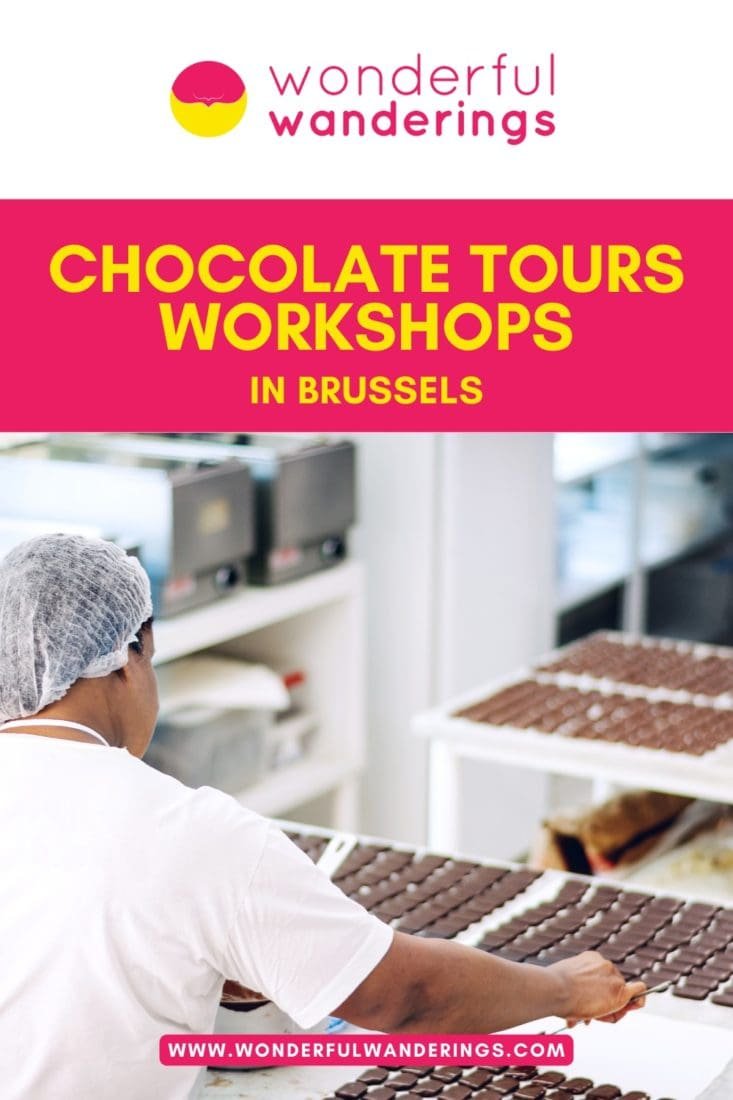
The workshop at the end was messier and better than expected. Everyone got a plate, a pool of melted chocolate and a tray of things to put in it, and I made mine with coconut, almond and sesame seed. You eat whatever you want while you work and take home whatever survives. While ours set, we were shown how a praline is made: melted chocolate goes into a mould that is colder than the chocolate so it sticks, the mould is turned over so the excess runs out and leaves a shell, the filling goes in, which in our case was caramel, and a final layer of chocolate seals it before the whole thing is scraped flat and knocked out of the mould.
Set your expectations before you book. The chocolate arrives already tempered and liquid, so you are decorating and filling rather than learning to temper from scratch. If you want the technical side, book the bean-to-bar workshop at The Belgian Chocolate Makers or Gerbaud’s Saturday session instead. If you want to lick chocolate off your fingers with a legitimate excuse, the tour workshop is exactly right.
The chocolatiers a Brussels chocolate tour visits
Six Brussels chocolate houses turn up on almost every tasting tour, and they are listed below with what each one is known for.
- Neuhaus: the oldest of them, trading since 1857 and the house that invented the filled praline in 1912. Its flagship sits in the Galeries Royales Saint-Hubert, which is where Jean Neuhaus opened up in the first place.
- Wittamer: family-run since 1910 and still on the Place du Grand Sablon, as much a pâtissier as a chocolatier. The chocolate-dipped strawberries are the thing it is known for.
- Pierre Marcolini: the modern name on the Sablon, bean-to-bar, sourcing its own cocoa and working in sharper, less sweet flavours than the traditional houses.
- Leonidas: the everyday one, founded in 1913, sold loose by weight from a counter and priced so that buying a mixed 500 g bag is a normal thing to do rather than a splurge.
- Godiva: the Grand Place shop at numbers 21-22 opens daily from 10am to 8pm, and the house marked its centenary in 2026.
- Corné Port-Royal: trading in Brussels since 1932 and still Belgian-owned, with a shop in the Galeries Royales Saint-Hubert.
Two more are worth going out of your way for. Laurent Gerbaud near BOZAR builds his chocolates around dried fruit and nuts rather than sugar, and Frédéric Blondeel roasts his own cocoa in Koekelberg, at a shop that is a roastery and chocolate factory as much as a boutique and opens every day.
Belgian chocolate brands worth knowing
Nine Belgian chocolate brands account for most of what you will see on a shelf in Brussels, and their differences are worth knowing before you spend money. They are listed below.
- Neuhaus. Neuhaus opened in 1857 as a pharmacy in the Galeries Royales Saint-Hubert, coating medicines in chocolate to hide the taste. In 1912 the founder’s grandson Jean Neuhaus Jr. replaced the medicine with a filling and created the Belgian praline, and in 1915 his wife Louise Agostini designed the ballotin box to carry them home undamaged. Both are still the house’s signature.
- Godiva. Pierre Draps Sr. started making pralines in a small Brussels workshop in 1926, and the family adopted the Godiva name in 1945, taken from the Coventry legend. Godiva is now the most widely exported of the Belgian names, and its truffles with fruit, nut and liqueur ganaches are the range it is built on.
- Côte d’Or. Charles Neuhaus founded Côte d’Or in 1883 and named it after the Gold Coast, now Ghana, where its cocoa came from, which is also why an elephant is on the wrapper. The Chokotoff, a chocolate-covered toffee, is the product Belgians actually buy.
- Leonidas. Leonidas has been selling since 1913 on a straightforward promise: pure cocoa butter, more than 100 pralines, and prices low enough to buy chocolate without an occasion. The manon and the truffle are the volume sellers.
- Guylian. Guy Foubert and his wife Liliane founded Guylian in Sint-Niklaas in 1958, and the brand name is their two first names run together. The hazelnut-praline seashells are what it is known for worldwide, in milk, dark and white chocolate. We have a longer piece on Guylian if the seashells are what brought you here.
- Mary. Mary Delluc founded Mary in 1919 on Rue Royale and was one of the first women to run a chocolate house in Brussels. Mary has held a Belgian Royal Warrant since 1942, and the ornate boxes are half the point of buying it.
- Galler. Jean Galler founded Galler in 1976 at Vaux-sous-Chèvremont near Liège, and its flavoured bars are the range to look for. The company went through a restructuring in early 2026 and was bought in April 2026 by a group of Belgian investors, which returned it to fully Belgian ownership in its fiftieth year.
- Bruyerre. Bruyerre has made chocolate at Gosselies since 1909, works in 100% pure cocoa butter and exports well over half of what it makes. It is the least famous name here and the one Belgian pastry chefs buy from.
- Belvas. Belvas has been making organic, fair-trade chocolate at Ghislenghien since 2005 and calls itself Europe’s first organic chocolate factory. It is the brand to look for if certification matters to you, and it does vegan, gluten-free and sugar-free lines.
Where to buy chocolate in Brussels
Three parts of central Brussels hold almost all the chocolate shops worth your time. They are set out below.
- The Galeries Royales Saint-Hubert: the 1847 glass-roofed arcade off the Grand Place, with Neuhaus where it began and Corné Port-Royal a few doors along. This is the walk to do if you only have half an hour.
- The Place du Grand Sablon: the square for the serious houses, with Wittamer, Pierre Marcolini and The Belgian Chocolate Makers all within a few minutes of each other, plus the antiques market at weekends.
- The Grand Place and Rue de l’Étuve: Godiva on the square itself, Choco-Story and a Gerbaud boutique on the Étuve, and a great many tourist chocolate shops in between that are worth walking past.
Two rules make the buying easier. Buy loose by weight rather than in a gift box if the chocolate is for you, because the box is a large part of what you pay for. And buy on the day you leave, since a Belgian praline with a fresh cream ganache has a shelf life of two or three weeks at most and does not enjoy a warm suitcase.
Other Belgian desserts to try in Brussels
Chocolate is not the only reason to keep room for pudding, and 6 other Belgian sweets are easy to find in Brussels. They are listed below, with what each one actually is.
- Belgian waffles: two different things sold under one name. The Brussels waffle is rectangular, light and crisp and is usually eaten with a knife and fork, and the Liège waffle is denser and sweeter because pearl sugar is worked into the dough and caramelises. Street stands sell both.
- La Dame Blanche: the Belgian ice cream sundae, vanilla ice cream under warm chocolate sauce and whipped cream, on almost every brasserie menu in the city.
- Speculoos: spiced shortcrust biscuits with cinnamon, ginger, nutmeg and cloves, sold in every supermarket and bakery all year, and the base of the spread you will also see everywhere.
- Cuberdons: cone-shaped sweets with a hard shell and a soft raspberry centre, associated with Ghent but sold in Brussels sweet shops. They go hard within weeks, so eat them soon.
- Pannenkoeken: Belgian pancakes, larger and thinner than the American kind, served sweet or savoury in cafés across the city.
- Couque de Dinant: a biscuit of nothing but wheat flour and honey, pressed in a carved mould and hard enough that it is meant to be broken and sucked rather than bitten. It comes from Dinant rather than Brussels, so buy it as a souvenir rather than as a snack.
Our guide to Belgian food in Brussels covers the savoury half of the same question.
Getting to Brussels and where to stay for chocolate
Brussels is the easiest city in Belgium to reach without a car, and every venue on this page is walkable from the centre. Brussels Central, Midi and Nord all sit on the national network, Eurostar and high-speed services from Paris, London, Amsterdam and Cologne arrive at Midi, and trains and buses to Brussels can be compared in one search.
Stay near the Sablon or the Grand Place if chocolate is the point of the trip, because that puts Wittamer, Marcolini, Rue Lebeau, Choco-Story and the Galeries all inside a 15-minute walk. Compare places to stay in Brussels before fixing your dates, since the Sablon fills up around the December markets.
Chocolate in Brussels FAQ
Is a chocolate workshop in Brussels worth it?
A chocolate workshop in Brussels is worth it if you want to make something rather than only taste it. Expect roughly 90 minutes, a box of chocolates to take home and a real explanation of how a praline shell is moulded. Book a bean-to-bar session if you want technique, and a tour-plus-workshop if you would rather see the city as well.
How much chocolate can you bring home from Belgium?
You can carry as much Belgian chocolate as your luggage allows, and the practical limit is heat rather than customs. Chocolate softens above about 20°C (68°F), so pack it in the middle of a case rather than against the outside, and buy fresh cream-filled pralines on your last day because they keep for two to three weeks at most.
Which is the oldest chocolate shop in Brussels?
Neuhaus is the oldest, trading since 1857 from the Galeries Royales Saint-Hubert, where it started as a pharmacy selling chocolate-coated medicine. Wittamer has been on the Sablon since 1910 and Godiva dates from 1926, so the three oldest names in Belgian chocolate are all still open within a 10-minute walk of each other.
What is the difference between a praline and a truffle?
A praline is a moulded chocolate shell with a filling, invented in Brussels by Jean Neuhaus Jr. in 1912, while a truffle is a ball of ganache rolled and coated rather than moulded. In Belgium “praline” means any filled chocolate, which confuses visitors who expect the French meaning of caramelised nuts.
Do Brussels chocolate tours run all year?
Brussels chocolate tours run all year, and the guided walking tours are the ones most likely to change days by season. Workshops at The Belgian Chocolate Makers run daily including public holidays, Laurent Gerbaud’s runs on Saturdays only, and Choco-Story opens every day from 10am to 6pm. Check the live availability for your dates rather than a schedule written down anywhere.
WonderfulWanderings Pro Tips
The 4 tips below come from doing the tour myself and from re-checking every venue on this page against its own site, and two of them will save you a wasted walk.
- Book the workshop knowing whether the chocolate arrives tempered. On the tour workshop I did, the chocolate was already melted and ready, so the session was about filling and decorating rather than technique. That is fine if you want a fun hour, and disappointing if you turned up expecting to learn tempering. The bean-to-bar workshops on Rue Lebeau and Gerbaud’s Saturday class are the ones that teach the craft.
- Book direct rather than through a platform when the venue asks you to. The Belgian Chocolate Makers says plainly that booking platforms take up to 30% of the ticket, and that booking on their own site gets you more dates and better cancellation terms. The same workshop, less of your money going to a middleman.
- The Zaabär workshop on Chaussée de Charleroi is no longer bookable. The zaabar.com address now forwards to The Belgian Chocolate Makers near the Sablon, and the old Belgian domain has become a generic content page. If a listing still sends you to Saint-Gilles for a Zaabär workshop, it is out of date.
- Laurent Gerbaud runs one workshop a week, on Saturday. He teaches it himself, which is the point of it, and that means a single session with limited places. Book before you fly rather than on the day, and use the Ravenstein address for the class, not the Rue de l’Étuve boutique.
About the author. This guide is written and maintained by the Wonderful Wanderings editorial team. Wonderful Wanderings was founded in 2012 by Sofie Couwenbergh, and the first-hand account of the tasting walk and the praline demonstration comes from the chocolate tour and workshop she did in Brussels, paid for with Reward Points from Intercontinental Hotels Group, who invited her to test the programme. The opinions are her own. The team covers Belgium for independent travellers, including the workshops, chocolatiers, restaurants and hotels worth booking, and re-checks every venue on this page against its own site before republishing.


I practically live for chocolate (among other things!), and Brussels might be on my itinerary for next year!! Soooooo looking forward to it :D
You should definitely do this tour then! Our guide was really good and we got a lot of fun facts:)
How can we sign up for this tour?
Hey Emily!
This is the link to the one I went on: https://globalenterprises.be/tours/brussels-chocolate-walking-tour-and-workshop/