 EN
 Nederlands
 Français

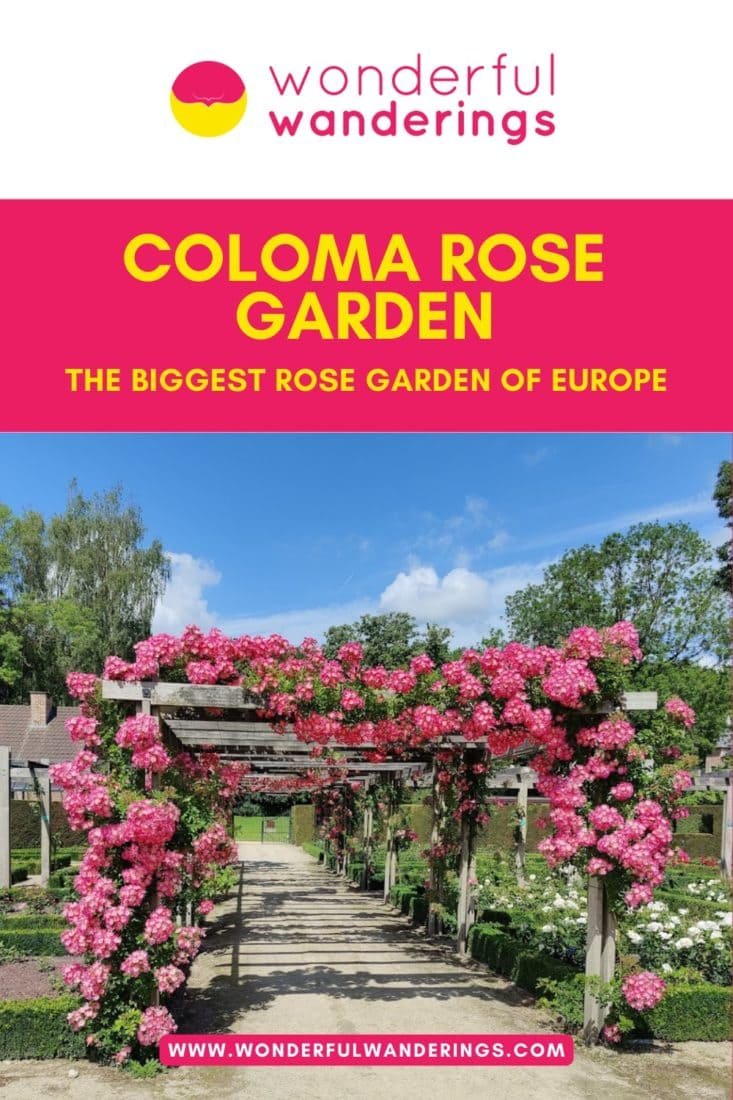
Coloma Rose Garden is free to enter, open all year from Tuesday to Sunday, and holds more than 3,000 rose varieties from 25 countries inside a 15-hectare (37-acre) castle park at Sint-Pieters-Leeuw, roughly 12 km (7.5 mi) southwest of central Brussels. The roses flower from June to October, and the commune names the end of June as the point when most of them are open at once.
The garden matters for two reasons that have nothing to do with its size. It costs nothing, and it is one of the few free attractions near Brussels that a rose grower would travel for: the collection runs from wild species roses to varieties bred by Flemish growers in the last twenty years, laid out in seven separate gardens rather than one large bed.
Check the season against an official source before you plan around it, because a lot of older write-ups have it wrong. Those guides describe Coloma as a May-to-September garden that shuts its gates for the winter. The Agency for Nature and Forests, which manages the park for the Flemish Community, lists it as open every day except Monday, all year, with only the closing time changing between the summer and winter halves of the calendar.
What does WonderfulWanderings think of Coloma rose garden?
Coloma is the trip I take when work has gone badly and I need to be outdoors without planning anything. It was a rough day, the weather was better than the work, and I drove out to Sint-Pieters-Leeuw on Sunday 10 September 2023 with no plan beyond walking.
I parked at the entrance on the Colomalaan, which is on the opposite side of the park from the Joseph Depauwstraat address most maps give you. That is worth knowing, because the Depauwstraat side puts you at the tourist office and the castle, and the Colomalaan side puts you closer to the roses. Once I was inside, the smell arrived before the colour did. Each section is given over to roses from a different country or a different period, so you walk out of one scent and into another every few minutes.
My favourites were the Japanese and Chinese gardens near the castle, which are the two newest sections and the two quietest. September is well past peak, and the garden was still full enough that I ran out of patience before I ran out of roses. I did not see all of it. Nobody does in one visit.
What is the Coloma Rose Garden?
Coloma Rose Garden is a public rose collection at Joseph Depauwstraat 25, 1600 Sint-Pieters-Leeuw, laid out in the grounds of Coloma Castle. The garden holds more than 3,000 rose varieties from 25 countries on roughly 60,000 rose bushes, which the commune counts as around 300,000 individual roses in a good season.

Coloma is owned by the Flemish Community and managed by the Agency for Nature and Forests, not by a private trust or a botanic garden foundation. That is why it is free: it is a public park with a rose collection in it, and the entrance has no ticket office at all. The commune describes it as one of the largest and most important rose gardens in Europe, and the Flemish heritage register records it as the largest rose garden in Flanders.
The planting is a collection rather than a display. Varieties are grouped by origin, by breeder and by period, with labels, so you can stand in front of a pre-1950 gallica and a disease-resistant modern shrub within a few metres of each other. Belgian growers including Louis Lens and Wilfried Delforge supplied varieties when the garden was laid out, along with the ILVO research institute at Melle.

What is the Coloma Castle?
Coloma Castle is a moated castle built in 1515 as the seat of the lordship of Leeuw, and it now houses the municipal cultural centre. Its ponds and its avenues of plane trees are the reason the rose garden has the setting it has.
The castle takes its name from Charles-Vital de Coloma, who acquired it around 1751 through his marriage to Baroness Eugenia Roose and had the fortified building remodelled into an 18th-century country house while keeping the water around it. It stayed in the family until 1947, served as a boarding school until 1972, then fell into disrepair. The Flemish public works service bought and restored the 15-hectare park in 1982, the municipality bought the castle in 1984, and a full restoration ran from 1989 to 1992 to the design of the Sint-Pieters-Leeuw architects W. Heremans and R. Vanhaelen.
Two outbuildings survive and both are open to walk past. The coach house carries the date 1731 and now trades as a tavern, and the 18th-century garden pavilion holds the Rose Museum, a small display on the history and structure of the rose. The castle grounds, the pavilion and the orchard are all free, in line with the garden itself.
Where is the Coloma Rose Garden?
Coloma Rose Garden is in Sint-Pieters-Leeuw, a Dutch-speaking municipality in the province of Flemish Brabant, roughly 12 km (7.5 mi) southwest of central Brussels. The garden sits on the eastern side of the Coloma estate, at coordinates 50.7779° N, 4.2488° E.
Sint-Pieters-Leeuw is close enough to Brussels to be a half-day trip and far enough out to feel like countryside. The Zenne valley starts here, and the same short drive puts you in the Pajottenland, the region the lambic breweries come from.
When did the Coloma Rose Garden open to the public?
The rose garden opened to the public in phases from 1995 onwards, section by section, rather than on a single opening date. Marcel Vossen of the Agency for Nature and Forests drew up the plan in the early 1990s, and the first section was planted in 1995.
Roses had grown on the estate long before that, but the collection you walk through today is a deliberate 1990s project on castle grounds that were already a public park. The castle park itself had been open since the Flemish public works service restored it in 1982.
How to get to the Coloma rose garden?
Reach Coloma by bus 170, by car from the Brussels ring, or by train to Brussels-South and then bus 170. The three routes the commune publishes are listed below, most useful first.
- By bus: take De Lijn line 170, which runs Brussels to Halle, and get off at the “kerk” stop on the J. Depauwstraat. That is the single stop the commune names, and it puts you at the castle entrance.
- By metro then bus: take Brussels metro line 5 towards Erasmus and change at Bizet, Het Rad or COOVI onto bus 170.
- By train then bus: travel to Brussels-South (Brussel-Zuid / Bruxelles-Midi) or to Halle, then change onto bus 170. Belgian domestic fares are cheapest booked in advance, and you can check NMBS train times and tickets before you leave.
- By car: leave the Brussels ring at exit 15a, “Lennik ULB Erasmus”, follow signs for Vlezenbeek, and pick up the Pastorijstraat past the church onto the J. Depauwstraat. The visitor car park is on the left, opposite the Deli Traiteur. Coaches park separately on the E. Rooselaersstraat.
Every one of those routes runs through Brussels, so the leg worth pricing first is the one that gets you into the city rather than the one that gets you out to the garden. That is the cross-border journey if you are travelling from another country. Omio compares trains, buses and flights across Europe into Brussels-South, which is where bus 170 picks up.
Both the rose garden and the de Viron country house are wheelchair accessible. A second, easier entrance to the rose garden can be opened for wheelchair users, but the tourist office asks you to arrange it in advance so the park keeper knows to expect you.
What is the history of the Coloma Rose Garden?
The Coloma rose garden was created by the Agency for Nature and Forests in phases from 1995, on castle grounds that had been a public park since 1982. Marcel Vossen of the agency conceived it, and Flemish rose breeders donated their most representative varieties to fill it.
The first section took the red and white of the Roose family arms and the local heraldry as its theme, and the garden then grew outwards for the next seventeen years, one themed section at a time. That phased build is why Coloma reads as seven gardens rather than one: each section was designed on its own terms, with its own layout, in its own decade.
What are the seven parts of the Coloma rose garden?
The Coloma rose garden is divided into seven sections, each with a different theme and a different opening date. They are listed below in the order they were created.
- The red and white rose garden (1995): white and red roses set in hedged garden rooms that form geometric shapes, referring to the arms of the Roose family, the castle’s former owners.
- The Flemish rose garden (1996): roses from 40 Flemish rose breeders, Louis Lens the most widely known of them, arranged around a central arbour roofed with pleached limes.
- The old rose garden (2000): 710 rose varieties bred before 1950, laid out as a chronological walk through the development of the rose, with modern disease-resistant varieties at the centre for contrast.
- The international rose garden (2000): the largest of the seven, with roses from around the world grouped into garden rooms by country.
- The standard rose garden (2004): 300 to 400 standard roses planted along the path that leads to the Rose Museum entrance.
- The Japanese rose garden (2009): more than 150 varieties of Japanese origin, planted in a half-circle with radiating beds that echo the rising sun.
- The Chinese rose garden (2012): the newest section, next to the Japanese garden and near the castle.
Alongside the seven sits the rose orchard, planted in the 1980s with around 160 standard fruit trees and later underplanted with 125 climbing rose varieties. It flowers twice: fruit blossom in spring, climbing roses through the summer.
What are the visiting hours of Coloma Rose Garden?
Coloma Rose Garden opens at 9:00 from Tuesday to Sunday, all year, including public holidays. Closing time depends on the season: 20:00 from 1 April to 30 September, and 17:00 from 1 October to 31 March.
Monday is the one closed day, and the single exception is an official Belgian public holiday falling on a Monday, when the garden opens as normal. The garden is not seasonally shut, so a January walk through bare rose beds and around the moat is possible, if not the reason most people come.
The tourist office in the de Viron country house keeps different hours from the garden, so do not use its times to plan a visit. If you need it for a folder or a group booking, it opens 10:00 to 18:00 Tuesday to Friday and 9:30 to 12:30 at weekends.
When is the best time to visit Coloma Rose Garden?
Visit at the end of June if you want the garden at full bloom. That is the period the commune’s own tourism service names as ideal, on the grounds that most of the roses are open at once.
The wider recommended window runs from June to early October, which is longer than the peak and easier to plan around. June gives you the first and heaviest flush, July and August hold colour with more gaps, and September into early October brings a second flush on the repeat-flowering varieties with far fewer people in the paths. June is also when the commune runs its Rozenfestival programme in the garden, with events scheduled through the month.
Two practical notes on timing. The garden opens at 9:00 and the morning is when the scent is strongest, before the sun has taken it off the flowers. And Sunday afternoons in June are the busiest hours of the year here, so a weekday morning is a different garden entirely.
How much is the entrance fee for Coloma rose garden?
There is no entrance fee for Coloma Rose Garden. Entry is free, no reservation is needed, and there is no ticket office on the site.

The free entry covers the whole estate: the seven rose gardens, the castle park, the rose orchard, the garden pavilion with the Rose Museum, and the grounds around the moat. Occasional exhibitions or events held in the castle cultural centre may charge separately, but nothing in the garden itself does. Parking at the Depauwstraat car park is free as well.
How long is the typical visit time in Coloma rose garden?
Plan on 1 to 2 hours for a first visit, and expect not to see everything. There is no time limit and no closing sweep beyond the gates shutting, so you can stay from opening to closing if you want to.
An hour covers two or three of the seven sections at a walking pace with stops. Two hours gets you round most of them, plus the castle exterior and the pavilion. Half a day suits anyone who is reading labels, photographing varieties or bringing a picnic to the benches. The 15-hectare park also has the plane tree avenues and the orchard to walk, which are worth an extra half hour on their own.
Are there any guided tours to the Coloma rose garden?
Yes. Guided tours are available for groups, booked in advance through the Sint-Pieters-Leeuw tourism service, and the details are fixed rather than negotiable.

A guide costs €72 (about $78, £62) for the group, not per person. A group is a minimum of 10 people and a maximum of 25, and a second guide is added above that. The tour lasts about 2 hours and can be shortened on request, and it combines the history of the castle, the orchard, the history of the rose garden and the roses themselves. The tourism service asks for at least three weeks’ notice, runs group visits from mid-May to the end of September, Tuesday to Sunday, and lists the tour languages as Dutch, French and German. English is not among the languages it advertises, so ask before you assume it.
What are the house rules of the Coloma rose garden?
Two rules are published by the people who manage the garden, and both are easy to get wrong from older guides. They are listed below.
- Dogs are allowed, on a lead. Several write-ups state that no pets are permitted at Coloma. The commune’s own page says the opposite: dogs must be kept on a leash.
- Photography is allowed for private use. Wedding and communion photography needs no permission at all. Shooting for a magazine, a book or any other commercial purpose does need an application, submitted through Natuurinvest, which handles filming and events on the Coloma estate.
Beyond that it is an ordinary public park: stay on the paths, leave the roses on the bushes, and take your litter with you.
Is it worth it to visit the Coloma rose garden?
Yes, if you go between June and early October, and yes for any length of trip if you are already near Brussels. It is free, it takes about 40 minutes to reach from the city centre, and there is nowhere else in Belgium where you can compare 3,000 rose varieties side by side with labels.
Be honest about what it is not. Coloma is a working collection in a public park, not a manicured show garden with a visitor centre, a café chain and a gift shop. Outside the flowering season there is a castle, a moat, an orchard and a lot of pruned stems. Go in the wrong month and you will wonder what the fuss is about; go at the end of June and you will understand the phased build, the seven gardens and the reason the commune keeps expanding it.
Where to stay and what else to do near Coloma
Brussels is the practical base, at roughly 12 km (7.5 mi), and it puts the garden inside a half-day trip rather than a day of its own. Sint-Pieters-Leeuw itself has limited accommodation, so most visitors sleep in the city and come out on bus 170 or by car.
Where in Brussels you sleep changes the trip more than which hotel you pick. A room near the Gare du Midi puts you on bus 170’s line without a metro leg, and a room out towards Anderlecht or the western ring puts you a short drive away. Booking.com lists Belgian hotels and guesthouses across the country, including those outer communes.
Our Brussels city guide covers the neighbourhoods in detail if you are choosing between them.
What are the best attractions to visit near Coloma Gardens?
The attractions worth pairing with Coloma are all within the estate or within a short drive of it. They are listed below, closest first.
- Coloma Castle: the 1515 moated castle at the centre of the estate, restored between 1989 and 1992 and now the municipal cultural centre. Free to walk around, with exhibitions and events inside that sometimes charge.
- The Rose Museum: a small display on the history and structure of the rose, in the 18th-century garden pavilion, at the end of the standard rose path. Part of the same free estate.
- The rose orchard: 160 standard fruit trees from the 1980s with 125 climbing rose varieties grown through them, on the far side of the domain from the castle. Fruit blossom in spring, climbing roses in summer.
- The Zenne valley breweries: Sint-Pieters-Leeuw sits in the cradle of Belgium’s sour beers, and the commune lists six breweries in the municipality, including Brouwerij Lindemans, Lambiekfabriek, 4Pajot, HUB Brewers, Donder Brews and Brouwerij Belgoo. VISIT Flemish Brabant made 2026 its Year of Beer, with October as the month of lambic.
- Brussels: 12 km (7.5 mi) northeast, and the reason most visitors are in the area at all. Our list of Belgian dishes and where to order them in Brussels is the one to read before dinner.
What are the biggest rose gardens in Europe?
Europe’s two heavyweight rose gardens are the Europa-Rosarium at Sangerhausen in Germany and Coloma in Belgium, and they are big in different ways. Sangerhausen holds the world’s largest rose collection, Coloma holds the largest in Flanders and one of the largest in Europe.
- Europa-Rosarium, Sangerhausen, Germany: roughly 8,600 rose varieties across 13 hectares (32 acres) of parkland, which the garden itself describes as the largest collection of roses in the world. It holds the German Gene Bank Rose and specialises in historic and rare varieties.
- Coloma Rose Garden, Sint-Pieters-Leeuw, Belgium: more than 3,000 varieties from 25 countries on around 60,000 bushes, in a 15-hectare (37-acre) castle park. Free, open all year, and the largest rose garden in Flanders per the Flemish heritage register.
- Roseraie du Val-de-Marne, L’Haÿ-les-Roses, France: the departmental rose garden outside Paris, open for a defined season each year rather than all year, and the one to check dates for before travelling.
- Sissinghurst Castle Garden, Kent, England: not the largest, but the most influential. Vita Sackville-West shaped its rose plantings in the 1930s, and its White Garden is the template a great many later rose gardens copied.
A flower trip around Europe does not have to choose between these gardens, because they flower in different halves of the year. The Netherlands runs the other headline event of the season, and it finishes before Coloma’s roses start. Keukenhof in Lisse opens for about eight weeks in spring, so a March-to-October flower season is possible with the two of them and a summer in between.
WonderfulWanderings Pro Tips
The 5 tips below come from my own September visit and from the commune’s own pages, which disagree with most of what is written about this garden elsewhere.
- Park on the Colomalaan side, not the Joseph Depauwstraat side. Both are entrances to the same park, but the Depauwstraat address that maps give you lands you at the tourist office and the castle, and the Colomalaan car park puts you next to the roses. On a short visit that is the difference between starting in the garden and walking to it.
- Come on any day except Monday, in any month. The garden is free, needs no reservation, and opens Tuesday to Sunday from 09:00 all year, closing at 20:00 from 1 April to 30 September and 17:00 from 1 October to 31 March. The one exception to the Monday closure is a Belgian public holiday, when it opens as normal. Guides that describe it as a May-to-September garden that shuts for winter are wrong.
- Aim for the end of June if you want it at full bloom. That is the week the commune’s own tourism service names, on the grounds that most of the roses are open at once, and the recommended visiting season runs from June to early October rather than ending in July.
- Ask about language before you book a guided tour. A guide costs €72 for the whole group rather than per person, takes 10 to 25 people, runs about 2 hours from mid-May to the end of September, and needs three weeks’ notice. The advertised languages are Dutch, French and German, and English is not among them.
- Bring the dog, and check the rules only if you are shooting commercially. Dogs are allowed on a lead, whatever the write-ups saying no pets claim, and photography for your own use costs nothing. A commercial shoot is the exception and needs an application to Natuurinvest first.
About the author. This guide is written and maintained by the Wonderful Wanderings editorial team. Wonderful Wanderings was founded in 2012 by Sofie Couwenbergh, who is Belgian, and the first-person notes in this post come from her September visit to the Coloma rose garden at Sint-Pieters-Leeuw. The team covers Belgium for independent travellers, including the day trips from Brussels, the trains and buses that reach them and the places worth booking a room near, and updates this page when opening hours, bloom dates and tour prices change.