 EN
 Nederlands
 Français
The Braunschweig Christmas Market runs from 25 November to 29 December 2026, confirmed on the city’s own site, braunschweig.de. Around 130 wooden stalls fill the area around Dom St Blasii and the Burgplatz, selling Christmas gifts, ornaments, crafts, clothing, candles and food. Braunschweig’s closing date, 29 December, runs later into the holidays than most German Christmas markets, which makes it a genuine option for travellers arriving between Christmas and New Year.
What is the Braunschweig Christmas Market?
The Braunschweig Christmas Market is a traditional outdoor Christmas market held every winter in the historic centre of Braunschweig, Germany, around the Dom St Blasii and the Burgplatz. The market rests on a royal charter dated 9 December 1505, granted by Emperor Maximilian I, which makes it one of the oldest documented Christmas market rights in Germany. That charter is a separate fact from the market’s current location: today’s market has stood on the Burgplatz since 1956, so the site itself is younger than the charter that permits it, even though both facts are often blurred into a single “500 years on this square” claim that is not accurate.

The market features around 130 decorated wooden stalls selling handmade crafts, ornaments, toys, clothing, candles and other seasonal goods. Entertainment includes Christmas carols performed by choirs, concerts at the Dom St Blasii, a puppet theatre at the regional museum, and light displays across the castle moat and the Oker River.
When does the Braunschweig Christmas Market open in 2026?
The Braunschweig Christmas Market opens on 25 November 2026 and runs daily until 29 December 2026, confirmed directly on braunschweig.de. Opening day runs from 5:45pm to 9pm, with the market officially starting at 6pm. Regular hours run Monday to Saturday from 10am to 9pm and Sunday and public holidays from 11am to 9pm, closing on 29 December from 10am to 8pm. The market closes entirely on 24 and 25 December.
Where is the Braunschweig Christmas Market taking place?
The Braunschweig Christmas Market takes place in the historic city centre of Braunschweig, around the Dom St Blasii at Burgplatz 4A, 38100 Braunschweig, and Platz der Deutschen Einheit. The Dom’s coordinates are 52°15’52″N 10°31’31″E, in the heart of the old town.
Why should you visit the Braunschweig Christmas Market?
Listed below are reasons to visit the Braunschweig Christmas Market.
- Seasonal flavours. Braunschweig’s stalls sell regional specialities such as bratwurst, potato pancakes, roasted chestnuts, gingerbread and mulled wine.
- Local arts and crafts. Craftspeople demonstrate glassblowing, iron forging and wood carving alongside stalls selling traditional wooden decorations, glass baubles and carved nutcrackers.
- German Christmas traditions. Braunschweig’s mayor taps the first barrel of “Weihnachtsbier,” the local Christmas beer, in an opening-week ceremony.
- Shows and parades. Medieval-themed performers, dance shows and Santa parades feature throughout the market’s run, alongside a large Advent-calendar light display on the Town Hall facade.
What does it cost to enter the Braunschweig Christmas Market?
Entry to the Braunschweig Christmas Market is free. Visitors only pay for optional extras: rides such as carousels, Ferris wheels and children’s steam trains range from about €2 ($2.30, £1.70) to €8 ($9, £7) per ride, food and drink such as bratwurst and Mumme beer range similarly, and special concerts or events, including the choir performances at Dom St Blasii and the puppet theatre, cost roughly €5 ($6, £4) to €10 ($11, £8) per event. These figures come from the market’s general fee structure in past years and are worth checking again closer to opening.
What attractions sit close to the Braunschweig Christmas Market?
Listed below are attractions close to the Braunschweig Christmas Market.
- Burgplatz. Burgplatz is the historical heart of Braunschweig, home to the medieval Dankwarderode Castle and Brunswick Cathedral, both essential stops alongside the market itself.
- Herzog Anton Ulrich Museum. The Herzog Anton Ulrich Museum, about 0.5 km (0.3 mi) from the market, is one of Germany’s oldest art museums, with a broad collection of European art.
- Schloss Arkaden. Schloss Arkaden offers modern shopping close to the market, a contemporary contrast to the traditional stalls around the Dom.
- Braunschweigisches Landesmuseum. The Braunschweigisches Landesmuseum covers the regional history and culture of Braunschweig, a useful stop for visitors who want context beyond the market itself.
Is there another name for the Braunschweig Christmas Market?
Yes, the Braunschweig Christmas Market is also known as the “Braunschweiger Weihnachtsmarkt,” its German name.
What food can visitors eat at the Braunschweig Christmas Market?
Listed below are German foods worth trying at the Braunschweig Christmas Market.
- Brunswick stollen. Brunswick stollen is a dense, moist fruitcake filled with nuts, candied peel and raisins, a regional Christmas treat and one of the market’s signature foods.
- Bratchips with dips. Bratchips with dips is a Braunschweig speciality: paper cones filled with hot bratwurst pieces, fried potato cubes, sausage meatballs and bacon bits.
- Potato pancakes. Potato pancakes, made from grated potato, flour and egg fried until golden, are served with apple sauce or savoury dips at market stalls.
- Roasted almonds. Roasted almonds, roasted fresh in iron pans over open fires, fill the market with their smell and are sold hot in paper cones.
What can visitors drink at the Braunschweig Christmas Market?
Listed below are drinks available at the Braunschweig Christmas Market.
- Glühwein. Glühwein, hot spiced red wine infused with orange, lemon, cinnamon, star anise and cloves, is the market’s standard drink, served in a souvenir mug.
- Hot chocolate. Hot chocolate, made from melted chocolate and steamed milk, is topped with whipped cream or marshmallows at several stalls.
- Fruit wine. Fruit wine made from strawberries, raspberries or blueberries is a Braunschweig speciality, sometimes fortified with brandy.
- Mumme beer. Mumme beer is the drink most associated with Braunschweig’s market: a sweet, malty beer brewed locally to an old recipe using malt dried over open fires.
What can people buy at the Braunschweig Christmas Market?
Listed below are souvenirs sold at the Braunschweig Christmas Market.
- Braunschweig ornamental wares. Braunschweig ornamental wares include glass mugs, cups and Christmas balls painted or engraved with local landmarks.
- Artisanal wooden toys. Artisanal wooden toys, such as hand-carved trucks, trains, planes and rocking horses, reflect traditional German craft techniques.
- Decorative candles. Decorative candles, shaped into stars, trees and angels from beeswax, are sold as fragrant holiday decor.
- Wooden nutcrackers. Wooden nutcrackers, carved into toy-soldier or king figures, come in a range of sizes at the market’s craft stalls.
How do you get to the Braunschweig Christmas Market?
Braunschweig is reachable by plane, train, tram or on foot. Braunschweig Airport (BWE) sits about 9 km (5.6 mi) from the city centre, with a taxi or bus taking 15 to 20 minutes to the market, and flights bookable through Trip.com. Braunschweig Central Station connects to major cities across Germany with hourly trains; from the station, walk south down Bahnhofstrasse and turn right onto Schild to reach the market. Tram lines M1 and M2 stop at Rathaus or Bohlweg, both close to the market grounds, and taxis are available outside the station or by advance booking. Visitors staying in the Old Town can walk the roughly 1 km (0.6 mi) from most downtown hotels. Drivers reach Braunschweig via the A2 or A39 autobahns, with rental cars bookable through DiscoverCars; parking garages sit around the edge of the pedestrianised Old Town, a short walk from Burgplatz.
Where should you stay in Braunschweig during the Christmas market?
Listed below are hotels worth considering near the Braunschweig Christmas Market, with a range of properties bookable through Booking.com.
- Steigenberger Parkhotel Braunschweig. A 4-star hotel about 1 km (0.6 mi) from the market, with an on-site spa, sauna and indoor pool.
- Premier Inn Braunschweig City Centre. A hotel about 1.6 km (1 mi) from the market, with contemporary rooms suited to a straightforward, comfortable stay.
- IntercityHotel Braunschweig. A hotel about 1.6 km (1 mi) from the market, with modern rooms and a generous breakfast buffet.
- B&B Hotel Braunschweig-City. A budget-focused hotel about 2.4 km (1.5 mi) from the market, aimed at visitors who prioritise cost over location.
What are the best restaurants to eat at in Braunschweig?
Listed below are restaurants worth visiting near the Braunschweig Christmas Market.
- SULTANA – Das arabische Restaurant. SULTANA, about 1.6 km (1 mi) from the market, is a family-run Middle Eastern restaurant known for its mixed grills.
- Braunschweiger Parlament. Braunschweiger Parlament, in a historic mill about 2 km (1.2 mi) from the market, serves regional dishes such as Braunkohl, smoked pork with stewed kale, and a Mumme-flavoured pork roast.
- Restaurant Saz. Restaurant Saz, about 2 km (1.2 mi) from the market, serves Turkish dishes including kebabs, lahmacun and homemade baklava.
- Tandure. Tandure, about 3 km (1.8 mi) from the market, serves Indian dishes such as chicken tikka masala and tandoori specialities.
What should you wear at the Braunschweig Christmas Market?
Dress in layers with a warm coat, hat and gloves, because the market runs through the coldest weeks of the German winter. Daytime highs in Braunschweig average around 2-5°C (36-41°F) through late November and December, with nights close to or below freezing, according to multiple climate data sources. Rain or light snow falls on roughly a third of December days, so waterproof shoes are worth packing alongside warm layers for the market’s paved squares around the Dom.
How many days do you need for the Braunschweig Christmas Market?
A single day covers the Braunschweig Christmas Market comfortably, since the stalls sit within a compact area around Burgplatz and Platz der Deutschen Einheit. Visitors combining the market with the Herzog Anton Ulrich Museum or the Braunschweigisches Landesmuseum, both under 1 km (0.6 mi) away, may prefer a second day, since both museums close well before the market’s evening hours.
Is the Braunschweig Christmas Market better than the Düsseldorf Christmas Markets?
It depends on what kind of market you prefer. Braunschweig’s market rests on a charter granted in 1505 and sits in a compact old town around the Dom St Blasii, Dankwarderode Castle and the city’s half-timbered guild halls, giving it an intimate, traditional feel focused on local crafts and Mumme beer. The Düsseldorf Christmas Markets spread across several squares in a larger city, with a wider range of themed markets to choose between. Visitors who want one walkable, historic market square tend to prefer Braunschweig; visitors who want more markets and a bigger city to explore around them tend to prefer Düsseldorf.

Braunschweig’s Christmas market fits into a wider trip around Christmas markets across Germany, several of which are within a few hours by train.
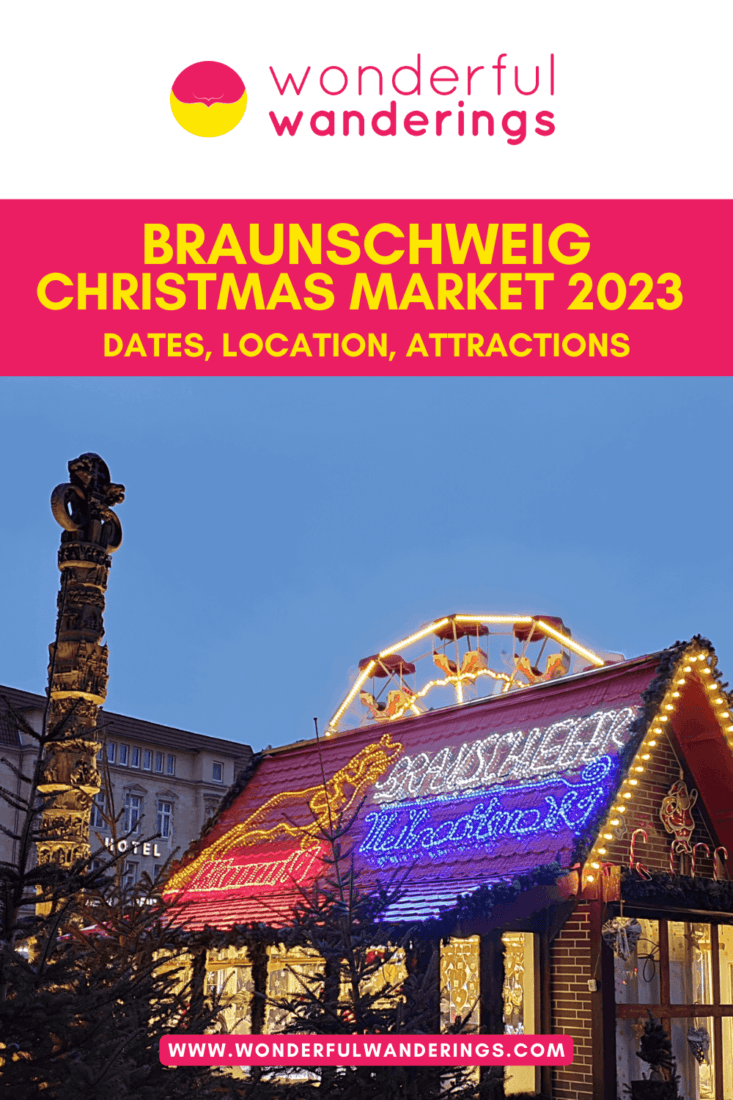
PIN FOR LATER
About the author. This guide is written and maintained by the Wonderful Wanderings editorial team. Wonderful Wanderings was founded in 2012 by Sofie Couwenbergh, and the team covers Braunschweig and Germany’s wider Christmas market season for independent travellers, including the hotels and trains worth booking around them, and updates this page each year once the market’s new dates are confirmed.