 EN
EN
 Nederlands
 Français
The 15 places to visit in Hungary below are ordered by how much of your time they deserve, starting with Budapest and working outwards. Hungary is small enough that almost everything on this list is a day trip or an overnight from the capital, and the country is badly served by cross-country transport, so the honest advice is to base yourself in Budapest and pick two or three of these rather than trying to see them all.
This page is a routing page. Each entry says what the place is for, how long it needs and how you get there, then sends you to the guide that goes deeper.
Hungary uses the forint (HUF) and has not adopted the euro, so every price here is in forints with a conversion after it. For the country-wide practicalities, start at our Hungary travel guide, and for the background trivia, the facts about Hungary.
The 15 places, at a glance
| Place | Give it | Get there from Budapest |
|---|---|---|
| 1. Budapest | 3 to 4 days | You are there |
| 2. Lake Balaton | 2 days | 2h by train |
| 3. Eger | 1 to 2 days | 2h by train or coach |
| 4. Szentendre | Half a day | 40 min by HÉV suburban rail |
| 5. Pécs | 2 days | 3h by train |
| 6. Visegrád | Half a day | 1h by bus or boat |
| 7. Tihany | Half a day | Via Balatonfüred |
| 8. Szeged | 1 to 2 days | 2h 20m by train |
| 9. Hortobágy | 1 day | Via Debrecen, car strongly preferred |
| 10. Sopron | 1 to 2 days | 2h 30m by train |
| 11. Keszthely | 1 day | 2h 30m by train |
| 12. Debrecen | 1 to 2 days | 2h 30m by train |
| 13. Miskolc and Lillafüred | 1 to 2 days | 2h by train |
| 14. Győr | Half a day | 1h 20m by train |
| 15. Gödöllő | Half a day | 50 min by HÉV |
1. Budapest
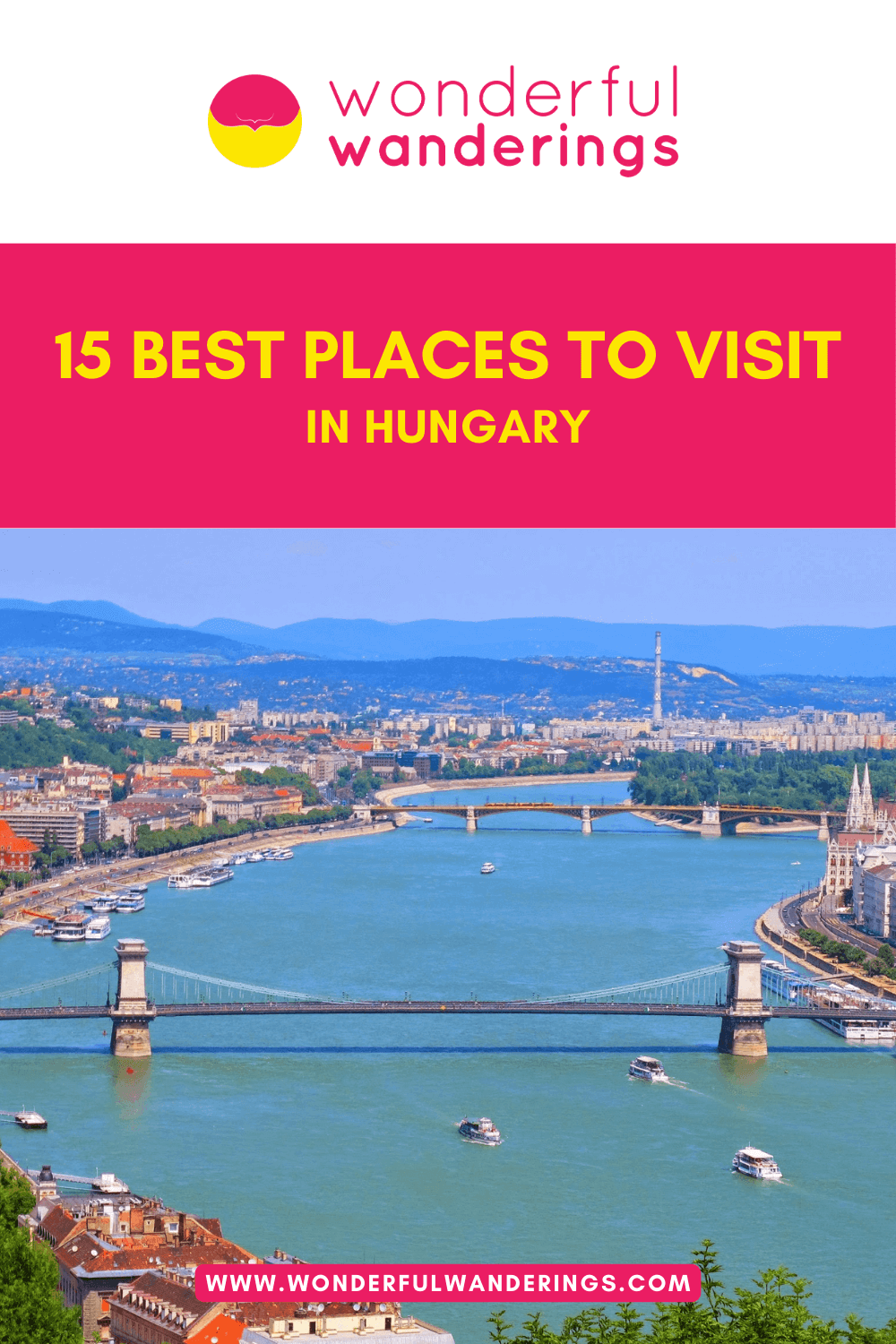
Budapest deserves three to four days, which is more than every other place on this list put together. Budapest is split by the Danube into hilly Buda on the west bank and flat Pest on the east, and the short version of what to see is Buda Castle and the Fisherman’s Bastion on one side, the Parliament and St Stephen’s Basilica on the other, and a thermal bath in between.

What you should not miss: the Hungarian Parliament, the Great Market Hall, the ruin bars of the Jewish Quarter, a Danube cruise after dark when the Parliament is lit, and one of the working thermal baths.
One warning that most guides have not caught up with. Gellért Bath closed on 1 October 2025 for a full renovation and its own website expects it to reopen in 2028. Do not build a day around it. Széchenyi in City Park is the working flagship, with 2026 tickets at 13,200 Ft (about €36, $42, £31) Monday to Thursday and 14,800 Ft (about €41, $47, £35) Friday to Sunday, locker included. Rudas, the 16th-century Turkish bath under Gellért Hill, is the atmospheric alternative, with the Turkish section women only on Tuesdays and men only on Wednesdays. Neither admits anyone under 14.
Go deeper: is Budapest worth visiting, the 4-day Budapest itinerary, whether the Budapest Card pays off, and where to stay, eat, drink and see museums.
2. Lake Balaton
Lake Balaton deserves two days and a base on the north shore. Lake Balaton is the largest lake in Central Europe, shallow enough that the water is genuinely warm by July, and the two shores are different holidays: the north has the hills, the wine and the old resort towns, the south has the long sandy beaches and the music festivals.

Base yourself in Balatonfüred, the oldest resort town on the lake, or in Keszthely at the western end. From either you can reach the Tihany peninsula, the Badacsony wine slopes and the thermal lake at Hévíz. Trains run from Budapest-Déli to the north shore in about two hours.
Go deeper: beaches in Hungary if swimming is the point, and Hungarian festivals for the summer lake events.
3. Eger
Eger deserves a day for the town and a second for the wine. Eger is a baroque town in the northern hills built around a fortress that held off an Ottoman siege in 1552, and it pairs that with Egri Bikavér, the red blend sold abroad as Bull’s Blood.

The two things to do are the castle and the cellars. Eger Castle opens its gate daily from 06:00 to 22:00, with the ticket office to 18:30; a full museum ticket is 4,800 Ft (about €13, $15, £11) and a general admission ticket for the grounds alone is 800 Ft (about €2.20, $2.55, £1.90). The cellar row at Szépasszony-völgy, a short walk or taxi from the centre, is where the wine happens.
The catch: Hungary’s drink-drive limit is 0.00%, with no allowance for a glass at lunch. Either somebody does not drink, or you stay the night, which is why Eger works better as an overnight than a day trip. Find a room near the cellars here.
Go deeper: the Eger guide.
4. Szentendre
Szentendre deserves half a day and is the easiest trip out of Budapest. Szentendre is a Serbian-founded artists’ town on the Danube 20 km (12.4 mi) north of the capital, reachable in about 40 minutes on the H5 HÉV suburban line from Batthyány tér, which makes it the one entry on this list you can do on a whim.

Walk the Bogdányi shopping street, look into the Orthodox churches the 17th and 18th-century Serb refugees built, and if you have longer, the Hungarian Open Air Museum on the edge of town holds the country’s largest collection of relocated village architecture.
5. Pécs
Pécs deserves two days and is the most underrated city in Hungary. Pécs sits on the Mecsek slopes in the southwest, was a European Capital of Culture in 2010, and layers Roman, early Christian, Ottoman and art nouveau in a walkable centre.

The reason to come is the early Christian necropolis, inscribed as a UNESCO World Heritage Site in 2000 and displayed at the Cella Septichora visitor centre. Add the cathedral, the Jakovali Hassan mosque, which is one of the few Ottoman buildings in Hungary still standing as a mosque, and the Zsolnay Cultural Quarter, built in the old ceramics factory that invented frost-proof pyrogranite and tiled half the landmarks in the country.
Pécs is about three hours by train from Budapest. Its airport, Pécs-Pogány, has no useful scheduled service, so do not plan to fly.
6. Visegrád
Visegrád deserves half a day and repays it with the widest view in the Danube Bend. Visegrád is a castle town on the right bank where the Danube turns sharply south, about 41 km (25.5 mi) from Budapest, and the Citadel on the hilltop is the viewpoint on every Hungarian tourism poster.

Three things sit in the same small area: the hilltop Citadel, the 13th-century Salomon Tower below it, and the ruined Royal Palace of Charles I and Matthias Corvinus at river level. Buses and summer boats run from Budapest, and a car turns Visegrád into a loop with Szentendre and Esztergom.
Go deeper: castles in Hungary.
7. Tihany
Tihany deserves half a day and is the prettiest thing on Lake Balaton. Tihany is a village on a volcanic peninsula that nearly cuts the lake in two, and its Benedictine abbey, founded by King Andrew I in 1055, holds the oldest surviving document containing Hungarian words.

The lavender is the other reason people come. The peninsula’s fields bloom in June and July and there is a lavender festival in June. Off-season, the Inner Lake, the ridge paths and the view down the whole length of Balaton are enough. Reach Tihany from Balatonfüred by bus, or by the short ferry from Szántód on the south shore, which saves driving round the lake.
8. Szeged
Szeged deserves a day, two if you like art nouveau. Szeged is Hungary’s third-largest city, on the Tisza near the Serbian and Romanian borders, and it was rebuilt almost entirely after the flood of 1879, which is why the centre is a single coherent piece of late 19th-century architecture rather than a medieval muddle.

See the Votive Church on Dóm Square, the big twin-towered brick cathedral built as a thank-offering after the flood. It is one of Hungary’s largest churches, though the largest is Esztergom Basilica, a claim plenty of older guides hand to Szeged by mistake. The square itself hosts the Szeged Open Air Festival in summer. Szeged is also the home of Hungarian paprika, of the sharp fish soup halászlé, and of Pick salami.
Trains from Budapest-Nyugati take about two hours and twenty minutes.
Go deeper: the Szeged guide and Hungarian food.
9. Hortobágy
Hortobágy deserves a full day and a car. Hortobágy is the great grass plain of eastern Hungary, a UNESCO World Heritage Site listed for a cultural landscape rather than a building, and the point of it is the emptiness, the horse-herding displays, the grey longhorn cattle and the birds.
The bird numbers are the serious draw: the autumn crane migration brings tens of thousands of birds through the puszta. Public transport barely reaches the park, so combine it with Debrecen and hire a car for the day.
10. Sopron
Sopron deserves a day and a wine evening. Sopron sits on the Austrian border beside Lake Fertő, was the Roman town of Scarbantia, and kept more of its medieval and baroque core than almost any Hungarian town because it escaped both the Ottoman and the Soviet-era demolitions.

Climb the Firewatch Tower, the town’s symbol, look at the Roman forum remains under the main square, and then drink Kékfrankos, the spicy local red, in one of the town’s own cellars. Lake Fertő, shared with Austria as the Neusiedler See, is a UNESCO site and a birdwatching and cycling destination. Nearby Fertőrákos and Nagycenk add a quarry theatre, the Esterházy connection and the Széchenyi family seat.
Sopron is closer to Vienna than to Budapest, which makes it a good first or last stop on a trip that flies into either.
11. Keszthely
Keszthely deserves a day, mostly for one building. Keszthely is the largest town on Lake Balaton, at the western end, and the Festetics Palace is the reason to come: a baroque palace with an intact library, a coach museum and a park, built by one of Hungary’s wealthiest noble families.

Add the Balaton Museum for the lake’s own history, and use Keszthely as the base for Hévíz, 7 km (4.3 mi) away, which has the largest biologically active natural thermal lake in the world and where you swim outdoors in warm water in February.
12. Debrecen
Debrecen deserves a day, and it is the gateway to the east. Debrecen is Hungary’s second-largest city, the historic capital of Hungarian Protestantism, and a university town with a big student population that keeps the centre busy.
See the Great Reformed Church, where Hungary declared independence from the Habsburgs in 1849, walk Piac Street, and use the city as the base for Hortobágy and for the Hajdúszoboszló spa complex. Debrecen also has Hungary’s second airport with scheduled flights, which is useful if a cheap Wizz Air route happens to suit you. The Advent fair in December is one of the country’s better Christmas markets.
Go deeper: the Debrecen guide.
13. Miskolc and Lillafüred
Miskolc deserves a day and has something no other Hungarian town does. Miskolc is Hungary’s fourth-largest city, at the foot of the Bükk hills in the northeast, and the Miskolctapolca Cave Bath is the only natural cave bath in the country: warm karst water running through real cave passages rather than a pool with a rock facade.

Check this one before you go, and check it against a recent source. A fire in September 2024 closed the cave section for nearly two years. It reopened on 20 August 2026 and now runs 09:00 to 19:00 daily, with the ticket office closing at 18:00 and the pools at 18:30. Listings sites and review sites still show it as temporarily closed, which it is not. The Aquatherapy section remains closed.
Also here: Diósgyőr Castle, a restored four-towered medieval fortress that was a queens’ residence, and Lillafüred a few kilometres out, with its lake, waterfall, terraced garden and a neo-Renaissance hotel that looks like a castle. The Bükk National Park starts at the edge of town.
14. Győr
Győr deserves half a day, usually on the way somewhere. Győr sits where the Rába and Rábca meet the Danube, roughly halfway between Budapest and Vienna, and its baroque old town is compact, handsome and almost always skipped.

Walk Vienna Gate Square and the old town, see the Cathedral Basilica and the Benedictine church, and look into the Margit Kovács ceramics collection. Győr is about an hour and twenty minutes from Budapest by train, on the main line to Vienna, which is exactly why it works as a stop rather than a destination.
15. Gödöllő
Gödöllő deserves half a day and one palace. Gödöllő is a town 30 km (18.6 mi) northeast of Budapest, reachable on the H8 HÉV line in about 50 minutes, and the Royal Palace of Gödöllő is the draw: the Grassalkovich baroque complex that became the Hungarian summer residence of Emperor Franz Joseph and Empress Elisabeth, Sisi.

The palace opens daily 10:00 to 18:00, with the ticket office closing at 17:00. Elisabeth’s own rooms, garden and veranda are the part people come for, and there is a baroque theatre and a wartime bunker as well. A full state-backed restoration was announced in October 2025, so parts of the complex may close in stages over the next few years; check before a long journey.
When is the best time to visit Hungary?
The best time to visit Hungary is May, June, September and early October, when the days are warm and long without July and August’s heat and crowds. Hungary has four sharp seasons and a continental climate.
- Spring, April to June. Mild days, cool evenings, everything open, the Tihany lavender in bloom from June.
- Summer, July and August. The hottest, busiest and dearest months. This is Balaton’s season and festival season, including Sziget on an island in the Danube.
- Autumn, September and October. Harvest and wine season, thinner crowds, still warm enough for the outdoor thermal pools, and the crane migration on the puszta.
- Winter, November to March. Cold, often grey, and the right weather for thermal baths and Christmas markets, which run mid-November to early January.
Where should you go in each season?
The place to go changes with the season, and these three are the clearest matches.
- Summer: Lake Balaton. The water is warm, the lake towns are open, the beaches and the festivals are the whole point, and Budapest in a July heatwave is hard work.
- Winter: Budapest. The thermal baths are better in the cold, the Christmas markets run from mid-November, and the museums and ruin bars do not care about the weather. Eger is the good second choice, for cellars rather than markets.
- December: Budapest and Pécs. Budapest’s Christmas Fair and Winter Festival is the big one, and Pécs’s Advent market on Széchenyi Square is the handsome provincial alternative. Szentendre, Debrecen and Veszprém all run good smaller markets.
Go deeper: Budapest’s Christmas markets and Hungarian holiday dates.
How do you travel between these places?
You travel between these places by train from Budapest, and by car for the four that trains do not reach. Hungary’s rail network radiates from the capital, so Budapest to anywhere is easy and anywhere to anywhere else usually means going back through Budapest.
The fare to plan around is the Magyarország24 day ticket at 4,999 Ft (about €14, $16, £12), which covers unlimited train and coach travel nationwide for one calendar day, and which beats a Budapest day return to Debrecen, Szeged or Pécs on price.
Four of the 15 really want a car: Hortobágy, the Balaton uplands beyond the station towns, the Aggtelek caves and the Danube Bend loop. Compare rental prices for Hungary here, then read driving in Hungary before you set off, because the motorway network needs an e-vignette bought in advance and the drink-drive limit is zero.
Full details: transport in Hungary and renting a car in Hungary.
Frequently asked questions
What is the most visited place in Hungary?
Budapest, by a wide margin. The capital takes almost all of Hungary’s inbound tourism, and Lake Balaton takes most of the rest, largely from Hungarians and Germans in summer.
How many days do you need in Hungary?
Four days covers Budapest properly. Seven lets you add Lake Balaton, or Eger and the wine country, or the Danube Bend, without rushing. Ten to twelve days is enough to reach Pécs or the east as well.
Is Hungary expensive to visit?
Hungary is cheaper than Western Europe and no longer cheap. Public transport, museum entry and provincial food are good value; central Budapest restaurants, cocktails and the flagship thermal baths are priced for visitors. Our page on prices in Hungary has the current figures.
What is there to do in Hungary besides Budapest?
Swim and sail on Lake Balaton, drink in the Eger and Tokaj cellars, walk the Hortobágy puszta, see Roman and early Christian Pécs, bathe in the Miskolctapolca cave or the Hévíz thermal lake, and walk the medieval core of Sopron. Hungary’s non-Budapest attractions are spread thin rather than absent.
Which Hungarian castles are worth visiting?
Eger for the siege history, Visegrád for the view, Diósgyőr in Miskolc for the restoration, and Festetics in Keszthely and Gödöllő for the palaces rather than the fortresses. Our page on castles in Hungary puts them in driving order.
WonderfulWanderings Pro Tips
Four things that change how you plan a Hungarian trip are listed below.
- Two headline attractions have changed status and most guides still have it wrong. Gellért Bath in Budapest closed on 1 October 2025 and its own site expects 2028. The Miskolctapolca Cave Bath went the other way: shut after a September 2024 fire and reopened on 20 August 2026, while listings sites still mark it closed. Check the operator’s own site, not a review site, for both.
- Plan around Budapest, not across the country. The railway radiates from the capital, so Szeged to Pécs or Debrecen to Sopron means going back through Budapest and losing most of a day. Two hub-and-spoke trips beat one loop.
- Buy the Magyarország24 day ticket for any long day trip. At 4,999 Ft it covers unlimited trains and coaches nationwide for a calendar day, which is less than a Budapest to Debrecen return in singles, and it lets you go out by train and come back by coach.
- Eger and Tokaj are wine towns with a zero alcohol limit. Hungary allows no alcohol at all before driving. Book the night in the wine town rather than the drive home, and it usually costs less than the alternative anyway.
About the author. This guide is written and maintained by the Wonderful Wanderings editorial team. Wonderful Wanderings was founded in 2012 by Sofie Couwenbergh, whose habit of testing whether a place really earns a detour shapes how this list is ordered. The team covers Hungary for independent travellers, including the hotels, thermal baths, castles and rental cars worth booking, and updates this page when opening times, prices and closures change.