EN
EN
 Nederlands
 Français
The festivals in Switzerland worth planning a trip around run from the autumn Alpabfahrt cattle-descent celebrations in September 2026 to the Locarno International Film Festival in August 2027, with the Street Parade in Zurich (900,000 ravers in 2026) and the Paléo Festival in Nyon (a sold-out 250,000 visitors in 2026) as the largest draws. This page lists 14 festivals with their next confirmed dates, checked against each festival’s own website in September 2026, plus the food, wine, trade-fair and reenactment events that fill the rest of the Swiss calendar.
Switzerland is a small, mountainous country split into German-, French- and Italian-speaking regions, and its festival calendar reflects that mix. Zurich’s Street Parade and Basel’s Fasnacht carnival anchor the German-speaking north, Montreux, Nyon and Geneva’s Fête de l’Escalade drive the French-speaking west, and the Locarno International Film Festival represents Italian-speaking Ticino in the south. 4 things changed for this season: Caprices Festival left Crans-Montana for a new home in Gstaad after 23 editions, the Geneva International Motor Show was formally dissolved and will not return, BaselWorld’s watch-fair slot is being replaced by a first-time Basilia fair in April 2027, and Lucerne Festival’s separate November Piano Festival no longer appears on the programme, folded into the newer Forward series. The city guides, food and getting-around advice behind these events are covered in our Switzerland travel guide.
The Switzerland festival calendar for the rest of 2026 and 2027 is listed below in date order, with the next confirmed dates for each event and the usual timing for the one festival that had not yet published its 2027 dates.
| Festival | Town | Next confirmed dates | Usual timing |
|---|---|---|---|
| Alpabfahrt (Désalpe) | various alpine valleys | late September to early October 2026 (e.g. Charmey and L’Etivaz, 26 September) | mid-August to early October |
| Fête de l’Escalade | Geneva | 11–13 December 2026 | weekend nearest 11–12 December |
| Festival International de Ballons | Château-d’Œx | 23–31 January 2027 | last week of January |
| Basler Fasnacht | Basel | 15–18 February 2027 | Monday after Ash Wednesday |
| Caprices Festival | Gstaad | 12–14 and 19–21 March 2027 | 2 weekends in March |
| Shapes Festival Leysin | Leysin | 15–21 March 2027 | mid-March |
| Zermatt Unplugged Festival | Zermatt | 6–10 April 2027 | early-to-mid April |
| Greenfield Festival | Interlaken | 10–12 June 2027 | mid-June |
| Montreux Jazz Festival | Montreux | 2–17 July 2027 | first half of July |
| Gurten Music Festival | Bern | 14–18 July 2027 | mid-July |
| Verbier Festival | Verbier | 2027 not confirmed on the official site (widely reported: 15 July–1 August) | mid-July to early August |
| Paleo Festival De Nyon | Nyon | 19–25 July 2027 | mid-to-late July |
| Locarno International Film Festival | Locarno | 4–14 August 2027 | first half of August |
| Street Parade | Zurich | 14 August 2027 | second Saturday of August |
1. Street Parade
The Street Parade takes place on Saturday 14 August 2027 in Zurich, according to the festival’s official website, after the 2026 edition on 8 August drew 900,000 ravers to the shores of Lake Zurich. The Street Parade is the world’s largest techno parade, and its Love Mobiles and stages line a 2 km (1.2 mi) route that runs from Utoquai through Bellevue, Quaibrücke and Bürkliplatz to Hafendamm Enge. Zurich, Switzerland’s largest city, hosts the parade every August.

The Street Parade began on 5 September 1992 with 1,000 participants and has grown into an event that fills the entire lake basin with dancers. It is officially registered as a demonstration for freedom, love and tolerance, which is why the route stays open to anyone who wants to join rather than requiring a ticket. The 2026 edition ran with 26 Love Mobiles and more than 200 artists across 9 stages, according to the festival’s own recap of the day. Zurich’s Seefeld district, where the route starts at Utoquai, fills with sound systems and dancers from early afternoon until midnight.
Visitors reach the Street Parade by train to Zurich Hauptbahnhof or by tram to Stadelhofen, which sits closest to the route, and the organisers advise against driving because no parking is available near the lake. The parade does not charge an entrance fee; it is funded by voluntary contributions and drink sales at official stands rather than tickets. Accommodation in Zurich should be booked well ahead of the second Saturday in August, because hotel rooms fill up for the whole weekend.
2. Montreux Jazz Festival
The Montreux Jazz Festival runs its 61st edition from 2 to 17 July 2027 in Montreux, according to the festival’s official website, after the 60th edition filled 3 to 18 July 2026 with concerts at the newly renovated Montreux Music & Convention Centre. The Montreux Jazz Festival has been held on the shore of Lake Geneva since 1967, when the Swiss music promoter Claude Nobs founded it as a small jazz gathering. Montreux is a lakeside town in the French-speaking canton of Vaud.

The 2026 edition opened with a sold-out night from the British singer RAYE and went on to sell out shows by Sting, Nick Cave & the Bad Seeds, John Legend and Deep Purple, while the American saxophonist Charles Lloyd returned 60 years after playing the first 1967 edition. The festival keeps several free stages around the lakefront alongside its paid Auditorium Stravinski shows, so visitors without a ticket can still watch live music by the water. Its programme now stretches well beyond jazz into rock, pop, blues and electronic music, though the jazz billing that built its reputation still anchors the schedule. The Montreux Music & Convention Centre reopened for the 2026 edition after renovation work, and it remains the festival’s main indoor venue on the same lakefront site.
Visitors reach Montreux by direct train from Geneva, Lausanne or Zurich, since the town sits on Switzerland’s main rail network, and the festival site is a short walk from Montreux station. Hotels along the lakefront and in the surrounding hills sell out for the festival’s 2 weeks, so early booking matters for the opening and closing weekends. Ticket tiers range from free lakeside access to paid seating for the headline shows, and prices vary by artist and venue.
3. Gurten Music Festival
The Gurten Music Festival, known officially as the Gurten Festival, takes place from 14 to 18 July 2027 on the Gurten hill south of Bern, according to the festival’s own information page, marking its 44th edition and the festival’s 50th anniversary since it began in 1977. The 2026 edition ran from 15 to 18 July with headliners Lorde, Sean Paul, Lily Allen, Kraftklub, Nina Chuba and Teddy Swims. Bern, Switzerland’s capital, is the nearest city, and the funicular up the Gurten hill from the Bern suburb of Wabern is part of the festival experience.

The Gurten Festival started in 1977 as the “Internationales Folk-Festival Bern-Gurten” and only became a fixed annual event in the 1990s, according to the festival’s own history page. The 2027 edition restores the Sunday programme for its anniversary year, extending the festival to 5 days instead of the usual 4. The festival estimates its direct and indirect economic value to the Bern region at around 30 million CHF (about €32 million, $37 million, £27 million) a year.
Visitors reach the Gurten hill from Bern by the Gurtenbahn funicular from Wabern, which connects to Bern’s tram and rail network, so no car is needed. Camping is available on site for festival-goers who want to stay close to the stages, and hotels and hostels in Bern serve as the alternative. Multiple ticket tiers cover single days or the whole festival, with 2027 prices published closer to the event.
4. Paleo Festival De Nyon
The Paleo Festival De Nyon runs for 7 days from 19 to 25 July 2027 near Nyon, one extra day added for its 50th-anniversary edition, according to the festival’s official website. The 2026 edition, held from 21 to 26 July, sold out at 250,000 visitors and pushed the festival’s cumulative attendance past 8 million since it began in 1976. Nyon is a lakeside town between Geneva and Lausanne, and the festival’s Asse site sits just north of it.

Paléo, as it is often shortened, is an independent, non-profit festival named Best Major Festival in Europe at the 2025 European Festival Awards. The 2026 lineup included Gorillaz, The Cure, Twenty One Pilots and Orelsan, and demand for Katy Perry’s show reportedly outstripped the roughly 1,500 available tickets by 12,000 requests. The 2027 lineup had not been announced at the time of writing; ticket sales for previous editions opened in March.
Paléo offers several ticket formats: full-week passes, flex vouchers that can be exchanged for any single evening and multi-day packs. Children up to 12 are admitted free, and reduced tariffs apply for teenagers aged 12 to 18, students, apprentices, senior citizens, disabled visitors and their helpers. Visitors reach Nyon by direct train from Geneva or Lausanne, and the festival village includes camping, food stalls and craft markets around its 7 stages.
5. Alpabfahrt (Désalpe)
Alpabfahrt, known as Désalpe in French-speaking Switzerland, is not one single festival but a tradition celebrated by dozens of towns as cattle come down from their summer alpine pastures, and the 2026 season runs from late September into early October in the cantons of Vaud, Valais and Fribourg. Charmey and L’Etivaz, in the Fribourg and Vaud alps, both hold their Désalpe on 26 September 2026, and Albeuve, in the Gruyère district, spreads its cattle descent over 2 days on 3 and 4 October 2026, according to the towns’ own event pages. Because each valley sets its own date, visitors should check the specific town’s website rather than expect one national event.

The tradition dates back centuries, to when alpine communities marked the end of the summer grazing season with a procession of herders and decorated cows. Cows wear elaborate headdresses of flowers and pine branches for the descent, and the parades are followed by folk music, craft stalls and local food. L’Etivaz, whose Désalpe is timed alongside the well-known Gstaad Züglete tradition, charges 10 CHF (about €11, $12, £9) for adult entry, which includes a shuttle bus, while under-16s enter free.
Visitors reach these events by train or postbus to the nearest valley town and then by local shuttle or on foot to the display ground, since most Désalpe routes run through village centres rather than main roads. Parking is limited in the smaller villages, so public transport or an early arrival is more reliable than driving in on the day. Accommodation ranges from chalets and guesthouses in the alpine valleys to hotels in nearby towns such as Gruyères or Château-d’Œx, and rooms near the more famous Désalpe towns book out weeks ahead of the parade weekend.
6. Festival International de Ballons
The Festival International de Ballons takes place from 23 to 31 January 2027 in Château-d’Œx, according to the festival’s official website, after the 2026 edition marked its 46th year with more than 45,000 visitors, 382 balloon flights and 530 hours in the air. Château-d’Œx, a village in the Swiss Alps in the canton of Vaud, has hosted the festival since 1979, when the actor David Niven sponsored the first International Hot Air Balloon Week with 12 balloons from 5 countries.

Château-d’Œx earned its reputation as the alpine capital of hot-air ballooning in March 1999, when Bertrand Piccard and Brian Jones launched the Breitling Orbiter III from the village and completed the first non-stop round-the-world balloon flight, covering 45,755 km (28,431 mi). The festival now draws 20,000 to 50,000 spectators across 9 days and around 60 balloon crews from multiple countries. Highlights include morning inflations and take-offs, night glow shows and a dedicated children’s day.
Visitors reach Château-d’Œx by train from Montreux or by car through the Pays-d’Enhaut. Accommodation includes hotels, guesthouses and chalets in the village, and rooms should be booked ahead for the festival’s peak weekends. Tickets cover the full festival or single activities such as tethered or passenger balloon flights, and prices vary by activity.
7. Basler Fasnacht
Basler Fasnacht opens with the Morgestraich at 4am on Monday 15 February 2027 and runs for 3 days to the Ändstraich at 4am on Thursday 18 February 2027, according to the official Fasnacht website, which confirmed the dates on its 2027 countdown. Basler Fasnacht is Basel’s carnival and Switzerland’s largest, and it begins the Monday after Ash Wednesday, a week after most other European carnivals have already ended for Lent. The 2026 edition ran from 23 to 26 February.

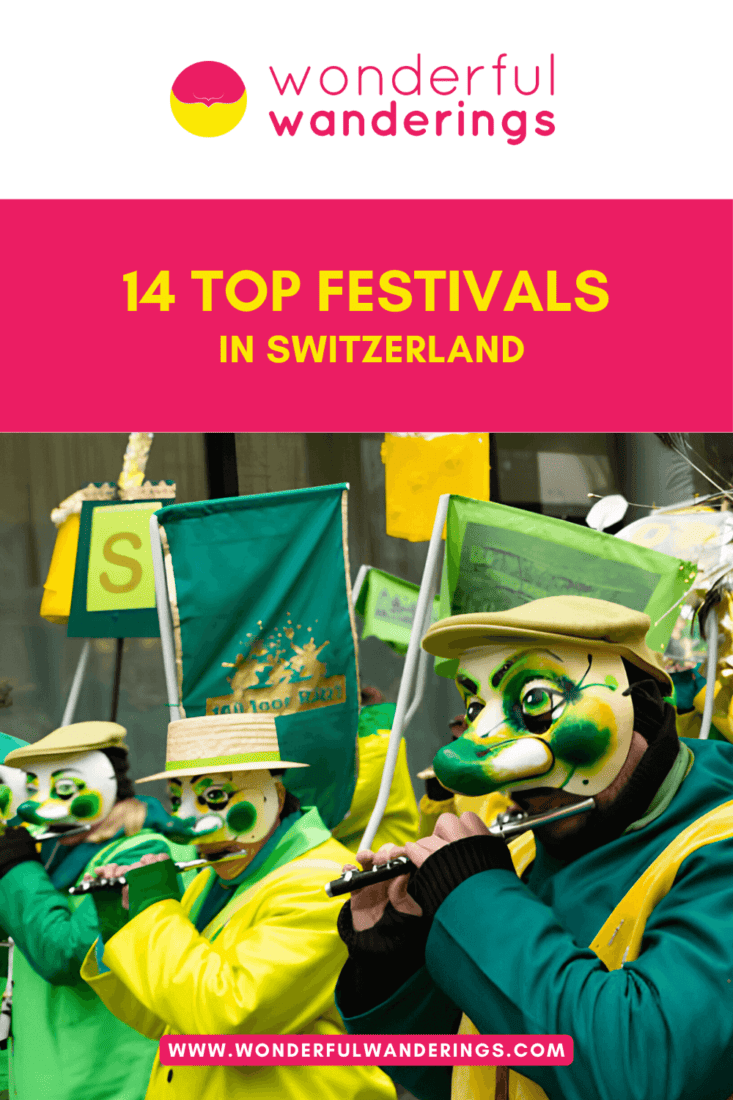
Basler Fasnacht dates back to the 14th century and has grown into 3 days of parades led by cliques (Cliquen) in painted lanterns and traditional costumes, with piccolo and drum bands providing the music. The Morgestraich, when Basel’s street lighting switches off and the parade starts in darkness behind illuminated lanterns, is the festival’s signature moment. Cliques spend months preparing their sujets, satirical themes that comment on the year’s politics and events, which appear on their lanterns and costumes. Guggenmusik brass bands, drum corps (Trommler) and piccolo players (Pfyffer) move through the old town for the full 3 days, and confetti (Räppli) covers the cobblestones by the Ändstraich.
Visitors reach Basel by direct train from Zurich, Bern or Geneva, and the old town’s Fasnacht routes are all within walking distance of Basel SBB station. Hotels and guesthouses in Basel fill up for Fasnacht week, so early booking matters. Basler Fasnacht does not charge an entrance fee, since it takes place in the public streets and squares of the old town. Basel-Stadt’s school holidays are usually timed around Fasnacht week, so check the Switzerland holiday dates page if travelling with school-age children.
8. Verbier Festival
The Verbier Festival had not published its summer 2027 dates on its own website at the time of writing, though several music outlets report the 34th edition running from around 15 July to 1 August 2027; confirm on verbierfestival.com before booking. The Verbier Festival is an international classical music event founded in 1994 by the Swiss arts administrator Martin Engström, and it is held every summer in the ski resort of Verbier, in the canton of Valais.

The festival’s mission pairs great masters with young musicians, and it runs 3 training ensembles: the Verbier Festival Orchestra, the Verbier Festival Chamber Orchestra and the Verbier Festival Junior Orchestra. A typical summer edition includes more than 100 masterclasses, rehearsals and performances. Ticket prices have previously ranged from about 10 to 55 CHF (about €11-59, $12-68, £9-50), with discounts for under-30s and under-16s, though 2027 prices were not yet published. A separate free fringe programme, UNLTD, adds outdoor jazz and world-music concerts around the village and has drawn more than 7,000 spectators in past editions.
Visitors reach Verbier by train to Le Châble followed by a cable car up to the resort, or by car via Martigny. Accommodation in Verbier ranges from hotels to chalets and apartments, and rooms should be booked well ahead of the festival’s peak weeks, so check the chalets and apartments on Vrbo alongside the hotels. Parking is available in the resort’s public car parks, though many visitors prefer the cable car connection from Le Châble.
9. Zermatt Unplugged Festival
Zermatt Unplugged takes place from 6 to 10 April 2027 in Zermatt, according to the festival’s official news page, which published the dates as a save-the-date announcement, after the 17th edition ran from 7 to 11 April 2026 with 120 concerts across 17 stages and more than 35,000 visitors. Zermatt Unplugged is an acoustic music festival held in the shadow of the Matterhorn, and Zermatt itself is a car-free alpine resort in the canton of Valais.

Thomas Sterchi, Marco Godat and Heinz Julen founded Zermatt Unplugged in 2007 as a singer-songwriter festival, with early backing from ABBA’s Anni-Frid Lyngstad and Deep Purple’s Jon Lord. The 2026 lineup included Placebo, Herbert Grönemeyer, Tom Odell, Emeli Sandé and Rea Garvey performing acoustic sets across the village’s hotels, bars and outdoor stages. The festival’s acoustic format puts artists and audiences closer together than a typical amplified concert, and shows spread across the village rather than concentrating on one main stage.
Visitors reach Zermatt by train from Täsch, since private cars are not allowed into the village; the Täsch car park serves as the usual parking point before the connecting shuttle train. Hotels, chalets and guesthouses in Zermatt range from budget to luxury, and the festival’s April dates fall in the shoulder season between winter and summer sports. Zermatt Unplugged sells day passes, festival passes and VIP passes, with prices set closer to each edition.
10. Caprices Festival
Caprices Festival takes place across 2 weekends, 12 to 14 and 19 to 21 March 2027, in Gstaad, according to the festival’s official website, after the electronic music event relocated there in 2026 following 23 editions in its former home of Crans-Montana. The move brought Caprices to the Eggli mountain station above Gstaad, a resort in the Bernese Oberland, where the 2026 edition ran across 13 to 15 and 20 to 22 March with more than 100 artists, including Sven Väth, Ricardo Villalobos, Luciano and Jamie Jones.

Caprices started in 2004, co-founded by Maxime Léonard, and built its reputation on a glasshouse stage that gave clubbers alpine views while they danced. The Gstaad edition keeps that format across 3 stages named Peak, CNTRL and Ridge, and the 2026 production carried a budget of around 3 million CHF (about €3.2 million, $3.7 million, £2.7 million), according to the promoters. Over its 2 decades in Crans-Montana, Caprices drew visitors from more than 75 countries, and the festival expects the Gstaad move to keep that international following.
Visitors reach Gstaad by train via Zweisimmen or Montreux, and the Eggli cable car carries festival-goers up to the stages from the village. Accommodation in Gstaad ranges from luxury hotels to chalets and apartments, and rooms should be booked well ahead given the resort’s limited size. Day passes and weekend passes are sold through the festival’s own ticket shop, with prices confirmed closer to each edition.
11. Fête De L’Escalade
The Fête de l’Escalade takes place from 11 to 13 December 2026 in Geneva, according to the Compagnie de 1602, the historical society that organises the commemoration. The festival marks Geneva’s defence against a night attack by troops of Charles-Emmanuel I, Duke of Savoy, on 11 and 12 December 1602, when 18 Genevans died defending the city. Geneva, Switzerland’s second-largest city, is the sole host of the celebration.

The Compagnie de 1602 has more than 2,000 members, making it the largest historical society in Switzerland, and the Escalade has been recognised on Switzerland’s list of Living Traditions since 2018. The main procession involves 800 costumed volunteers on foot and horseback, leaving from the Parc des Bastions, and the programme includes demonstrations of musket and cannon fire, halberd handling and other scenes from 17th-century Genevan life. Evening events include readings, historical talks and a bonfire singalong where the crowd smashes a chocolate cauldron, a nod to the legend of a housewife who drove off a Savoy soldier with a pot of boiling soup. A separate event, the Course de l’Escalade running race, takes place on a different weekend, 5 and 6 December 2026, with adult entry at 42 CHF (about €45, $52, £38) and 26 CHF (about €28, $32, £24) for junior and children’s categories.
Visitors reach Geneva by direct train from Zurich, Bern or Lausanne, or through Geneva Airport, and the Escalade route in the old town is walkable from the main station. Hotels and guesthouses in Geneva serve festival visitors, and the old town’s historic venues host lectures, readings and a traditional bonfire singalong alongside the parade. The Escalade does not charge an entrance fee for the public procession, though some evening events are ticketed separately.
12. Greenfield Festival
Greenfield Festival takes place from 10 to 12 June 2027 at Interlaken Airport, according to the festival’s official website, and it is Switzerland’s largest rock and metal festival. Interlaken, a town between Lake Thun and Lake Brienz in the Bernese Oberland, has hosted Greenfield Festival every year since 2005.

Greenfield Festival draws more than 70,000 visitors across its 3 days and books more than 40 international bands on multiple stages, with past headliners including Rammstein, Foo Fighters, Green Day and System of a Down. The festival uses the open runway of Interlaken Airport as its main site, which gives visitors a clear view of the surrounding mountains between sets. The lineup covers the full range of guitar-driven genres, from mainstream rock and metal to punk and alternative acts on the smaller stages.
Visitors reach Interlaken by direct train from Bern, Zurich or Lucerne, and Interlaken Airport is a short walk or shuttle ride from Interlaken Ost station. Camping is available on site for the festival weekend, and hotels and hostels in Interlaken serve as the alternative. Day passes and full festival passes are sold through the official ticket shop.
13. Locarno International Film Festival
The Locarno International Film Festival is scheduled for 4 to 14 August 2027, its 80th edition, according to the event listing on the official Ascona-Locarno tourism site; the festival’s own site did not confirm the dates directly at the time of writing, so check locarnofestival.ch before booking. The 79th edition ran from 5 to 15 August 2026, drew 7,759 submissions and screened 233 selected films, including 103 world premieres, with the Golden Leopard awarded to Florin Șerban’s You Don’t Belong Here.

The Locarno International Film Festival dates back to 1946, when its first evening screened O Sole Mio at the height of Europe’s post-war cultural revival, which makes it one of the continent’s oldest festivals alongside Cannes and Venice. The open-air screen on the Piazza Grande seats 8,000 people, and the festival adds 13 further venues around the town for its full programme of fiction, documentary and short films.
Visitors reach Locarno by direct train from Zurich, Bern or Lugano, and the Piazza Grande sits a short walk from Locarno’s train station. Hotels and guesthouses in Locarno and the surrounding Ascona-Locarno region fill up for the festival’s 11 days, so book ahead. Day passes and full festival passes for the indoor and evening screenings are sold through the official ticket shop, and prices vary by venue and screening.
14. Shapes Festival Leysin
Shapes Festival Leysin runs from 15 to 21 March 2027, according to the festival’s official countdown, after the 2026 edition took place from 16 to 22 March. Shapes Festival Leysin combines electronic music with alpine skiing in Leysin, a ski resort that the festival’s own site calls the closest ski resort to Geneva, near Glacier 3000 and the thermal baths on Lake Geneva.

The festival pairs daytime skiing with slopeside sound systems, après-ski parties and evening club sets, and its lineup mixes underground electronic acts with more established names each edition. Shapes describes itself as a roaming celebration of music in unusual locations, and the Leysin edition has run for several consecutive winters, though the festival’s own site does not publish an exact founding year or ticket prices. Leysin’s mix of low-altitude sunshine and long lift lines makes the resort popular with skiers who want a shorter travel day from Geneva than the bigger Valais resorts offer.
Visitors reach Leysin by train to Aigle and then the connecting mountain railway up to the resort. Accommodation in Leysin ranges from hotels to chalets and hostel-style lodges aimed at the festival’s younger crowd. Day passes and festival passes are sold through the official ticket shop, and prices are confirmed closer to each edition.
What are the best summer festivals in Switzerland?
The summer festivals in Switzerland worth planning a trip around are listed below in calendar order, with the 2027 dates given where each festival’s own site had published them at the time of writing.
- Montreux Jazz Festival (2–17 July 2027). The Montreux Jazz Festival brings jazz, rock, pop and blues to the shore of Lake Geneva across 16 days, with free lakeside stages alongside its paid headline shows.
- Gurten Music Festival (14–18 July 2027). The Gurten Music Festival takes over the Gurten hill south of Bern for its 50th-anniversary edition, with 5 days of music reached by funicular from Wabern.
- Paleo Festival De Nyon (19–25 July 2027). The Paleo Festival De Nyon runs for 7 days on its Asse site near Nyon for its 50th-anniversary edition, with 7 stages of rock, world music, hip hop and chanson.
- Lucerne Festival Summer (13 August–13 September 2026). The Lucerne Festival runs its Summer season, the flagship of 4 separate festivals held each year alongside Spring, Pulse and Forward, and brings more than 100 classical concerts to the KKL Lucerne concert hall.
- Locarno International Film Festival (4–14 August 2027). The Locarno International Film Festival screens fiction, documentary and short films on the 8,000-seat open-air Piazza Grande and in 13 further venues around the town.
What are the best music festivals in Switzerland?
The music festivals in Switzerland worth knowing are listed below across genres, from electronic music on the ski slopes to a summer open-air stage.
- Shapes Festival Leysin (15–21 March 2027). Shapes Festival Leysin combines skiing by day with electronic music on the slopes of Leysin by night.
- Caprices Festival (12–14 and 19–21 March 2027). Caprices Festival plays its glasshouse stages above Gstaad across 2 March weekends after relocating from Crans-Montana in 2026.
- Zermatt Unplugged Festival (6–10 April 2027). Zermatt Unplugged Festival stages acoustic sets across 17 venues in the car-free resort of Zermatt, beneath the Matterhorn.
- Greenfield Festival (10–12 June 2027). Greenfield Festival brings Switzerland’s largest rock and metal lineup to the runway of Interlaken Airport.
- Sion sous les étoiles (14–17 July 2027). Sion sous les étoiles fills the Plaine de Tourbillon in Sion with a summer lineup that sold out at 45,000 spectators in 2026, including Julien Doré and Gims.
What are the best food festivals in Switzerland?
The food festivals in Switzerland worth a detour are listed below, and each one pairs a Swiss specialty with a different season, from street food in early summer to the grape harvest and wine tastings in autumn.
- Zurich Street Food Festival (usually late May to June; 2026: 27 May–21 June). The Zurich Street Food Festival had not announced its 2027 dates at the time of writing; the 2026 edition brought more than 150 food trucks and stands to Hardturmstrasse in Zurich West, serving traditional Swiss food such as rösti alongside street food from around the world.
- Fête des Vendanges de Neuchâtel (25–27 September 2026). The Fête des Vendanges de Neuchâtel marks the grape harvest with a lakeside parade and more than 300 stands, and its 2026 edition is the 99th year of the tradition.
- Weinfestival Basel (24 October–1 November 2026). The Weinfestival Basel fills Halle 2 of Messe Basel with around 140 exhibitors and 3,000 wines, with Italy, Provence and Hungary as the 2026 guest regions.
What are the best fairs or trade festivals in Switzerland?
The fairs and trade festivals in Switzerland that draw the largest crowds are the 5 listed below, with the dates published by their organisers.
- Art International Zurich (21–23 May 2027). Art International Zurich is a contemporary art fair running since 1999, and its 29th edition returns to the Puls 5 venue in Zurich with more than 50 exhibitors from over 25 countries.
- Basilia Jewellery & Watch Fair (April 2027). Basilia is a new jewellery and watch fair opening in Messe Basel’s Hall 2 in April 2027, replacing BaselWorld, which closed after its 2019 edition; since this is Basilia’s first edition, treat its exact dates and format as provisional until organisers MCH Group and Informa Markets confirm the final programme.
- Versoix Chocolate Festival (usually late March; 2026: 21–22 March). Versoix Chocolate Festival, known locally as Festichoc, is a chocolate fair that gathers more than 30 chocolatiers from French-speaking Switzerland at Espace Lachenal in Versoix, near Geneva, with free entry.
- Swissbau (18–21 January 2028). Swissbau is a construction and real estate fair held every 2 years, in even years, at Messe Basel, so after its January 2026 edition the next Swissbau falls in January 2028, not 2027.
- Basel Autumn Fair (24 October–8 November 2026). Basel Autumn Fair, also called Basler Herbstmesse, is Switzerland’s largest funfair, running since 1471 across Barfüsserplatz, Münsterplatz, Messeplatz, Petersplatz and the Rosentalanlage.
What are the best reenactment festivals in Switzerland?
The reenactment festivals in Switzerland are the 2 listed below, each tied to a specific historical anniversary.
- Roman Festival in Augusta Raurica (28–29 August 2027). The Roman Festival in Augusta Raurica, near Basel, had its 2026 edition cancelled because of drought and heat, according to the organisers, so the next Römerfest runs on 28 and 29 August 2027 with its usual costumed camps, gladiator displays and Roman-era market stalls.
- Folklore Festival in Zermatt (usually the second weekend of August; 2026: 8–9 August). The Folklore Festival in Zermatt had not announced its 2027 dates at the time of writing; the 2026 edition brought 30 groups in traditional costume to Obere Matten for a Sunday parade and a full day of music and dance.
What are the top destinations to visit in Switzerland during the festivals?
There are 4 destinations in Switzerland worth visiting for the festivals, and each one anchors a different part of the calendar. Firstly, Grindelwald hosts the World Snow Festival from 18 to 24 January 2027, when teams carve snow sculptures over 5 days against the backdrop of the Eiger’s north face. Secondly, Château-d’Œx hosts the Festival International de Ballons from 23 to 31 January 2027, when balloons from multiple countries fill the winter sky above the Pays-d’Enhaut. Thirdly, Basel hosts Basler Fasnacht from 15 to 18 February 2027, and the carnival begins on the Monday after Ash Wednesday, a week after most other Swiss carnivals have already ended for Lent. Lastly, Zurich hosts the Street Parade on 14 August 2027, when the city’s lakeside streets fill with music, dancing and Love Mobiles, which makes Zurich one of the must-visit destinations in Switzerland for festival travellers.
How to get around in Switzerland during the festivals?
To get around in Switzerland during the festivals, choose from 3 main options: public transport, a rental car and a bicycle. Firstly, the Swiss public transport network covers more than 5,000 km (3,106 mi) and is backed up by city tram and bus systems, so trains, postbuses and trams reach nearly every festival venue on this page. The Swiss Travel Pass covers unlimited travel on trains, boats, postbuses and city tram-and-bus networks, which makes it a practical option for a multi-festival trip. Single journeys, and the coaches that run in from neighbouring countries, are priced on Omio, the train and bus search for Europe, which is worth comparing against the pass if you are only going to one festival. Secondly, a rental car suits festivals that public transport reaches slowly, such as the Désalpe events in smaller alpine valleys, and Switzerland’s roads and train timetables are well integrated for drivers who still want to combine both, so it is worth checking car rental in Switzerland before you commit to the pass. Lastly, cycling works for shorter hops between towns and festival sites, and railway stations across the country rent out bicycles that can be dropped off at a different station.
WonderfulWanderings Pro Tips
The 5 tips below come from checking each of these festivals against its organiser’s own site in September 2026, and they cover the traps that a calendar entry on its own will not show you.
- Pick the right Escalade weekend in Geneva. The Course de l’Escalade running race is on 5 and 6 December 2026 and the Fête de l’Escalade commemoration is on 11 to 13 December 2026, two separate events a week apart under one name. The procession is free to watch; the race costs 42 CHF for adults and 26 CHF for junior and children’s categories.
- Set a reminder for Paléo tickets in March. The 2026 edition sold out at 250,000 visitors, and demand for a single headline show reportedly ran 12,000 requests past the 1,500 tickets available. The 2027 edition runs 19 to 25 July with an extra day for the 50th anniversary, and sales for previous years have opened in March.
- Be standing in Basel before 4am on Monday 15 February 2027. Morgestraich starts with the city’s street lighting switched off and the cliques marching behind their lanterns in the dark, and it is the one part of Basler Fasnacht that has no equivalent anywhere else. Turning up at a reasonable hour means arriving after it.
- Check the individual village’s date for a Désalpe, never the tradition’s. Dozens of alpine towns each set their own cattle-descent day: Charmey and L’Etivaz both fall on 26 September 2026 and Albeuve runs 3 and 4 October. L’Etivaz charges 10 CHF for adults, free under 16, and that includes the shuttle bus, which matters because village parking fills early.
- Leave the Geneva International Motor Show out of any plan. It was formally dissolved in May 2024 and is not returning to Geneva, and the name now belongs to an unrelated event in Qatar. Basel’s watch-fair slot is also in transition, with a first-time Basilia fair pencilled in for April 2027.
About the author. This guide is written and maintained by the Wonderful Wanderings editorial team. Wonderful Wanderings was founded in 2012 by Sofie Couwenbergh, and the team covers Switzerland for independent travellers, including the festivals, food and destinations worth planning a trip around, and updates this page when festival dates, prices and rules change.