 EN
 Nederlands
 Français

Montreux is a lakeside resort town of about 26,000 people with two things that pull people from abroad: Chillon Castle and the Montreux Jazz Festival. Two days covers it comfortably, one for the castle and the promenade and one for a mountain or the Lavaux vineyards. Skip Montreux if you want a city: the shops close early, the nightlife outside festival season is thin, and Lausanne is 20 minutes away by train when you want more.
The town sits on the north-east shore of Lake Geneva at the foot of the Alps, in French-speaking Vaud, on a slope that runs from the water at 374 m up to the Rochers-de-Naye ridge above 2,000 m. A mild microclimate is why palm trees grow on the promenade and why Belle Époque hotel-builders picked this stretch of shoreline in the 1890s. Freddie Mercury kept a flat here and recorded at Mountain Studios in the casino, which is why a bronze statue of him stands on the quay.
The 17 things to do in Montreux are listed below.
- Chillon Castle, for Switzerland’s most visited historic building.
- The lakeside promenade, for the flower beds and the sculptures.
- Lake Geneva, for the Belle Époque paddle steamers.
- Queen: The Studio Experience, for free entry to Mountain Studios.
- Lavaux vineyard terraces, for the UNESCO wine slopes.
- Rochers-de-Naye, for the cog railway above the lake.
- Gorges du Chauderon, for a shaded walk from the station.
- Plexus Art Gallery, for contemporary art in a Belle Époque villa.
- Clarens, for the quieter half of Montreux.
- Villeneuve, for the far end of the lake on foot.
- Montreux Riviera boat trips, for the CGN steamers to Chillon and Vevey.
- Montreux town centre, for the Freddie Mercury statue.
- Le Vieux Montreux, for the old village above the lake.
- Montreux Jazz Festival, for two weeks of music in July.
- Septembre Musical, for classical music in September.
- Montreux Noël, for the lakeside Christmas market.
- The GoldenPass Express, for the panoramic train to Interlaken.
1. Chillon Castle
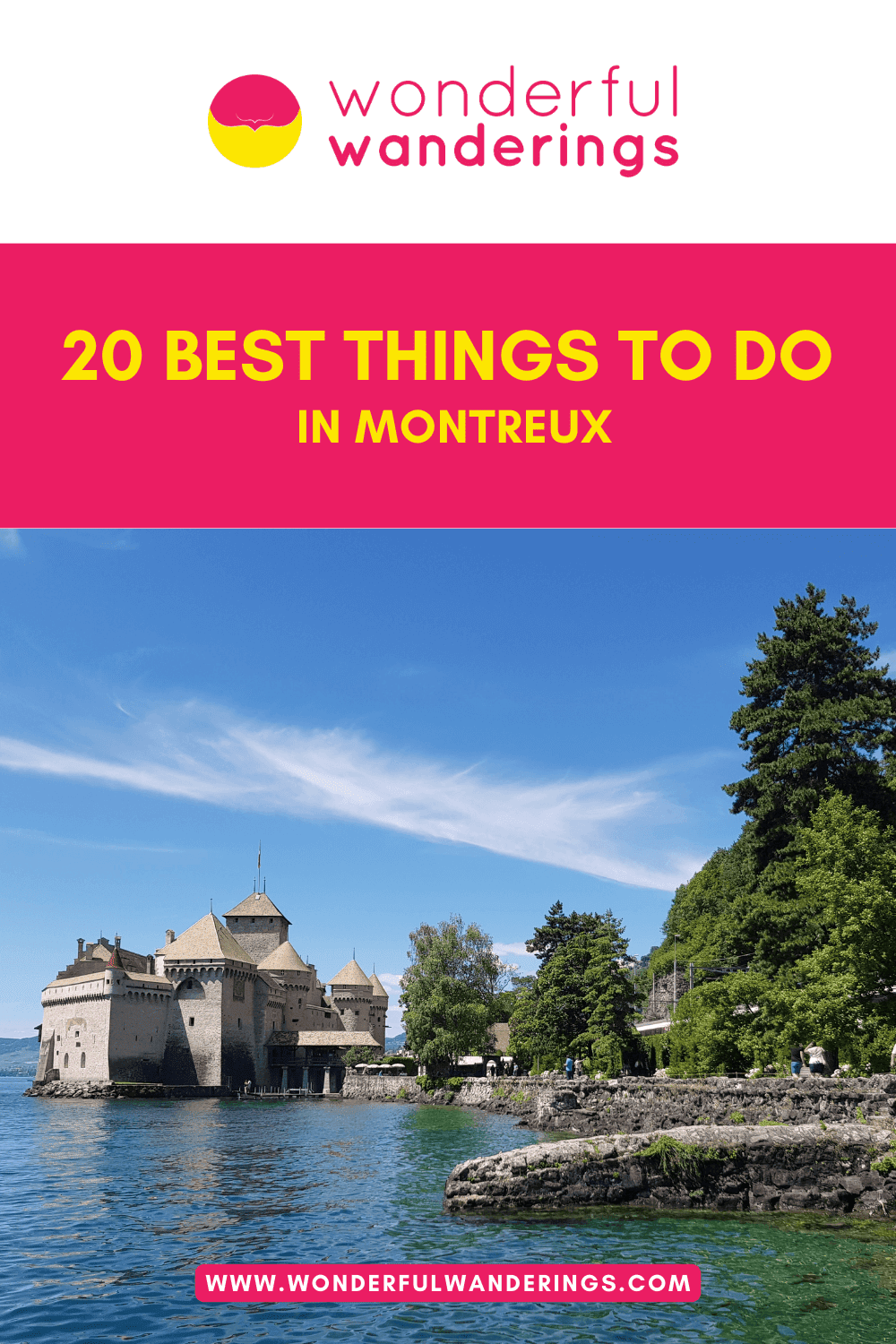
Chillon Castle is the reason most people come to Montreux, and it is the most visited historic building in Switzerland. It stands on a rock in the lake at Veytaux, 3 km (1.9 mi) south of the town centre, and it has been there in some form since the 11th century, with the oval shape dictated by the island it sits on.

Inside there are 25 buildings and three courtyards behind two rings of wall, and the route takes you through the vaulted underground rooms, the Savoy great halls, a bedchamber kept as the Bernese bailiffs left it and 14th-century wall paintings. Lord Byron wrote The Prisoner of Chillon after a visit in 1816, which is what made the place famous outside Switzerland, and his name is carved on a pillar in the dungeon.
Adults pay CHF 15 (about €16, $19, £14) and children CHF 7. Opening hours are 09:00 to 19:00 from April to September with last entry at 18:00, 09:30 to 18:00 in March and October with last entry at 17:00, and 10:00 to 17:00 from November to February with last entry at 16:00. It closes on 1 January and 25 December. Take bus 201 from Montreux, walk the lake path in about 45 minutes, or arrive by boat.
2. Promenade de Montreux Riviera
The lakeside promenade is the walk everyone does in Montreux, and it runs continuously along the water from Vevey through Montreux to Chillon and on to Villeneuve, about 10 km (6.2 mi) end to end. It is flat, paved and free, and you can join or leave it at any station on the line.

Flower beds are replanted several times a year, there are palms, cypresses and umbrella pines that the microclimate keeps alive, and public sculptures left over from the Montreux sculpture biennale stand along the route. The Montreux to Chillon stretch takes about 45 minutes and is the one to do if you only do one, because the castle appears at the end of it.
Start at Quai Edouard-Jacoud, a minute down the steps from Montreux station. Bus line 201 shadows the whole promenade from Vevey to Villeneuve if you want to walk one way and ride back.

3. Lac Léman
Lake Geneva is the largest lake in western Europe and Montreux sits at its eastern end, which is the deep, mountain-walled part rather than the open water near Geneva. The French shore and the Dents du Midi are the view from the quay, and the lake is a national border, so boats that cross to Evian-les-Bains or Saint-Gingolph land in France.

CGN runs the world’s largest fleet of Belle Époque paddle steamers on this lake, and several of them work the Montreux end. Scheduled services to Chillon, Vevey and Lausanne are ordinary public transport rather than sightseeing cruises, which makes them the cheap way to see the shoreline, and the Montreux Riviera Card takes a discount off them. Swimming is possible from the public spots at Territet, Clarens and Villeneuve in summer.
Bring a passport or national ID card if you plan to cross to the French shore. The quay is a minute from Montreux station and the landing stage is right in front of the Fairmont.
4. Queen Studio Experience
Queen: The Studio Experience is free, it is open every day of the year from 09:00 to 21:00, and it sits inside the Casino Barrière at Rue du Théâtre 9. Queen bought Mountain Studios in 1979 and recorded six albums here between 1978 and 1995, and the exhibition rebuilds the control room in the space the studio actually occupied.

The cases hold handwritten lyrics, instruments, costumes and studio tape boxes from the band’s own archive, and the mixing desk lets you pull apart the stems of Bohemian Rhapsody and rebuild your own mix, which is the part people remember. David Bowie and the Rolling Stones also worked here, and the studio’s log book is on display.
There is no ticket. A donation box collects for the Mercury Phoenix Trust, the AIDS charity Brian May, Roger Taylor and Jim Beach set up after Mercury’s death. Half an hour is enough, and the Freddie Mercury statue is a four-minute walk away.
5. Corniche Lavaux Vineyards
The Lavaux vineyard terraces are a UNESCO World Heritage site, inscribed in 2007, and they cover about 30 km (18.6 mi) of south-facing slope between Lausanne and Chillon. The terraces and their dry stone walls were laid out by Benedictine and Cistercian monasteries from the 11th century, and the shape of them has barely changed since the 14th.

Chasselas is the grape, and most of what is made here never leaves the canton, so drinking it on the spot is the only realistic way to try it. The walk from Chexbres to Lutry along the Corniche takes about two and a half hours downhill through the vineyards with the lake below, and village caveaux open at weekends for tasting. The Lavaux Express and Lavaux Panoramic tourist trains run through the terraces in season.
Walking the terraces costs nothing; tastings and the tourist trains are paid separately. Trains from Montreux reach Chexbres-Village or Cully in about 20 to 30 minutes with a change at Vevey.
6. Rochers-de-Naye
Rochers-de-Naye is the 2,042 m (6,699 ft) summit above Montreux, reached by a cog railway that climbs more than 1,600 m from the lakeshore in about 50 minutes. The view takes in Lake Geneva end to end, the Dents du Midi, the Vaud and Valais Alps and Mont Blanc on a clear day.

At the top there is the Rambertia alpine garden with more than 1,000 mountain plants, a marmot enclosure, walking trails along the ridge and a restaurant. Santa Claus receives children in a grotto near the summit during the Christmas market season, which is a Montreux institution and books out.
Check the timetable before you plan this. No trains ran between Montreux and Rochers-de-Naye from 14 September to 17 October 2026 while the line was rebuilt, with buses replacing trains as far as Haut-de-Caux, and MOB has flagged further works on the line into December 2026. In January, February and March, trains run only as far as Haut-de-Caux on Mondays and Tuesdays. A full-fare return from Montreux is around CHF 72.80 (about €77, $90, £66); a Swiss Travel Pass covers Montreux to Haut-de-Caux and gives 50% off the top section, and a Half Fare Card takes 50% off the whole thing.
7. Gorges du Chauderon
The Gorges du Chauderon is a free walk that starts a few minutes from Montreux station and climbs a wooded ravine cut by the Baye de Montreux. It is shaded, damp and noticeably cooler than the lakeshore, which makes it the obvious thing to do on a hot afternoon.

Follow the yellow hiking signs from the station towards Les Avants and the path takes you up the gorge on walkways and steps, past waterfalls, with the motorway viaducts crossing high overhead in one section. The climb takes around two hours to Les Avants; coming back down takes roughly a third of that, and the alternative is to ride the MOB train back from Les Avants to Montreux.
It is free and open all year. The footing is rough in places and there are long flights of steps, so it does not work for pushchairs or for anyone with mobility problems.
8. Gallery Plexus Montreux
Plexus Art Gallery shows contemporary art in Villa Murillo, a Belle Époque house at Rue du Lac 61 in Clarens with the Dents du Midi across the water. Eugène Jost, the architect of several of the Riviera’s grand hotels, built the villa between 1894 and 1897, and the rooms have kept their proportions.

The programme is temporary exhibitions of Swiss and international artists, usually one at a time, and the gallery also hires the villa out for private events, so the show is not always the only thing happening in the building. Entry to the exhibitions is free.
It opens Friday to Sunday from 14:00 to 17:30 and at other times by appointment, so check before crossing town. Bus 201 stops at Clarens, about five minutes’ walk away.
9. Clarens
Clarens is the western half of Montreux and the part people actually live in, a 15-minute walk or one bus stop from the centre. It has the lakeside without the hotel frontage, a public swimming area, playgrounds and the ordinary shops and restaurants that the tourist stretch does not have.

Its literary claim is older than Montreux’s musical one. Jean-Jacques Rousseau set Julie, or the New Heloise here in 1761 and the novel made the place a pilgrimage for European readers. Tchaikovsky stayed in Clarens and finished his violin concerto here, and Stravinsky wrote much of The Rite of Spring in the village in 1912 and 1913.
Getting there is free with the Montreux Riviera Card, or one stop on bus 201 or the train. The lake path from Montreux to Clarens takes about 20 minutes on the flat.
10. Villeneuve
Villeneuve is the small town at the very eastern end of Lake Geneva, 6 km (3.7 mi) beyond Montreux, and it is where the promenade finishes. Around 6,000 people live there, the medieval grid of the old town survives, and the Grand-Rue has the cafés and the Saturday market.

The reason to walk out here is the Grangettes nature reserve just south of the town, where the Rhone comes into the lake through reed beds and lagoons. It is one of the most important bird sites in Switzerland, with marked paths, hides and a beach at the mouth of the river. Romain Rolland lived in Villeneuve for years and Igor Stravinsky spent time here too.
The walk from Chillon takes about 25 minutes along the water. Trains from Montreux take 5 minutes and bus 201 runs the same route. Both are free with the Montreux Riviera Card.
11. Montreux Riviera
Montreux Riviera is the stretch of shoreline running from Lausanne through Vevey and Montreux to Villeneuve, and the way to see it is from a boat rather than from the road. CGN’s Belle Époque paddle steamers, several of them over a century old and still running on their original steam engines, work this end of the lake from spring to autumn.
The short hop from Montreux to Chillon takes about 15 minutes and lands you at the castle gate. Montreux to Vevey takes around 30 minutes and gives you the Lavaux terraces from the water, and there is a Chaplin-themed link to Vevey, where Charlie Chaplin lived for 25 years and the Chaplin’s World museum sits in his old house at Corsier-sur-Vevey.
Fares are set by CGN and vary by route and season. The Montreux Riviera Card gives a discount rather than free travel on the boats, and a Swiss Travel Pass covers CGN scheduled services.
12. Montreux City Center
Montreux town centre is small enough to cross in 10 minutes, and the thing most people come to it for is the Freddie Mercury statue on the quay at Place du Marché. Irena Sedlecká, the Czech sculptor, made the 3 m bronze, and it was unveiled on 25 November 1996, five years to the day after Mercury’s death. Fans still leave flowers and letters at the base.

The rest of the centre is Grand-Rue and the streets behind it, with the covered market hall that Henri Nestlé gave the town in the 1890s, the Casino Barrière with the Queen exhibition inside, and the Auditorium Stravinski in the 2m2c congress centre where the jazz festival’s main concerts happen. The market on the quays in front of the Forum centre runs every Friday from 08:00 to 14:00 all year.
Montreux station is directly above the centre and everything here is within five minutes of it. Paid parking is at Parking du Marché and Parking La Paix, and it is expensive.
13. Le Vieux Montreux
Le Vieux Montreux is the original village, on the slope about 10 minutes above the lake, and it is what the town looked like before the hotels arrived. Narrow lanes, spring-fed fountains, 18th-century winegrowers’ houses and a couple of small restaurants, with the lake and the Dents du Midi appearing between the buildings.

The parish church of Saint-Vincent, on its terrace above the village, is the oldest building in Montreux and the view from the churchyard is the one to walk up for. From here the paths run on to the Gorges du Chauderon, to Glion and to Les Avants, so this is where a walking day out of Montreux usually starts.
It costs nothing and is a steep 10-minute walk up from the station, or take the local bus if the hill is a problem. There is very little parking.
14. Montreux Jazz Festival
The Montreux Jazz Festival runs for about two weeks every July and it is the second-largest annual jazz festival in the world. Claude Nobs, Géo Voumard and René Langel started it in 1967 in the old casino, and it stopped being only a jazz festival decades ago: the bill now runs from jazz and blues through soul, rock, hip-hop and electronic music.

The list of people who have played here is the festival’s real asset, and it runs from Nina Simone, Miles Davis, Ella Fitzgerald and Marvin Gaye to Prince, David Bowie, Leonard Cohen and Stevie Wonder. Deep Purple wrote Smoke on the Water about the night the old casino burned down during a Frank Zappa concert in December 1971, and “Funky Claude” in the lyric is Claude Nobs.
The 61st edition runs from 2 to 17 July 2027. Paid concerts happen at the Auditorium Stravinski and the Casino, and a large free programme runs on the lakefront stages, which is what fills the town. Book a room the day the dates are announced, because Montreux, Vevey and Villeneuve all sell out.
15. Septembre Musica
Septembre Musical Montreux-Vevey is the classical festival that has run here since 1946, and it is the quieter counterweight to the jazz festival. Concerts are held in the Auditorium Stravinski in Montreux, in Vevey and in Chillon Castle itself, where the acoustics of a medieval hall do most of the work.

The 80th edition ran from 9 to 18 September 2026, returning to the Auditorium Stravinski after a break, with a concert inside Chillon Castle on 10 September. Orchestras, conductors and soloists are international, and the format leans towards a small number of large concerts rather than a crowded fringe.
Ticket prices vary by concert and seat and are sold through the festival. Check septembremusical.ch for the next edition’s dates before booking travel, because the festival has moved and paused before.
16. Montreux Noël
Montreux Noël is the Christmas market that fills the lakeside promenade from late November to Christmas Eve, and the 2026 edition runs from 20 November to 24 December. Around 150 chalets sell crafts, raclette, mulled wine and roasted chestnuts along the quay, with the lake and the mountains behind them.

Two things make it different from other Swiss markets. A Ferris wheel on Place du Marché puts you above the lake, and a Flying Santa Claus crosses above the market on a wire at set times each evening, which is the moment every child is waiting for. Santa’s grotto is at the top of Rochers-de-Naye, reached by the cog railway, and it needs booking.
Entry to the market is free and the chalets, the food and the Ferris wheel are not. Come on a weekday if you can: the market is one of the busiest in Switzerland and the Saturday crowd on the promenade is solid. Montreux is one of the top festivals to attend in Switzerland at this time of year.
17. GoldenPass Express
The GoldenPass Express is the panoramic train from Montreux to Interlaken Ost, and it takes about 3 hours 15 minutes without a change, which is the point: until 2022 the same journey meant changing trains and gauges at Zweisimmen. Variable-gauge bogies now switch the train from metre gauge to standard gauge while you stay in your seat.
The route climbs out of Montreux through the Lavaux vineyards with the lake dropping away behind, crosses the Pays-d’Enhaut to Château-d’Oex and Gstaad, then runs down the Simme valley and along Lake Thun into Interlaken. Prestige class seats sit higher than the driver at the front of the train and have to be reserved.
Seat reservations are compulsory in Prestige and recommended in the other classes. The Swiss Travel Pass covers the fare, and you pay only the reservation. Trains run several times a day in each direction all year.
Where is Montreux?
Montreux is on the north-east shore of Lake Geneva in the canton of Vaud, in French-speaking Switzerland, at the point where the lake narrows and the Alps come down to the water. It is part of the district of Riviera-Pays-d’Enhaut.
Lausanne is 23 km (14.3 mi) west and 20 minutes by train, Vevey is 6 km (3.7 mi) away, and Geneva Airport is 93 km (57.8 mi) west, about an hour and a quarter by direct train. The town runs uphill from 374 m at the lake to the Rochers-de-Naye ridge above 2,000 m, so a walk out of the centre in any direction but along the shore is a climb.
What is the history of Montreux?
Montreux’s history is a Roman road, then vineyards, then hotels. The Roman route from Italy over the Simplon Pass forked here, and a Roman villa and an early medieval cemetery have been dug up in the area. Wine came in the 12th century and the slopes from Lavaux to Montreux became a serious wine region.
The modern town is a 19th-century invention. The railway arrived in 1861, the Vevey to Chillon tramway in 1888 was the first electric tramway in Switzerland, and between 1890 and 1914 the hotel builders put up the Belle Époque frontage that still lines the lake. Writers and musicians followed the hotels: Byron, Nabokov, who lived his last 16 years in the Montreux Palace, Stravinsky, Tchaikovsky, Chaplin in nearby Vevey and Queen from 1978.
Montreux basics: language, money, plugs and time
Montreux runs on French, Swiss francs, Type J plugs and Central European Time. Switzerland is not in the EU and does not use the euro, which catches out visitors arriving from France across the lake. The practical facts about Switzerland are set out below.
| Detail | What to know |
|---|---|
| Language | French. English is widely spoken in hotels, shops and restaurants |
| Currency | Swiss franc (CHF). Some places take euros and give change in francs at a poor rate, so pay in francs or by card |
| Plugs | Type J, 230 V. Type C two-pin europlugs fit; three-pin plugs from elsewhere do not |
| Time zone | Central European Time (UTC+1), summer time (UTC+2) from late March to late October |
| Getting around | Every overnight guest gets a free Montreux Riviera Card covering local buses, trains and the funicular |
| Emergency number | 112 |
How many days do you need in Montreux?
Two days covers Montreux and three is comfortable. Day one is the promenade, the Freddie Mercury statue, the Queen exhibition and the walk out to Chillon Castle. Day two is a mountain or the vineyards: Rochers-de-Naye by cog railway, or the Lavaux terraces on foot from Chexbres.
A third day buys Vevey and Chaplin’s World, a boat along the Riviera, or a day trip out on the GoldenPass Express towards Gstaad. Montreux also works as a base for Lausanne, which is 20 minutes away, and for the Valais, but not for Zermatt or the Jungfrau region, which are both three hours or more each way.
Is Montreux expensive to visit?
Yes, Montreux is expensive, and hotel rates in July and December are the sharpest part of it. During the jazz festival and the Christmas market, rooms in Montreux itself roughly double and availability collapses, so people stay in Vevey, Villeneuve or Aigle and commute in. The wider picture on prices in Switzerland applies here too.
Three things bring the total down. The Montreux Riviera Card, issued free to every overnight guest in the region, covers local buses, trains and the funicular so you never buy a local ticket. Most of the town’s attractions are free anyway: the promenade, the Queen exhibition, the gorge walk, the statue, the old village and Plexus gallery all cost nothing, and Chillon at CHF 15 (about €16, $19, £14) is the only significant entry fee. And the Friday market on the quays and the Coop and Migros near the station are how you eat lunch for a fraction of a restaurant bill.
What to eat in Montreux
Montreux eats Vaud food, which means cheese, lake fish and Chasselas wine rather than anything specific to the town. The dishes worth trying are below, and the list of best foods to eat in Switzerland covers the rest of the country.
- Fondue moitié-moitié. Half Gruyère and half Vacherin Fribourgeois melted with white wine, ordered by the pot for the table. Eaten from October to March rather than in July.
- Filets de perche. Perch fillets floured and fried in butter with lemon, the standard lakeside lunch. Ask whether they are from the lake, because a lot of restaurant perch is imported.
- Papet vaudois. Leeks and potatoes stewed together under a saucisse aux choux, the cabbage sausage that is the canton’s own. Winter food.
- Malakoffs. Deep-fried cheese fritters from the Vaud wine villages, served as a starter with mustard and pickles.
- Raclette. Melted cheese scraped onto potatoes with pickles and onions, sold from stalls at the Christmas market and in restaurants all winter.
- Chasselas from Lavaux. The white wine grown on the terraces just up the lake, dry and low in acid, best drunk in the village caveaux where it is made.
- Taillé aux greubons. A savoury pastry made with pork crackling, sold in Vaud bakeries and gone by mid-morning.
Where are the best places to eat in Montreux?
Start with La Rouvenaz on Rue du Marché, a trattoria and brasserie in the centre that has been cooking Italian food and lake fish since 1965, and the Montreux Jazz Café in the Fairmont, which is open to non-residents and serves through the afternoon.
For a meal worth the trip, Auberge de Chaulin is up in the hills above the town and cooks a small seasonal menu, and Le Fouquet’s in the Fairmont is the grand-hotel option on Avenue Claude Nobs.
Cheaper: the Friday market on the quays, the bakeries on Grand-Rue and the Clarens restaurants one stop west, which serve the same food to locals at local prices.
Where to stay in Montreux
Stay on the Montreux lakefront, in Clarens or in Territet, because all three sit on the same bus line and each solves a different problem. The lakefront puts you in the middle of the festival and the market and costs the most. Clarens is 15 minutes west, cheaper and more residential. Territet is 10 minutes east, quiet, and the closest base to Chillon. Whatever you book, the Montreux Riviera Card comes with it.
On the lakefront: Fairmont Le Montreux Palace. The Belle Époque palace hotel that defines the Montreux waterfront, opened in 1906, with 236 rooms, a spa across the road, and the Montreux Jazz Café and Le Fouquet’s inside. Vladimir Nabokov lived here for 16 years. It is the festival’s centre of gravity in July. Check dates for Fairmont Le Montreux Palace.
By the station: Grand Hotel Suisse Majestic. A renovated Belle Époque hotel directly above the quay and about 50 metres from Montreux station, with lake-facing rooms and a terrace restaurant over the promenade. Useful if you are arriving by train or doing day trips. Check dates for the Grand Hotel Suisse Majestic.
On the water, mid-range: Hotel Mona. A four-star on the lake in Territet that traded for years as the Eurotel Montreux, with lake and Alp views from every room and the castle walk starting outside the door. The booking.com listing still carries the old name in its address. Check dates for Hotel Mona.
Getting to Montreux and getting around
Arrive by train, because Montreux station sits directly above the town centre and the promenade is one flight of steps below it. Geneva Airport has a station under the terminal with direct trains to Montreux in about 1 hour 15 minutes. Lausanne is 20 minutes away, Bern about 1 hour 40 minutes and Zurich about 2 hours 40 minutes with one change.
Locally, bus line 201 runs the length of the Riviera from Vevey through Montreux to Villeneuve and is the line you will actually use. The Territet to Glion funicular and the MOB trains up to Les Avants and Rochers-de-Naye leave from the same area. All local buses and trains inside Mobilis fare zones 70 and 72 to 78 are free with the Montreux Riviera Card.
Compare train fares on Omio before buying at the counter, since advance Swiss fares beat walk-up prices, and note that the Riviera Card stops at the regional boundary: journeys to Lausanne, Geneva or Zurich are not covered by it.
Tours and day trips from Montreux
Book a guided tour in Montreux for the Lavaux vineyards and the lake, which are the two things that work better with someone driving or steering. Wine tours through the terraces, cheese and chocolate trips to Gruyères and Broc, and boat excursions to Chillon and Vevey are the regular options.
Beyond that, Vevey and Chaplin’s World are 10 minutes away, Gruyères about an hour and a half with a change at Montbovon, and Basel and Lucerne are both reachable in under three hours if you want a longer day out. The full list of Swiss destinations covers the rest.
Montreux FAQ
Is Montreux worth visiting? Yes, for Chillon Castle, the promenade and the setting, and emphatically yes in July for the jazz festival or in December for the Christmas market. It is a resort town rather than a city, so two days is usually enough outside those two seasons.
Is Montreux safe to visit? Yes. Crime is low and the promenade is comfortable to walk at night. The usual care with bags applies in festival crowds.
Is Montreux easy to visit with kids? Yes. Chillon Castle is built for children, the Rochers-de-Naye marmots and the Christmas market’s flying Santa are both aimed at them, and the Riviera Card covers everyone aged 3 and over on local transport.
What is Montreux famous for? The Montreux Jazz Festival, Chillon Castle and Freddie Mercury. Claude Nobs, who founded the festival in 1967 and is the “Funky Claude” of Smoke on the Water, was born in Montreux and is one of the important people in Switzerland the town is known for.
Do I need a car in Montreux? No. The town is walkable, bus 201 covers the Riviera and both are free with the guest card. Parking is limited and expensive.
WonderfulWanderings Pro Tips
The 5 tips below come from reading Montreux’s operators, venues and timetables off their own sites in September 2026, and each one changes what a visit costs or whether it happens at all.
- Check the Rochers-de-Naye line before you plan a mountain day. No trains ran between Montreux and Rochers-de-Naye from 14 September to 17 October 2026 while the track was rebuilt, buses replaced trains only as far as Haut-de-Caux, the Glion-Alpes stop was not served, and MOB has flagged further works into December 2026. In January, February and March, trains stop at Haut-de-Caux on Mondays and Tuesdays even in a normal year.
- Activate the Montreux Riviera Card from the email, three days before you arrive. It is free with any overnight stay in Montreux, Vevey, Veytaux, Villeneuve and the neighbouring communes, it is digital, and your host sends the activation link three days ahead. One card per person is needed, including children aged 3 and over, and it covers Mobilis zones 70 and 72 to 78 but not the trip to Lausanne or Geneva.
- Do the Queen exhibition on a Sunday evening, when nothing else is open. Queen: The Studio Experience is free and open every day of the year from 09:00 to 21:00 inside the Casino Barrière, which makes it the one Montreux attraction that is never shut.
- Time Chillon for the last hour. Last entry is an hour before closing, 18:00 from April to September and 16:00 from November to February, and the tour groups and the boat arrivals have gone by then. The castle is closed on 1 January and 25 December.
- Do not plan a Musée de Montreux visit. The town’s local history museum in the two 17th-century winegrowers’ houses on Rue de la Gare is listed as temporarily closed by Switzerland Tourism. Older guides still give its opening hours and an entry price. Check
museemontreux.chbefore making the walk.
About the author. This guide is written and maintained by the Wonderful Wanderings editorial team. Wonderful Wanderings was founded in 2012 by Sofie Couwenbergh, and the team covers Montreux and the rest of Switzerland for independent travellers, including Chillon Castle, the lake boats, the Lavaux wine tours and the lakefront hotels worth booking early for jazz-festival and Christmas-market dates. We update this page when prices, opening hours and closures change.