 EN
EN
 Nederlands
 Français
The 10 things to do in Bydgoszcz below centre on the Brda, the river that built the city, and eight of the ten are either free or cost 25 zł (about €6, $7, £5) or less. Bydgoszcz is a working city of about 321,000 people in northern Poland that almost nobody visits on purpose, and it is honest to say so. It has no royal castle, no walled old town of any size and no queue for anything. What it has is a river running through the middle of it, a set of red brick mills and granaries that have been turned into museums, and direct Ryanair flights from four British airports.
Prices on this page are in Polish złoty, because Poland uses the złoty and has not adopted the euro. Every ticket price, closing day and free day below comes from the venue’s own website, checked in September 2026. Two things most Bydgoszcz guides still get wrong: the Holiday Inn on Grodzka Street became the Qubus Hotel in January 2025, and the Gallery of Modern Art on Mennica Street is not currently open to visitors.
Why visit Bydgoszcz
Visit Bydgoszcz for the cheap flight, the river and the industrial architecture, not for monuments. Most British and Irish visitors arrive because the fare was low: the airport runs scheduled summer 2026 services to London Stansted four times a week, Birmingham four times, London Luton three times, Dublin, Bristol and Alicante twice each, plus Warsaw daily. That makes Bydgoszcz a useful front door to northern Poland rather than a destination people fly to for its own sake.

Bydgoszcz repays two days on those terms. The centre is a walkable stretch of Art Nouveau townhouses along Gdańska and Cieszkowskiego streets, the Brda cuts through it with granaries on one bank and a park island on the other, and its heaviest museum sits inside a Nazi explosives factory in the woods. Bydgoszcz is also the birthplace of Marian Rejewski, the mathematician who reconstructed the German Enigma machine in 1932, which is a bigger claim to fame than the city makes of it. Go to Toruń instead if you want cobbles and Gothic, 45 km (28 mi) east and under an hour away by train, and see our index of destinations in Poland for the rest of the region.
10 things to do in Bydgoszcz
The 10 things to do in Bydgoszcz are listed below, most rewarding first.

- Młyny Rothera. Młyny Rothera is the 1851 grain mill complex on Mill Island that reopened in November 2022 as a science and culture centre, and it is the single strongest reason to stop in Bydgoszcz. One exhibition costs 22 zł (about €5, $6, £4), reduced 18 zł; two cost 35 zł (about €8, $9, £7) and all three cost 48 zł (about €11, $12, £10). The viewing point over Mill Island is free. The permanent shows are “Knots: a story of a city by the river”, “Mill-Machine” and an activity zone for children. Hours are Monday 12:00 to 18:00 for the building, Tuesday to Friday 9:00 to 18:00 and weekends 12:00 to 20:00, with “Mill-Machine” closed on Mondays.
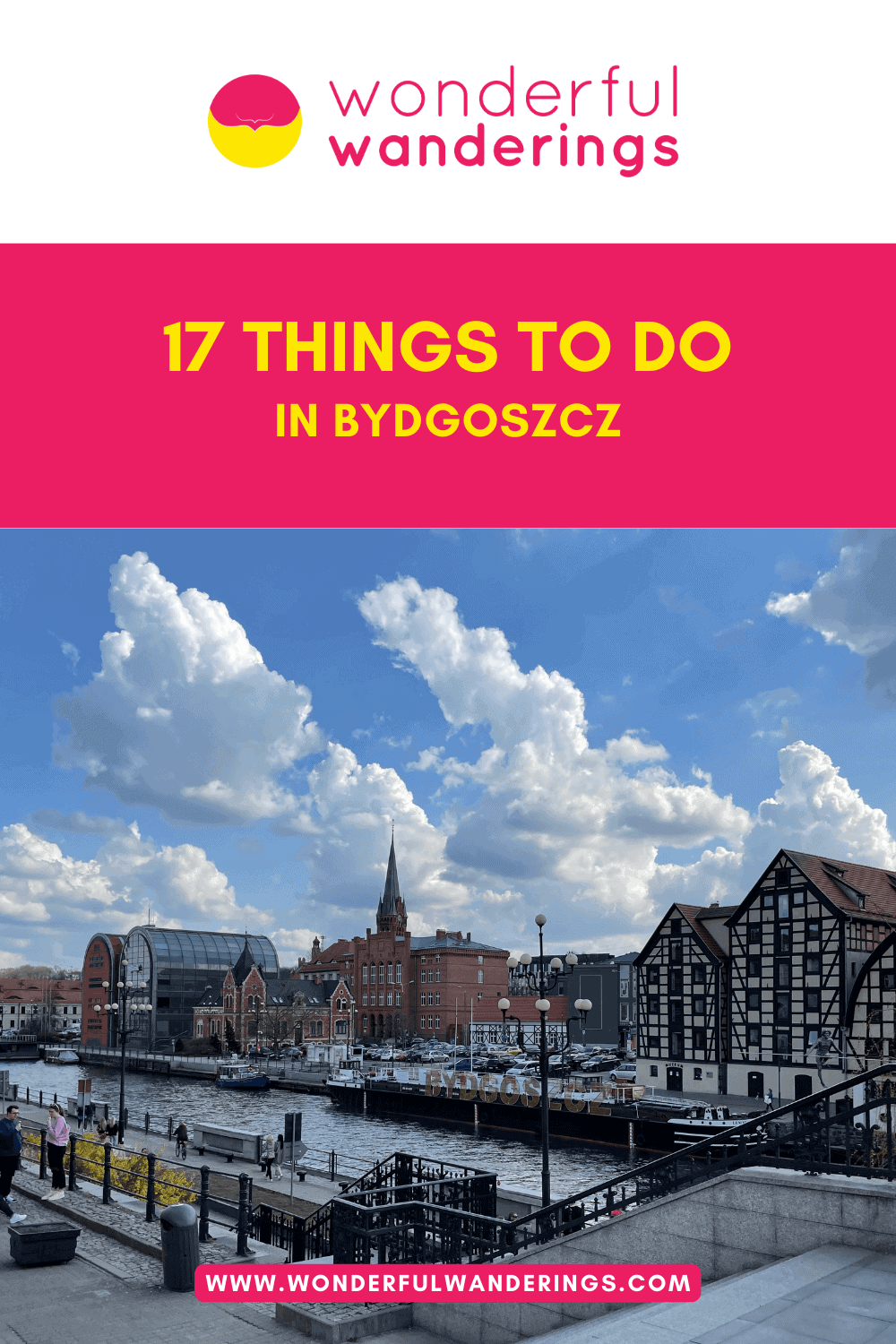
- Mill Island (Wyspa Młyńska). Mill Island is the 6.5-hectare island between the Brda and its mill race, a five-minute walk from the Old Market Square, and walking it costs nothing. Four branches of the District Museum sit along ul. Mennica: the Archaeological Collections at number 2, the European Money Centre at number 4, the Leon Wyczółkowski House at number 7 and the Gallery of Modern Art at number 8, which is closed to visitors at present. The island has a beach, a marina, a playground and an amphitheatre, and it is the reason people call Bydgoszcz a Venice, which is generous but not absurd.
- Exploseum. Exploseum occupies the DAG Fabrik Bromberg site, the explosives factory Nazi Germany built in the forest south-east of Bydgoszcz using forced labour, and it is the most affecting museum in the city. Standard entry is 25 zł (about €6, $7, £5), reduced 20 zł, with a guided alternative route at 28 zł, a combined package at 45 zł (about €11, $12, £9) and an extreme route at 60 zł. It opens Tuesday to Sunday 10:00 to 18:00 and is closed on Mondays, with the last entry to the permanent exhibition one hour before closing. Allow two to three hours, and book a guide for the alternative route in advance because it cannot be walked alone.
- Museum of Soap and History of Dirt. The Museum of Soap and History of Dirt at ul. Długa 13-17 explains 600 years of washing, and every visit includes a soap-making workshop you take home. Tickets are 39 zł (about €9, $10, £8), reduced 35 zł. Visits run for 50 minutes, start on the hour between 10:00 and 18:00 daily, and take a maximum of 35 people, so buy a timed ticket before you arrive rather than turning up. Guided visits in English need booking ahead.
- The Granaries on the Brda. The three half-timbered granaries on the Brda are the image on every Bydgoszcz postcard, and they house the Museum of Bydgoszcz History at ul. Grodzka 7-11, on the bank opposite Mill Island. Entry to the District Museum’s city-centre buildings is 17 zł (about €4, $4, £3), reduced 12 zł, family 50 zł, and permanent exhibitions are free on Thursdays. Viewing the granaries from the riverbank or from a boat costs nothing.
- The Water Tower. The Water Tower at ul. Filarecka 1 is a neo-Gothic brick tower of 1900, 45 metres (147.6 ft) tall, and its viewing terrace at 38 metres (124.7 ft) gives the widest view in Bydgoszcz. Tickets to the Waterworks Museum inside are 10 zł (about €2, $3, £2), reduced 5 zł, which makes it the cheapest paid attraction on this list. Around 170 steps lead to the terrace, and telescopes are set up at the top.
- The river, and the man walking across it. Bydgoszcz’s most photographed sculpture hangs above the Brda rather than standing beside it: Jerzy Kędziora’s “Crossing the River”, a 50 kg balancing figure suspended on a 100-metre line near the Jerzy Sulima-Kamiński bridge on Mostowa Street since May 2004. Looking at it is free. The Słonecznik passenger boats run along the Brda in season, and the Planty gardens follow the Old Bydgoszcz Canal west of the centre, a 1774 waterway that connected the Vistula to the Oder and made the city’s fortune. After Kędziora’s 2024 exhibition the city agreed to add more of his balancing sculptures permanently, so expect company for the tightrope walker.
- The Deluge Fountain and the Music District. The Deluge Fountain in Kazimierz Wielki Park is Ferdinand Lepcke’s 1904 bronze group of figures drowning in the biblical Flood, melted down by the German occupiers in 1943 and rebuilt between 2006 and 2014. Entry is free. Ten minutes away, Jan Kochanowski Park holds Lepcke’s other Bydgoszcz landmark, the 1910 nude archer that scandalised the city on unveiling and now appears on its souvenirs, along with statues of Chopin and Moniuszko and the Pomeranian Philharmonic concert hall next door.
- Two very different churches. Bydgoszcz Cathedral, properly the Cathedral of St Martin and St Nicholas, is the fifteenth-century Gothic parish church at ul. Farna 2 that became a cathedral when the Diocese of Bydgoszcz was created in 2004, and it is also the Sanctuary of Our Lady of Beautiful Love. Entry is free. The contrast is the Basilica of St Vincent de Paul, a neoclassical rotunda modelled on the Roman Pantheon, begun in 1924 and raised to a minor basilica by John Paul II in 1997, with a dome covering roughly 2,500 square metres.
- Myślęcinek and Bydgoszcz Zoo. Myślęcinek is one of the largest city parks in Poland, on the northern edge of Bydgoszcz, with a botanical garden, a lake, a funfair and the zoo, and entry to the park itself is free. Bydgoszcz Zoo concentrates on Polish species, including bison, elk, wolves and brown bears. Tickets in season are 38 zł (about €9, $10, £8), reduced 28 zł, family 105 zł, dropping to 29 zł and 15 zł out of season. Weekday Wednesdays are discounted to 20 zł, reduced 15 zł, which is worth planning around.
What the District Museum costs, and why Thursday is free
The District Museum in Bydgoszcz charges 17 zł for any of its city-centre buildings and gives permanent exhibitions away free every Thursday. That covers seven separate addresses on one ticket policy, so a Thursday in Bydgoszcz is the cheapest museum day in the city. The buildings, their addresses and their hours are set out below.

| Branch | Address | Normal ticket |
|---|---|---|
| Main building | ul. Gdańska 4 | 17 zł |
| Pharmacy under the Swan | ul. Gdańska 5 | 17 zł |
| Granaries on the Brda | ul. Grodzka 7-11 | 17 zł |
| Archaeological Collections | ul. Mennica 2 | 17 zł |
| European Money Centre | ul. Mennica 4 | 17 zł |
| Leon Wyczółkowski House | ul. Mennica 7 | 17 zł |
| Gallery of Modern Art | ul. Mennica 8 | closed to visitors |
| Exploseum | ul. Alfreda Nobla | 25 zł |
All of them close on Monday. They open Tuesday to Thursday 10:00 to 18:00, Friday 12:00 to 20:00 and at weekends 11:00 to 17:00, except Exploseum, which runs 10:00 to 18:00 Tuesday to Sunday. A two-day combined ticket covering every branch plus Exploseum is 80 zł (about €19, $21, £16), reduced 60 zł. Temporary exhibitions are charged on Thursdays even when the permanent ones are not.

How many days do you need in Bydgoszcz?
Two days is right for Bydgoszcz, and one day works if you skip Exploseum. Day one covers Mill Island, Młyny Rothera, the granaries on Grodzka Street and the Water Tower terrace, all within half an hour’s walk of each other. Day two takes Exploseum in the morning, since it is out in the forest and needs a bus, and Myślęcinek or the Music District afterwards. Anyone with a third day should use it on Toruń rather than on more of Bydgoszcz.

Getting to Bydgoszcz
Fly into Bydgoszcz Ignacy Jan Paderewski Airport if you are coming from Britain or Ireland, because it is the only Polish airport with direct flights to Bristol and Birmingham. The airport sits inside the city with its own railway platform and city bus links, so the transfer is minutes rather than an hour. LOT also flies to Warsaw seven times a week, which connects Bydgoszcz to the rest of the network.

By land, Bydgoszcz Główna station puts Warsaw about 3 hours away, Gdańsk about 2 hours and Toruń under an hour, and long-distance coaches serve the same routes more slowly. Driving to Warsaw takes roughly 4 hours over 340 km (211.3 mi) on the A1 and A2, both tolled. Advance fares on the express trains are much cheaper than walk-up prices, so it pays to check Polish rail and coach times on Omio before you travel rather than buying at the counter.
Day trips from Bydgoszcz
Take the train to Toruń for the day, because it gives you the medieval Polish city Bydgoszcz does not have. Toruń’s Gothic old town is a UNESCO World Heritage Site, Copernicus was born there, and the journey takes under an hour. Other trips within reach are Biskupin, a reconstructed Iron Age settlement, the Gothic town of Chełmno, and the salt graduation towers at Inowrocław. Bydgoszcz itself makes a cheaper base than Toruń for all of them.

Where to stay in Bydgoszcz
Stay in Śródmieście or on Mill Island, because everything on this page except Exploseum and Myślęcinek is inside a 25-minute walk of both. Śródmieście has the Art Nouveau streets, the Opera Nova and the widest choice of hotels; Mill Island is quieter and prettier and has fewer beds. The Old Market Square sits between them. Outlying districts such as Fordon and Bartodzieje are cheaper but add a tram ride each way for no real gain, since Bydgoszcz hotel rates are low to begin with.

Three options cover the range, and the city’s Tourist Card is worth pricing alongside them because it includes entry to Młyny Rothera and discounts at the District Museum.
- Bohema Boutique Hotel & Spa. Bohema is the five-star choice, a restored building beside the 300-year-old Kazimierz Wielki Park with a spa and indoor pool, a short walk from the Deluge Fountain. Rates and dates are at Bohema Boutique Hotel & Spa.
- Mercure Bydgoszcz Sepia. Mercure Bydgoszcz Sepia is the central four-star, next to the Opera Nova and the District Museum’s main building, with a roof terrace over the river. Availability is at Mercure Bydgoszcz Sepia.
- Everything cheaper. Bydgoszcz is one of the least expensive cities of its size in Poland and rooms drop further outside the summer months. Compare rates across hotels in Poland.

Where to eat in Bydgoszcz
Eat on or beside Mill Island, because that is where Bydgoszcz’s kitchens cluster and where the river view is. Five places were confirmed open in September 2026 and are listed below.

- Karczma Młyńska. Karczma Młyńska stands at ul. Mennica 1 on Mill Island, built into the walls of an 1873 grain granary, and it is the most obvious choice for żurek, bigos and beef zrazy with a river outside.
- Warzelnia Piwa. Warzelnia Piwa at ul. Poznańska 8 has brewed on the premises since 2011 and pairs its own beer with a menu that runs from Polish to Indian, which is an odd combination that works.
- Pierogarnia Stary Młyn. Pierogarnia Stary Młyn at ul. Poznańska 4/2 belongs to a national chain but makes its pierogi on site, and it is the reliable cheap dinner in the Old Town.
- King Fu Fusion. King Fu Fusion at ul. Jatki 2, just off the Old Market Square, is the city’s Asian and sushi kitchen and opens daily from 12:00.
- Katarynka. Katarynka at ul. Niedźwiedzia 3 is the breakfast address in the centre and has its own cake shop 30 metres away at ul. Batorego 4.
What to order is Polish rather than Bydgoszcz-specific, which is worth saying plainly because several guides invent a local cuisine for the city. Bydgoszcz is inland, 165 km (102.5 mi) from the Baltic, so it has no seafood tradition of its own, no Kashubian herring and no gingerbread heritage; gingerbread belongs to Toruń, up the river. Order pierogi, żurek, rosół, bigos, kielbasa from a street grill and a zapiekanka if you are walking home late. More on all of them in our guide to the food to eat in Poland.

What Bydgoszcz costs
Bydgoszcz is cheap even by Polish standards, and every price is in złoty. Museum admissions run from 5 zł at the Water Tower to 48 zł for all three exhibitions at Młyny Rothera, a restaurant main sits around 40 to 60 zł (about €9 to €14, $10 to $16, £8 to £12), and a pint of the house beer at Warzelnia Piwa costs a fraction of a London price. Cards and contactless work everywhere, including ticket machines, so there is little reason to carry cash.

Two free days do most of the work on a budget. Thursday clears the District Museum’s permanent exhibitions, and weekday Wednesdays cut the zoo from 38 zł to 20 zł. For a wider picture, see our guide to prices in Poland.
Bydgoszcz FAQ
Is Bydgoszcz worth visiting?
Yes, Bydgoszcz is worth visiting for two days, with a caveat. The river, Młyny Rothera, Exploseum and the Art Nouveau streets are a genuine city break, and you will share them with almost no other tourists. What Bydgoszcz does not have is a preserved historic core: the city was Prussian for over a century, was damaged in the war and rebuilt plainly, and its appeal is industrial and riverside rather than medieval.
Is Bydgoszcz safe to visit?
Yes, Bydgoszcz is safe for visitors. The centre, the Old Market Square and the Brda riverside are lit and busy into the evening, and violent crime against tourists is rare. Ordinary caution about unlit streets late at night and about valuables on crowded trams is all that is needed.
What is Bydgoszcz famous for?
Bydgoszcz is famous for its granaries, its canal and its music. The three half-timbered granaries on the Brda are the city’s emblem, the Bydgoszcz Canal of 1774 linked the Vistula and Oder river systems and made the city a trading port, and the Pomeranian Philharmonic and Opera Nova give it a musical reputation out of proportion to its size. The tightrope walker suspended over the river has become the modern shorthand for the city.
Who are the most famous people born in Bydgoszcz?
Marian Rejewski, born in Bydgoszcz in 1905, is the city’s most consequential native: he reconstructed the German Enigma cipher machine in 1932, years before Bletchley Park, and his work underpinned Allied codebreaking. Zbigniew Boniek, born in 1956, started at Zawisza Bydgoszcz and went on to Juventus and three World Cups. Tomasz Gollob, born in 1971, won the individual speedway world championship in 2010. Several older lists credit Bydgoszcz with Ignacy Jan Paderewski and Jan Bytnar, and neither is correct: Paderewski was born in Kuryłówka in Podolia and Bytnar in Kolbuszowa. More on the rest in our guide to notable people from Poland.
Is Bydgoszcz good for children?
Yes, Bydgoszcz suits children better than most Polish cities of its size. The soap museum’s workshop gives every child a bar of soap to take home, Młyny Rothera has an activity zone built for them, the zoo concentrates on animals they can name, and Myślęcinek has a funfair, a lake and playgrounds. The city is flat, compact and cheap, which helps.
What festivals happen in Bydgoszcz?
Bydgoszcz’s fixed dates are the Bydgoszcz Opera Festival at the Opera Nova in April and May, the Bydgoszcz Music Festival at the Pomeranian Philharmonic in September and October, and Drums Fusion, a percussion festival, at the turn of May and June. A Christmas market runs on the Old Market Square in December. Dates shift year to year, so check our list of festivals in Poland before you build a trip around one.
WonderfulWanderings Pro Tips
Four details will save you money or a wasted journey in Bydgoszcz, each checked against the venue’s own site in September 2026.

- Go to the museums on a Thursday. Permanent exhibitions at all of the District Museum’s open branches, from the granaries on Grodzka Street to the Leon Wyczółkowski House, are free on Thursdays. Temporary shows are still charged, and Exploseum is not included.
- Book the soap museum before you go. The Museum of Soap and History of Dirt admits a maximum of 35 people per hourly slot, and every ticket includes the 50-minute workshop, so walk-ins are regularly turned away. Buy a timed ticket online.
- Do not plan a Monday around museums. Every branch of the District Museum, including Exploseum, closes on Monday, and the “Mill-Machine” exhibition at Młyny Rothera closes too. Młyny Rothera’s building, its free viewing point and its “Knots” exhibition do open from 12:00, which is the Monday fallback.
- Take the zoo on a weekday Wednesday. Bydgoszcz Zoo’s discounted Wednesday rate is 20 zł instead of 38 zł, and 15 zł instead of 28 zł for a reduced ticket. It applies on weekdays only.
About the author. This guide is written and maintained by the Wonderful Wanderings editorial team. Wonderful Wanderings was founded in 2012 by Sofie Couwenbergh, and the team covers Poland for independent travellers, including the museums worth a ticket in a city most guidebooks skip, the hotels and river trips worth booking, and the free days worth planning around. We check every price, address, closing day and free day on this page against the venue’s own website, and update it when they change.