 EN
EN
 Nederlands
 Français
The 10 things to do in Gdynia below start with the thing that changed the city’s standing in July 2026: the Modernist Centre of Gdynia was inscribed on the UNESCO World Heritage List on 27 July 2026, covering 87.9 hectares of the city centre and making it Poland’s eighteenth World Heritage property. The decision landed in Gdynia’s centenary year, because the city was granted its charter on 10 February 1926 and was built almost from nothing in the two decades that followed.
That is the short answer to why Gdynia is worth a day when Gdańsk is 20 km (12.4 mi) down the same railway line. Gdańsk is a rebuilt Hanseatic port; Gdynia is a complete 1920s and 1930s city, and the streets themselves are now the monument. Prices on this page are in Polish złoty, because Poland uses the złoty and has not adopted the euro, and every ticket price and closing day was taken from the venue’s own website in September 2026.
Why visit Gdynia rather than Gdańsk or Sopot
Visit Gdynia for twentieth-century architecture, ships and a working port, and use Gdańsk for medieval streets and Sopot for the beach resort. The three cities form the Tricity, they are joined by a commuter railway that runs every few minutes, and nobody sensibly chooses one and ignores the others. What separates Gdynia is that it has no old town at all. Poland lost access to a seaport of its own after 1918, picked a fishing village of a few hundred people, and built a modern city and harbour on the spot, which is precisely what UNESCO recognised.

Gdynia is also the least touristed of the three and the cheapest, with about 239,000 residents and a centre you can cross on foot in twenty minutes. The things worth seeing are a short list rather than a long one, which makes it a strong day trip and a reasonable base, especially in July when Sopot and Gdańsk are full. For the wider region, see our index of destinations in Poland.
10 things to do in Gdynia
The 10 things to do in Gdynia are listed below, most rewarding first.

- The modernist city centre. Gdynia’s modernist centre is the UNESCO site, and walking it costs nothing. The inscribed area runs along 10 Lutego, Świętojańska, Starowiejska and Aleja Jana Pawła II, and the buildings to look for are the ones that borrow from ships: rounded corners, ribbon windows, railings like promenade decks and white rendered walls. The 1933 Dworzec Morski passenger terminal at the foot of the Southern Pier is the set piece, and the Polish Ocean Lines building of 1936 is the other name that comes up. Gdynia’s centre had already been a Polish Monument of History before the UNESCO decision of 27 July 2026.
- Emigration Museum. The Emigration Museum occupies that same Dworzec Morski at ul. Polska 1, the terminal Polish emigrants actually sailed from, and it is the strongest museum in the city. Tickets are 28 zł (about €7, $7, £6), reduced 20 zł, family 74 zł (about €17, $19, £15). It is closed on Mondays, opens Tuesday 12:00 to 20:00 and Wednesday to Sunday 10:00 to 18:00, and the permanent exhibition takes 90 minutes to two hours. Audio guides run in English, German, French, Spanish and Swedish through a paid app, 18 zł.
- Dar Pomorza. Dar Pomorza is a three-masted sailing ship of 1909, moored at the Pomeranian Quay off Aleja Jana Pawła II, and it is a branch of the National Maritime Museum rather than a Gdynia museum. Tickets are 35 zł (about €8, $9, £7), reduced 25 zł, and it opens 10:00 to 18:00 with the ticket desk closing an hour early. Built in Hamburg as Prinzess Eitel Friedrich, taken by France as reparations and bought by Poland in 1929, it trained Polish cadets until 1981.
- ORP Błyskawica and ORP Sokół. ORP Błyskawica is the 1937 destroyer that fought through the whole of the Second World War and is the only Polish ship awarded the Virtuti Militari, and the submarine ORP Sokół is moored nearby. Both are branches of the Naval Museum, ticketed separately at 15 zł (about €4, $4, £3) and 20 zł (about €5, $5, £4). Two things matter before you go: the ships close for winter from 1 November to 31 March and reopen on 1 April, and since 4 August 2026 only Błyskawica’s deck is open while the below-deck exhibition is rebuilt. Błyskawica is still a commissioned warship with a serving crew, so it can also shut at short notice for a naval ceremony.
- Gdynia Aquarium. The Gdynia Aquarium sits at al. Jana Pawła II 1 beside the ships, holds around 250 species across freshwater and marine tanks, and is the wet-weather answer in Gdynia. Tickets are 48 zł (about €11, $12, £10) from 1 May to 31 August and 43 zł (about €10, $11, £9) from 1 September to 30 April, with a family 2+1 at 119 zł. A happy-hour ticket after 18:00 costs 29 zł in high summer, when the aquarium stays open until 21:00 in July and August. Winter hours are 10:00 to 17:00.
- Kamienna Góra and its free funicular. Kamienna Góra is the wooded hill immediately behind the waterfront, and the view over the harbour and the Gulf of Gdańsk is the widest in the city. The funicular from Plac Grunwaldzki is free, runs all year from 10:00 and takes 96 metres (315 ft) of track in under two minutes, which makes the top reachable for anyone who cannot manage the paths. A 1970s steel cross stands at the summit, and the park at the base has a summer amphitheatre.
- Naval Museum. The Naval Museum at ul. Zawiszy Czarnego 1B traces the Polish Navy from the Middle Ages to the present across two floors, with uniforms, instruments, ship models and outdoor artillery. Tickets are 30 zł (about €7, $8, £6), reduced 15 zł, family 2+2 75 zł. Hours change by month: 10:00 to 16:00 in January, February and from October to December, 10:00 to 17:00 in March and April, and 10:00 to 18:00 from May to September.
- The Orłowo cliff and pier. Orłowo is the seaside district 4 km (2.5 mi) south of the centre where the coast turns to cliff, and its wooden pier below the Orłowski Cliff is free to walk. The pier was first built during the First World War and extended in the 1920s as Orłowo became a bathing resort, and it is much quieter than Sopot’s. Above it, the Kępa Redłowska nature reserve carries marked trails through forest along the cliff top, with wartime fortifications still in the undergrowth. Take the commuter train to Gdynia Orłowo and walk downhill.
- Museum of the City of Gdynia. The Museum of the City of Gdynia at ul. Zawiszy Czarnego 1 tells the story that explains everything else here: how a village of a few hundred people became a city of 120,000 in thirteen years. Tickets are 20 zł (about €5, $5, £4), reduced 12 zł, family 45 zł, and children under 7 go free. Tuesday entry is free. The building faces the harbour boardwalk, next door to the Naval Museum.
- Experyment Science Centre. Experyment at al. Zwycięstwa 96/98 is Gdynia’s hands-on science centre, with five exhibition zones covering water, the human body, physics, nature and health. Tickets are 35 zł (about €8, $9, £7), reduced 25 zł, family 2+1 85 zł with each extra person 20 zł. It is closed on Mondays, opens Tuesday to Friday 9:00 to 18:00 and at weekends 10:00 to 19:00, and it shuts for annual maintenance at the start of September, reopening on 13 September in 2026.
Ticket prices and closing days at a glance
Five of Gdynia’s paid attractions close one day a week or for part of the year, and one of them is free one day a week. The table below sets out what each one costs and when it is shut, all verified against the venue’s own website in September 2026.

| Attraction | Normal ticket | Closed | Free or cheap |
|---|---|---|---|
| Modernist city centre | free | never | always free |
| Emigration Museum | 28 zł | Monday | Gdynia resident card, Pomeranian Tourist Card |
| Dar Pomorza | 35 zł | check the National Maritime Museum calendar | none |
| ORP Błyskawica | 15 zł | 1 Nov to 31 Mar, deck only since 4 Aug 2026 | none |
| ORP Sokół | 20 zł | 1 Nov to 31 Mar | none |
| Naval Museum | 30 zł | open year round | none |
| Gdynia Aquarium | 48 zł May to Aug, 43 zł Sept to Apr | open year round | 29 zł after 18:00 in high summer |
| Kamienna Góra funicular | free | never | always free |
| Museum of the City of Gdynia | 20 zł | Monday | free on Tuesday |
| Experyment Science Centre | 35 zł | Monday | none |
The ORP Błyskawica row is the one that catches people out. The ship is not open at all between 1 November and 31 March, so a winter visit to Gdynia’s waterfront means the Naval Museum, the aquarium and Dar Pomorza rather than the destroyer.

How many days do you need in Gdynia?
One full day covers Gdynia, and two days is generous. A single day takes the modernist streets in the morning, the Emigration Museum and the ships around Kościuszki Square in the afternoon, and the funicular up Kamienna Góra at the end for the view. A second day belongs to Orłowo and the Kępa Redłowska cliff, or to the aquarium and Experyment with children. Gdynia is not a city that needs three days, and treating it as a day out from Gdańsk or a base for the Tricity is the sensible reading.

Getting to Gdynia and around the Tricity
Take the SKM commuter train, because it links Gdańsk, Sopot and Gdynia every few minutes and stops at every district you are likely to want. Gdynia Główna to Gdańsk Główny takes roughly 35 minutes and Sopot sits halfway. Orłowo, Redłowo and Wzgórze Św. Maksymiliana all have their own SKM stations, which is how you reach the cliff, the beaches and the Orłowo pier without a car.

Fly into Gdańsk Lech Wałęsa Airport, the only international airport serving the Tricity, roughly 30 km (18.6 mi) from Gdynia and connected by the PKM rail line and by coach. Long-distance trains put Warsaw about 3 hours from Gdynia Główna, and express fares are far cheaper booked ahead than bought at the window, so it pays to compare Polish rail and coach times on Omio before you travel.
Where to stay in Gdynia
Stay in Śródmieście if you want to walk to everything on this page, because the modernist centre, the museums, the ships and the city beach are all inside it. Kamienna Góra is the hillside villa district immediately behind, quiet and green with a short walk down to the waterfront. Orłowo and Redłowo are the seaside options, better for a beach holiday than for sightseeing, and both are on the commuter railway. Gdańsk and Sopot are 20 and 10 km (12.4 and 6.2 mi) away respectively, so a Gdynia base is a legitimate way to see all three for less.

Two hotels cover the waterfront and the seafront, and a wider search covers the rest.
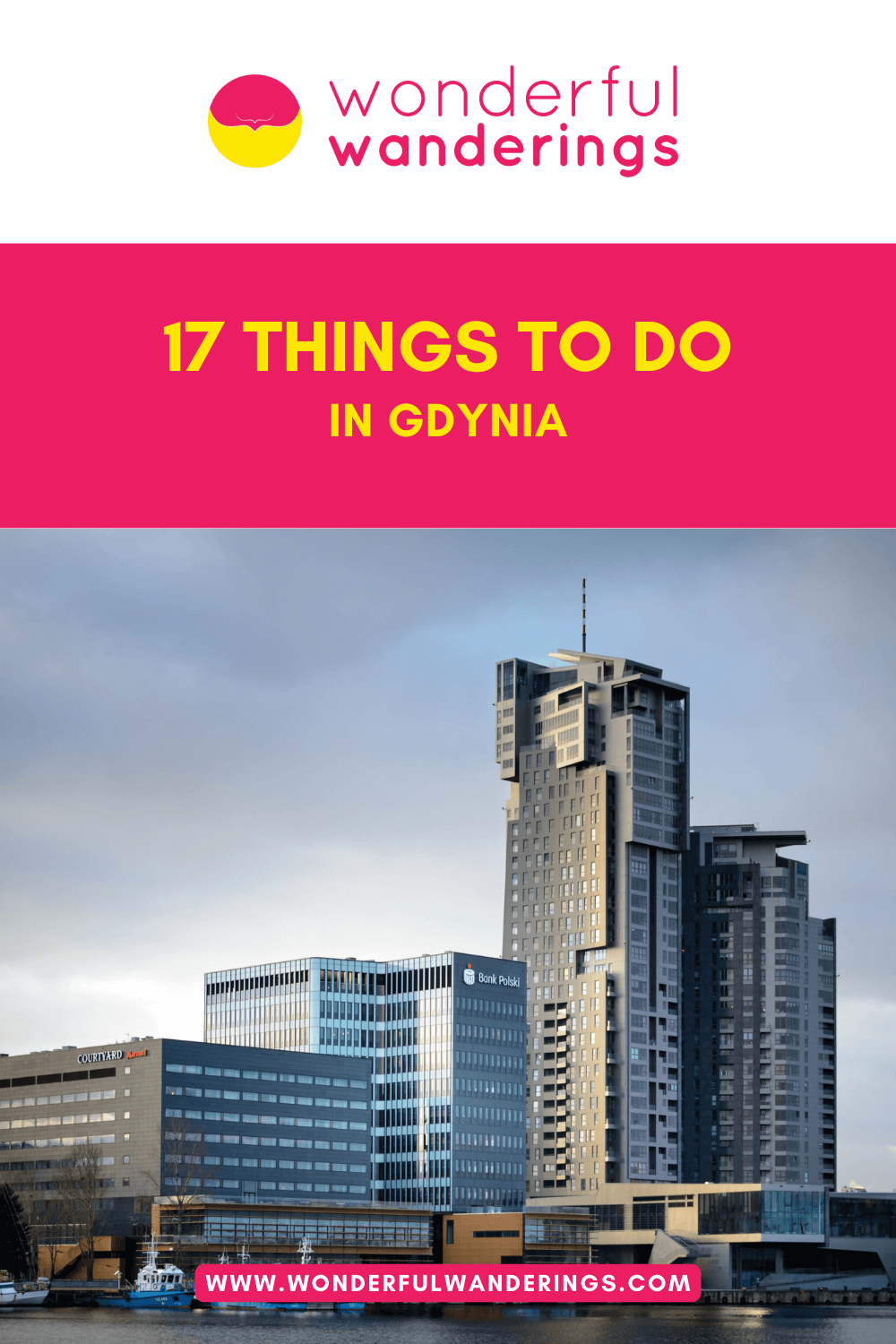
- Courtyard by Marriott Gdynia Waterfront. Courtyard by Marriott Gdynia Waterfront stands on the boulevard a few hundred metres from the sand, with sea-facing rooms and the museums a ten-minute walk away. Rates and dates are at Courtyard by Marriott Gdynia Waterfront.
- Hotel Nadmorski. Hotel Nadmorski at ul. Ejsmonda 2 sits on the Nadmorski Boulevard on the Wzgórze Św. Maksymiliana slope, a four-star with a spa and around 90 rooms, many of them looking at the bay. Availability is at Hotel Nadmorski.
- Everything else in the Tricity. Gdynia rates sit below Sopot’s in summer and below Gdańsk’s during festivals, which is the argument for basing yourself here. Compare rates across hotels in Poland.

Where to eat in Gdynia
Eat fish in Gdynia, because it is a Baltic port and this is the one Polish city on this site where the sea genuinely shapes the menu. Smoked and fried Baltic herring, cod, salmon and flounder turn up everywhere, and Kashubian herring with egg, potato and onion, śledzie po kaszubsku, is a regional dish rather than an invented one, because Gdynia sits in historic Kashubia.

Five Gdynia restaurants confirmed open in September 2026 are listed below.
- Tawerna Orłowska. Tawerna Orłowska at ul. Orłowska 3 sits by the Orłowo pier under the cliff and is the fish restaurant with the view, with a large terrace for the summer.
- Sztuczka. Sztuczka at ul. Abrahama 40 is the modern-European kitchen locals name first, working a seasonal tasting menu in a small, plain room in the centre.
- Tłusta Kaczka. Tłusta Kaczka at ul. Spółdzielcza 2 does Polish cooking at the ambitious end, and duck is the point of it, as the name says.
- Hashi Sushi. Hashi Sushi at ul. Przebendowskich 38 in Orłowo is the sushi address in Gdynia, on two floors with an elliptical bar upstairs.
- Czerwony Piec. Czerwony Piec at ul. Starowiejska 40c bakes wood-fired pizza a short walk from the station and is the cheap, reliable dinner.

Polish staples are everywhere too, and none of them is specific to Gdynia: pierogi, żurek, rosół, bigos, grilled kielbasa and a late-night zapiekanka. Gingerbread, which some Gdynia lists claim as local, belongs to Toruń. More on all of them in our guide to the food to eat in Poland.
What Gdynia costs
Gdynia is inexpensive by Western European standards, and every price is in złoty. Museum admissions run from free at the funicular and the modernist streets to 48 zł at the aquarium in high season, a restaurant main sits around 50 to 80 zł (about €12 to €19, $13 to $21, £10 to £16), and the SKM train across the Tricity costs a few złoty. Cards and contactless work everywhere, including ticket machines.

Two ways to cut the bill are worth knowing. Tuesday clears the Museum of the City of Gdynia, and the Pomeranian Tourist Card is honoured at the Emigration Museum, the Naval Museum, ORP Błyskawica and Experyment, so it is worth pricing if you are covering the whole Tricity. For a wider picture, see our guide to prices in Poland.
Day trips from Gdynia
Take the SKM south for Sopot and Gdańsk, and the train or ferry north for the Hel peninsula. Sopot is 10 km (6.2 mi) away and has the longest wooden pier in Europe; Gdańsk is 20 km (12.4 mi) and has the Main Town, the European Solidarity Centre and the Museum of the Second World War. Hel, the long sandspit closing the Bay of Puck, is reachable by train from Gdynia in summer and by seasonal passenger ferry from the Southern Pier, which is the better way to arrive.

Gdynia FAQ
Is Gdynia worth visiting?
Yes, Gdynia is worth a day, and the UNESCO inscription of July 2026 strengthens the case. The modernist centre, the Emigration Museum and the ships on Kościuszki Square are a coherent half-day each, and the city is quieter and cheaper than Gdańsk or Sopot. What Gdynia does not have is a historic old town, so a visitor expecting cobbles and gabled houses should plan on Gdańsk for that and treat Gdynia as the twentieth-century half of the trip.
Is Gdynia safe to visit?
Yes, Gdynia is safe for visitors. Violent crime is low, the waterfront and the centre stay busy in the evening, and the commuter railway is well used late. Ordinary caution applies around the station and on crowded summer trains.
What is Gdynia famous for?
Gdynia is famous for being built on purpose. Poland had almost no coastline of its own after 1918, chose a fishing village, and built its main seaport and a modern city there between 1921 and 1939, which is why the centre is uniformly modernist and why UNESCO listed it in 2026. Gdynia is also Poland’s second seaport, the home of the Open’er Festival and the host city of the Polish Film Festival, and its shipyard workers were shot during the protests of December 1970.
Who are the most famous people from Gdynia?
Gdynia is a young city and its famous names mostly arrived rather than were born there, which is worth saying because several lists get this wrong. Donald Tusk, whom some Gdynia pages claim, was born in Gdańsk in 1957. Gdynia’s own claims are more recent and less international: the city’s cultural profile rests on the Polish Film Festival and Open’er rather than on a roll of native sons. For genuine Polish names and where they came from, see our guide to notable people from Poland.
Is Gdynia good for children?
Yes, Gdynia suits children well. The aquarium, Experyment, two museum ships they can climb around and a city beach in the middle of town are four separate half-days, and the free funicular is a ride in its own right. Note that the ships close from November to March and Experyment closes on Mondays, so a wet winter Monday is the one combination to avoid.
What festivals happen in Gdynia?
Gdynia’s two fixed dates are the Open’er Festival at the Gdynia-Kosakowo airfield at the turn of June and July, which is Poland’s largest music festival, and the Polish Film Festival in September, where the Golden Lions are awarded. Gdynia Design Days runs for about a week in summer, and the Ladies Jazz Festival takes place in July. Line-ups and dates change every year, so check our list of festivals in Poland before building a trip around one.
WonderfulWanderings Pro Tips
Five details will change how you plan a 2026 visit to Gdynia, each checked against the venue’s own site in September 2026.

- Do not come for ORP Błyskawica between November and March. The destroyer and the submarine ORP Sokół are both closed to visitors from 1 November to 31 March and reopen on 1 April. Since 4 August 2026 only Błyskawica’s deck has been open while the below-deck exhibition is rebuilt, so check the Naval Museum’s page before you buy.
- Ride the Kamienna Góra funicular, because it is free. It runs all year from 10:00 and climbs 96 metres of track in under two minutes. Several guides still list a 4 zł fare; there is none.
- Take the Museum of the City of Gdynia on a Tuesday. Entry is free that day, and the museum sits next door to the Naval Museum, which is not free on any day, so a Tuesday pairs one free ticket with one paid one.
- Buy an aquarium ticket after 18:00 in July or August. The happy-hour rate is 29 zł instead of 48 zł, and the aquarium stays open until 21:00 in those two months, which is also when the tanks are quietest.
- Avoid Monday altogether for indoor Gdynia. The Emigration Museum, the Museum of the City of Gdynia and Experyment all close on Mondays. Experyment also shuts for annual maintenance at the start of September, reopening on 13 September in 2026.
About the author. This guide is written and maintained by the Wonderful Wanderings editorial team. Wonderful Wanderings was founded in 2012 by Sofie Couwenbergh, and the team covers Poland for independent travellers, including the museums and museum ships worth a ticket, the hotels worth booking across the Tricity, and the free days and seasonal closures worth planning around. We check every price, address, closing day and free day on this page against the venue’s own website, and update it when they change.