 EN
EN
 Nederlands
 Français
Ten castles and fortresses in Croatia are open to visitors in 2026, and entry runs from €3 (about $4, £3) at Dubovac in Karlovac to €12 (about $14, £10) at Klis Fortress above Split. Half of them close on Mondays, two of the most familiar names are shut for building work, and the cluster in Hrvatsko zagorje north of Zagreb is hard to reach without a car. This guide gives each castle’s 2026 ticket price, its opening hours, the day it closes and how to get there, so you can build a day around the ones that will actually be open.
Castles in Croatia at a glance: 2026 prices and closed days
The ten castles below are listed with their 2026 adult ticket price and the day each one closes. Prices are the published adult rate for the castle museum; children, students and pensioners pay less almost everywhere, and five of the ten sell a family ticket.
| Castle | Where | Adult ticket | Closed |
|---|---|---|---|
| Trakošćan | Hrvatsko zagorje, near Lepoglava | €10 | Christmas and Easter only |
| Veliki Tabor | Desinić, Hrvatsko zagorje | €7 | Mondays |
| Klis Fortress | Klis, above Split | €12 | Open daily |
| Čakovec (Stari grad Zrinskih) | Čakovec, Međimurje | €6, or €10 for both displays | Public holidays |
| Medvedgrad | Medvednica, above Zagreb | €10 weekends, €8 weekdays | Mondays |
| Dubovac | Karlovac | €3 | Mondays and public holidays |
| Ozalj | Ozalj, on the Kupa | €6 | Open daily |
| Pazin Castle | Pazin, central Istria | €6 | Mondays in summer |
| Morosini-Grimani | Svetvinčenat, Istria | Sold online and at the gate | Winter, except group bookings |
| Brod Fortress | Slavonski Brod | Grounds free | Grounds open daily |
1. Trakošćan Castle
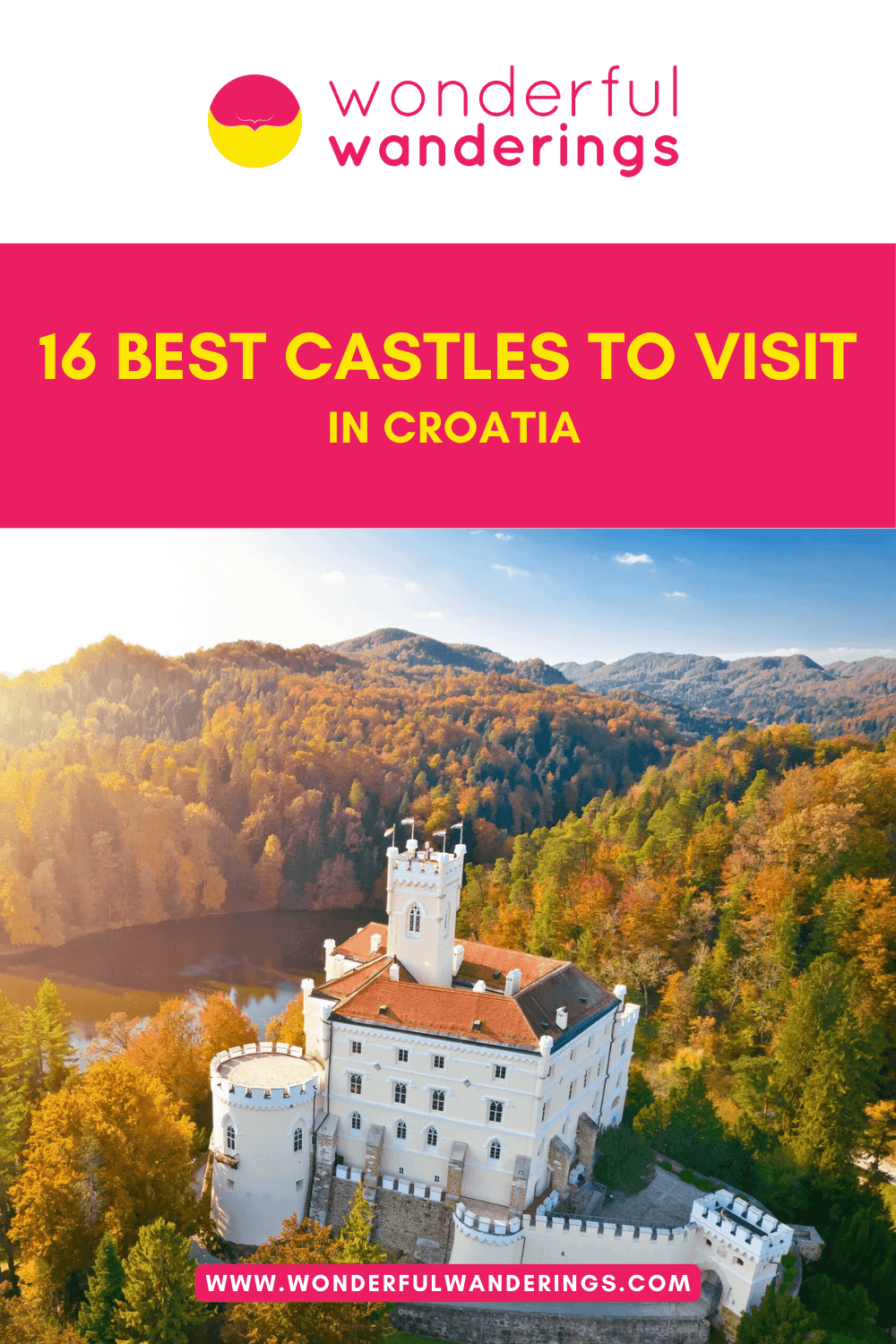
Trakošćan Castle charges €10 (about $12, £9) for adults and opens every day of the year except Christmas and Easter, which makes it the easiest Croatian castle to fit into a fixed itinerary. Trakošćan sits on a wooded hill above an artificial lake about 80 km (49.7 mi) north of Zagreb, and the ticket covers both the castle museum and the park around the water.

Entry is cheaper for four groups. Visitors under 26 and over 65 pay €7 (about $8, £6) with proof, students pay €5 (about $6, £4), and children under 7 go free with a parent. A family ticket for the museum and park costs €25 (about $29, £22). The park-only ticket is €5 if you want the lake and the grounds without the interiors.
Hours change twice a year. From 1 April to 31 October the museum is open 09:00 to 18:00 with last entry at 17:30, and from 1 November to 31 March it closes at 16:00 with last entry at 15:30. Audio guides in Croatian and English are free at reception. A live guided tour in English is priced per group at €40 for up to 50 people and has to be booked in advance, so it is worth it for a family or a coach party and not for a couple.
The castle keeps the Drašković family’s rooms, weapons and portraits. The family held Trakošćan for more than three centuries, rebuilt it in a romantic neo-Gothic style in the 19th century and dug the lake at its foot, then left for Austria in 1944.
2. Veliki Tabor Castle
Veliki Tabor Castle costs €7 (about $8, £6) for adults and closes on Mondays, so a Monday trip through Hrvatsko zagorje will find the gate shut. Veliki Tabor stands on a hilltop near the village of Desinić, about 57 km (35.4 mi) from Zagreb and close enough to the border to see into Slovenia on a clear day.

Children, students and pensioners pay €5, and a family ticket for parents with children under 18 is €15 (about $18, £13). Hours split by day of the week: Tuesday to Friday 09:00 to 17:00, Saturday and Sunday 10:00 to 18:00, with last entry half an hour before closing. The museum also opens 10:00 to 18:00 on most public holidays, but it shuts completely on All Saints’ Day, Christmas Eve, Christmas Day, St Stephen’s Day, New Year’s Eve, New Year’s Day and Easter Sunday.
What survives is the pentagonal defensive core built in the mid-15th century, wrapped in the Renaissance ranges the Ráttkay family added after they took the estate in the early 16th century. The painter Oton Iveković bought the ruin in the 1920s; restoration ran through the 1990s and 2000s.
3. Klis Fortress
Klis Fortress charges €12 (about $14, £10) for adults and €4 (about $5, £3) for children up to 15, and it is open every day from 08:30 to 20:30. Klis sits on the ridge 12 km (7.5 mi) northeast of Split, guarding the pass between Mosor and Kozjak, and the ticket also covers the interpretation centre on Mejdan square in the village below.

Klis is reachable by public bus, which is unusual for a Croatian castle. Promet Split line 22 runs from the HNK stop in central Split up to Klis Megdan, directly under the fortress, and the ride takes about 30 minutes. Buses are roughly every 90 minutes on weekdays, so check the return time before you climb.
Game of Thrones fans arrive expecting Meereen. What is there is the real fortress: Klis played Meereen’s exteriors in seasons 4 and 5, but the city was built in post-production, the walls were extended digitally in every direction, and no sets or props were left behind. The terraces, the gates and the long ramp you recognise are the fortress’s own, mostly from the Venetian rebuilding after 1648, on foundations that run back through Ottoman, Croatian and Roman occupation to the Illyrian Dalmatae.
4. Čakovec Castle (Stari grad Zrinskih)
Čakovec Castle costs €6 (about $7, £5) for one permanent display or €10 (about $12, £9) for the combined ticket covering the palace and the fortification. Čakovec Castle stands in a park in the middle of the town, about 90 km (55.9 mi) north of Zagreb, and it houses the Museum of Međimurje.

Opening hours are longer than most Croatian museums manage: Monday 10:00 to 18:00, Tuesday to Friday 08:00 to 18:00, Saturday and Sunday 10:00 to 16:00. The museum closes on public holidays. Students, pensioners and visitors with disabilities pay €4 for one display or €6 for the combined ticket, preschool children go free, and a family ticket is €15. A guided tour in English costs €30 for the group and needs 48 hours’ notice.
Nikola Šubić Zrinski was given Čakovec and the Međimurje estate in 1546 and turned the fortress into a Renaissance residence. The star-shaped earthworks around it came later. Two displays run inside: the regional collection and Riznica Međimurja, which covers the county’s intangible heritage.
5. Medvedgrad
Medvedgrad charges €10 (about $12, £9) for adults at the weekend and €8 (about $9, £7) from Tuesday to Friday, which is the clearest reason to visit this one on a weekday. Medvedgrad sits on the Mali Plazur spur of Medvednica above Zagreb, more than 500 m (1,640 ft) up, and the visitor centre is open Tuesday to Sunday 09:00 to 16:00 with last entry at 15:00.

Children aged 7 to 18 pay €6 at the weekend and €5 on weekdays. Students, pensioners and hikers pay €7 and €6. A family ticket for two adults and up to three children is €23 at the weekend and €18 on weekdays. Guided tours run at 11:00 and 14:00.
Getting up there is part of the day. From Zagreb, take bus 102 from Mihaljevac to the church at Šestine and follow hiking trail 12 from Lagvić, which takes about an hour on foot. The alternative is bus 128 from Črnomerec to Lukšići, then about an hour on the paved road via Himper. Drivers should know the access roads are one-way: up via Lukšići and Himper, back down past Kraljičin zdenac to Šestine.
Bishop Philip of Zagreb built Medvedgrad between 1249 and 1254, after the Tatars burned the city in 1242. An earthquake in 1590 finished it as a residence. The reconstructed octagonal chapel, the tower and the great palace are what you walk through now.
6. Dubovac Castle, Karlovac
Dubovac Castle is the cheapest castle ticket in this guide at €3 (about $4, £3) for adults, with children, students and pensioners at €2 and a family ticket at €5. Dubovac sits on a hill over Karlovac, about 55 km (34.2 mi) southwest of Zagreb, and the Branič tower holds a permanent display from the Karlovac town museum.

It opens Tuesday to Sunday and closes on Mondays and public holidays. From 1 June to 30 September the hours are 10:00 to 20:00, and from 1 October to 31 May they are 10:00 to 18:00, with last entry 30 minutes before closing. Holders of the Karlovac cultural card pay €1.
The layout you see is largely the 15th-century Renaissance work done under Bernardin Frankopan, strengthened again in the 16th century against the Ottoman advance. Count Laval Nugent gave it a romantic makeover in the 19th century; the 1950s restoration pulled it back towards the Renaissance version. Knight tournaments, concerts and open-air film nights run in the courtyard through the summer.
7. Ozalj Castle
Ozalj Castle charges €6 (about $7, £5) for adults and €4 (about $5, £3) for children, students and pensioners, and it opens every day. Ozalj stands on a rock over the Kupa about 66 km (41.0 mi) southwest of Zagreb, and it holds the Ozalj local history museum.

Hours run long in summer: weekdays 08:00 to 20:00, weekends and holidays 10:00 to 20:00. In winter they shorten to weekdays 08:00 to 16:00 and weekends and holidays 10:00 to 16:00. Groups of ten or more can arrange a visit outside those hours with notice.
Ozalj was the Zrinski family’s seat and its story ends badly. Petar Zrinski, who held the castle, was executed in Wiener Neustadt in 1671 with his brother-in-law Fran Krsto Frankopan after the failed conspiracy against Vienna, and the family’s Croatian estates were confiscated. The Baroque ranges around the courtyard date mostly from the 18th century.
8. Pazin Castle
Pazin Castle costs €6 (about $7, £5) for adults and €3 (about $4, £3) for pupils, students and pensioners, and it holds two museums at once: the Ethnographic Museum of Istria and the Pazin Town Museum. Pazin Castle is built straight onto the karst above the Pazinčica gorge, about 30 km (18.6 mi) from Rovinj and from Pula.

Hours change on fixed dates. From 15 April to 15 October it opens Tuesday to Sunday 10:00 to 18:00 and closes on Mondays. From 16 October to 14 April the pattern is Tuesday to Thursday 10:00 to 15:00, Friday 11:00 to 16:00, Saturday and Sunday 10:00 to 16:00. Groups of more than ten pay €2.50 each; children under 7 and visitors with disabilities enter free. A guided tour in English costs €25 for up to 25 people and has to be booked at least five days ahead.
The first record of the castle is a document of 983 in which Emperor Otto II granted “Castrum Pisinum” to the bishops of Poreč. Most of what stands is the Renaissance rebuilding of the 15th and 16th centuries, when the Counts of Pazin governed central Istria for the Habsburgs.
9. Morosini-Grimani Castle, Svetvinčenat
Morosini-Grimani Castle sells tickets online and at the gate, but its opening calendar is the thing to check first, because the castle is effectively shut to individual visitors for four months of the year. Morosini-Grimani stands on the main square of Svetvinčenat in central Istria, about 25 km (15.5 mi) from Pula.

The 2026 pattern runs like this. January, February and December are group bookings and venue hire only. March and April open at weekends, 10:00 to 16:00. May opens at weekends, 09:00 to 17:00. June to September open Tuesday to Sunday, 09:00 to 17:00, with Mondays closed and some late Friday openings in July and August. October drops to Wednesday to Saturday, 10:00 to 16:00, and November to Thursday to Saturday, 10:00 to 16:00. Festival weekends close it outright, including the medieval festival at the turn of July and August.
The quadrangular castle around the square is Venetian: the Morosini family rebuilt the older de Castro Pola fortification in the 15th century, and Marino Grimani restored it in Renaissance form after a fire. Their coat of arms is still over the gate.
10. Brod Fortress, Slavonski Brod
Brod Fortress is free to walk, which makes it the cheapest half-day on this list. Brod Fortress sits on the Sava in Slavonski Brod, star-shaped and Habsburg-built, about 200 km (124.3 mi) east of Zagreb, facing Bosnia and Herzegovina across the river.

Work began in 1715 to plans associated with Prince Eugene of Savoy and finished around 1780, and the complex covers roughly 33 hectares, making it one of the largest fortifications in Croatia. The grounds, the bastions and the parade ground are open; individual buildings inside have their own hours and tickets, including the education and multimedia centre with its planetarium, the Ružić gallery and a tamburica museum.
Two Croatian castles that are closed right now
Two castles that appear on almost every Croatian castle list cannot be visited in 2026, and both closures have been confirmed by the museums that run them.
- Varaždin’s Stari grad is closed to visitors during energy-efficiency works on the building, with no reopening date published. The Varaždin town museum’s other departments stay open: Palača Sermage holds the art gallery and Palača Herzer the natural history collection, Tuesday to Friday 09:00 to 17:00, with weekend hours, closed Mondays and public holidays. An adult ticket for a department is €5 (about $6, £4).
- Oršić Castle in Gornja Stubica is closed until spring 2027. The Museum of Peasant Revolts inside it shut on 1 March 2024 for a full renovation and a new permanent display. Older guides still describe touring the rooms above the Stubica valley; that is not possible at the moment.
Swap in Trakošćan for Varaždin, and Veliki Tabor or the Krapina Neanderthal Museum for Gornja Stubica, if you are working from an older itinerary built around either closed castle. The Neanderthal museum is 20 km (12.4 mi) from Veliki Tabor, costs €10 (about $12, £9) for adults and €5 for children, and opens Tuesday to Friday 09:00 to 17:00 and weekends 10:00 to 18:00 from 1 April to 31 October.
How to reach Croatian castles without a car
Take a city bus to two of them and accept that the other eight need a car. Klis Fortress is served by Promet Split line 22 to Klis Megdan, and Medvedgrad is an hour on foot from the end of Zagreb city bus routes 102 and 128.
Everything in the northern cluster sits in villages with a handful of buses a day. Trakošćan, Veliki Tabor, Ozalj and Čakovec are realistic day trips by road from Zagreb and awkward by any other means. A car is the only practical way to link three or four of them in one day, and rates at the Zagreb and Zagreb Airport pick-up points are worth comparing across suppliers on DiscoverCars before you fly.
Rail helps with the cities rather than the castles themselves. Zagreb to Varaždin and Zagreb to Čakovec both run on the northern line, Split is the coastal terminus for Klis, and cross-border trains and buses from Ljubljana, Budapest and Vienna come up in one search on Omio.
Which castles can you combine in one day?
Three combinations work in a single day, and the rest are too far apart to attempt. The Zagorje pair, the Karlovac pair and the Istrian pair each sit within an hour of each other.
- Trakošćan and Veliki Tabor. The two are about 40 km (24.9 mi) apart across Hrvatsko zagorje. Do Veliki Tabor first because it closes at 17:00 on weekdays, then Trakošćan, which stays open until 18:00 in summer. Avoid Mondays: Veliki Tabor is shut.
- Dubovac and Ozalj. Karlovac and Ozalj are about 15 km (9.3 mi) apart on the Kupa, and the two tickets together cost €9 (about $10, £8). Ozalj opens daily, Dubovac does not open on Mondays.
- Pazin and Svetvinčenat. The two Istrian castles are about 35 km (21.7 mi) apart through the inland hills. Both close on Mondays in summer, and Svetvinčenat is weekends-only in spring, so treat this pair as a June-to-September combination.
The Zagorje route rewards a stop for two things besides the castles. Roadside klets serve the local foods worth eating in Croatia, and several of the festivals in Croatia run their summer programme in castle courtyards. Where each of these castles sits in the wider country is mapped out in the guide to places to visit in Croatia.
Frequently asked questions about castles in Croatia
Which is the most visited castle in Croatia?
Trakošćan is the most visited castle museum in Croatia and the one built for visitors. It opens every day of the year bar Christmas and Easter, it has the widest range of concession tickets, and its free audio guide comes in Croatian and English. Klis Fortress draws large numbers too, but a share of those are day-trippers from Split coming for the view and the Game of Thrones connection rather than the museum.
Are Croatian castles free to enter?
The grounds of six are free, the interiors almost never are. Brod Fortress’s grounds are open at no charge, and at Trakošćan, Veliki Tabor, Dubovac, Ozalj and Pazin you can walk the surrounding paths and courtyards without a ticket. Going inside costs from €3 at Dubovac to €12 at Klis.
Do Croatian castles close in winter?
Most stay open with shorter hours, and one closes almost completely. Trakošćan drops to a 16:00 closing from 1 November, Ozalj and Dubovac both shorten their afternoons, and Pazin switches to a winter timetable on 16 October. Morosini-Grimani in Svetvinčenat is the exception: from December to February it takes group bookings only, and individual visits restart in March.
Is Klis Fortress worth visiting if you have not watched Game of Thrones?
Yes, and the fortress stands on its own without the show. The pass it guards was fought over for two thousand years, the museum inside holds the weapons and documents from that, and the view runs from Split’s harbour and the islands to the Mosor range behind. The series used the exterior for Meereen and left nothing physical behind, so there is no set to look for.
Can you stay overnight in a Croatian castle?
A few castles in Hrvatsko zagorje have been converted into hotels and event venues rather than museums, so they are places to book rather than places to tour. That is a different kind of visit from the ten above, and the rooms, rates and availability change from season to season, so check the property directly before planning a night around it.
WonderfulWanderings Pro Tips
Five details from checking each castle’s own 2026 timetable are worth knowing before you set off.
- Visit Medvedgrad on a weekday and pay €2 less. The adult ticket is €8 from Tuesday to Friday against €10 at the weekend, and the family ticket drops from €23 to €18. The guided tours at 11:00 and 14:00 run either way.
- Skip the live guide at Trakošćan unless you are a group. The English-language tour is priced at €40 for up to 50 people, not per person, while the audio guide in English is free at reception. Two people are better off with the audio guide.
- Do not build a Varaždin day around the Stari grad. The castle is closed for energy-efficiency works with no reopening date. Palača Sermage and Palača Herzer are open and cost €5 each.
- Check the month before driving to Svetvinčenat. Morosini-Grimani is weekends-only in March, April and May, group bookings only from December to February, and closed outright over the medieval festival at the turn of July and August.
- Take bus 22 to Klis rather than a taxi. Promet Split’s line 22 runs from the HNK stop to Klis Megdan, right under the fortress walls, in about half an hour. Departures thin out to roughly every 90 minutes on weekdays, so note the return time on the way up.
About the author. This guide is written and maintained by the Wonderful Wanderings editorial team. Wonderful Wanderings was founded in 2012 by Sofie Couwenbergh, and the team covers Croatia for independent travellers, from the castle museums of Hrvatsko zagorje and the Venetian fortresses of Istria and Dalmatia to the tours, car hire and rail links that get you to them. We check each castle’s own 2026 prices, opening hours and closed days, and update this page when they change.