 EN
EN
 Nederlands
 Français
The most famous Croatians are Nikola Tesla, Ruđer Bošković, Ivan Meštrović, Goran Ivanišević and Luka Modrić, and the list runs long because Dalmatia and Zagreb kept exporting talent to Venice, Vienna, Paris and, later, to American laboratories. Croatia has produced 2 Nobel laureates in chemistry, a Wimbledon champion who entered on a wild card, a Ballon d’Or winner and the man who gave his name to the boundary between the Earth’s crust and mantle.
This guide covers 39 of them, grouped by field, with the dates, birthplaces and single achievements that make each one worth knowing. Every name has been checked for nationality and birthplace, because “famous Croatian” lists elsewhere are full of people who were neither.
Most famous Croatian scientists and inventors
Croatian scientists gave the world alternating current, the tungsten light bulb, the mechanical pencil and the seismic boundary called the Moho. Croatian science is also unusually concentrated: Zagreb, Dubrovnik and the Dalmatian coastal towns account for most of the names below. The 13 who matter most are listed below.

1. Nikola Tesla
Nikola Tesla built the alternating-current systems that carry electricity to almost every building on Earth. Tesla was born on 10 July 1856 in Smiljan, then in the Austrian Empire and now in Croatia, to a Serbian family, which is why both Croatia and Serbia claim him. He emigrated to the United States in 1884, held roughly 300 patents worldwide, and his polyphase AC motor and transmission patents settled the argument with Edison’s direct current. The Niagara Falls hydroelectric plant, which began delivering power to Buffalo in 1896, was the first large installation to prove it worked over distance. He died on 7 January 1943 in New York.

2. Ruđer Bošković
Ruđer Bošković proposed that matter is made of point-like centres of force rather than solid particles, roughly a century and a half before atomic physics caught up. Bošković was born on 18 May 1711 in Dubrovnik, then the Republic of Ragusa, joined the Jesuits and taught mathematics and astronomy in Rome, Milan, Paris and Vienna. His 1758 “Theoria Philosophiae Naturalis” set out a single law of forces that Faraday and Kelvin both read. He also worked on optics, geodesy and the measurement of the meridian, and he died on 13 February 1787 in Milan.

3. Andrija Mohorovičić
Andrija Mohorovičić found the boundary between the Earth’s crust and its mantle, which every geologist now calls the Moho. Mohorovičić was born on 23 January 1857 in Volosko near Opatija and ran the Zagreb meteorological observatory when an earthquake struck the Kupa valley south of the city in October 1909. Two sets of seismic waves arriving at different speeds told him there was a sharp change in rock density tens of kilometres down, which he put at about 54 km (33.6 mi) from his readings. That boundary is the Mohorovičić discontinuity, and he died on 18 December 1936 in Zagreb.
4. Stjepan Mohorovičić
Stjepan Mohorovičić predicted positronium, an atom made of an electron and a positron, 17 years before anyone found one. Mohorovičić was born on 20 August 1890 in Bakar, studied physics in Zagreb and Göttingen and worked much of his life as a schoolteacher in the shadow of his father Andrija. His prediction appeared in a 1934 paper in Astronomische Nachrichten, and Martin Deutsch confirmed the particle experimentally at MIT in 1951. He died on 13 February 1980.

5. Leopold Ružička
Leopold Ružička won the 1939 Nobel Prize in Chemistry for work on polymethylenes and higher terpenes, sharing it with Adolf Butenandt. Ružička, whose name is also written Lavoslav in Croatian, was born on 13 September 1887 in Vukovar and studied in Karlsruhe before settling in Zurich, where he became a Swiss citizen in 1917 and a professor at ETH. He achieved the first chemical synthesis of the sex hormone androsterone and worked out the structures of muscone and civetone, the musk compounds the perfume industry runs on. He died on 26 September 1976 in Mammern, Switzerland.
6. Vladimir Prelog
Vladimir Prelog shared the 1975 Nobel Prize in Chemistry with John Cornforth for the stereochemistry of organic molecules. Prelog was born on 23 July 1906 in Sarajevo to a Croatian family, grew up and studied in Zagreb, taught there until 1941 and then spent the rest of his career at ETH Zurich. With Robert Cahn and Christopher Ingold he devised the CIP rules, the system every chemistry student still uses to label a molecule’s handedness as R or S. He died on 7 January 1998 in Zurich.

7. Franjo Hanaman
Franjo Hanaman co-invented the tungsten-filament light bulb, the first metal-filament lamp that was cheap enough to sell. Hanaman was born on 30 June 1878 in Drenovci in Croatia-Slavonia, then part of Austria-Hungary, and worked in Vienna with the chemist Alexander Just. Their Hungarian patent was granted on 13 December 1904, a factory in Újpest started production in 1906 and later took the name Tungsram, and Hanaman sold the American rights to General Electric in 1910. He died on 23 January 1941 in Zagreb.

8. Slavoljub Eduard Penkala
Slavoljub Eduard Penkala patented the mechanical pencil in 1906 and a solid-ink fountain pen the following year. Penkala was born on 20 April 1871 in what is now Liptovský Mikuláš in Slovakia, moved to Zagreb as an engineer and took the Croatian first name Slavoljub to mark the change of country. With the businessman Edmund Moster he built a pen and pencil factory in Zagreb that became one of the largest in the world, and the Croatian word for a pen still carries his name. He died on 5 February 1922 in Zagreb.
9. Marin Soljačić
Marin Soljačić demonstrated that electricity can be sent through the air over a few metres, which is the basis of wireless charging. Soljačić was born on 7 February 1974 in Zagreb, took his first degree at MIT in 1996 and his doctorate at Princeton in 2000, and has been a physics professor at MIT since 2005. His group’s 2006 experiment used coupled magnetic resonators to light a bulb about 2 m (6.6 ft) from the power source, and he founded the company WiTricity on the result the following year. He was given a MacArthur Fellowship in 2008.

10. Zvonimir Janko
Zvonimir Janko found four sporadic simple groups, which now carry his name as J1 to J4. Janko was born on 26 July 1932 in Bjelovar and left Yugoslavia for Australia in 1962 after failing to get a university post at home. His discovery of J1 in 1964 was the first new sporadic group in 90 years and it restarted the whole classification of finite simple groups. He later held chairs in Ohio and Heidelberg, and he died on 12 April 2022.

11. Ivo Šlaus
Ivo Šlaus was Croatia’s best-known nuclear physicist and one of the country’s most visible voices in international science policy. Šlaus was born on 26 September 1931 in Zagreb, spent his career at the Ruđer Bošković Institute and held visiting posts at UCLA, Duke, Georgetown and Kyoto. He published more than 400 scientific papers, served as president of the World Academy of Art and Science from 2011 to 2013 and remained its honorary president. He died on 8 August 2026.

12. Ranko Matasović
Ranko Matasović wrote the standard etymological dictionary of Proto-Celtic, which is an unusual thing for a Croatian linguist to be known for. Matasović was born on 14 May 1968 in Zagreb, took his doctorate at the University of Zagreb in 1995 and has taught comparative Indo-European linguistics there since. His “Etymological Dictionary of Proto-Celtic”, published by Brill in 2009, is the reference work for the reconstructed ancestor of Irish, Welsh and Breton. He is a member of the Croatian Academy of Sciences and Arts.

13. Mirko Malez
Mirko Malez ran the excavations at Vindija Cave that produced one of the richest late Neanderthal collections anywhere. Malez was born on 5 November 1924 in Ivanec, studied geology and palaeontology in Zagreb and led the Institute for Quaternary Palaeontology and Geology. His Vindija digs from 1974 to 1986 yielded the fossils that later supplied DNA for the first Neanderthal genome sequence. He is called the father of Croatian speleology, and he died in Zagreb on 23 August 1990.

Most famous Croatian artists
Croatian art is best known abroad for one sculptor, Ivan Meštrović, and for the Dalmatian painters who worked in Venice. Croatian painting turned modern late and fast, between about 1890 and 1913, which is why several of the names below overlap. The 7 best known are listed below.
14. Ivan Meštrović
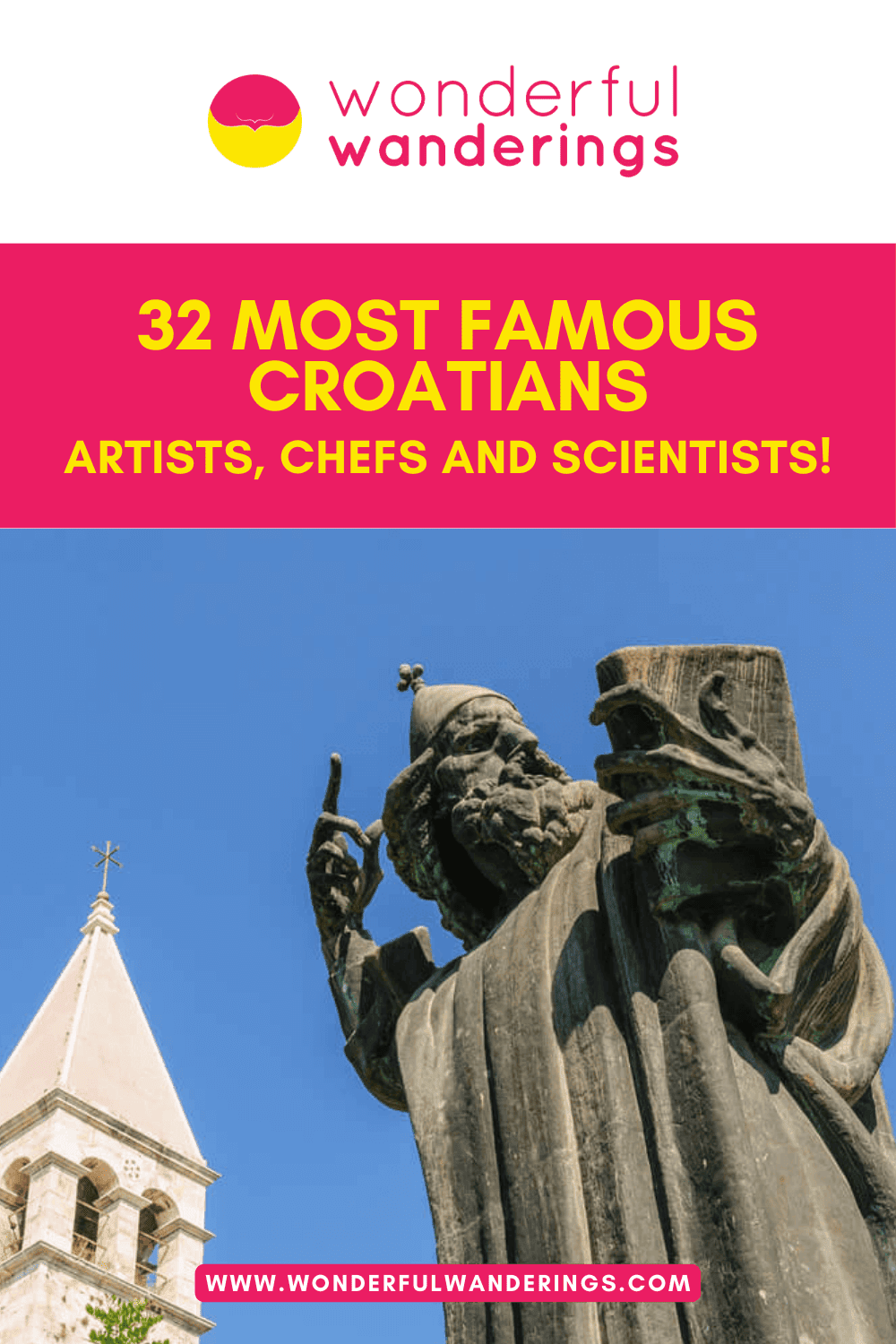
Ivan Meštrović is the only Croatian artist whose work you will meet without looking for it, in Split, Zagreb, Belgrade, Chicago and South Bend. Meštrović was born on 15 August 1883 in Vrpolje in Slavonia to a family from the Dalmatian hinterland, and he trained in Vienna before exhibiting internationally from 1904. His enormous Grgur Ninski in Split, the Račić mausoleum in Cavtat and “The Bowman” and “The Spearman” outside Chicago’s Grant Park are the works to look for. He emigrated to the United States in 1947, taught at Syracuse and Notre Dame, and died in South Bend, Indiana, on 16 January 1962.

15. Vlaho Bukovac
Vlaho Bukovac is treated in Croatia as the founder of modern Croatian painting. Bukovac was born Biagio Faggioni on 4 July 1855 in Cavtat near Dubrovnik to an Italian father and a Croatian mother, and he took the Croatian surname in 1877. He got into Alexandre Cabanel’s overfull class at the École des Beaux-Arts in Paris and was exhibiting at the Salon by 1878; “La Grande Iza” of 1882 made his name. He moved to Prague in 1903 as a professor at the Academy of Fine Arts, introduced pointillism there and died in the city on 23 April 1922.

16. Andrea Schiavone
Andrea Schiavone was one of the most original painters in 16th-century Venice, and Croatia claims him as Andrija Medulić. Schiavone was born around 1510 to 1515 in Zadar, then Venetian Zara, to a family from Meldola in Romagna, and his nickname means “the Slav”. He combined Parmigianino’s elongated Mannerist figures with Venetian colour and loose brushwork, and Tintoretto, Veronese and Bassano all took from him. Ivan Meštrović sculpted the monument to him that stands outside the Art Pavilion in Zagreb. He died in Venice in 1563.

17. Miroslav Kraljević
Miroslav Kraljević did more to bring modernism into Croatian painting in five years than most painters manage in fifty. Kraljević was born on 14 December 1885 in Gospić, studied in Munich and Paris and moved from dark realism to fast, high-colour brushwork after seeing Manet and Cézanne. “Self-portrait with a Dog” of 1910 is his best-known canvas. He died of tuberculosis in Zagreb on 16 April 1913 at 27, leaving about 200 works.

18. Ivan Rendić
Ivan Rendić is the sculptor Croatia calls the father of its modern sculpture, the generation before Meštrović. Rendić was born on 27 August 1849 in Imotski and was taken to Supetar on the island of Brač at three months old, which is the town he considered home and where a gallery of his work now sits. He trained in Venice and Florence and produced the monuments to Ivan Gundulić in Dubrovnik and Petar Preradović in Zagreb, along with the striking bell tower at Ložišća on Brač. He died in Supetar on 29 June 1932.

19. Julije Knifer
Julije Knifer painted one shape, the meander, for more than 40 years and almost nothing else. Knifer was born on 23 April 1924 in Osijek, studied in Zagreb and co-founded the Gorgona group in 1959, an anti-art collective that predated most of international conceptualism. From about 1960 his work reduced to interlocking black and white right angles, repeated at every scale from a notebook page to a quarry wall. He moved to Paris in 1994 and died there on 7 December 2004.

20. Emanuel Vidović
Emanuel Vidović brought post-Impressionism and Symbolism into Croatian painting and then spent 40 years painting the same Dalmatian interiors. Vidović was born on 17 June 1870 in Split, trained in Venice and worked in Chioggia before returning home. His early industrial and lagoon landscapes gave way to dim church interiors and still lifes of candlesticks and dolls, painted in a narrow, silvery range of colour. He died in Split on 1 June 1953, and the city keeps a museum of his work.

Most famous Croatian writers, singers and musicians
Croatian song abroad means the chanson tradition of Split and Dubrovnik, and at home it means the Split and Zagreb festivals that ran through the Yugoslav decades. Croatian poetry’s founding figures come out of the 19th-century Illyrian movement. The 5 below cover both.
21. Petar Preradović
Petar Preradović wrote the patriotic verse of the Croatian national awakening while serving as a general in the Austrian army. Preradović was born on 19 March 1818 in Grabrovnica near Pitomača, went to military school in Vienna at 12 and had to relearn Croatian as an adult. “Zora puca, bit će dana” (Dawn Breaks, the Day Will Come), published in 1844, is the poem every Croatian schoolchild knows. He rose to major general and died on 18 August 1872 near Vienna; his remains were brought to Zagreb’s Mirogoj cemetery in 1879.

22. Tereza Kesovija
Tereza Kesovija is the biggest Croatian singer to have built a career in France, and she is often called the Croatian Edith Piaf. Kesovija was born on 3 October 1938 in Dubrovnik, trained as a flautist and sang at the Olympia in Paris in the 1960s. She is one of very few performers to have sung at the Eurovision Song Contest for two countries, Monaco in 1966 and Yugoslavia in 1972. She has recorded in Croatian, French, Italian and German and holds the Vladimir Nazor lifetime award.
23. Arsen Dedić
Arsen Dedić wrote the songs that the rest of Yugoslav popular music borrowed from for 40 years. Dedić was born on 28 July 1938 in Šibenik, trained as a flautist at the Zagreb Academy of Music and published poetry alongside his records. He wrote for dozens of other performers and scored more than 40 films, and albums such as “Čovjek kao ja” set the template for the Croatian singer-songwriter. He died in Zagreb on 17 August 2015.
24. Vice Vukov
Vice Vukov was one of the most popular singers in Yugoslavia in the 1960s and then was quietly erased from its airwaves for a decade. Vukov was born on 3 August 1936 in Šibenik, represented Yugoslavia at Eurovision in 1963 and 1965 and sold out halls across the country. After the Croatian Spring was suppressed in 1971 he was branded a nationalist, moved to France and returned in 1976 to find himself barred from performing and his records pulled from the shops. A new album in 1989 brought him back, and he later served as a Croatian senator. He died in Zagreb on 24 September 2008.
25. Severina
Severina has been the most visible pop performer in Croatia for more than 30 years. Severina Vučković was born on 21 April 1972 in Split and had her first hits in the early 1990s, which makes her one of the few Croatian acts whose career spans the whole independent period. She represented Croatia at the Eurovision Song Contest in 2006 with “Moja štikla”, a song built on a Dalmatian folk form that started a national argument about what counted as Croatian music. She still fills arenas across the region.
Most famous Croatian actors and filmmakers
Croatian screen careers have usually meant leaving, either for Belgrade before 1991 or for Hollywood after it. Croatian film’s single biggest name never acted at all: he produced. The 3 below are the ones an English-speaking audience will actually recognise.
26. Branko Lustig
Branko Lustig is the only filmmaker from the former Yugoslavia to have won two Academy Awards. Lustig was born on 10 June 1932 in Osijek, survived Auschwitz and Bergen-Belsen as a child, and lost most of his family in the camps. He produced “Schindler’s List”, which took Best Picture in 1994, and “Gladiator”, which took it in 2001, and he founded the Festival of Tolerance in Zagreb. He died in Zagreb on 14 November 2019.
27. Rade Šerbedžija
Rade Šerbedžija has appeared in more than 100 films and is the Croatian actor most likely to turn up in a Hollywood production. Šerbedžija was born on 27 July 1946 in Bunić in Lika to a Serb family from Croatia, and he built his reputation on the Yugoslav stage before the wars. English-speaking audiences know him from “Before the Rain”, “Eyes Wide Shut”, “Snatch”, “X-Men: First Class” and “Harry Potter and the Deathly Hallows”. He is also a poet and a singer, and he founded the Ulysses Theatre on the island of Brijuni.
28. Mira Furlan
Mira Furlan was a leading actress in Yugoslav cinema who rebuilt her career from scratch in American television. Furlan was born on 7 September 1955 in Zagreb and won the country’s main acting awards for her work in films including “When Father Was Away on Business”. She left Croatia in 1991 after being attacked in the press for refusing to take a side in the war, and became known to a new audience as Delenn in “Babylon 5” and Danielle Rousseau in “Lost”. She died in Los Angeles on 20 January 2021.
Most famous Croatian athletes
Croatia’s sporting record is out of all proportion to a population of under 4 million, with World Cup finals, Wimbledon and four Olympic alpine golds among the returns. Croatian athletes below are ordered by how widely they are recognised outside the country. The 5 are listed below.
29. Luka Modrić
Luka Modrić is the most recognised Croatian alive and the only Croatian to win the Ballon d’Or. Modrić was born on 9 September 1985 in Zadar and spent part of his childhood in a refugee hotel after his family was displaced from the Zadar hinterland. He captained Croatia to the 2018 World Cup final, took the tournament’s Golden Ball, and won the Ballon d’Or that December, breaking a decade of Messi and Ronaldo. He won six Champions League titles with Real Madrid before joining AC Milan in 2025, and he is Croatia’s most-capped player.
30. Goran Ivanišević
Goran Ivanišević is the only man to have won Wimbledon on a wild card. Ivanišević was born on 13 September 1971 in Split, reached world number 2 in 1994 and lost three Wimbledon finals, in 1992, 1994 and 1998, before the 2001 tournament. Ranked 125 and admitted only by invitation, he beat Pat Rafter in a five-set final held over to the Monday, and half of Split turned out on the Riva when he came home. He later coached Novak Djokovic to nine of his major titles.

31. Janica Kostelić
Janica Kostelić is the most successful alpine skier Croatia has produced and the first woman to win 4 Olympic golds in the sport. Kostelić was born on 5 January 1982 in Zagreb and trained on a shoestring with her father Ante coaching and the family living out of a car on the European circuit. At Salt Lake City in 2002 she won the slalom, giant slalom and combined and took silver in the super-G, then added a fourth gold in the combined at Turin in 2006. Injuries ended her career at 25.
32. Dražen Petrović
Dražen Petrović was the player who proved a European guard could lead an NBA team, and he is in the Naismith Hall of Fame. Petrović was born on 22 October 1964 in Šibenik, won two European club titles with Cibona Zagreb and an Olympic silver with Croatia at Barcelona in 1992. He averaged over 20 points a game for the New Jersey Nets in his last full season, which no European had done before. He was killed in a car crash in Germany on 7 June 1993 at 28.
33. Stipe Božić
Stipe Božić was the second European after Reinhold Messner to climb Everest twice, and he filmed both ascents. Božić was born on 2 January 1951 near Split and reached the summit by the west ridge with a Slovenian expedition in 1979 and by the south ridge with a Macedonian one in 1989. He has completed the Seven Summits and directed more than 60 documentaries, most of them about mountains. He is Croatia’s most successful Himalayan climber.
Most famous Croatian chefs
Croatian cooking became internationally visible after the Michelin guide first covered the country in 2017, and there are now 13 starred restaurants, 1 of them with 2 stars. Croatian chefs at that level work almost entirely from the Adriatic catch and from Istrian truffles, oil and wine. The 6 below are the names to know.
34. Stevo Karapandža
Stevo Karapandža was the first television chef in Yugoslavia and is still the most recognised cook in the region. Karapandža was born on 27 May 1947 near Karlovac and hosted “Male tajne velikih majstora kuhinje” (Little Secrets of the Great Masters of Cooking) on TV Zagreb from 1974 to 1991, demonstrating over a thousand recipes. He left Croatia during the war after threats and worked abroad before returning to open a restaurant in Lovran on the Kvarner coast. He did for Balkan home cooking what Delia Smith did for British.

35. Mate Janković
Mate Janković is the chef most responsible for putting Croatian food in front of a foreign audience. Janković was born in 1975 and judged the first two series of MasterChef Hrvatska alongside Tomislav Gretić and Radovan Marčić. He guided Anthony Bourdain around Croatia for the “No Reservations” episode filmed there, which remains the single most-watched piece of television about Croatian food. He works as a consultant, writer and private chef, and he co-created the Papak beer with the Varionica brewery.

36. Deni Srdoč
Deni Srdoč became the youngest Croatian chef to win a Michelin star, at 27. Srdoč was born in 1989 and grew up on the island of Krk, trained in Split and took over the kitchen at Nebo, the restaurant of the Hilton Rijeka Costabella. Nebo has held its star every year since the Michelin guide’s Croatian selection began, and Gault&Millau named him the country’s best young chef in 2018. His cooking is Adriatic seafood worked through French and Italian technique.

37. David Skoko
David Skoko turned his parents’ fishermen’s tavern into the restaurant every visiting chef wants to eat at. Skoko was born on 10 January 1976 in Pula and cooks at Konoba Batelina in Banjole, south of the city, where his father still lands the fish. Michelin gives it a Bib Gourmand rather than a star, which is exactly the point: the menu changes with the catch, the prices stay reasonable and the by-catch nobody else uses is the star of it. He has written cookbooks and presented television about Istrian food.

38. Marina Gaši
Marina Gaši is a self-taught chef running one of the most talked-about kitchens on the Istrian coast. Gaši took over her family’s restaurant in Novigrad when it reopened in 2011 and learned to cook in it, and Restaurant Marina now serves only two tasting menus, of four and eight courses. Gault&Millau Croatia has given her its Grand Chef award and the Michelin guide lists the restaurant. There is no fixed menu because the fish decides.

39. Ana Grgić Tomić
Ana Grgić Tomić was the first woman to run the kitchen at Zagreb’s Esplanade, the city’s grand hotel, which she took over in 2012. Grgić Tomić trained under Yves Mattagne at Sea Grill in Brussels and Christian Lohse at Fischers Fritz in Berlin before returning to Croatia. Gault&Millau Croatia named her chef of the year in 2022. She cooks Mediterranean food inland, which is a harder trick in Zagreb than it sounds.

Where to see their traces in Croatia
Four places hold most of what is left to visit: Split and Cavtat for Meštrović, Zagreb for Tesla and Penkala, Zadar for Modrić and Schiavone, and Smiljan for Tesla’s birthplace. The Meštrović Gallery in Split occupies the villa he built for himself, and the Račić mausoleum he carved sits above Cavtat harbour, 45 minutes by boat from Dubrovnik. The Nikola Tesla Memorial Centre stands on his birthplace at Smiljan, near Gospić, and the Technical Museum in Zagreb runs a Tesla demonstration room. If you are planning a route around them, compare hotels in Split, Zagreb and Dubrovnik on Booking.com before fixing your dates, because Dalmatian coastal prices roughly double in July and August.
Guided day trips handle the awkward legs better than public transport does, particularly Cavtat from Dubrovnik and the Plitvice or Lika run that passes Smiljan.
Rijeka, Novigrad and Banjole are the three towns to build a food trip around, and all three are a long way from the Dubrovnik crowds; the choice of places to stay in Istria and Kvarner is much wider and cheaper than in the south.
More about Croatia
Croatia repays a two-week trip more than a long weekend, and the practical questions come up in the same order every time. Our guide to fun facts about Croatia covers the islands, the national parks and the Game of Thrones locations. The guide to costs and prices in Croatia covers what a day actually costs in euro, which has been the currency since 2023. Our list of popular holiday dates in Croatia matters more than it sounds, because Statehood Day and the August holidays close things. The full list of top places to visit in Croatia starts with Dubrovnik, Split, Zagreb and Istria.
WonderfulWanderings Pro Tips
The 4 tips below come from checking all 39 names on this page one at a time, which turned up several biographies in circulation elsewhere that belong to nobody at all.
- Do not try to book a table at Lexington Brindle in London. No restaurant of that name exists, though a Croatian chef called Ana Grgić is credited with a Michelin star for it on several lists. The real chef is Ana Grgić Tomić, executive chef at the Esplanade in Zagreb, the first woman to hold that post and Gault&Millau Croatia’s chef of the year in 2022.
- Check which Stipe Božić you are reading about. The mountaineer born on 2 January 1951, the second European after Reinhold Messner to summit Everest twice, is entry 33 on this page and is real. The strongman of the same name who supposedly towed a 61-tonne C-130 is not, and the same trick has been played with Ivana Brkljačić, a hammer thrower with a national record of 75.08 m who has been rewritten elsewhere as a record-breaking free-diver.
- Marina Abramović and John Malkovich are not Croatian, whatever the list says. Abramović was born in Belgrade to Serbian parents. Malkovich is American, with paternal grandparents who emigrated from Ozalj, and a grandparent is not a nationality.
- Ruđer Bošković and Roger Joseph Boscovich are one man, not two. Boscovich is simply the Latin form of his name, which is how he was published across Rome, Milan, Paris and Vienna, so searching both spellings returns the same 1758 “Theoria Philosophiae Naturalis” rather than two scientists who influenced each other.
About the author. This guide is written and maintained by the Wonderful Wanderings editorial team. Wonderful Wanderings was founded in 2012 by Sofie Couwenbergh, and the team covers Croatia for independent travellers, including the Meštrović galleries in Split and Cavtat, the Tesla memorial at Smiljan, the Istrian and Kvarner restaurants worth the drive, and the hotels and day trips that make each of them reachable. Every name, date and birthplace on this page is checked against at least two independent sources, and the page is updated when museums, restaurants and records change.