 EN
EN
 Nederlands
 Français
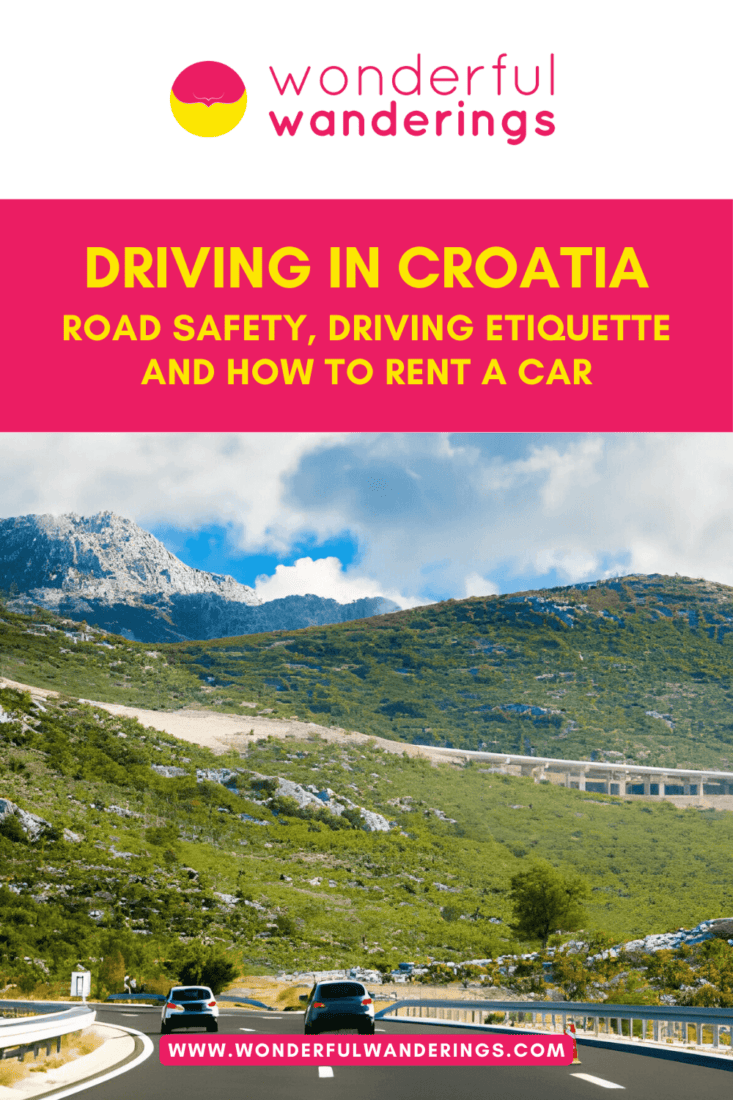
Driving in Croatia is straightforward on a good motorway network, and the rules that catch foreign drivers out are the 0.00% alcohol limit for anyone under 24, the winter equipment period from 15 November to 15 April, and dipped headlights through the winter half of the year. Croatia drives on the right, tolls are charged by distance rather than by vignette, and Croatia has used the euro since 1 January 2023, so there is no currency to change at the border.
A car is the honest answer for Istria, the Dalmatian hinterland, the national parks and anything off a ferry route. The figures below come from the Croatian Road Traffic Safety Act, the Ministry of the Interior, the European Commission’s official road-rules record for Croatia and Hrvatske autoceste, the state motorway operator.
What are the speed limits in Croatia?
Speed limits in Croatia are set by the Road Traffic Safety Act and apply unless a sign says otherwise. There are four of them and they are easy to remember.
| Road type | Limit |
|---|---|
| Motorway (autocesta), the A-numbered roads | 130 km/h (80.8 mph) |
| Expressway (brza cesta) and roads reserved for motor vehicles | 110 km/h (68.4 mph) |
| All other roads outside built-up areas | 90 km/h (55.9 mph) |
| Inside a built-up area (naselje) | 50 km/h (31.1 mph) |
A built-up area begins at the white place-name sign and ends at the same sign crossed through, not at the point where the houses start. Inside one, a sign can raise the limit to a maximum of 80 km/h (49.7 mph) where the road is engineered for it, and that is the only exception in the law.
The fines are fixed in the Act and they are not small. Outside a built-up area, exceeding the limit by 10 to 30 km/h costs €60 ($70, £50), by 30 to 50 km/h costs €260 ($304, £216), and by more than 50 km/h costs €660 to €1,990 ($772 to $2,328, £548 to £1,652) with three penalty points. Inside a built-up area, exceeding the limit by more than 50 km/h carries €1,320 to €2,650 ($1,544 to $3,101, £1,096 to £2,200) or up to 60 days in prison.
One rule that used to exist no longer does. Croatia previously capped young drivers at 80, 100 and 120 km/h, but Article 221 of the Act was deleted by the 2017 amendment and the Ministry of the Interior confirms those special restrictions were abolished. If you are working from an older guide that still lists reduced speed limits for drivers under 24, it no longer matches the law. The alcohol rule for that age group was not abolished, and that is the one that matters.
What is the drink driving limit in Croatia?
Croatia has two blood alcohol limits, and which one applies to you depends on your age and what you are driving. Both are stricter than most drivers expect.

- 0.00% for drivers under 24. Anyone who has not turned 24 must have no alcohol in their blood at all. The same zero limit applies to professional drivers, driving instructors, and holders of C, CE, D and D1 licences.
- 0.05% (0.5 g/kg) for everyone else. That is roughly one small drink for many adults, and well below the 0.08% limit most of the United States uses.
The European Commission’s official record for Croatia, supplied by the Croatian authorities, lists exactly these: 0.5 mg/ml for standard drivers and 0.0 mg/ml for novice and professional drivers. The European Transport Safety Council dates the zero limit for the under-24 group to 2004.
Penalties scale with the reading. A driver in the zero-limit group who registers any alcohol up to 0.50 g/kg is fined €90 ($105, £75). Above 0.50 up to 1.00 g/kg the fine is €390 to €660 ($456 to $772, £324 to £548). Above 1.00 up to 1.50 g/kg it is €660 to €1,990. Above 1.50 g/kg, or refusing the breath test, brings €1,320 to €2,650 or up to 60 days in prison. Everyone involved in a collision is breath tested where their condition allows it, and a positive breath test is followed by blood and urine samples.
Croatian police run frequent roadside checks, and checks after any collision are automatic, not discretionary.
What are the winter equipment rules in Croatia?
Winter equipment is compulsory on designated Croatian roads from 15 November to 15 April, regardless of the weather on the day. This is a calendar rule, not a conditions rule, and it is the one that most often catches a driver who has looked out of the window in Split and decided the roads are dry.
For a vehicle up to 3.5 tonnes, the law gives two legal options, listed below.
- Four winter tyres on all wheels, marked M+S, M&S or with the three-peak mountain snowflake (3PMSF) symbol. This is the option the authorities recommend.
- Four summer tyres with at least 4 mm of tread, plus snow chains carried in the vehicle and ready to fit to the driven wheels.
Studded tyres are banned in Croatia year round.
Two extras apply outside the calendar window. Whenever a road is actually covered in snow or ice, winter equipment becomes mandatory on every road in the country on any date, which matters for late spring snow in Gorski kotar, Lika and the Velebit passes. And the police can order a driver to stop the journey if the vehicle is judged unsafe, with the plates removed temporarily if the driver refuses.
The fine for driving without required winter equipment is €130 ($152, £108) for a private driver. For a company putting a vehicle on the road without it, the range is €660 to €1,990.
If you are hiring in winter, ask the rental desk in writing which option the car carries. A Croatian hire car in January will normally be on M+S tyres, but a car collected in Dubrovnik for a coastal-only trip may not be, and the paperwork is your evidence at a roadside check.
Do you need headlights on during the day in Croatia?
Dipped headlights are compulsory during the day in Croatia through the winter half of the year. The European Commission’s record for Croatia puts it precisely: daytime running lights are mandatory for all vehicles after the clocks go back in autumn and before they go forward in spring, and are not required during summer time. Motorcycles and mopeds use them all year.
In practice that means from the last Sunday in October to the last Sunday in March. Many hire cars now run automatic daytime running lights, which satisfy the rule, but check that the switch has not been left on the off position by the previous driver.
What must you carry in the car in Croatia?
Croatian law requires a specific kit in every car, and a hire car should have all of it. The required items are listed below.
- A warning triangle. Two if you are towing a trailer.
- A high-visibility reflective vest, kept inside the cabin rather than in the boot, because you have to put it on before you get out on a motorway.
- A first aid kit.
- Spare bulbs, unless the car has xenon, neon or LED units.
Mobile phones may only be used hands-free. Seat belts are compulsory for every occupant, and child restraint systems are required. Croatia’s emergency numbers are 112 for any emergency, 192 for police, 193 for fire, 194 for an ambulance and 1987 for roadside assistance from the Croatian Auto Club (HAK), which also takes an SMS to the same number with your location and vehicle details.
How do Croatian motorway tolls work in 2026?
Croatian motorways charge by distance, and in 2026 you still stop at a barrier to pay. There is no vignette in Croatia, unlike Slovenia, Austria or Hungary. You take a ticket on entry, hand it over on exit, and pay for the kilometres you actually drove.
Payment at the barrier works with cash in euro, credit and debit cards including contactless, or an ENC electronic tag on the windscreen. Hrvatske autoceste credits a prepaid ENC account with a 21.74% discount on its own motorways, which is worth having if you are covering the length of the country and not worth the setup for a weekend.
Hrvatske autoceste publishes the full table. For a category I car, the common runs from Zagreb are below.
| Route | Car (category I) | Motorcycle (category IA) |
|---|---|---|
| Zagreb to Split, A1 | €26.40 ($31, £22) | €15.80 ($18.50, £13) |
| Zagreb to Zadar centar, A1 | €17.60 ($21, £15) | €10.80 ($12.60, £9) |
| Zagreb to Rijeka (Grobnik), A6 | €10.10 ($12, £8) | €6.10 ($7.15, £5) |
| Zagreb to Karlovac, A1 | €2.80 ($3.30, £2.30) | €1.70 ($2, £1.40) |
Category I is a two-axle vehicle under 1.90 m high. A roof box or a high-roof van pushes the same car into category II, which is roughly 60% more, and a trailer does the same.
This is changing. Croatia has contracted a nationwide free-flow system called Crolibertas, and the Toll Collection Act requires it to start operating on 1 March 2027. Gantries with cameras replace the toll plazas, light vehicles are read by licence plate or by an existing ENC tag, and heavy goods vehicles must use an ENC. Charging stays distance-based; Croatia is not switching to a vignette. Foreign drivers will need to register a plate and a payment method in advance, online or at a sales point, so anyone planning a spring 2027 trip should check the position before setting off. Until then, the barriers are still there.
Two roads run on separate concessions with their own toll points: the Istrian Y, operated by Bina-Istra, and the Zagreb to Macelj motorway. The single Crolibertas system is due to cover both.
Which routes should you know before you drive in Croatia?
Four routes carry nearly all foreign driving in Croatia, and each has a quirk worth knowing before you set off.
- The A1 motorway, Zagreb to Split and on to Ploče. The spine of the country, four lanes, tunnels through the Velebit, and a full run of around four and a half hours from Zagreb to Split. It is the fastest way south and it is where the toll money goes.
- The D8 Adriatic Highway. The old coast road, slower, two lanes, and far better looking than the motorway. Take it for a section rather than for the whole journey, and expect to lose an hour on every hour the motorway would take.
- The Pelješac Bridge on the way to Dubrovnik. Opened on 26 July 2022, 2,404 metres (7,887 ft) long and free to cross, it connects the Dubrovnik region to the rest of Croatia without entering Bosnia and Herzegovina at Neum. Before 2022 that drive meant two non-Schengen border crossings in 20 minutes. It no longer does, and old route advice about passport queues at Neum is out of date for anyone using the bridge.
- The Istrian Y, the A8 and A9. Fast, well surfaced and toll-charged separately from the state network, linking Pula, Rovinj and Poreč to the Slovenian and Italian borders.
Border crossings are worth one line. Croatia joined the Schengen area on 1 January 2023, so there is no passport check crossing from Slovenia, Hungary or Italy by land or sea. The borders with Bosnia and Herzegovina, Serbia and Montenegro are external Schengen borders with full checks, and queues there can run long in August.
What licence and documents do you need to drive in Croatia?
An EU or EEA driving licence is valid in Croatia with no extra paperwork. A licence from outside the EU is accepted for a limited period after you enter the country, and an International Driving Permit is required when the licence is not written in the Latin alphabet, which covers Cyrillic, Chinese, Arabic, Japanese and Korean licences.
Get an IDP anyway if you are hiring. It costs very little at a motoring association at home, some Croatian rental desks ask for one regardless of the alphabet on your licence, and a police officer at a roadside check will read it faster than a foreign card.
At the rental counter you need four things: the licence itself, your passport, a credit card in the main driver’s name for the deposit hold, and your booking voucher. Every additional driver has to present a licence and passport in person. Deposit holds vary widely by company and car class, so read that figure on the booking before you pay rather than at the desk.
Basic third-party cover is included by Croatian law. The collision damage waiver sold with the car reduces your liability to an excess rather than removing it, and that excess is what a super-CDW or an independent excess policy buys out. DiscoverCars shows the excess and the fuel policy on the comparison page rather than at the counter, which is where most Croatian hire disputes start. The wider booking questions, including automatic availability and one-way drop charges, are covered in our guide to car rental in Croatia.
What are Croatian roads actually like to drive?
Croatian roads are better than their reputation on the motorways and demanding on the secondary network. The A1, A3, A4, A6 and A7 are modern, well lit at junctions, clearly signed in Croatian with international symbols, and rarely congested outside the July and August changeover Saturdays.
Away from them, three conditions recur. Coastal and island roads are narrow, unlit and edged with low stone walls rather than barriers, and the drop is often real. Mountain roads in Lika and Gorski kotar carry sharp curves, steep grades, rockfall sections and fog. Old town centres are not for cars: Dubrovnik’s, Split’s within Diocletian’s Palace, Hvar Town’s and Rovinj’s are pedestrianised or effectively impassable, and the parking is outside.
Local driving habits are worth adjusting to rather than arguing with. Overtaking is more assertive than in the UK or North America, tailgating on two-lane roads is common, and the useful response is to keep right, hold a steady speed and let the car behind go by at the first safe place.
Navigation needs data rather than luck. HAK publishes live road conditions, closures and webcam feeds, and the mountain passes and coastal sections are exactly where a signal drops and an offline map earns its keep. An Airalo eSIM installs on the driver’s phone before the trip and covers HAK’s service, the toll calculator and maps without roaming charges; it is a data plan for one device rather than a shared hotspot, so the navigator needs their own or a tether.
Petrol stations are frequent on motorways and in towns, thinner in rural Istria, Lika and on the islands, where evening closing is normal. Most sell Eurosuper 95, Eurosuper 100 and Eurodiesel. Many stations are attended, particularly on the coast in summer, and a good number now have self-service pumps, so do not assume one or the other. Cards are accepted almost everywhere. The Croatian government caps maximum fuel prices and resets the cap on alternate Tuesdays; in the fortnight to 14 September 2026 the caps were €1.67 a litre for Eurosuper 95 and €1.79 for Eurodiesel. Running costs across the whole trip are broken down in our guide to prices in Croatia.
How do you park in Croatia?
Parking in Croatian towns is zoned, paid and enforced, and the zones are colour-coded on the signs. Blue, red and yellow zones run from the most expensive and most central outwards, with different hourly rates and different maximum stays, all shown on the machine.
The practical sequence is below.
- Park outside the old town, not near it. Every coastal historic centre is pedestrianised, and the garages and surface lots on the approach roads are cheaper than the nearest kerbside space.
- Pay at the machine or by SMS. Croatian towns run an SMS parking system where you text your registration to a zone number, and the machines take cards and coins. Display the ticket on the dashboard where the machine issues one.
- Read the maximum stay, not just the price. A zone that costs little per hour often caps you at one or two hours, and overstaying is what generates the ticket.
- Watch for resident-only bays. These are signed and enforced, and a hire car parked in one is towed rather than ticketed in high season.
Two habits that Croatian drivers keep and visitors often skip: set the handbrake every time, because coastal towns are built on slopes, and turn the front wheels towards the kerb when parked facing downhill.
Where does a Croatian road trip actually take you?
A Croatian road trip is worth the hire cost mainly for the places the buses and ferries do not reach well. The routes below are the ones a car genuinely unlocks.
- Plitvice Lakes and Krka. Both national parks sit inland with limited public transport, and both reward arriving early or late rather than on the coach timetable.
- Inland Istria. Motovun, Grožnjan, Hum and the truffle country between them are a network of hill roads that no bus serves usefully.
- The Velebit and the Lika villages. The mountain road behind the coast is the scenic alternative to the A1 and it is empty most of the year.
- The Pelješac peninsula and Ston. Wine, oysters and the longest defensive wall in Europe, all reachable now that the bridge is open.
- Zadar, Šibenik and the smaller Dalmatian towns. Easy to reach and easy to park outside, unlike Zagreb, Split and Dubrovnik, which are better visited without a car once you are in them. The full list of top cities in Croatia to visit shows which ones are worth driving between.
Driving in Croatia FAQ
Which side of the road does Croatia drive on? The right, and overtaking is on the left. Turning right on a red light is prohibited unless a separate green arrow permits it, and at unmarked junctions traffic from the right has priority.
Is there a vignette for Croatian motorways? No. Croatia charges by distance at toll plazas. The free-flow Crolibertas system due on 1 March 2027 keeps distance-based charging and replaces the barriers, so there will still be no vignette.
Can I take a Croatian hire car into Bosnia and Herzegovina or Montenegro? Only with the rental company’s written permission and a Green Card, arranged in advance and usually carrying a fee. Many companies refuse some neighbouring countries outright, so ask before you book rather than at the desk.
Do I need winter tyres for a coastal trip in December? Yes, if you are on a designated road between 15 November and 15 April, and the rule applies whatever the weather looks like in Split. Check with the rental company which of the two legal options the car meets.
What is the alcohol limit if I am 23? Zero. The 0.00% limit applies to every driver who has not turned 24, with no allowance for a single drink.
Are Croatian roads safe? The motorway network is modern and well maintained, and Croatia’s road death rate has fallen sharply since 2010, though it remains above the EU average. The risk sits on narrow coastal and mountain roads rather than on the motorways.
WonderfulWanderings Pro Tips
The five points below are the ones that change how a Croatian driving trip goes, and each comes from a rule or a price that was checked for 2026.
- Treat 15 November and 15 April as hard dates. Winter equipment is required on designated roads between them whatever the weather, and €130 is the fine for turning up without it. Coastal sunshine is not a defence.
- If anyone in the party is under 24 and driving, the limit is zero. Not “one small beer”, not “a glass with lunch”. Plan the designated driver around the age rule, not around the 0.05% figure most guides print.
- Skip the ENC tag unless you are crossing the country. The 21.74% prepaid discount pays for itself over a Zagreb to Dubrovnik round trip and not over a weekend on the Istrian Y, which runs on a different concession anyway.
- Check the Crolibertas position before any trip from March 2027. The barriers come down on 1 March 2027 and foreign plates have to be registered in advance, online or at a sales point, to pass the gantries without a charging problem.
- Take the D8 for one leg, not the whole coast. The Adriatic Highway is the drive people remember and it roughly doubles the time the A1 would take, so give it the Zadar to Šibenik or the Makarska stretch and use the motorway for the rest.
About the author. This guide is written and maintained by the Wonderful Wanderings editorial team. Wonderful Wanderings was founded in 2012 by Sofie Couwenbergh, and the team covers Croatia for independent travellers, including the car hire, road rules, tolls and driving routes that a Dalmatian or Istrian trip depends on, and updates this page when limits, fines, toll tariffs and the winter equipment rules change.