 EN
EN
 Nederlands
 Français
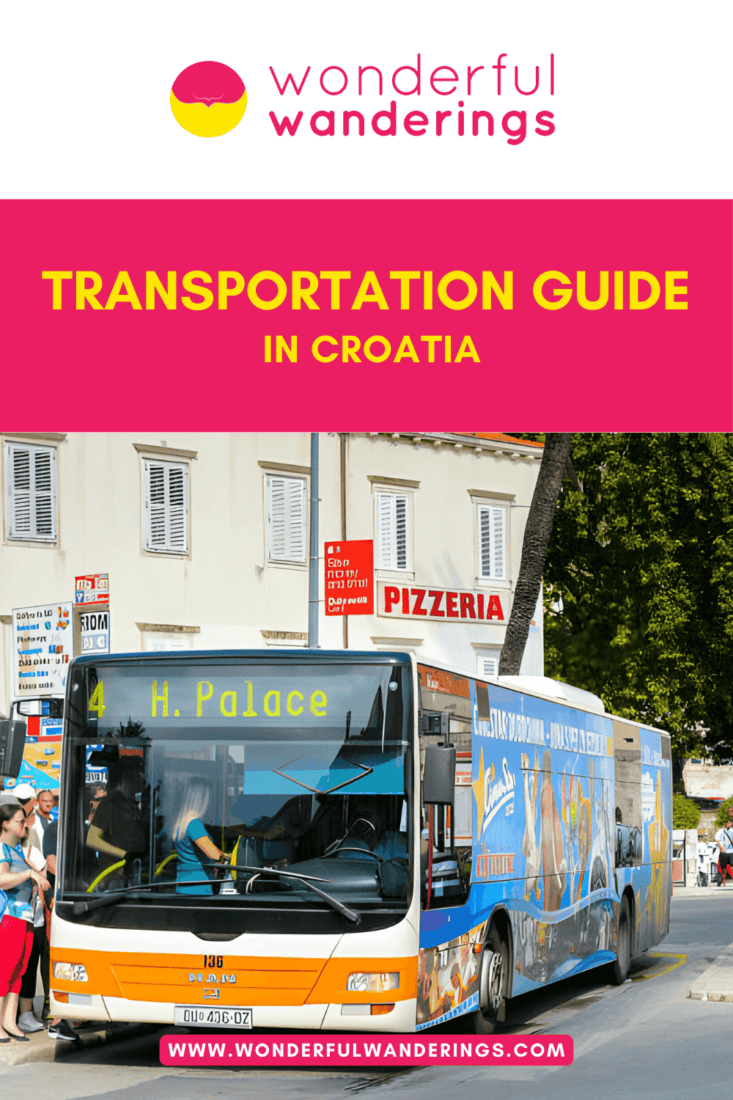
Getting around Croatia works on buses on land, ferries at sea and a hire car for everything in between, because the rail network reaches only a fraction of the country and stops well short of Dubrovnik. Buses go everywhere and go often. Ferries are the only way to the islands. Trains are cheap, slow and useful on exactly three corridors.
The shape of the country explains all of it. Croatia is long, thin and bent around Bosnia and Herzegovina, so a straight line between two towns on a map is rarely a straight line on the ground. Croatia has also used the euro since 1 January 2023 and joined the Schengen area on the same day, so arriving overland from Slovenia, Hungary or Italy involves no currency change and no passport check.
How do you get around Croatia?
Croatia has five practical ways to move between places, and each one wins in a different part of the country. The comparison below is the short version.

| Mode | Good for | Watch out for |
|---|---|---|
| Coach | Everywhere, including towns no train reaches | Sells out on coastal routes in August |
| Ferry and catamaran | The islands, and only the islands | Most catamaran routes run April to October only |
| Hire car | Istria, the national parks, the hinterland | Old towns are pedestrianised; parking is outside |
| Train | Zagreb to Rijeka, Split and Osijek | No trains south of Split, none to Dubrovnik |
| Domestic flight | Zagreb to Dubrovnik in an hour instead of ten | Only Croatia Airlines flies most domestic routes |
The single most useful planning fact is negative. There is no railway to Dubrovnik, and none along the southern coast, so every land journey there is a coach or a car. Split is the furthest south the train goes.
How do you get to Croatia?
Most visitors reach Croatia by air in summer and overland the rest of the year. Zagreb, Split, Dubrovnik, Zadar and Pula all take direct flights from across Europe between May and October, and the coastal airports thin out sharply in winter, when Zagreb carries most of the year-round traffic.

Overland, Croatia is easy to reach and easier since Schengen. Direct trains run from Slovenia, Austria, Hungary and Germany into Zagreb, and international coaches connect Ljubljana, Trieste, Venice, Vienna, Budapest, Belgrade, Sarajevo and Mostar. Coaches from Bosnia and Herzegovina, Serbia and Montenegro cross an external Schengen border, so build in time for checks in summer.
Ferries link Italy to Croatia across the Adriatic in the warmer months. Jadrolinija runs Ancona to Split and Zadar and Bari to Dubrovnik and Split, and in 2026 added a Zadar to Ancona fast craft. These are seasonal services, not a year-round bridge.
Which airports does Croatia have?
Croatia has nine airports with scheduled passenger flights, and four of them handle almost all foreign arrivals. The full list is below, with the code you will see on a booking.

- Zagreb Franjo Tuđman (ZAG). The largest, busiest and the only one with a serious year-round schedule. 17 km (10.6 mi) southeast of the centre.
- Split (SPU). The second busiest and the main gateway to Dalmatia and the islands. It sits 25 km (15.5 mi) west of Split, near Trogir.
- Dubrovnik (DBV). Heavily seasonal, 20 km (12.4 mi) southeast of the old town at Čilipi.
- Zadar (ZAD). A low-cost hub in summer and the closest airport to Plitvice and Krka.
- Pula (PUY). The Istrian airport, busiest from May to September.
- Rijeka (RJK). Actually on the island of Krk, around 30 km (18.6 mi) from Rijeka, and almost entirely seasonal.
- Osijek (OSI). The Slavonian regional airport, with domestic and seasonal charter flights.
- Brač (BWK) and Lošinj (LSZ). Small island airfields with limited seasonal service.
Croatia Airlines is the national carrier and flies the domestic connections, linking Zagreb with Split, Dubrovnik, Zadar and Pula on its own timetable. Domestic flights make sense for one journey in particular, Zagreb to Dubrovnik, which takes about an hour in the air against nine or ten by coach.
How do you get from Croatian airports into town?
Every Croatian airport has a bus into town, and the bus is always cheaper than the taxi by a wide margin. The pattern is the same everywhere: an airport shuttle timed to flights and running to the main bus station, plus a cheaper city bus on an ordinary ticket.

At Zagreb, the Pleso Prijevoz shuttle runs to the Central Bus Station in 30 to 45 minutes and costs around €9 ($11, £7) one way. ZET’s city bus 290 is the cheaper alternative on an ordinary ZET ticket, and it drops you at Kvaternikov trg rather than the bus station, which suits some hotels and not others.
At Split, the airport shuttle to the bus station on the Riva costs roughly €8 ($9, £7), and the local Promet bus line 37 costs a couple of euro and takes about twice as long, stopping frequently along the Kaštela coast. In summer there is also a passenger boat from the airport area into Split harbour.
At Dubrovnik, the Platanus airport bus meets flights and runs to Pile Gate and the bus station. At Zadar, Pula and Rijeka, airport buses are timed to arrivals and are sparse outside those windows, which matters for a late landing.
Taxis and ride-hailing work at all of them, and Uber and Bolt operate in Zagreb, Split, Dubrovnik and Zadar. Airport taxi fares run several times the bus fare on every route.
How do buses work in Croatia?
Buses are Croatia’s real transport network, reaching towns, villages and national parks that no train serves. Several companies share the routes, including Arriva, FlixBus, Autotrans, Croatia Bus and Čazmatrans, and they all sell into the same station system.
Four things are worth knowing before you use one.
- Book ahead in July and August. Coastal services genuinely sell out, and a Split to Dubrovnik seat bought on the morning of travel in August may not exist.
- Budget for the luggage charge. Croatian coaches charge separately for a bag in the hold, usually a euro or two, paid in cash to the driver at the door.
- Use the bus station, not the roadside. Croatian towns have a proper autobusni kolodvor with ticket windows, timetables and left luggage, and long-distance coaches use it rather than street stops.
- Expect an ID check on international routes. Croatia is in Schengen, so there is no check crossing from Slovenia or Hungary, but the Bosnian, Serbian and Montenegrin borders are external Schengen borders and everyone gets off the bus.
Timetables and fares across the operators are easiest to compare in one search, and Omio sells Croatian coaches and trains together, which is the fastest way to see whether the train or the bus wins on a given day.
How do trains work in Croatia?
Croatian trains are cheap, comfortable and limited to a handful of corridors. HŽ Putnički prijevoz runs them, and three routes matter to visitors: Zagreb to Rijeka, Zagreb to Split and Zagreb to Osijek and the Slavonian east.
Fares are low. HŽPP’s own 2026 to 2030 plan prices Zagreb to Split at €15.82 ($18.50, £13) and Zagreb to Rijeka at €8.42 ($9.85, £7) year round. The Split run takes six hours or more against roughly five by coach, and there is an overnight service with couchettes that doubles as a night’s accommodation.
The limits are real and worth stating plainly. There is no line to Dubrovnik, no coastal line linking the Dalmatian towns to each other, and no rail access to any island. Trains are worth it on the Zagreb to Rijeka and Zagreb to Split corridors and nowhere else on a typical coastal itinerary.
How do ferries and catamarans work in Croatia?
Ferries are the only way to reach Croatia’s inhabited islands, and there are two different kinds of boat doing two different jobs. Getting the distinction right is the difference between a smooth island hop and standing on a quay.
Car ferries (trajekt) carry vehicles and foot passengers, run year round on the main routes, and are slower. Jadrolinija, the state operator, runs most of them. On its Split to Supetar crossing, a 50-minute sailing and the busiest on the coast, a foot passenger pays about €4.40 out of season and €6.50 in season ($5 to $8, £3.65 to £5.40) while a car under 5 metres costs about €18.20 to €26.10 ($21 to $31, £15 to £22).
Catamarans (katamaran) are fast passenger-only craft. They take no cars, they are the quickest link between Split and the islands, and most of them are seasonal.
Which ferry routes are seasonal?
Most catamaran routes are seasonal and most car ferry routes are not, which is the rule to plan around. Krilo’s long Split to Brač to Hvar to Korčula to Dubrovnik catamaran, the route that makes a southern island chain possible without a car, runs daily from 1 April to 31 October and does not run in winter. The Italy to Croatia crossings are seasonal too.
Year-round car ferries keep the main islands connected through the winter: Split to Supetar on Brač, Split to Stari Grad on Hvar, Split to Vis, Zadar to Preko on Ugljan, Valbiska to Merag for Cres, and Orebić to Dominče for Korčula. Frequencies drop sharply out of season, sometimes to a handful of sailings a day.
Three habits save trouble. Book vehicle space online in July and August, because cars queue at Split and Zadar for hours in the peak weeks. Check the return sailing before you go, because an island day trip that works in July does not exist in November. And read the port, not the island: Hvar Town and Stari Grad are an hour apart by road, and the car ferry docks at the one most people are not staying in.
Should you hire a car in Croatia?
Hire a car in Croatia if your trip is built around Istria, the national parks or the hinterland, and skip it if you are moving between cities and islands. The costs are fuel, motorway tolls charged by distance, and parking, and the value depends entirely on where you are going.
A car is worth it for Plitvice and Krka, inland Istria, the Pelješac peninsula, the Velebit and the smaller Dalmatian coastal towns, none of which public transport reaches well. A car is a liability inside Zagreb, Split, Dubrovnik and Hvar Town, all of which are walkable or pedestrianised, and it is an expensive passenger on a ferry, where taking a car multiplies the crossing cost several times over.
The compromise most people land on is to hire for a section rather than the whole trip. Pick the car up when you leave the city and drop it before the next one; one-way drops between Croatian branches are normal, though they carry a fee. DiscoverCars shows the excess, the fuel policy and the cross-border rules on the comparison page rather than at the desk.
Two practical points the desks will raise. An International Driving Permit is required when your licence is not in the Latin alphabet, and many desks ask for one regardless. And taking a hire car into Bosnia and Herzegovina or Montenegro needs written permission and a Green Card arranged in advance, which some companies refuse outright. Everything else about the booking is in our guide to rent a car in Croatia, and the road rules, tolls and limits are in our guide to driving in Croatia.
How do you get around Croatian cities?
Croatian cities are small, walkable and cheap to move around, and four of them double as the country’s transport hubs.
Zagreb runs trams and buses under ZET, and its published 2026 fares are €0.53 ($0.62, £0.44) for 30 minutes bought in advance, €0.93 for 60 minutes, €1.33 for 90 minutes and €3.98 ($4.65, £3.30) for a day ticket covering trams, buses and the funicular. Buying from the driver costs more. The centre is flat and compact, and the tram network is the fastest way across it. What the city itself is worth is covered in our guide to Zagreb.
Split is the ferry capital of the country, with the port, the bus station and the train station in one block on the Riva, which makes it the easiest place in Croatia to change between modes. Promet runs the city buses. The old town inside Diocletian’s Palace is walked, not driven. More on the city is in our guide to Split.
Rijeka is the northern Adriatic’s main port and a road and rail junction for Istria and the Kvarner islands, with a bus network and a single tram-style line. Its airport is on Krk, which catches people out.
Osijek is the hub for Slavonia in the east, on the Drava, with a compact bus and tram network and rail links west to Zagreb. It is the one major Croatian city most itineraries skip, and it is also the cheapest.
Buying tickets and reading live timetables works most easily on the operators’ own apps, which need mobile data. An Airalo eSIM installs on one phone before you fly and covers ferry apps, ZET’s ticketing and maps without roaming charges; it is a data plan for a single device rather than a shared hotspot, so a group travelling together needs one each or one phone tethering.
When is the best time to visit Croatia?
The best time to visit Croatia for transport is late May to June and September, when everything runs and nothing is full. That window has the full ferry timetable, the seasonal catamarans, the direct flights and swimmable sea, without the August queues at the Split car ferry ramp or the sold-out coaches.
July and August have the most services and the most competition for them. From November to March the coastal airports go quiet, the catamarans stop, car ferry frequencies drop and the islands become genuinely difficult to reach, which is a reason to base a winter trip on Zagreb and the inland. The broader seasonal picture, including weather and prices, is in our guide to visit Croatia.
Croatia transport FAQ
Is there a train to Dubrovnik? No. Croatia has no railway south of Split and none to Dubrovnik, so every land approach is by coach or car. The nearest railhead is Split, about four and a half hours away by road.
Can you take a car on a Croatian ferry? Yes on a car ferry, no on a catamaran. Catamarans are passenger-only, and in summer vehicle queues at Split and Zadar are long enough that booking the vehicle space online is worth doing.
Do you need a car in Croatia? Not for a city and island trip. A car earns its cost for the national parks, inland Istria and the hinterland, and costs you money and parking stress everywhere else.
Are buses or trains better in Croatia? Buses, in almost every case. They go to far more places, run more often, and are usually faster than the train on the same route. Trains win on price on the Zagreb to Rijeka and Zagreb to Split corridors.
Is Croatia in Schengen? Yes, since 1 January 2023 for land and sea borders and 26 March 2023 for air. There is no passport check arriving from Slovenia, Hungary or Italy; the borders with Bosnia and Herzegovina, Serbia and Montenegro are external Schengen borders with full checks.
What currency do you pay with? The euro. Croatia replaced the kuna on 1 January 2023, and ticket windows, ferry offices and toll booths all take cards as well as cash.
WonderfulWanderings Pro Tips
The four points below are the ones that change a Croatian transport plan, and each was checked against the operator that runs the service.
- Check the catamaran season before you build an island chain. Krilo’s Split to Hvar to Korčula to Dubrovnik catamaran runs daily from 1 April to 31 October only. An October itinerary works; the same route in November does not exist, and the fallback is a long coach on the coast road.
- Leave the car on the mainland for a single-island stay. Two foot passengers cross Split to Supetar for around €13; the same two with a car pay around €39 each way before parking, and the island towns are walkable.
- Land at Zadar for Plitvice, not Zagreb. Zadar is the closest airport to both Plitvice and Krka, and the low-cost carriers use it heavily from May to September.
- Buy ZET tickets at a kiosk, not from the driver. A 30-minute Zagreb ticket is €0.53 bought in advance and €0.80 on board, and the same gap applies on most Croatian city networks.
About the author. This guide is written and maintained by the Wonderful Wanderings editorial team. Wonderful Wanderings was founded in 2012 by Sofie Couwenbergh, and the team covers Croatia for independent travellers, including the ferries, coaches, trains and car hire that an Adriatic trip is actually built on, plus the tours and places to stay worth booking at each stop, and updates this page when timetables, seasons and fares change.