 EN
EN
 Nederlands
 Français
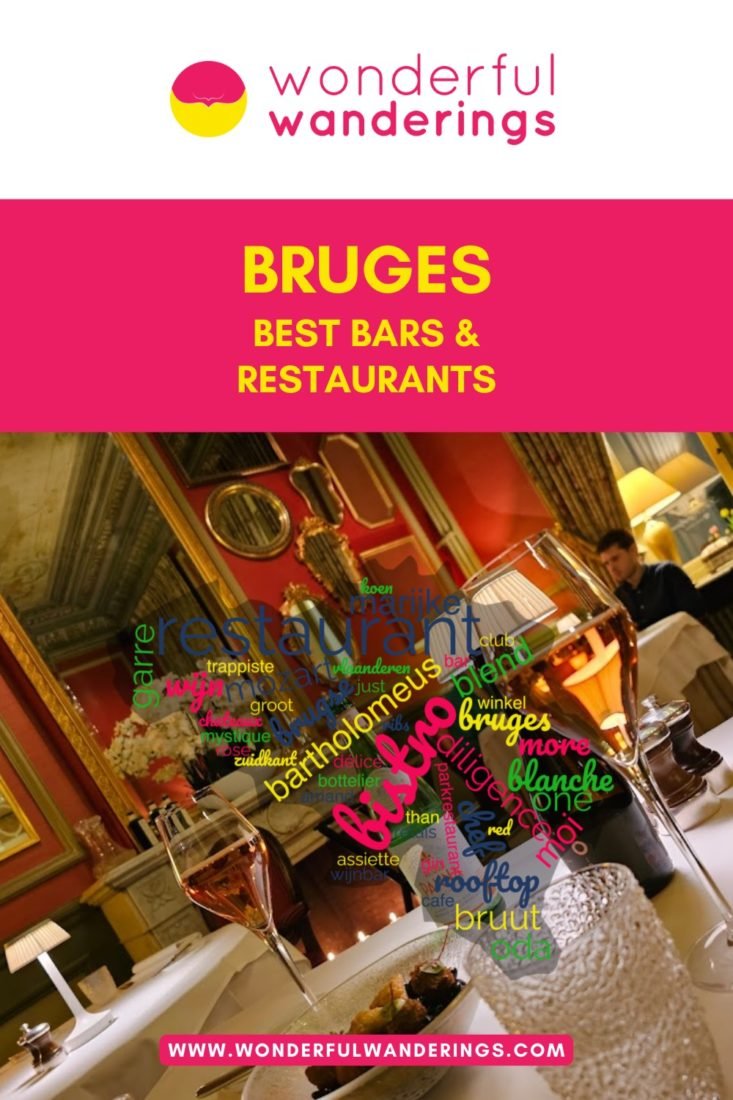
The best restaurants in Bruges sit inside the ring canal, take bookings days rather than months ahead, and cook Flemish classics rather than international menus. Bruges is a small city, so the 12 restaurants and 7 bars below are all within a 20-minute walk of the Markt, with two exceptions on the coast and in Damme that are worth the short drive. Every one of them was checked against its own website or the city tourism board before it went on this list.
Bruges is a medieval city whose historic centre became a UNESCO World Heritage Site in 2000, and the food follows the same logic as the architecture: old recipes, done properly, in small rooms. The dishes to look for are moules-frites, carbonade flamande (beef slow-cooked in beer), grey North Sea shrimp, waterzooi and vol-au-vent, washed down with Trappist and abbey beer. Prices run from about €20 for a plate of stew and fries to €130 for a tasting menu with a Michelin star behind it.
One habit matters more than any single recommendation here: Bruges eats early and closes often. Checking all 12 kitchens on this list turned up the same pattern again and again. Lunch service is frequently a 90-minute window, dinner orders stop between 8.30 p.m. and 9.30 p.m. in most of the centre, and almost every independent restaurant shuts two days a week, often midweek rather than at the weekend. Several also close for a two-week annual holiday whose dates move each year. Book before you travel, and check the restaurant’s own site on the morning of your meal.
Listed below are the best restaurants in Bruges.
- Bartholomeus. A two-star restaurant on the seafront at Knokke-Heist, a 25-minute drive from Bruges, cooking modern seafood.
- One Restaurant. A small family-run Flemish kitchen on Arsenaalstraat, known for beef stew and hand-cut fries.
- Le Chef et Moi. A French-Flemish bistro on the Dijver canal, with the owner at the stove and a €25 lunch.
- Bistro Bruut. A fixed-menu restaurant on the Meestraat scoring 16/20 in Gault&Millau, open weekday lunch and dinner only.
- Bij Koen & Marijke. A charcoal-grill and beer restaurant on Hooistraat, trading since 1977 and open evenings only.
- Délice Bruges. A family brasserie by the Minnewaterpark, doing mussels, carbonade and steak at fair prices.
- Mozart, More Than Just Ribs. A rib specialist on Sint-Jakobsstraat, serving spareribs with herb-butter potatoes.
- Assiette Blanche. A refined French-Belgian kitchen opposite the Burg, with hand-peeled grey shrimp as the house dish.
- Bistro Den Amand. A traditional bistro on a traffic-free square off the Markt, cooking seasonal vegetable-heavy plates.
- Restaurant Diligence. A late-night Belgian restaurant on Hoogstraat, with the kitchen open until midnight.
- De Zuidkant. A one-star restaurant in Damme, 7 km from Bruges, serving modern cuisine by an open fire.
- Le Mystique. A fine-dining room inside the Relais & Châteaux Hotel Heritage, open for dinner only.
1. Bartholomeus
Bartholomeus is a two-Michelin-starred restaurant at Zeedijk-Heist 267 in Knokke-Heist, and it is not in Bruges: it is on the coast, roughly a 25-minute drive or a 40-minute train-and-bus trip north. Bartholomeus faces the North Sea across the promenade, which is the point, because the kitchen builds its menu around what comes off the boats in front of it.

The cooking is modern seafood, using Flemish grey shrimp, turbot, brill and Dover sole alongside oysters and scallops. Grey shrimp are a local speciality worth ordering anywhere on this coast, and they are at their best hand-peeled rather than pre-picked. The dining room is small and the tasting menu is the way most people eat here, with a wine flight chosen by the sommelier.
Book well ahead. A two-star kitchen on the Belgian coast fills its weekend tables long before you arrive, and there is no walk-in option. Getting back matters more than getting there, because the coastal services thin out in the evening, so check Belgian rail timetables before you commit to a late sitting without a car.
2. One Restaurant
One Restaurant is a small family-run Belgian kitchen at Arsenaalstraat 55, and it is the one on this list where booking ahead matters most. It seats very few people, it takes groups of up to 4 only, and it will not let you book several tables to make a larger party. Arrive on time, because the table is released 15 minutes after your booking.

The cooking is Belgian and made from scratch, with slow-cooked stews and hand-cut fries as the backbone. Flemish beef stew braised in beer and served with fries is the dish to order, and the menu changes with the season around it. The room is small and brick-walled, which is why people describe it as the place for a quiet dinner rather than a group night out.
3. Le Chef et Moi
Le Chef et Moi is a French-Flemish bistro at Dijver 13, on the canal between the Groeningemuseum and the Rozenhoedkaai, and the owner cooks every service himself. Caroline runs the floor. The kitchen is open from 12 p.m. to 1.30 p.m. and from 6.30 p.m. to 8.30 p.m., which is a narrow window, so plan the day around it rather than the other way round.

The card is deliberately short and it changes often, and there is a daily lunch at €25 (about $27, £22) covering a main course and coffee. Everything is cooked from ingredients bought that day. Ask for what is on the blackboard rather than reading the menu twice.
Local dishes to look for here are carbonade flamande, grey shrimp croquettes and North Sea sole with hand-cut fries. The dining room is classic and low-lit, and the canal is directly outside, so ask for a window table when you book.
4. Bistro Bruut
Bistro Bruut is a fixed-menu restaurant at Meestraat 9, and it serves one set menu for dinner and a shorter version at lunch, with no substitutions. That is the house rule and the restaurant states it plainly: each course is built to follow the one before it, so the kitchen does not take it apart on request. Tell them about allergies when you book, not when you sit down.

Bistro Bruut scores 16/20 in Gault&Millau and has appeared in the OAD list of European restaurants, and it works with regional Flemish produce given a modern treatment. It opens Monday to Friday only, from 12 p.m. to 2 p.m. and 7 p.m. to 9 p.m., and it closes at weekends. That weekday-only pattern catches out visitors who arrive for a Saturday break.
The Meestraat is one of the quietest lanes in the centre, a minute from the Groenerei and the bridge used in the film In Bruges. If you are walking the In Bruges filming locations, this restaurant is directly on the route.
5. Bij Koen & Marijke
Bij Koen & Marijke is a charcoal-grill and beer restaurant at Hooistraat 42 that has been trading since 1977, and it cooks local seasonal dishes over an open fire. Meat off the grill is the reason to come, paired with craft Belgian beer chosen to match the plate rather than the label. The kitchen is evening-only, opening from 6 p.m., and it is closed at the weekend, so check before you walk over.

Hooistraat is in the Sint-Anna quarter northeast of the Burg, about 10 minutes on foot from the Markt and well outside the tourist strip. The room is small and the hosts run it themselves, so the atmosphere is closer to a dinner party than a restaurant service. Book, because there is not much space.
6. Délice Bruges
Délice Bruges is a family-run brasserie at Wijngaardstraat 21, beside the Minnewaterpark, and it is the sensible choice for Belgian classics without a fine-dining bill. Mussels are the house dish, done in several styles, and the carbonade flamande, slow-cooked in beer and served with frites, is what most tables order alongside it. Steak and seasonal specials fill out the rest of the card.

The location works well as the last stop of a walk: the Minnewater, the Beguinage and the Halve Maan brewery are all within three minutes. Portions are generous and the beer list is local. It is a bistro rather than a destination restaurant, and it does not pretend otherwise, which is exactly why it is on this list.
7. Mozart, More Than Just Ribs
Mozart, More Than Just Ribs is a rib restaurant at Sint-Jakobsstraat 9 that opened its Bruges branch in December 2019, and ribs are what it does. The spareribs come with a choice of sauces, the house herb-butter potato and a salad, and the kitchen also runs steaks, chicken, fish and vegetarian plates for anyone at the table who does not want ribs.

Mozart takes takeaway orders as well as bookings, which is useful if you have an apartment rather than a hotel room. The interior is fitted out with bookshelves and old train-carriage seating, and it is one of the few restaurants in the centre that suits a family with children and a long evening. Sint-Jakobsstraat runs north from the Markt, five minutes’ walk from the Belfry.
8. Assiette Blanche
Assiette Blanche is a French-Belgian restaurant at Philipstockstraat 23-25, directly opposite the Burg and a short walk from the Markt, and its house speciality is hand-peeled grey shrimp. That dish alone justifies the booking: peeling North Sea shrimp by hand is slow work and most kitchens no longer bother. Marleen and Stefan run the restaurant between them.

The menu changes every six weeks and stays small and seasonal, built on French-Belgian classics and regional dishes. Lunch is €35 (about $38, £30) and a three-course choice menu is €60 (about $66, £51). The interior is formal without being stiff, and the service is the kind that remembers what you ordered last time.
Check before travelling in high summer, because the restaurant closes for an annual holiday and the dates move each year.
9. Bistro Den Amand
Bistro Den Amand is a traditional bistro at Sint-Amandsstraat 4, hidden on a small traffic-free square that backs onto the Markt, and it is the closest good dinner to the main square. Chef An Vissers cooks in the open kitchen and Arnout runs the floor. Reservations are taken by telephone only, and a table is released 15 minutes after the booking time.

The kitchen does seasonal vegetarian, fish and meat dishes, each with a generous portion of vegetables, plus a monthly menu and a list of daily suggestions. Children get their own dishes rather than a smaller version of an adult plate. Locals eat here as much as visitors do, which in a city centre this touristed is the signal worth trusting.
10. Restaurant Diligence
Restaurant Diligence is a Belgian restaurant at Hoogstraat 5 whose kitchen stays open until midnight every day, and that makes it the answer to the hardest question in Bruges: where to eat after 10 p.m. Most of the centre stops serving at 9 p.m. or 9.30 p.m. Diligence keeps going, 200 metres (0.1 mi) from the Burg and the Markt.

The card is bistro cooking: shrimp croquettes to start, carbonade flamande made with Trappist beer, mussels in several styles, vol-au-vent, steak with fries, and chocolate mousse to finish. Portions are large. Staff speak several languages, which is a practical point when the rest of the street has shut.
11. De Zuidkant
De Zuidkant is a one-Michelin-starred restaurant at Jacob van Maerlantstraat 6 in Damme, about 7 km (4.3 mi) northeast of Bruges, and it holds its star in the 2026 Michelin Guide Belgium. Patrick and Cora run it, and the cooking is modern, precise and built on local produce. The room has an open fire in winter and a terrace in summer.

De Zuidkant opens Monday, Tuesday and Friday from 12 p.m. to 1 p.m. and 7 p.m. to 9 p.m., and Saturday from 12 p.m. to 2 p.m. and 7 p.m. to 9 p.m., and it closes on Wednesday, Thursday and Sunday. Those are unusually tight sittings for a starred restaurant, so book early and arrive on time.
Damme is reachable by bike along the tree-lined Damse Vaart canal in about 30 minutes from Bruges, which is the pleasant way to do it, or by car in 15 minutes. Do not plan the cycle back after a wine pairing.
12. Le Mystique
Le Mystique is the restaurant inside the Relais & Châteaux Hotel Heritage at Niklaas Desparsstraat 11, and it opens for dinner only, daily, with 8 p.m. the latest arrival time. Chef Seppe Swinnen cooks traditional French and Belgian dishes with influences from further afield. Non-residents can book, not only hotel guests.

Places are limited and the hotel cannot guarantee a table even to its own guests, so reserve well ahead. The restaurant can be taken privately for up to 24 people, and it caters for allergies and special diets with 48 hours’ notice. Children are welcome from the age of 8, and there is no separate children’s menu. The hotel’s bar, Le Magnum, serves until 11 p.m. if you want a drink afterwards.
The restaurant closes for two annual holiday periods each year, so check the dates on the hotel’s site before you plan a special occasion around it.
What are the best bars to drink in Bruges?
The best bars in Bruges are beer cellars, and the city treats beer the way other places treat wine. Seven bars are described below, covering Trappist and abbey beer, cocktails, gin, wine and a rooftop terrace, and all seven are inside the historic centre.

- Le Trappiste: a specialist beer bar in an 800-year-old vaulted cellar, pouring Belgian classics and rare imports.
- ODA Rooftop Bar: a rooftop terrace opposite St Salvator’s Cathedral, serving cocktails, wine and small plates.
- Groot Vlaenderen: a cocktail bar in an 18th-century building on Vlamingstraat, named Gault&Millau Belgian cocktail bar of the year.
- Cafe Rose Red: a small bar hung with red roses, pouring Trappist and lambic beers just off the Markt.
- Blend Wijnbar: a wine bar and shop on Kuipersstraat with 35 wines by the glass and Italian charcuterie.
- De Garre: a hidden alley cafe trading since 1984, with 140 regional beers and its own tripel.
- Beers at Yesterday’s World: a beer bar on Wijngaardstraat in a historic building, with live music and long opening hours.
1. Le Trappiste
Le Trappiste is a specialist beer bar in an 800-year-old vaulted cellar at Kuipersstraat 33, about 300 metres (0.2 mi) from the Markt, and it is the most serious beer list in the centre. The cellar is the attraction: brick vaulting, low light and no windows, which makes it a good place to sit out an afternoon of Bruges rain.

The bar keeps around 100 bottled beers and 15 on tap, organised by style rather than by brewery, and it stocks rare international brews alongside the Belgian range. Its own house tripel, Abbott, is brewed for it by the Van Steenberge brewery. Ask the staff to steer you rather than reading the whole list.
2. ODA Rooftop Bar
ODA Rooftop Bar is a rooftop terrace at Steenstraat 96, opposite St Salvator’s Cathedral, and it is the only bar in this guide with a view. The terrace looks straight at the cathedral tower and out over the rooftops, which in a city this flat and this low is rarer than it sounds. There is indoor seating for when the weather turns, which in Bruges it will.

ODA opens Thursday to Monday and serves cocktails, wine and champagne alongside tapas-style plates such as patatas bravas, mini burgers and steamed buns. Go for the hour before sunset and get there early, because the terrace is small and does not hold many people.
3. Groot Vlaenderen
Groot Vlaenderen is a cocktail bar at Vlamingstraat 94 that Gault&Millau named Belgian cocktail bar of the year, and note the spelling: it is Vlaenderen with an “e”, which is how the name has stood on the facade since 1879. Shanna Delfosse and Dieter Moeyaert run it. Drinks are mixed in front of you at a stainless-steel bar set into an 18th-century Bruges townhouse with heavy wooden ceilings and cornicing.

The list covers classics and house creations built around local ingredients, plus whisky, rum, vodka, gin, wine and a few Belgian beers for anyone not drinking cocktails. Groot Vlaenderen opens Wednesday to Sunday from 5 p.m. and does not take reservations, so arrive early or expect to wait.
4. Cafe Rose Red
Cafe Rose Red is a small bar at Cordoeaniersstraat 16, a two-minute walk from the Markt, and the ceiling is covered in hanging red roses. Trappist and lambic beers are the speciality, and the staff know the list well enough to pick for you if you describe what you like. There is a courtyard terrace at the back.

The food is bar food deliberately: cheese, charcuterie and olives to go with the beer rather than a full menu. Cafe Rose Red sits below Hotel Rose Red, so it fills with hotel guests early in the evening and with beer drinkers later.
5. Blend Wijnbar
Blend Wijnbar is a wine bar and shop at Kuipersstraat 6-8, and it pours 35 wines by the glass from a cellar of more than 350 bottles. Kees Dobbelaar, named best sommelier in Belgium in 2009, runs it with Joke Fleurbaey, which is why the by-the-glass list is better than the size of the room suggests. Artisanal Italian snacks come alongside.

Blend opens Monday to Saturday from 4 p.m. to midnight and Sunday from 4 p.m. to 10 p.m., and closes on Tuesday. It does not take reservations; you simply turn up. You can also buy bottles to take away from the shop side, which is useful if you have an apartment.
6. De Garre
De Garre is a cafe down a narrow alley between the Markt and the Burg that has been trading since 1984, and it serves its own Tripel van De Garre with a small dish of cubed cheese. The alley is so narrow that most people walk past its entrance; look for the sign on the wall of the passage called De Garre, off the Breidelstraat.

Staminee De Garre keeps 140 different regional beers, from names you know to ones you will not find outside West Flanders, and Margot and Carleen have run it for years. The house tripel is a strong, full-bodied beer with a slightly bitter finish, and the bar limits how many it will serve you, which tells you something.
De Garre opens every day: Monday and Tuesday from 12 p.m. to 7 p.m., Wednesday to Sunday from 12 p.m. to 11 p.m. It does not take reservations. There are three small floors and they all fill up, so go early or late rather than at 8 p.m.
7. Beers at Yesterday’s World
Beers at Yesterday’s World is a beer bar at Wijngaardstraat 6, near the Beguinage and the Minnewater, set in a historic building fitted out with old advertising signs and shop fittings. The room is the reason to go: it looks like a preserved interwar Belgian shop, and the beer list is long.

The bar closes on Mondays and opens from around 11 a.m. on the other days, which makes it one of the earlier options in the centre, and it puts on live music. It is a five-minute walk from Délice Bruges, so the two work as a pair on a Beguinage evening.
What are the best restaurants in Bruges Historic Centre?
The best restaurants inside the historic centre are the ones within a 10-minute walk of the Markt, which rules out the coast and Damme. Three of them are described below, chosen for a different reason each: one for a special occasion, one for a local dinner, one for a late one.

- Le Mystique. Inside the Relais & Châteaux Hotel Heritage on Niklaas Desparsstraat, this is the special-occasion room in the old town. Chef Seppe Swinnen cooks French and Belgian dishes with international influences, dinner only, with an 8 p.m. latest arrival. Book early, because places are limited even for hotel guests, and the hotel bar Le Magnum stays open until 11 p.m. afterwards.
- Bistro Den Amand. Tucked on a traffic-free square backing onto the Markt, this is where Bruges residents eat within sight of the tourist crowds. An Vissers cooks seasonal vegetarian, fish and meat dishes with a generous portion of vegetables on every plate, and Arnout runs the room. Reservations are by telephone only.
- Assiette Blanche. Opposite the Burg and a short walk from the Markt, this restaurant serves a small French-Belgian menu that changes every six weeks. The house speciality is hand-peeled grey shrimp, lunch runs at €35 and a three-course menu at €60. Marleen and Stefan have run it long enough that regulars book by name.
Which are the best Michelin-rated restaurants in Bruges?
Two restaurants near Bruges hold Michelin stars in the 2026 guide, and neither is inside the city walls. That is the honest answer, and it is worth knowing before you plan a starred dinner around a Bruges hotel. A third restaurant on this list is highly rated by Gault&Millau rather than by Michelin.

- Bartholomeus: two Michelin stars, at Zeedijk-Heist 267 in Knokke-Heist, a 25-minute drive from Bruges. Modern seafood built around the North Sea catch, served as a tasting menu with optional wine pairings.
- De Zuidkant: one Michelin star, at Jacob van Maerlantstraat 6 in Damme, 7 km (4.3 mi) from Bruges. Modern cuisine by Patrick and Cora, in a room with an open fire and a summer terrace, open four days a week.
- Bistro Bruut: 16/20 in Gault&Millau rather than a Michelin star, at Meestraat 9 in the centre. A single fixed menu at dinner and a shorter one at lunch, using regional Flemish produce, weekdays only.
Which are the best Italian restaurants in Bruges?
Two Italian restaurants in Bruges are worth crossing town for, and both cook southern Italian rather than the generic pizza-and-pasta menu that fills the streets around the Markt.
- Osteria 45. A Sicilian kitchen at Sint-Jakobsstraat 45, run by Italians and cooking in the old style. It has opened for lunch as well as dinner, which makes it easier to fit into a day of sightseeing.
- Sale e Pepe. A Sicilian kitchen at Kleine Sint-Amandsstraat 1, a few steps off the Markt on a lane most visitors walk past. Note the spelling: it is Sale e Pepe, and searching for the anglicised version will not find it.
Which are the best Cafés in Bruges?
The best cafes in Bruges do specialty coffee rather than the tourist waffle trade, and three of them are described below.
- Li O Lait. A specialty coffee bar at Dweersstraat 30, popular with locals, serving coffee and tea alongside bagels, quiches and pastries. It is one of the best cafes in Bruges and a short walk west of the Markt.
- Kottee Kaffee. A coffeehouse in the historic centre, a few minutes’ walk from the Markt, serving specialty coffee, tea and freshly baked bread including gluten-free options. It opens at 8 a.m. on most weekdays and 9 a.m. on Saturday, so it is a genuine breakfast option.
- Tonka. A tearoom at Walplein 18, next to the Halve Maan brewery and near the Beguinage, whose menu is built around fresh pancakes and waffles made daily. There is an inner terrace, which is the quiet place to sit on a busy afternoon.
What is the best Belgian food to try in Bruges?
The Belgian food to try in Bruges is carbonade flamande, moules-frites, grey North Sea shrimp and waterzooi, in that order. Carbonade flamande is beef slow-cooked in dark beer until the sauce goes sweet and sticky, served with fries, and it is on almost every menu in this guide. Moules-frites is a pot of mussels with a bowl of fries, and it is at its best from autumn onwards when Zeeland mussels are in season.

Grey North Sea shrimp are the local delicacy and the thing most visitors miss. They are small, they are peeled by hand, and they turn up in croquettes, in a tomato shell or simply with egg and butter. Waterzooi is a creamy chicken or fish stew from Ghent that Bruges kitchens cook too.
For sweet things, Belgian waffles come in two forms that are not the same: the light rectangular Brussels waffle dusted with sugar, and the dense, chewy, caramelised Liège waffle. Chocolate is everywhere in Bruges and the quality varies enormously, so buy from a chocolatier who makes on the premises rather than from a shop on the Breidelstraat. Our Belgian food guide sets out how French, German and Dutch cooking all fed into the national kitchen.
Do you need to book restaurants in Bruges?
Yes, book every restaurant on this list, and book before you arrive in the city rather than on the day. Bruges receives far more visitors than its centre has covers, and the good independent kitchens are small: One Restaurant caps parties at 4 people, Bistro Den Amand takes bookings by telephone only, and Le Mystique cannot guarantee a table even to guests staying in its own hotel.
Two practical points follow from that. First, arrive on time, because several restaurants here release a table 15 minutes after the booking. Second, tell the kitchen about allergies and diets when you book, not when you sit down, since fixed-menu restaurants such as Bistro Bruut will not rework a course on the night and Le Mystique asks for 48 hours’ notice.
Bars are the opposite. De Garre, Blend Wijnbar and Groot Vlaenderen all refuse reservations outright, so the only tactic that works there is going early or going late.
How much does dinner cost in Bruges?
Dinner in Bruges costs roughly €25 to €45 per person for a main course and a drink in a bistro, and €60 to €130 for a multi-course menu at the top end. The verified figures on this page give you the shape of it: a set lunch runs €25 at Le Chef et Moi and €35 at Assiette Blanche, and a three-course choice menu at Assiette Blanche is €60 (about $66, £51).
Beer is the cheap pleasure and the good one. A Belgian beer in a centre bar generally costs a few euro, so a long evening at De Garre or Le Trappiste is far less expensive than the equivalent in wine. Service and VAT are already inside every listed price, so the menu figure is what you actually pay.
Two costs catch people out. Fries are sometimes charged separately from the dish they belong with, and bottled water is never free. Ask for tap water if you want it, though not every restaurant will serve it.
Is tipping included in restaurants and bars in Bruges?
Yes, service and VAT are included in the prices printed on the menu in Bruges, and a tip is not expected. Belgian law requires the listed price to be the price you pay, so the bill will not carry an added service charge the way it does in some other countries. Staff are paid a wage rather than living on tips.
Leaving something extra is normal for good service rather than obligatory. Most people round the bill up, or leave roughly 5 to 10 percent after a long dinner. In a bar, rounding up to the nearest euro is plenty. If a bill does show a service line, which happens with large groups, you have already tipped and nothing further is needed.
What beer should you drink in Bruges?
Drink a Trappist or an abbey beer in Bruges, and drink it from the glass it is brewed for, because Belgian bars pour each beer into its own branded glassware and the shape genuinely changes the beer. Trappist beers are the ones brewed inside working abbeys under monastic supervision, and Belgium has several of them. Abbey beers use a monastery name under licence and are brewed commercially, which is a real distinction and not marketing.
Bruges has its own brewery in the centre, De Halve Maan on the Walplein, which makes Brugse Zot and Straffe Hendrik and runs tours that end with a glass. It also pipes its beer under the streets to a bottling plant outside the centre, which is how a working brewery stays inside a UNESCO-listed old town without tankers on the cobbles. Tonka and Beers at Yesterday’s World are both a short walk from the brewery gate.
Three styles are worth trying beyond the Trappists. Tripel is strong, pale and deceptively easy to drink, and De Garre’s own version is the local example. Lambic and gueuze are the sour, spontaneously fermented Brussels-region beers that Cafe Rose Red keeps. Kriek is lambic refermented on cherries, and it turns up in kitchens too, in the rabbit and the meatball sauces on several menus in this guide.
Strength is the thing to watch. Belgian beers routinely run from 6 to 11 percent, so a session of three is not the same as three lagers at home.
What are the best things to do in Bruges?
The best things to do in Bruges fit inside one square kilometre, so you can walk between all of them in a day. A canal boat trip is the standard opener and gives you the city from the water for half an hour. The Belfry on the Markt is the climb, at 366 steps, and the Groeningemuseum is the art, with Jan van Eyck, Hans Memling and Hieronymus Bosch in one collection.
Beyond the landmarks, the brewery tour at De Halve Maan explains how Bruges beer is made and ends with a glass, and Choco-Story does the same for chocolate. The Beguinage and the Minnewater are the quiet end of town, and the streets north of the Markt around Jan van Eyckplein empty out completely.
Film fans have a route of their own: the In Bruges filming locations run through the Markt, the Burg, the Rozenhoedkaai and the Jerusalem Church, and several of the restaurants in this guide sit directly on it. For a wider plan, our round-up of things to do in Belgium covers the rest of the country.
What are the most interesting facts about Belgium?
Belgium runs on three official languages, Dutch, French and German, and that division shapes everything from politics to menus. Belgium was a founding member of what became the European Union, and Brussels now hosts the European Commission and the Council. René Magritte, the surrealist painter, was Belgian, and the country’s museums are stronger than its size suggests.
Food and drink carry the reputation abroad. Belgium is known for chocolate and for a brewing tradition that runs to well over a thousand different beers, including the Trappist beers brewed inside working abbeys. Belgians also claim the invention of the fried potato, which is a genuinely contested point with France and which any Belgian will happily argue.
Bruges itself is one of the best-preserved medieval towns in Europe and a UNESCO World Heritage Site, and the Atomium in Brussels, built for Expo 58, is a model of an iron crystal enlarged 165 billion times. More of these are collected in our fun facts of Belgium.
What is the best time to visit Bruges?
The best time to visit Bruges is May to September, when the weather is mild and the terraces are open. Temperatures in those months typically run from 15°C to 20°C (59°F to 68°F), which suits walking the whole centre without either freezing or overheating. Late spring gives you the daffodils in the Beguinage; early autumn gives you the turning trees along the canals.
July and August are the busiest months and the restaurants on this list fill up furthest ahead, so book before you travel if you are visiting then. Several of the smaller kitchens also close for an annual summer holiday, and the dates move year to year, so check each restaurant’s own site rather than assuming. Winter is cold and often wet, but the Christmas market and the lit-up squares are their own reason to come. Our guide to visiting Bruges goes through the seasons in more detail.
Wherever you land in the calendar, book a room inside the ring canal so every restaurant here is a walk rather than a taxi. A Belgium accommodation search will show what is left for your dates.
How is Christmas in Bruges?
Christmas in Bruges centres on the market in the Markt and the ice rink beside it, running from late November to early January. The Christmas market stalls sell mulled wine, chocolate, waffles and craft goods, and the whole centre is lit, which suits a city of brick gables and dark canals better than most.
Restaurants are at their fullest in December, and the ones in this guide that seat 20 or 30 people take bookings weeks ahead for the market weekends. The light installations along the canals and in the smaller squares are worth walking after dinner, when the market itself has thinned out. Special concerts and services run in St Salvator’s Cathedral and the Church of Our Lady through Advent.
Cold weather is the trade-off, and it is genuinely cold and often wet. Dress for standing outdoors with a cup of gluhwein in your hands rather than for sightseeing, and plan the museums for the afternoons.
WonderfulWanderings Pro Tips
The 3 tips below come from checking every venue on this page against its own website before this update, and each one contradicts something the Bruges round-ups still print.
- Three names on older Bruges lists have gone. Parkrestaurant on Minderbroedersstraat closed after 36 years and its website is now a farewell notice, De Bottelier on Sint-Jakobsstraat has shut and the premises trade as Freddy’s, and the Brugse Gin Club on Jozef Suvéestraat is permanently closed. All three were still being recommended when we checked.
- Do not open an old debottelier.com bookmark. The domain lapsed after the restaurant closed and now serves online-casino spam rather than anything to do with Bruges.
- Tonka is not a canal-side tearoom. It sits at Walplein 18 beside the De Halve Maan brewery and near the Beguinage, and the quiet seating is an inner terrace, so book your canal view somewhere else and come here for the pancakes and waffles.
About the author. This guide is written and maintained by the Wonderful Wanderings editorial team. Wonderful Wanderings was founded in 2012 by Sofie Couwenbergh, and the notes in this post come from repeat trips to Bruges and its restaurants. The team covers Belgium for independent travellers, including the restaurants, beer cafes, food tours and hotels worth booking in Bruges, and re-checks every venue on this page before each update, dropping the ones that have closed.